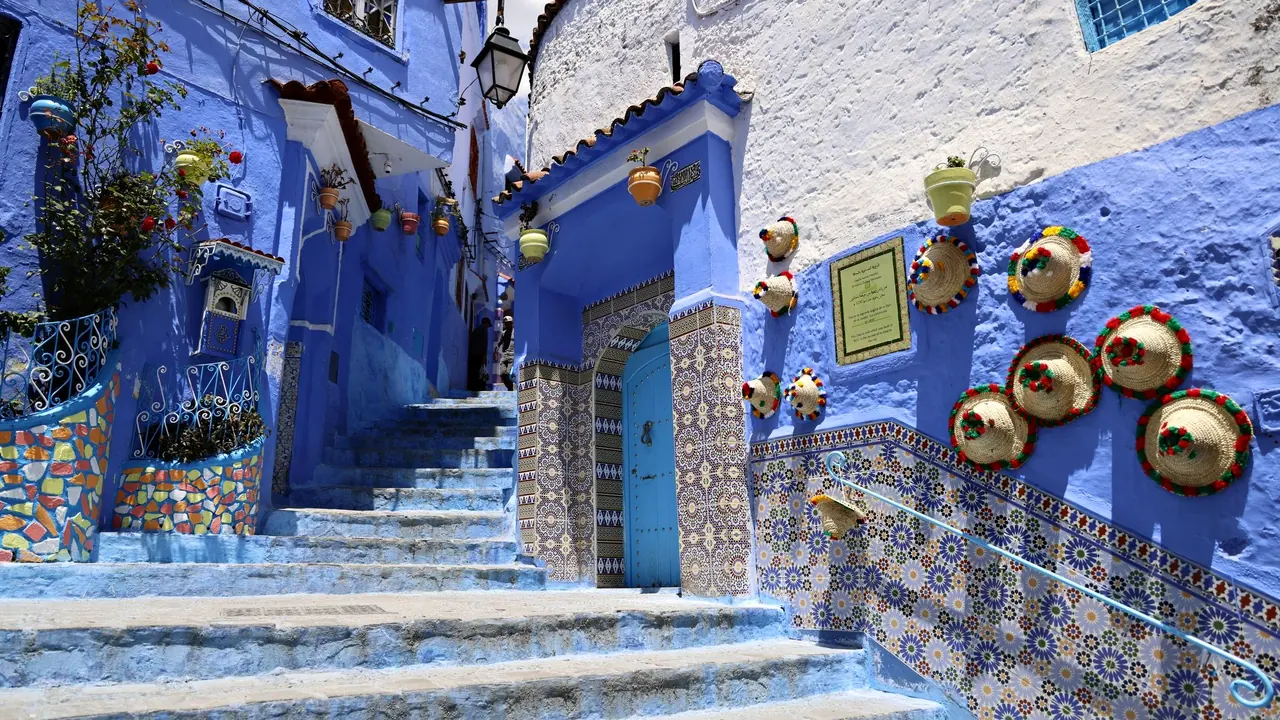
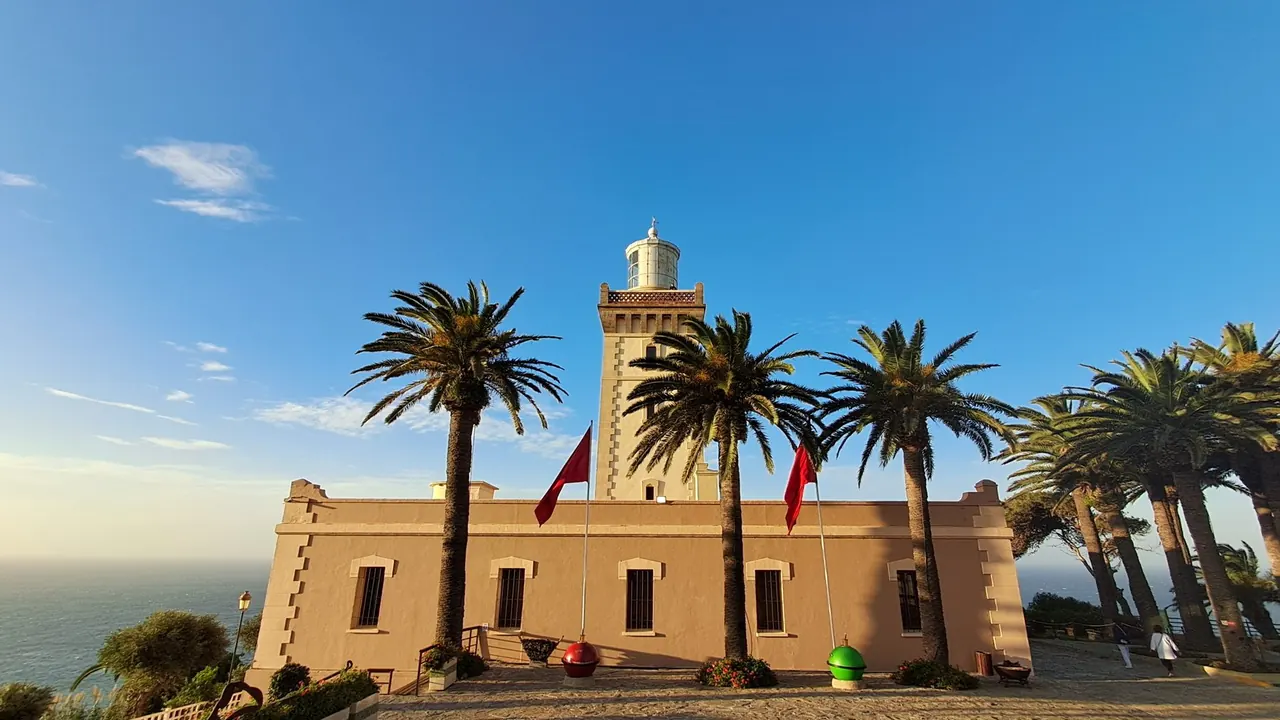
Photos: Chefchaouen by Christophe RASCLE, Pexels License; Tangier by Ideophagous, CC BY-SA 4.0, cropped.
Chefchaouen or Tangier?
Our verdict in twelve categories, each scored against the same fixed benchmark cities, and the climate month by month, so you can choose for your trip.
Choose Chefchaouen for
- nature and the outdoors
- getting around
- prices
Chefchaouen suits a slower, cheaper trip built around walking: a few days in the blue medina, then the Rif on the doorstep, with the gorge at Akchour and the trails of Talassemtane far closer than anything Tangier can offer. Choose it for quiet evenings and mountain air, and accept that the food is plain and there is no nightlife.
Choose Tangier for
- day trips
- beaches
- food and drink
Travellers who want a proper city, with more in it and more around it, will do better in Tangier. The kasbah museum, the American Legation and the fish markets give it more substance. The Atlantic beaches are a taxi ride away, and trains, buses and the ferry to Spain make it a far stronger base for exploring the north.
Scoreboard
Twelve categories on one fixed scale from 0 to 100. The shaded stretch is the gap between the two.
Your match
Pick a travel style or drag the sliders, and both match scores follow your weighting.
Wins on nature and the outdoors and getting around with your weighting.
Wins on day trips and beaches with your weighting.
What matters to you?
Category by category
What the scores mean for a trip.
Beaches & swimming
Neither is a beach destination, but only Tangier puts the sea within easy reach. From mountainous Chefchaouen, a swim means a long, winding drive down the gorge to the grey sand at Oued Laou, or a cold, shallow dip in the river pools at Akchour.
Tangier has its own beach curving around the bay, though the better swimming is a short taxi ride west on the wide Atlantic sands around Achakar, which have surf and cooler water. Asilah's beaches are also close. In high summer the beaches fill with Moroccan families, and beachwear is more modest than in Europe.
Food & drink
Chefchaouen's restaurants repeat the same tagines and kefta from lane to lane, so the rewards are the local specialities: Rif goat cheese wrapped in palm leaf, bissara for breakfast and bread from the communal ovens. A few days exhausts the choice.
Tangier eats noticeably better. Its cooking leans on fish from two seas, grilled at the port, along with msemen from street stalls and the produce markets around the Grand Socco, and the café terraces facing the Strait are a pleasure in themselves. Alcohol is limited in both towns and even scarcer in the mountains.
Culture & sights
Both towns are more about atmosphere than monuments, but Tangier has more to see. In Chefchaouen the blue medina itself is the attraction. The kasbah's small ethnographic museum is the only formal visit and the sunset walk to the Spanish Mosque gives the classic view, so a day or two covers it.
Tangier has more layers. There is the palace museum of Moroccan art in the kasbah, looking across to Spain, and the American Legation, which tells the story of the city's international era. Add St Andrew's church, the Art Deco Ville Nouvelle and the city's links with Paul Bowles and the Beat writers, and it is worth two or three days.
Nightlife
Chefchaouen has no nightlife beyond dinner, tea in Outa el-Hammam square and a stroll before the lanes go quiet, and drink is found only in a couple of hotel bars. Tangier is hardly a party city either, but it has a discreet circle of old international-era bars, hotel lounges in the Ville Nouvelle and beach clubs that come alive in summer, plus a seafront busy with families on warm evenings.
Nature & outdoors
This is where Chefchaouen pulls ahead. The trails begin at the edge of the medina and climb into the Rif. Talassemtane National Park, with its cedar forests, Barbary macaques, waterfalls and God's Bridge, is about forty minutes away. A local guide helps, as marked routes are few.
Tangier's outdoors are gentler and coastal. There are cliff paths and pine woods at Cap Spartel, where two seas meet, the wooded Perdicaris park and the Caves of Hercules. In spring and autumn, storks and raptors cross the Strait, and boats go out to watch dolphins.
Day trips
From Chefchaouen there is really one strong outing: Tetouan's larger and quieter medina, with the coast at Martil just beyond. Tangier and Fes are better treated as the next stop than as a return trip in a day.
Tangier is by far the better base. Asilah and Tetouan are each about an hour away, the high-speed train reaches Rabat in well under two hours, and the Roman ruins of Lixus lie down the coast. A ferry takes you to Tarifa in Spain in about an hour, which adds a second continent to the list.
Good for families
Neither town is built for children, so families will find them much alike. Chefchaouen is calm, with little traffic inside the walls, but its stepped lanes defeat pushchairs, and older children may like the river pools at Akchour best.
Tangier has a few more easy outings, such as the seafront promenade, the Perdicaris park and a day trip by ferry to Spain. Touts can wear parents down, though, and a hotel pool often does much of the work.
Getting around
Chefchaouen is simpler to manage. You can cross the medina on foot in about fifteen minutes, though the stairs and polished steps are tiring with bags, and grand taxis cover Akchour. There is no railway, so arrival is by bus or road.
Tangier covers more ground. Beyond the medina, the kasbah and Boulevard Pasteur you rely on petit taxis, as there is no metro or tram and the buses are of little use. Coming and going is easier, though, thanks to its train station and the ferry port in the centre.
Shopping & style
Chefchaouen's shops are more local, but the choice is small. Its lanes sell Rif blankets and weavings, djellabas, baskets and blue pigment, often made in the region, with weavers at their looms and gentle bargaining. The range repeats itself after a few streets.
Tangier offers a little more variety. The lanes around the Petit Socco sell rugs, lanterns, ceramics and striped Rif cloth, with a harder sell. The Ville Nouvelle and the malls on the bay add antique shops, chain stores and everyday buys.
Affordability
Both are cheap by European standards, and Chefchaouen is the lighter on the wallet. Its guesthouses and riads cost little, the town itself is the main sight and free to wander, and shared taxis to the valleys are inexpensive.
Tangier is still good value for grilled fish, tea and taxis. Hotels with sea views, seafront places in summer and anywhere that serves alcohol push costs up.
Live music & performing arts
Chefchaouen has nothing to book. There is no theatre or concert venue, so the town's music comes in snatches: the call to prayer and the odd sufi chant over the rooftops, and the Andalusian repertoire of its founders, which is heard mostly when a festival brings it out.
Tangier is no performance city either, but a music lover can plan a trip around it. Its annual jazz festival and its festival concerts of gnawa, Jilala and Andalusian music offer the kind of listening the mountain town cannot. The Jajouka players from the nearby hills, once famous abroad, give its music a history. Between festivals, the best you can hope for is a band in a hotel lounge or a film at the old cinema on the Grand Socco, not a night at the theatre.
Wellness & relaxation
The two are close for rest, and both have simple neighbourhood hammams with separate hours for men and women. Chefchaouen's calm is the bigger draw, with mountain air, roof terraces and the sound of the Ras el-Maa spring, though spa treatments are limited to a few riads.
Tangier has more comfortable hammam and massage spas in riads and larger hotels, and long afternoons on terraces over the Strait. The port and traffic below are never quiet, though.
When should you go?
Pick your month. The climate figures are measured averages, not a forecast.
Chefchaouen in July
Tangier in July
Daytime high, °C
Rainfall in the month, mm
Where the figures come from
Chefchaouen has no weather station within reach, so its figures come from a gridded climate model rather than a measured record, and read a broad area rather than the city itself.
Temperature and rainfall are climate normals, averaged over the years shown. Chefchaouen: 2001-2020 normals, NASA POWER reanalysis grid, no weather station within 90 km. Tangier: 1991-2020 normals, Tanger Aerodrome (9.5 km from centre).
Chefchaouen is at its best in May and again in September. Late spring brings wildflowers, full rivers and comfortable walking on the steep lanes and mountain paths, and September is warm and mostly dry. The rains come back in October, which brings 105mm, and from then until April the town is cool and wet, with snow on the high ground. July and August reach 35°C, too hot for climbing the stairs at midday and hard going in the valleys. The sea at Oued Laou is warmest in late summer, but it is a day out rather than a reason to time a trip.
Tangier is milder all year because it sits on the Strait. Summer highs stay around 30°C, the days are long and very sunny, and the sea reaches about 22°C, so July and August are the months for its Atlantic beaches. Spring and autumn are pleasant for walking the medina. Winter is wet here too, wettest from November to January, but noticeably warmer than up in the mountains.
Which traveller are you?
On an outdoors trip, Chefchaouen is the clear pick. Paths start at the Ras el-Maa spring, and the gorge, waterfalls and God's Bridge at Akchour are a short taxi ride away. From Tangier, the Rif needs an overnight stay.
For a food and nightlife trip, Tangier wins easily. Grilled fish at the port, the markets by the Grand Socco and a small circle of bars and summer beach clubs give its evenings some shape. Chefchaouen falls silent after mint tea.
On a beach and sun trip, Tangier is the only realistic base. The Atlantic sands at Achakar and Cap Spartel and the beaches near Asilah are close, while Chefchaouen's nearest sand at Oued Laou lies at the end of a long, winding road.
Before you go
| Measure | Chefchaouen | Tangier |
|---|---|---|
| Official language | Arabic, Standard Moroccan Tamazight | Arabic, Standard Moroccan Tamazight |
| Currency | Moroccan Dirham (MAD) | Moroccan Dirham (MAD) |
| Sockets | CE50 Hz | CE50 Hz |
| Driving side | Right | Right |
| Time zone | UTC+1 | UTC+1 |
| Emergency number | Police 19/112, ambulance 15, fire 15 | Police 19/112, ambulance 15, fire 15 |
| Elevation | 564 m | 56 m |
| Main airport | Tangier Ibn Battuta Airport (TNG)86 km from centre50 non-stop destinations | Tangier Ibn Battuta Airport (TNG)11 km from centre50 non-stop destinations |
| Public holidays this year | 11 days | 11 days |
By the numbers
| Measure | Chefchaouen | Tangier |
|---|---|---|
| City population | 46,168 | 1,275,428 |
| People per km² | 2,998 | 6,393 |
| Museums within 10 km | 1 | 6 |
| UNESCO World Heritage sites within 50 km | 1 | 1 |
| Swim season, months above 21 °C | 3 months | 3 months |
Where else could you go?
Every comparison below shares a destination with this one, so you can follow Chefchaouen or Tangier somewhere new.
- Fesvs Chefchaouen
- Rabatvs Chefchaouen
- Fesvs Tangier
- Rabatvs Tangier
- Casablancavs Chefchaouen
- Casablancavs Tangier