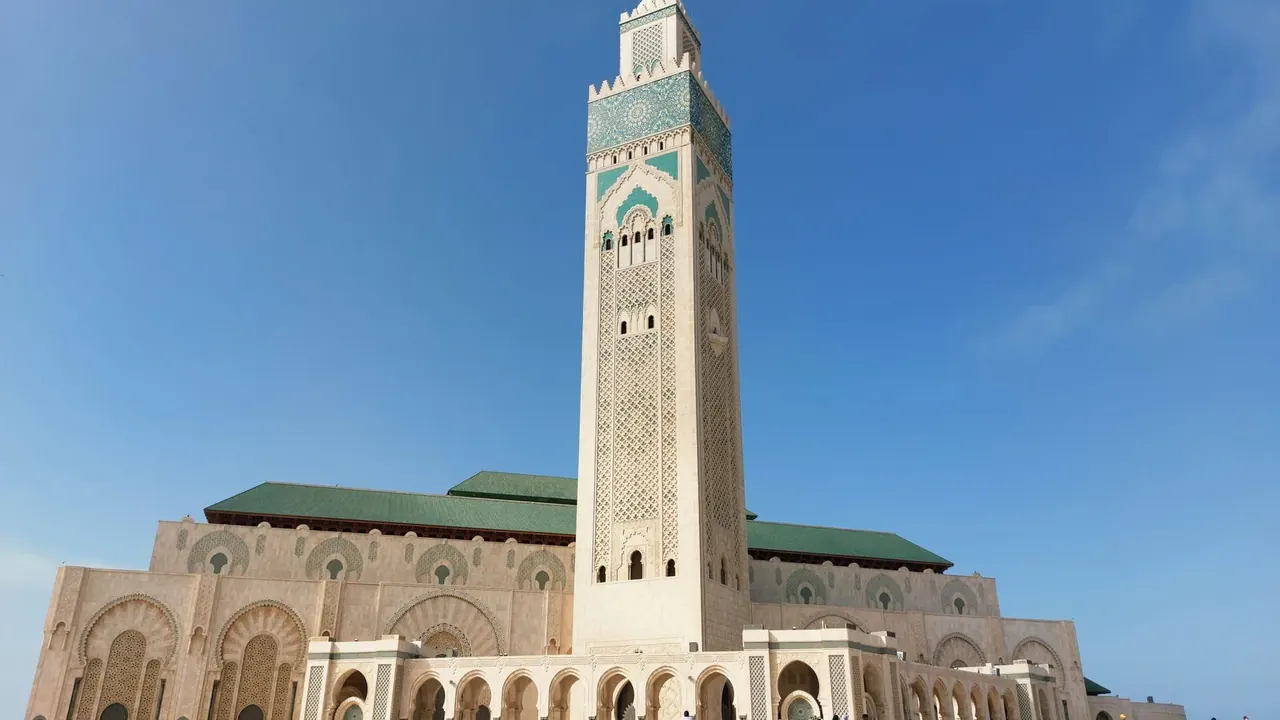
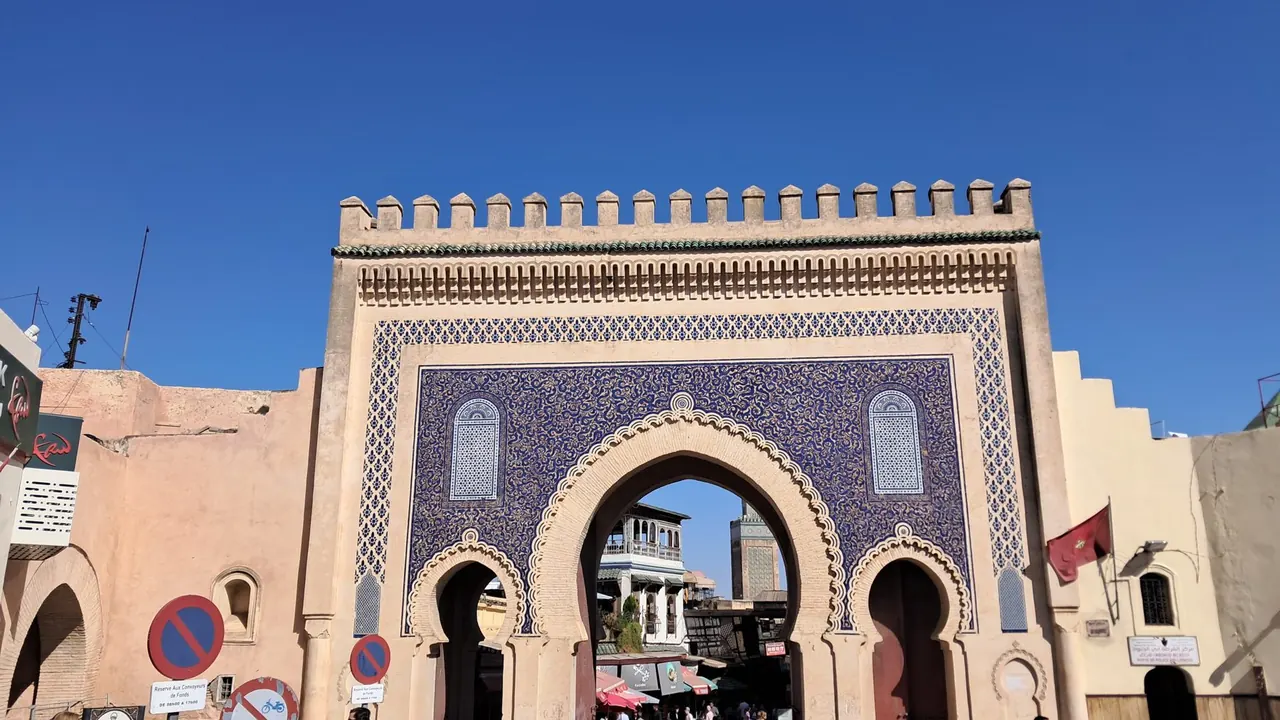
Photos: Casablanca by Samir Bakkah, Pexels License; Fes by Ideophagous, CC BY-SA 4.0, cropped.
Casablanca or Fes?
Our verdict in twelve categories, each scored against the same fixed benchmark cities, and the climate month by month, so you can choose for your trip.
Choose Casablanca for
- beaches
- nightlife
- families
Casablanca suits a traveller who wants a modern Moroccan city with the Atlantic on the doorstep. You get the Hassan II Mosque, Art Deco boulevards, an afternoon on the Corniche sands and a smart night out at Ain Diab. Fast trains make it an easy base for Rabat. It also gives families more to do, and summer stays mild.
Choose Fes for
- culture and sights
- nature and the outdoors
- shopping
Fes is for people who come to Morocco for its history and handwork. The medieval medina of Fes el-Bali, its Marinid madrasas and its lanes of workshops are the trip in themselves. A riad courtyard, a hammam and the Middle Atlas an hour away fill the rest of the time. It is cheaper day to day, but evenings are quiet and there is no beach.
Scoreboard
Twelve categories on one fixed scale from 0 to 100. The shaded stretch is the gap between the two.
Your match
Pick a travel style or drag the sliders, and both match scores follow your weighting.
Too close to call, level with your weighting
Wins on beaches and nightlife with your weighting.
Wins on culture and sights and nature and the outdoors with your weighting.
What matters to you?
Category by category
What the scores mean for a trip.
Beaches & swimming
Casablanca has a coastline and Fes does not. Ain Diab's Corniche has a long stretch of sand and beach clubs with pools. Dar Bouazza, Bouznika and Mohammedia offer better beaches within an hour. Strong Atlantic swell means you need to take care in the water, but you can have a beach afternoon on any summer trip.
Fes is about three hours from either coast, so the sea is out of reach on a normal stay. In the hot inland summer, a hotel pool or a riad's rooftop plunge pool is your only way to swim.
Food & drink
The two cities eat equally well but differently. Casablanca's strength is the sea: you can pick fish at the Marché Central and have it grilled next door, or eat sardines in simple harbour places. It also has more variety, with French-style brasseries and pâtisseries in Maarif and Gauthier, and alcohol is easier to find.
Fes is known for its old, refined home cooking. Pastilla with almonds and cinnamon and tagines with quince and preserved lemon are at their best in long riad dinners. Bissara counters and sfenj stalls supply the medina mornings, though there is little else on offer beyond Moroccan food.
Culture & sights
Fes is the stronger choice for culture by a wide margin. Fes el-Bali is a car-free medieval city that still works as one, with Marinid madrasas covered in cedar and zellige, the Quaraouiyine at its centre, the Chouara tannery and the Mellah. It is the place itself, more than its small museums, that fills several days.
Casablanca has one world-class building in the Hassan II Mosque, and unlike most Moroccan mosques it is open to non-Muslims on guided tours. After that, the city's interest lies in the protectorate's Art Deco and neo-Moorish downtown, the 1930s Habous quarter and a couple of small museums.
Nightlife
Casablanca is the clear choice for going out, though by Moroccan custom it stays behind closed doors. At weekends a well-dressed crowd fills the Ain Diab lounges and clubs, where house and Arabic pop play late. Downtown has hotel bars and old bars from the protectorate era, and you take taxis between them.
In Fes the medina empties when the shops close. An evening means dinner on a rooftop, with a hotel bar in the Ville Nouvelle the only option after that.
Nature & outdoors
Fes has the landscape. The cedar forests around Azrou, where Barbary macaques live wild, the lake-dotted plateaux of the Middle Atlas and the caves and ridges of Tazekka National Park are all within a drive. You need a car or a driver, and spring and autumn suit them best.
Casablanca's outdoor life follows the flat shoreline. You can run on the Corniche towards El Hank lighthouse or take a surf lesson at Ain Diab or Dar Bouazza. The eucalyptus of Bouskoura forest offers shade for walking and biking, but there are no hills.
Day trips
Fes has the slightly better day out. You can see imperial Meknes, the Roman mosaics of Volubilis and the holy town of Moulay Idriss in one long day with a driver. Ifrane's Alpine-style roofs and the cave houses of Bhalil add variety.
From Casablanca the train reaches Rabat in about an hour, with the Kasbah des Oudayas and the Chellah, and El Jadida's Portuguese cistern lies down the coast. These trips are easier to do without a car, but they are less memorable than the Volubilis circuit.
Good for families
Casablanca is the easier city with children. A mall on the Corniche with an aquarium and indoor rides, the zoo and amusement park at Ain Diab, and calm beach-club pools give it things built for families. Traffic and broken pavements still make it tiring.
Fes offers almost nothing aimed at children. Its steep lanes are shared with donkeys and handcarts, and summer afternoons are very hot. Older children who like watching craftsmen at work can love it in short outings.
Getting around
Both cities take some effort to get around, in different ways. Casablanca is spread out, so you combine the clean tram lines with shared red petits taxis. You can walk the downtown blocks, but crossing the big roundabouts on foot takes nerve.
Fes asks you to walk. The medina has no cars, porters carry your bags from the gates, and the twisting, climbing lanes defeat most maps, so a guide helps on the first day. Taxis connect the gates with the station. Casablanca has better rail links for onward travel.
Shopping & style
For anything handmade, Fes is the place to shop. Leather from the tanneries, copper from Seffarine square, blue-and-white Fassi pottery and carved cedar are sold in lanes where the workshop is often behind the counter. Bargaining is expected, and it pays to shop without a commission-seeking guide.
Casablanca is where to go for modern shopping: international brands at the Corniche mall, local designers in Maarif and the Derb Ghallef flea market. Sellers in the Habous craft shops push less, but carpets and traditional crafts are thin on the ground.
Affordability
Both are cheap to eat and get around in, but Fes keeps the whole trip cheaper. Modest riads in its medina offer character at low cost, and entry to the madrasas costs little. The money goes on grand riads, private guides and day-trip drivers.
Casablanca's pressure point is accommodation. Many hotels are aimed at business travellers, guesthouses are fewer, and drinks or dinner on the Corniche quickly add up.
Live music & performing arts
Neither city has much on during an ordinary week, but Casablanca has more to choose from. A large modern theatre on Place Mohammed V hosts concerts and dance, the cultural institutes run film and music, and a long-running jazz festival and an urban music festival come round each year. It is also the home of Moroccan chaabi and rap.
Music in Fes is older and more spiritual. It has the Andalusian classical tradition and Sufi devotion, heard at their best during the Festival of World Sacred Music in palace gardens. The rest of the year there are occasional concerts and music at riad dinners.
Wellness & relaxation
Fes is the better place to slow down. The medina is loud by day, but riad courtyards with fountains and quiet roof terraces make calm bases. The hot springs at Moulay Yacoub, used for centuries, are half an hour away.
Casablanca's hammams and spas offer the same black-soap scrub. Its seafront thalassotherapy centres add seawater treatments that Fes cannot match. Outside them, though, the traffic and noise make it hard to relax.
When should you go?
Pick your month. The climate figures are measured averages, not a forecast.
Casablanca in July
Fes in July
Daytime high, °C
Rainfall in the month, mm
Where the figures come from
Fes's station stands 171 m above the city centre, so the centre is likely a little warmer than the figures say.
Fes has no rain gauge within 25 km of the centre, so its rainfall comes from a gridded climate dataset read at the city rather than from a gauge further away.
Fes's sunshine is measured 52 km from the centre, at Meknes.
Temperature and rainfall are climate normals, averaged over the years shown. Casablanca: 1991-2020 normals, Casablanca (5.6 km from centre). Fes: 1999-2020 (sunshine 1991-2020, rainfall 1991-2020) normals, Fes-Sais (12.4 km from centre).
Casablanca is mild all year because the ocean keeps it from extremes. From June to September the days reach the mid-20s and almost no rain falls. That is the time for the beach, with the sea at about 23°C in August, which is bracing rather than warm. The rain comes from November to January, at its wettest close to 80mm a month. Even then the days stay pleasant enough for walking the boulevards, and every month gets plenty of sunshine.
Fes swings much further. In July and August the afternoons reach 36°C, which makes long walks in the medina's lanes hard work, though those months are the sunniest of the year. Winter is cool and wet from November to March. That leaves April, May and October as the best months for sightseeing and for getting out into the hills. Casablanca is the better choice in high summer, and Fes is at its best in spring and autumn.
Which traveller are you?
On a beach and sun trip, Casablanca is the only real option. It has the long Ain Diab sands, beach clubs with pools and wider beaches less than an hour away. From Fes the coast is about three hours' drive, so swimming means a riad plunge pool.
For a culture and arts trip, Fes wins clearly. Its medieval medina is on the UNESCO list, the Bou Inania and Al-Attarine madrasas are masterpieces, and the old craft quarters are still working. Casablanca's twentieth-century architecture and its great mosque take only two or three days.
On a food and nightlife trip, Casablanca comes out ahead. Market fish is grilled to order, the brasseries have a French accent, and lounges and clubs along the Corniche run late at weekends. Fes cooks the more refined classic dishes, but its evenings end with tea on a rooftop.
Before you go
| Measure | Casablanca | Fes |
|---|---|---|
| Official language | Arabic, Standard Moroccan Tamazight | Arabic, Standard Moroccan Tamazight |
| Currency | Moroccan Dirham (MAD) | Moroccan Dirham (MAD) |
| Sockets | CE50 Hz | CE50 Hz |
| Driving side | Right | Right |
| Time zone | UTC+1 | UTC+1 |
| Emergency number | Police 19/112, ambulance 15, fire 15 | Police 19/112, ambulance 15, fire 15 |
| Elevation | 115 m | 408 m |
| Main airport | Mohammed V International Airport (CMN)26 km from centre112 non-stop destinations | Fes Saïss International Airport (FEZ)13 km from centre35 non-stop destinations |
| Public holidays this year | 11 days | 11 days |
By the numbers
| Measure | Casablanca | Fes |
|---|---|---|
| City population | 3,215,935 | 1,167,842 |
| People per km² | 8,375 | 3,650 |
| Museums within 10 km | 3 | 2 |
| UNESCO World Heritage sites within 50 km | 0 | 1 |
| Swim season, months above 21 °C | 5 months | - |
Where else could you go?
Every comparison below shares a destination with this one, so you can follow Casablanca or Fes somewhere new.