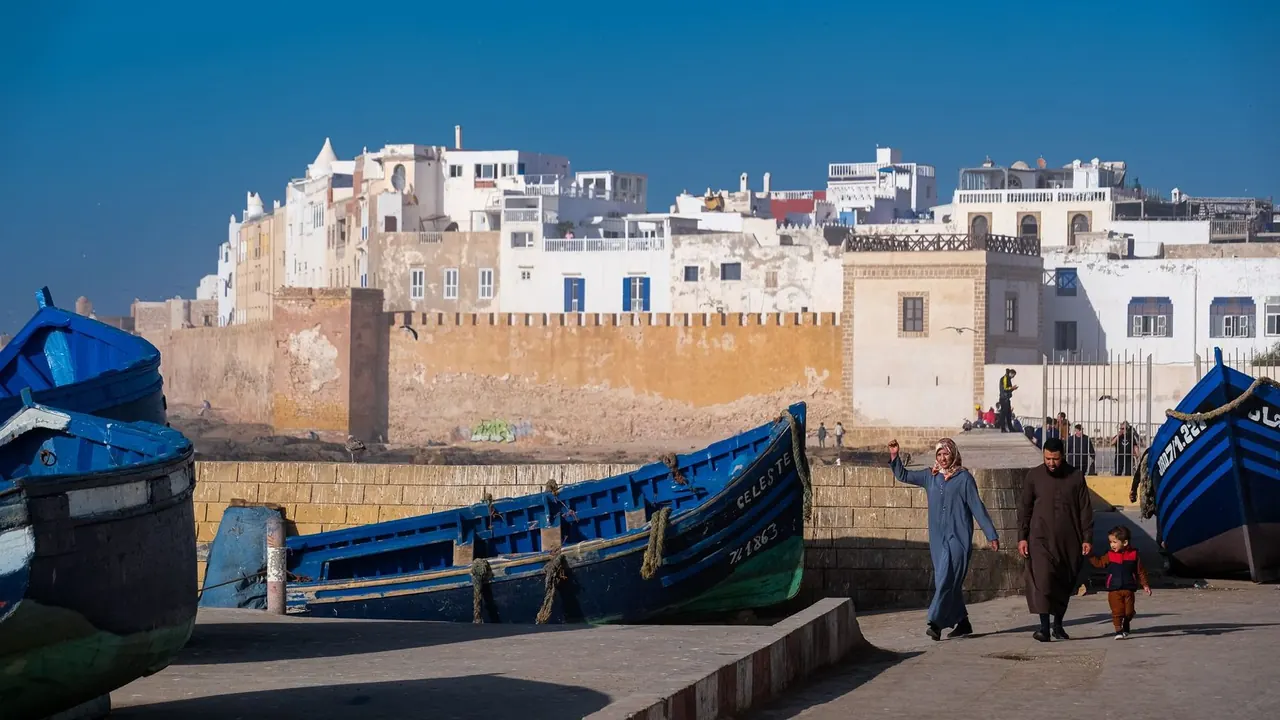
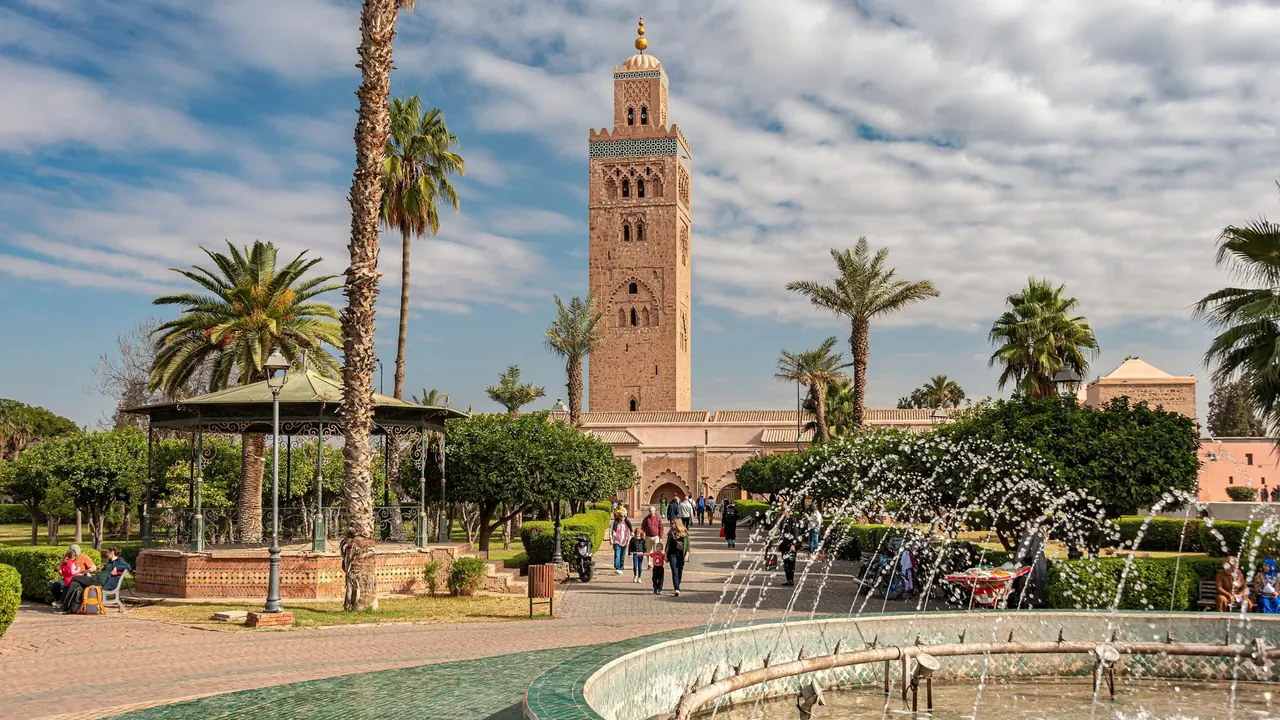
Photos: Essaouira by Manel Cusido, Pexels License; Marrakech by Jorge Franganillo, CC BY 2.0, cropped.
Essaouira or Marrakech?
Our verdict in twelve categories, each scored against the same fixed benchmark cities, and the climate month by month, so you can choose for your trip.
Choose Essaouira for
- beaches
- getting around
- families
Essaouira suits travellers who want Morocco at a slower pace. It has a small, car-free medina on the Atlantic, a long beach for walking and riding, fish grilled at the harbour and some of Africa's best-known wind for kitesurfing. It is also the easier choice with children and for anyone who would rather wander than find their way through a maze. In return, evenings are quiet and the sea stays cool.
Choose Marrakech for
- culture and sights
- shopping
- food and drink
Marrakech is the better pick for a trip built around sights, souks and food. Its palaces, madrasa and gardens give it far more to see, and its souks make shopping a reason to come. The High Atlas and the Agafay desert are close enough for days out. It asks more of the visitor, with crowds, persistent sellers and fierce summer heat, so it suits people who are happy to retreat to a riad between outings.
Scoreboard
Twelve categories on one fixed scale from 0 to 100. The shaded stretch is the gap between the two.
Your match
Pick a travel style or drag the sliders, and both match scores follow your weighting.
Wins on beaches and getting around with your weighting.
Wins on culture and sights and shopping with your weighting.
What matters to you?
Category by category
What the scores mean for a trip.
Beaches & swimming
Essaouira has a real beach on its doorstep, a long sweep of pale sand running south from the medina walls. The Atlantic stays cool, though, and the trade wind means most days are for walking, riding and watching the kites rather than sunbathing. Swim on calm mornings or in the sheltered corner by the port. Sidi Kaouki, further south, is a wilder stretch of beach.
Marrakech has no sea at all. Swimming there means a riad plunge pool or a hotel pool, which you will need in summer. The nearest proper beach is Essaouira itself, a long drive away. The Lalla Takerkoust reservoir makes a pleasant lakeside afternoon, but it is not a beach.
Food & drink
Marrakech has the wider range of food. There is tanjia slow-cooked in the embers of a hammam furnace, pastilla, mechoui lamb from underground ovens and the evening grill stalls of Jemaa el-Fna. When the riad tagines start to repeat, Gueliz and Hivernage have international cooking.
Essaouira's food is narrower but fresher. The meal people remember is at the harbour grills, where you choose sardines, sea bream or spider crab and watch them cooked. Fish tagines and amlou made with argan oil from the countryside add to it. Beyond the port the choice thins quickly, and a few days use up most of the range.
Culture & sights
Both medinas are on the UNESCO list, but they are very different places. Essaouira's is an eighteenth-century grid of whitewashed houses with blue shutters inside sea walls. It is best seen from the Skala ramparts with their old cannons and from the lanes of the mellah, and a day or two covers it.
Marrakech has far more to visit. There is the Koutoubia minaret, the Ben Youssef Madrasa, the Saadian Tombs, the Bahia and El Badi palaces and the storytellers of Jemaa el-Fna. Outside the walls are the Jardin Majorelle and the Yves Saint Laurent museum. Its medieval maze is denser and its monuments grander.
Nightlife
Neither town is the place for a big night out, but Marrakech at least gives you the choice. Hivernage and Gueliz have lounge bars, hotel bars and a few large clubs with DJs that stay open late. Inside the medina, the evening revolves around the food stalls and performers of Jemaa el-Fna.
Essaouira winds down well before midnight. There is a sunset drink on a rooftop terrace, a few licensed bars on the edge of the medina and along the seafront, and surfers in a couple of beach bars. Most people end the evening with a walk on the ramparts.
Nature & outdoors
Marrakech has the bigger landscapes within reach. In the High Atlas there is the Ourika valley, walks between villages from Imlil and the climb of Jebel Toubkal, and in winter there is skiing at Oukaimeden. Closer to the city are the stony Agafay desert and hot-air balloon flights at dawn. The catch is the city's summer heat, which pushes activity into the early morning.
Essaouira's outdoors is coastal and shaped by the wind. Kitesurfing and windsurfing on the bay, rides along the sand towards Diabat, argan forest with goats in the trees and Eleonora's falcons on the offshore islands make for gentler days. There are no mountains close by.
Day trips
Neither town is a great base for seeing other places, but Essaouira is the more cut off of the two. What you can reach from it are half-days close to home: a wilder surf beach down the coast, a woodcarving village and argan cooperatives inland. They are pleasant, but they barely change the scenery. The only other town within a day's reach is Safi, a pottery port two hours north, and anywhere bigger is too far to go and come back the same day.
Marrakech gives a day away from town more variety. The Berber weekly markets at Asni and Amizmiz and the Almohad mosque at Tinmel in the Nfis valley take you into rural Morocco. The Atlantic is within reach too, since Essaouira works as a long day out, though it is better with a night there. The kasbahs of Ait Benhaddou are another place that needs an overnight stay.
Good for families
Essaouira is the gentler place with children. The medina is small, flat and mostly car-free, and the beach is minutes away. Camels, horses and fishing boats keep young children happy, although nothing is built for them, and the wind and cool sea limit time on the beach.
Marrakech is harder going. The lanes are crowded and shared with motorbikes and carts, sellers are persistent, and summer heat makes outings in the middle of the day exhausting. A riad with a plunge pool or a resort hotel with gardens makes it manageable, and older children who enjoy markets and a little adventure get the most from it.
Getting around
Essaouira is easy to cover on foot. The port, the medina and the beach promenade sit in a line, rarely more than twenty minutes apart, and porters with hand carts take luggage from the gates to the riads. Only the villages and cooperatives outside town need a driver.
Marrakech takes more effort. The medina is a maze of unnamed alleys where unofficial guides offer directions for a tip. Reaching Gueliz or the Majorelle garden means a petit taxi, often with the fare agreed first, and the buses are hard for newcomers to use.
Shopping & style
Marrakech is a shopping destination in its own right. The souks north of Jemaa el-Fna are arranged by trade, with lanes of leatherworkers, dyers and carpet sellers. Gueliz has design boutiques that rework Moroccan crafts, and decorators buy from the showrooms of Sidi Ghanem. Expect long bargaining and sellers who can wear you down.
Essaouira is smaller and calmer, with less hard selling. Its speciality is thuya wood, carved and inlaid in workshops under the ramparts. Its small galleries of naive and gnawa-inspired painting are a distinctive local find.
Affordability
Both are cheap for everyday spending. Grilled fish at Essaouira's port, soup at the Jemaa el-Fna stalls, mint tea and short taxi rides all cost little. The difference lies in where your money goes. In Essaouira the main sight, the medina and its ramparts, is free, and riads are good value outside summer and the festival weekends.
Marrakech has a much deeper luxury tier, with palace hotels and boutique riads at international prices. Its palaces and madrasas charge small entry fees, and in the souks the final cost depends on how patiently you bargain.
Live music & performing arts
Both towns live on gnawa rather than staged performance, and neither has a theatre or concert season. Essaouira is the music's spiritual home, and once a year the Gnaoua World Music Festival fills its squares and ramparts. The rest of the year you hear it only informally, in a few restaurants and squares.
Marrakech offers live performance every evening instead, among the gnawa players, drummers and storytellers of Jemaa el-Fna, along with the Popular Arts Festival and dinner shows aimed at tourists.
Wellness & relaxation
Marrakech has the stronger bathing culture. There is a public hammam in every quarter, and spa hammams range up to lavish marble spas. Its courtyard riads shut out the noise of the lanes, so rest there comes from retreating from a demanding city.
In Essaouira the town itself sets a slow pace: no traffic, sea air, long breakfasts on roof terraces and surf-and-yoga stays along the coast. Its hammams and spas are fewer and simpler, and the wind can make a terrace less restful than it looks.
When should you go?
Pick your month. The climate figures are measured averages, not a forecast.
Essaouira in July
Marrakech in July
Daytime high, °C
Rainfall in the month, mm
Where the figures come from
Essaouira has no rain gauge within 25 km of the centre, so its rainfall comes from a gridded climate dataset read at the city rather than from a gauge further away.
Temperature and rainfall are climate normals, averaged over the years shown. Essaouira: 1991-2020 normals, Essaouira (1.4 km from centre). Marrakech: 1991-2020 normals, Marrakech (5.1 km from centre).
Essaouira barely changes through the year. Daytime highs stay between about 19 and 24°C, warmest in September, and the sea never gets much past 20°C. You can walk comfortably in any month, but the water is never truly warm for swimming. Summer is almost completely dry. The rain arrives in October and is heaviest around December, at 49mm.
Marrakech swings much further. Spring and autumn, roughly March to May and October to November, are the comfortable months for exploring the medina, with plenty of sunshine. From June to August highs reach 38°C, too hot for walking at midday, and that is exactly when Essaouira's cool coast is most welcome. Winter days are mild and the rain is light.
Which traveller are you?
On a beach and sun trip, Essaouira is the only one of the two with a beach: a long stretch of sand right beside the medina. Expect cool water and a strong wind, though. It is better for walking, riding and kitesurfing than for lying in the sun.
For a culture and arts trip, Marrakech is clearly ahead. The palaces, the Ben Youssef Madrasa, the Saadian Tombs, the Jardin Majorelle and the storytellers of Jemaa el-Fna fill several days. Essaouira's walled medina and ramparts can be seen in one or two.
On a family trip with children, Essaouira is far easier. The car-free medina is small and calm, the beach is a short walk away, and the camels and fishing boats keep children entertained. Marrakech's crowded lanes, motorbikes and summer heat wear young children out.
Before you go
| Measure | Essaouira | Marrakech |
|---|---|---|
| Official language | Arabic, Standard Moroccan Tamazight | Arabic, Standard Moroccan Tamazight |
| Currency | Moroccan Dirham (MAD) | Moroccan Dirham (MAD) |
| Sockets | CE50 Hz | CE50 Hz |
| Driving side | Right | Right |
| Time zone | UTC+1 | UTC+1 |
| Emergency number | Police 19/112, ambulance 15, fire 15 | Police 19/112, ambulance 15, fire 15 |
| Elevation | 11 m | 465 m |
| Main airport | Essaouira-Mogador Airport (ESU)15 km from centre13 non-stop destinations | Marrakesh Menara Airport (RAK)6 km from centre113 non-stop destinations |
| Public holidays this year | 11 days | 11 days |
By the numbers
| Measure | Essaouira | Marrakech |
|---|---|---|
| City population | 82,962 | 1,002,697 |
| People per km² | 16,592 | 4,360 |
| Museums within 10 km | 2 | 14 |
| UNESCO World Heritage sites within 50 km | 1 | 1 |
| Swim season, months above 21 °C | None | - |
Where else could you go?
Every comparison below shares a destination with this one, so you can follow Essaouira or Marrakech somewhere new.