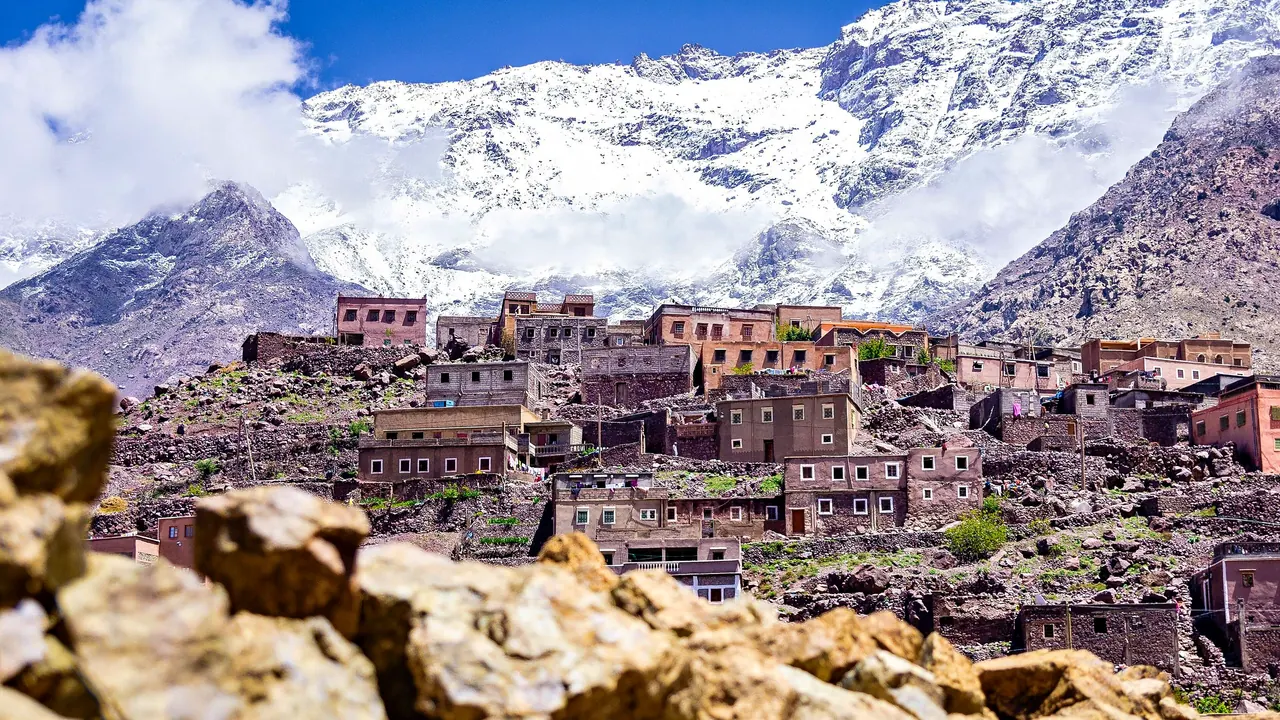
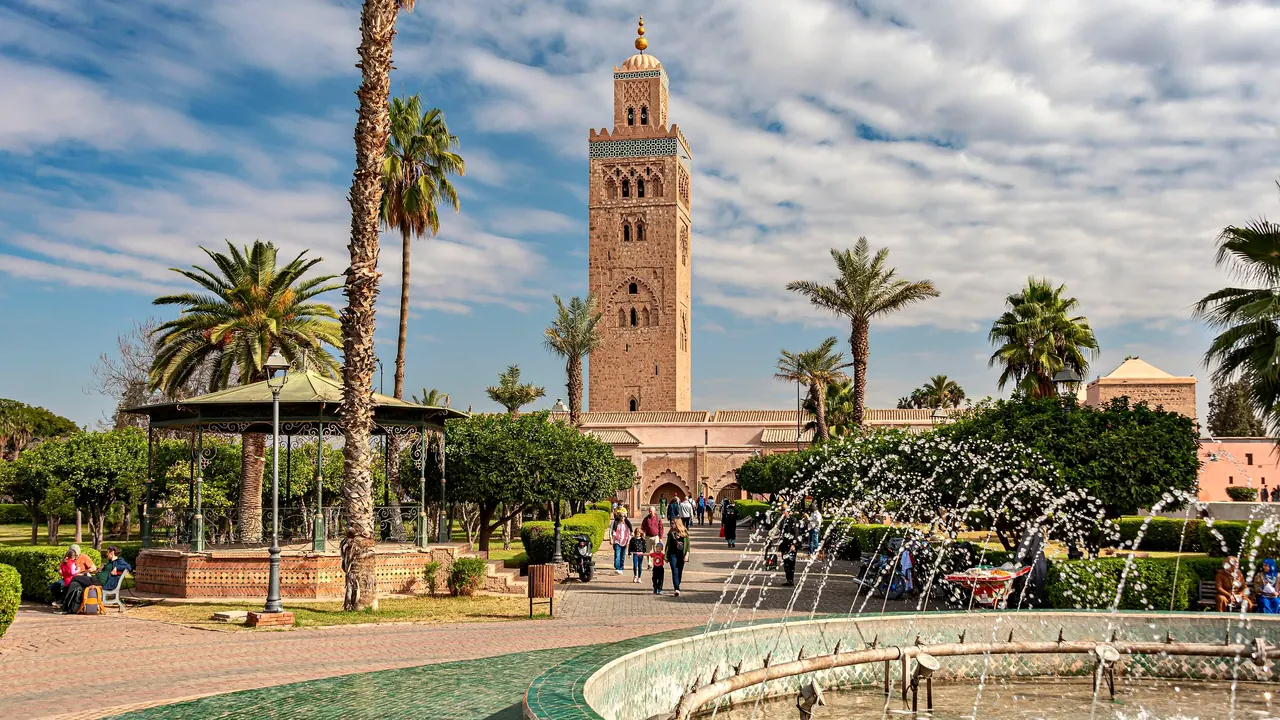
Photos: Atlas Mountains by Yann Macherez, CC BY-SA 4.0, cropped; Marrakech by Jorge Franganillo, CC BY 2.0, cropped.
Atlas Mountains or Marrakech?
Our verdict in twelve categories, each scored against the same fixed benchmark cities, and the climate month by month, so you can choose for your trip.
Choose Atlas Mountains for
- day trips
- nature and the outdoors
- prices
The Atlas Mountains suit walkers and anyone who wants landscape and silence more than sights. You get the trails from Imlil, the Dades and Todra gorges, the cedar forests of the Middle Atlas and nights in village guesthouses where dinner is included and costs stay low. The range also makes a better base for outings, with Fes and Volubilis in the north and the kasbah route in the south. The price is choice: food, shopping and evenings are simple, and long drives separate one part of the range from the next.
Choose Marrakech for
- shopping
- food and drink
- culture and sights
Marrakech is the pick for a stay built around a medina. Palaces, madrasas and the evening show on Jemaa el-Fna are all within walking distance, along with souks organised by trade, tanjia and grill stalls, and a hammam in every quarter. The mountains are still close enough for a day in the Ourika valley or at Imlil, but the city itself is the point of the trip. It is loud and demanding, and very hot in high summer.
Scoreboard
Twelve categories on one fixed scale from 0 to 100. The shaded stretch is the gap between the two.
Your match
Pick a travel style or drag the sliders, and both match scores follow your weighting.
Wins on day trips and nature and the outdoors with your weighting.
Wins on shopping and food and drink with your weighting.
What matters to you?
Category by category
What the scores mean for a trip.
Beaches & swimming
Neither is a beach destination, and the Atlantic is a long drive from both. What differs is the kind of water close by. The mountains have cold river pools in the valleys and reservoir lakes such as Bin el Ouidane and Lalla Takerkoust.
Marrakech relies on riad plunge pools and hotel pools, which become essential in the summer heat. The nearest seaside outing from the city is Essaouira's windy beach, and it is better with a night there.
Food & drink
At heart both serve the same food: tagines, Friday couscous and mint tea. In the Atlas the meals come from the guesthouse kitchen, with walnuts and honey from the valleys, dates from the oases, and argan oil and amlou from the Anti-Atlas. It is good food, but the same few dishes keep coming back, and in the villages the choice stops at a café and the weekly souk.
Marrakech has much more to eat. Tanjia, pastilla and harira, the grill stalls that fill Jemaa el-Fna at dusk and the mechoui counters in the medina give a stay real variety. Gueliz and Hivernage add international menus and licensed restaurants that serve wine.
Culture & sights
The Atlas has some remarkable single sights, above all the mud-brick village of Ait Ben Haddou and the painted ceilings of the Telouet kasbah. But they lie far apart along mountain roads, and there are very few museums, so seeing them shapes your route rather than filling your days.
Marrakech puts its heritage within one walk: the walled medina, the Koutoubia, the Ben Youssef Madrasa, the Saadian Tombs and the Bahia and El Badi palaces. The Jardin Majorelle and the Yves Saint Laurent museum are just outside the walls. Anyone who wants to spend days on sights gets far more here, with far less travel.
Nightlife
In the mountains an evening means tea on a guesthouse terrace under a dark, starry sky, then an early night before a dawn walk. Alcohol is hard to find.
Marrakech offers more, though on its own terms. There is the evening show on Jemaa el-Fna, cocktails at sunset on a rooftop, and lounge bars and a few large clubs in Hivernage and Gueliz for anyone who wants to stay out late.
Nature & outdoors
Staying in the Atlas puts you inside the landscape every day and opens up far more of it. There are multi-day treks and the Toubkal climb from Imlil, gentler walking in the Ait Bouguemez valley, the deep Dades and Todra gorges, and the cedar forests and Barbary macaques of the Middle Atlas.
From Marrakech you see much of this on day trips: Imlil, the waterfalls at Setti Fatma in the Ourika valley, and Oukaimeden for winter skiing. The city adds the stony Agafay desert and dawn balloon flights over the plain, but its own surroundings are flat and hot, and walkers lose time on the road.
Day trips
What you can reach from the Atlas depends on where you stay, but each side of the range has strong outings. Fes, Meknes and Volubilis are close to Ifrane and Azrou. The kasbah route and the palm oases lie beyond Ouarzazate, and Marrakech itself is within reach of the Ourika valley or Imlil.
Marrakech is a weaker base for other places. Its favourite trips, to Essaouira and to Ait Benhaddou, both work better with a night away. Closer to the city the choice comes down to the foothill souks at Asni and Amizmiz and the Almohad mosque at Tinmel.
Good for families
Neither is easy with small children, and both suit older, adventurous ones better. What differs is the strain. In the Atlas it comes from long, twisting roads, steep village paths and basic medical care. Mule-assisted walks, the Ouzoud falls, the macaques and a night in a kasbah make up for it.
In Marrakech the strain comes from crowded lanes shared with motorbikes, persistent sellers and the summer heat. A riad with a plunge pool helps, and so do the water park and the performers on Jemaa el-Fna.
Getting around
The Atlas asks for patience. You need a hired car or a driver for slow passes such as the Tizi n'Tichka, or cramped grand taxis that leave only when full, and winter snow can close the high roads. In trekking villages such as Imlil the car stays behind and you go on by foot, with a mule for the bags.
Marrakech is easier from day to day. The medina is walkable, even if it is a maze, and petit taxis link it to Gueliz and the Majorelle garden. For the mountains or the desert you still need a driver or a tour.
Shopping & style
Shopping in the mountains means crafts at the source. Berber rugs come from around Taznakht, argan oil from women's cooperatives, cedar woodwork from the Middle Atlas, and fossils from the roadside stalls near Ouarzazate. The weekly souks mostly sell livestock and produce.
Marrakech is one of the great places to shop for these same crafts. The souks north of Jemaa el-Fna are arranged by trade, the Mellah has its spice stalls, and Gueliz and Sidi Ghanem add design boutiques and showrooms. Bargaining takes time, and the sellers can be tiring.
Affordability
Both are cheap by European standards, but the mountains are cheaper still. Guesthouses usually include dinner and breakfast in the room rate, and a mountain guide with a mule is affordable even for a small group. Costs climb only with private drivers and the few luxury kasbah lodges.
In Marrakech, stall food, taxis and entry to the palaces stay cheap. But the city has a much larger luxury tier of palace hotels and boutique riads, alcohol is expensive, and what you pay in the souks depends on how patiently you bargain.
Live music & performing arts
Neither has theatres or concert halls. In the Atlas, music belongs to village life: Ahwash and Ahidous dances at weddings and harvest festivals, and the Imilchil marriage moussem in late summer. Hearing it depends on timing, or on an evening of drumming at your guesthouse.
Marrakech has something every night. Gnawa musicians, drummers and storytellers fill Jemaa el-Fna, and the Popular Arts Festival brings folk troupes from across Morocco. Now and then there is Andalusian music in a riad.
Wellness & relaxation
The Atlas offers quiet more than treatments. Mobile signal fades, roof terraces look over terraced fields, and the village hammams are simple and wood-fired. For a massage, a pool or a yoga retreat, the lodges near Imlil and in the Ourika valley are the places to go.
Marrakech has the deeper bathing culture. Every medina quarter has a public hammam, and spa hammams add argan oil massages and rhassoul clay wraps, in settings that range from neighbourhood baths to marble spas. The calm comes from the riad courtyard and the gardens, because the lanes outside are anything but restful.
When should you go?
Pick your month. The climate figures are measured averages, not a forecast.
Atlas Mountains in July
Marrakech in July
Daytime high, °C
Rainfall in the month, mm
Where the figures come from
Atlas Mountains has no weather station within reach, so its figures come from a gridded climate model rather than a measured record, and read a broad area rather than one spot.
Temperature and rainfall are climate normals, averaged over the years shown. Atlas Mountains: 1991-2020 normals, TerraClimate 4 km grid at the town, no weather station within 90 km. Marrakech: 1991-2020 normals, Marrakech (5.1 km from centre).
Summers are dry in both places and the rain falls in the cooler months, but the two sit at very different temperatures. In the trekking valleys where most mountain visitors stay, winter is properly cold, with daytime highs around 8°C in January and snow on the high peaks. The wettest spells come in March and November. Spring and autumn are the walking seasons, and in July and August the heights stay comfortable at about 28°C while the rain almost stops.
Marrakech is much warmer all year. Its winters are mild and very sunny, which is good weather for walking the medina, but July reaches about 38°C and pushes sightseeing into the early morning. The city is at its best from March to May and in October and November, and rain is light in every month. That makes the pair work well together: the city in the cooler half of the year, the mountains at the height of summer.
Which traveller are you?
For an outdoors trip, choose the Atlas Mountains and pick your base by the walking you want: Imlil for Toubkal and village treks, Ait Bouguemez for gentler routes, the southern side for the Dades and Todra gorges, Azrou for cedar forest and macaques.
On a culture and arts trip, Marrakech gives far more for the time. Stay in a medina riad, see the palaces and madrasas on foot over two or three cool mornings, take a petit taxi to the gardens beyond the walls, and keep evenings for the square's musicians.
For a shopping trip, Marrakech is far ahead. Allow at least a full day for the souks, bargain slowly over tea, and escape to the calmer showrooms if the sellers wear you down. The mountains suit one considered buy, such as a rug from its own village.
Before you go
| Measure | Atlas Mountains | Marrakech |
|---|---|---|
| Official language | Arabic, Standard Moroccan Tamazight | Arabic, Standard Moroccan Tamazight |
| Currency | Moroccan Dirham (MAD) | Moroccan Dirham (MAD) |
| Sockets | CE50 Hz | CE50 Hz |
| Driving side | Right | Right |
| Time zone | UTC+1 | UTC+1 |
| Emergency number | Police 19/112, ambulance 15, fire 15 | Police 19/112, ambulance 15, fire 15 |
| Elevation | - | 465 m |
| Main airport | Marrakesh Menara Airport (RAK)113 non-stop destinations | Marrakesh Menara Airport (RAK)6 km from centre113 non-stop destinations |
| Public holidays this year | 11 days | 11 days |
By the numbers
| Measure | Atlas Mountains | Marrakech |
|---|---|---|
| Population | - | 1,002,697 |
| People per km² | - | 4,360 |
| Museums within 10 km | - | 14 |
| UNESCO World Heritage sites within 50 km | - | 1 |
Where else could you go?
Every comparison below shares a destination with this one, so you can follow Atlas Mountains or Marrakech somewhere new.
- Essaouiravs Marrakech
- Agadirvs Marrakech
- Casablancavs Marrakech
- Rabatvs Marrakech
- Saharavs Atlas Mountains
- Saharavs Marrakech