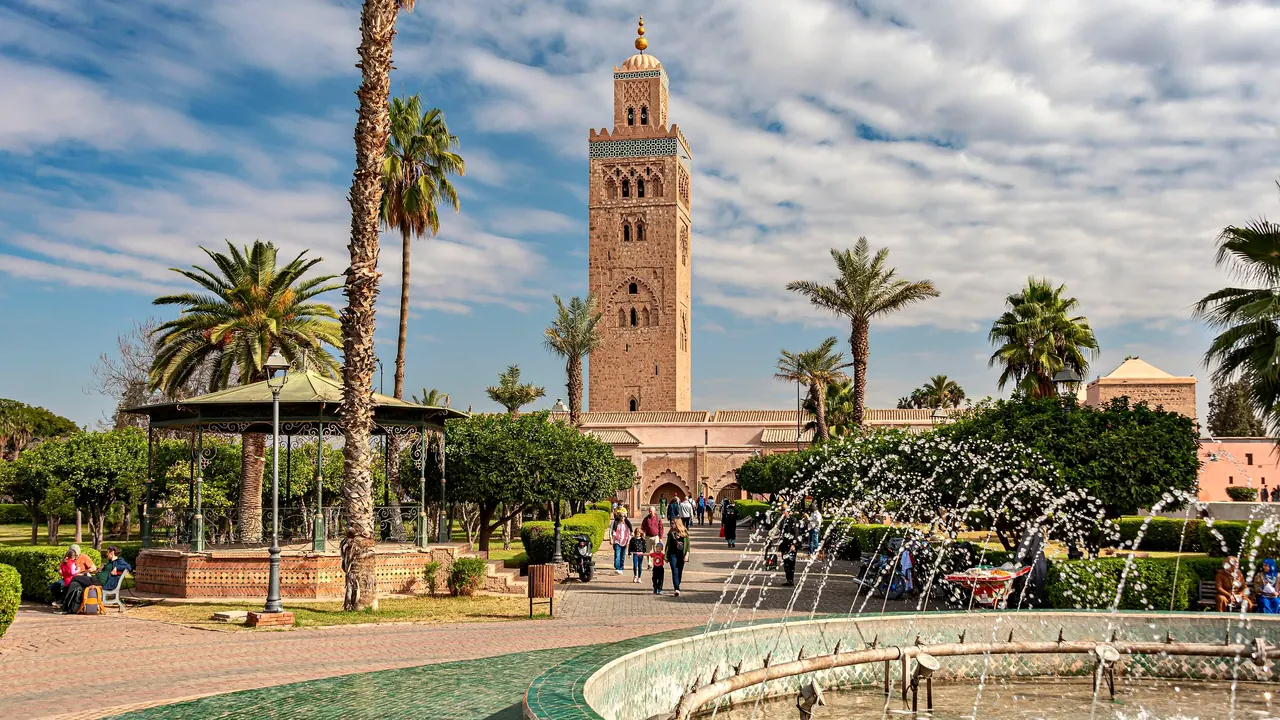
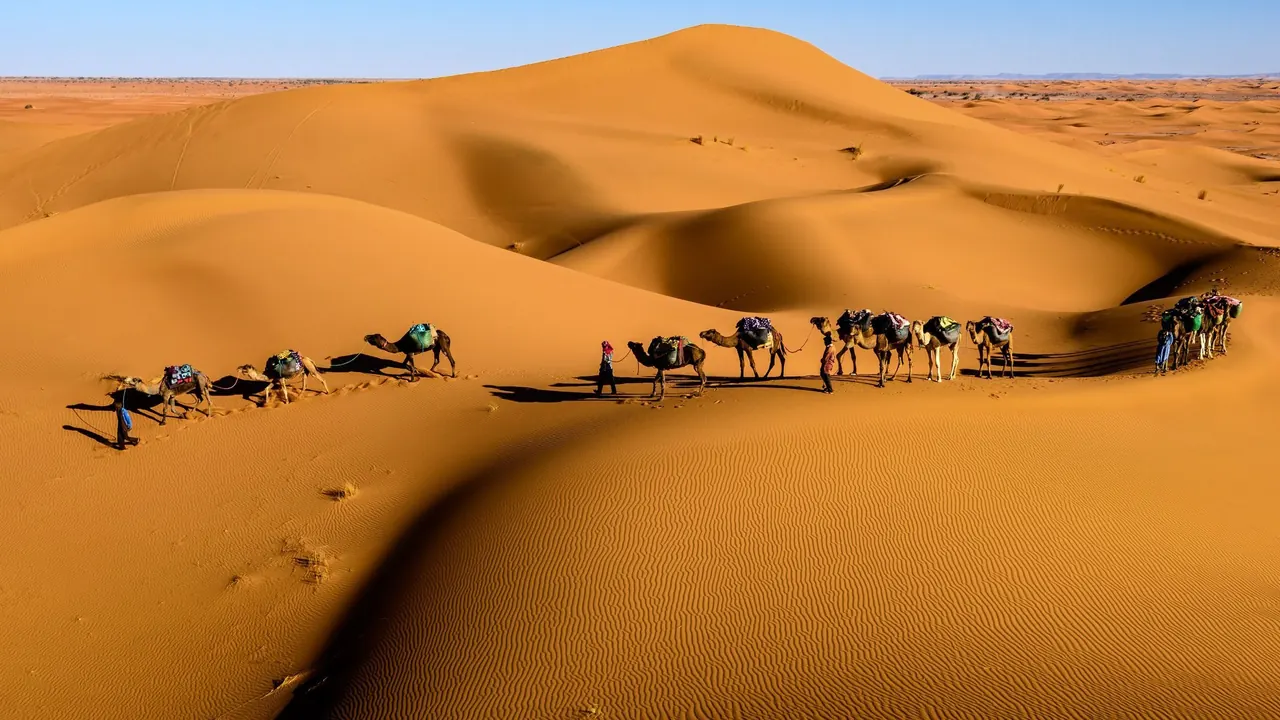
Photos: Marrakech by Jorge Franganillo, CC BY 2.0, cropped; Sahara by Sergey Pesterev, Pexels License.
Marrakech or Sahara?
Our verdict in twelve categories, each scored against the same fixed benchmark cities, and the climate month by month, so you can choose for your trip.
Choose Marrakech for
- shopping
- food and drink
- wellness
Marrakech is the choice for a city vacation with plenty to do in a small area. The walled medina, the palaces and madrasas, the souks and the evening food stalls of Jemaa el-Fna are all within walking distance. A riad with a hammam nearby makes it easy to rest between outings. It suits travellers who want sights, shopping and good Moroccan cooking from one base, with the Atlas close enough for a day in the mountains.
Choose Sahara for
- nature and the outdoors
- day trips
- families
The Sahara is a different kind of trip: a loop by road to move through, not somewhere to settle. You come for the landscape. You ride a camel into the dunes of Erg Chebbi, sleep in a camp under a dark sky, and walk through the Todra Gorge and the kasbah valleys on the way. In return you get long drives, repetitive meals and almost nothing to do after dark. It rewards travellers who put scenery and silence above comfort and variety.
Scoreboard
Twelve categories on one fixed scale from 0 to 100. The shaded stretch is the gap between the two.
Your match
Pick a travel style or drag the sliders, and both match scores follow your weighting.
Wins on shopping and food and drink with your weighting.
Wins on nature and the outdoors and day trips with your weighting.
What matters to you?
Category by category
What the scores mean for a trip.
Beaches & swimming
Neither place has a beach, so the difference is only in how you find water. Marrakech has riad plunge pools and hotel pools, which really help in the summer heat. There is also a lakeside afternoon at the Lalla Takerkoust reservoir, and the Atlantic at Essaouira is a long but possible day out. In the Sahara, swimming means a small pool at a kasbah hotel or camp. The coast is a full day's drive across the mountains, and the seasonal lake near Erg Chebbi is for watching flamingos, not for swimming.
Food & drink
Marrakech is far better for eating. You can follow a tagine with preserved lemon at lunch with tanjia slow-cooked in hammam embers, grilled food from the Jemaa el-Fna stalls at dusk and lamb from the mechoui counters in the medina. When riad menus start to repeat, Gueliz and Hivernage have other cuisines and licensed restaurants.
In the Sahara, most dinners are eaten at a camp or guesthouse, and the soup and tagine routine soon wears thin. The highlights are local: madfouna baked in sand-fired ovens around Rissani, and heaps of fine dates from the Tafilalet and Draa oases.
Culture & sights
The culture in Marrakech is concentrated and easy to reach on foot. The UNESCO-listed medina, the Koutoubia minaret, the Ben Youssef Madrasa, the Bahia and El Badi palaces, the Saadian Tombs and the Majorelle garden all fit into two or three days.
The Sahara's heritage is earthen architecture, and it is spread out. Ait Benhaddou, the kasbahs of Skoura and the Draa, the ruins of Sijilmassa and the library at Tamegroute are each worth a stop. But you see them in brief visits between long drives, and there are almost no museums to add depth.
Nightlife
Marrakech has some evening life, though not much. The square at Jemaa el-Fna stays busy through dinner, and lounge bars, hotel bars and a few large DJ clubs in Hivernage and Gueliz stay open late for anyone who wants a drink. In the Sahara the evening is a fire under a star-filled sky, and it ends early because the camps wake guests for the dawn. The few hotel bars in Ouarzazate and Zagora don't change that.
Nature & outdoors
The Sahara has the grander scenery. The dunes of Erg Chebbi rise high above the stony plain, and the wilder Erg Chigaga can be reached only by off-road vehicle or on a camel trek of several days. Along the way you pass the sheer walls of the Todra Gorge, the eroded rock of the Dades Valley and the green palm groves of the Draa.
Marrakech has the mountains on its doorstep instead. The Ourika valley and Imlil, the starting point for the climb up Jebel Toubkal, North Africa's highest peak, are both within about an hour and a half, and Oukaimeden has skiing in winter. The nearby Agafay plain is stony desert. It is good for a camel ride or a balloon flight but no substitute for real sand dunes.
Day trips
Neither makes a strong base, but the Sahara does slightly better because its outings are short and close by. From Merzouga, a half day covers the Rissani souk, the Gnawa village of Khamlia and the fossil workshops of Erfoud. Ouarzazate has the Skoura palm grove, the film studios and Telouet within reach.
From Marrakech, the outings that tempt people tend to be too far. Essaouira makes a very long day, and Ait Benhaddou needs a night away. Close to the city there are only the village souks at Asni and Amizmiz and the Almohad mosque at Tinmel.
Good for families
With children both are hard going, but the difficulties are different. In Marrakech the problems are the crowded lanes, the motorbikes and the persistent sellers. A riad with a plunge pool or a resort hotel gives a calm base, and there is a water park on the city's edge. In the Sahara a night in the dunes can be the highlight of a childhood trip. The cost is long days on mountain roads and camps far from medical care, so it suits school-age children on a carefully paced loop and not toddlers.
Getting around
Marrakech is easier to get around. The medina is a maze, but you can walk it, and petit taxis link it to Gueliz and the Majorelle garden, though you often need to agree the fare first.
The Sahara is all about distance. The Tizi n'Tichka pass takes most of a day to Ouarzazate, and Merzouga is most of another day beyond. Buses are infrequent and don't reach the camps, so most visitors take a driver-led tour or hire a car. The last stretch into the dunes is by camel, on foot or by 4x4.
Shopping & style
For shopping, Marrakech is the clear choice. Its souks are divided into lanes for leatherworkers, dyers, metalworkers and carpet sellers, and the Mellah has spice stalls. For calmer browsing, Gueliz has concept stores and Sidi Ghanem has showrooms used by decorators.
The Sahara has a few specialities: fossils from Erfoud, green-glazed pottery from Tamegroute, and dates and spices at the Rissani souk. Much of the selling happens in roadside shops where guides earn a commission, so check quality carefully.
Affordability
Overall the two cost about the same, but the money goes in different ways. In Marrakech you can choose cost item by item: cheap stall food, petit taxis and simple riads on one side, palace hotels and alcohol on the other, and your bargaining patience decides the souk price. In the Sahara most things come as a package. A shared tour and a mid-range camp cost little, while private drivers, 4x4 trips and luxury camps push the bill up, and prices are harder to compare.
Live music & performing arts
Neither has a concert hall or a theatre season, and in both the music is Gnawa and Berber, played out in the open. In Marrakech you hear it every evening in the circles of musicians and storytellers on Jemaa el-Fna, and the Popular Arts Festival brings folk troupes from across Morocco. In the desert the most authentic music is from the Gnawa families of Khamlia. The drumming around the camp fire is pleasant but mostly staged for guests.
Wellness & relaxation
Marrakech offers far more for rest and pampering. Every quarter has a public hammam for a scrub with black soap, the spa hammams add argan oil massages, and a riad courtyard with orange trees shuts out the noise of the lanes.
The desert's rest comes from silence and dark nights rather than treatments. Its spa options are simple town hammams and a few modest spas in the kasbah hotels of Skoura and the Dades, plus the old summer cure of being buried in hot sand at Merzouga.
When should you go?
Pick your month. The climate figures are measured averages, not a forecast.
Marrakech in July
Sahara in July
Daytime high, °C
Rainfall in the month, mm
Where the figures come from
Sahara has no weather station within reach, so its figures come from a gridded climate model rather than a measured record, and read a broad area rather than one spot.
Temperature and rainfall are climate normals, averaged over the years shown. Marrakech: 1991-2020 normals, Marrakech (5.1 km from centre). Sahara: 2001-2020 normals, NASA POWER reanalysis grid, no weather station within 90 km.
Marrakech is at its best in spring and autumn, roughly March to May and October to November, when the days are warm and walking the medina is pleasant. In July the afternoons reach 38°C, and sightseeing then has to happen early in the morning, with the riad pool for the rest of the day. Winter days are mild but cool in the evenings, and the little rain the city gets falls mostly between November and April, peaking at about 36mm in March. Sunshine is plentiful in every month.
The figures for the Sahara are measured in the desert towns where most visitors stay. They show a stronger version of the same pattern, with almost no rain at any time of year. Summer is too hot to visit, with July highs around 42°C. The season runs from October to April, when the days are comfortable for the dunes and for walking the gorges. In midwinter the days fall to about 16°C and the nights in camp get close to freezing, so warm layers matter more there than in Marrakech. October and April suit both, which makes them the natural months to combine the two.
Which traveller are you?
On an outdoors trip, choose the Sahara. It suits travellers happy to spend a week on the move, sleeping among the dunes, climbing in the Todra Gorge or trekking Jebel Saghro in winter. From Marrakech, the mountains fill a day, not a week.
For a short city break, Marrakech is the obvious pick. A long weekend covers the medina, the main palaces and an evening at Jemaa el-Fna, all on foot. Just reaching the desert takes a full day's drive, so it needs a week.
On a food and nightlife trip, Marrakech suits travellers who like to graze and stay up late. Dinner can be food from the grill stalls or slow-cooked tanjia, followed by a rooftop cocktail or a late club in Hivernage. Desert evenings end early, after a camp tagine and a fire.
Before you go
| Measure | Marrakech | Sahara |
|---|---|---|
| Official language | Arabic, Standard Moroccan Tamazight | Arabic, Standard Moroccan Tamazight |
| Currency | Moroccan Dirham (MAD) | Moroccan Dirham (MAD) |
| Sockets | CE50 Hz | CE50 Hz |
| Driving side | Right | Right |
| Time zone | UTC+1 | UTC+1 |
| Emergency number | Police 19/112, ambulance 15, fire 15 | Police 19/112, ambulance 15, fire 15 |
| Elevation | 465 m | - |
| Main airport | Marrakesh Menara Airport (RAK)6 km from centre113 non-stop destinations | Moulay Ali Cherif Airport (ERH)4 non-stop destinations |
| Public holidays this year | 11 days | 11 days |
By the numbers
| Measure | Marrakech | Sahara |
|---|---|---|
| Population | 1,002,697 | - |
| People per km² | 4,360 | - |
| Museums within 10 km | 14 | - |
| UNESCO World Heritage sites within 50 km | 1 | - |
Where else could you go?
Every comparison below shares a destination with this one, so you can follow Marrakech or Sahara somewhere new.
- Essaouiravs Marrakech
- Agadirvs Marrakech
- Casablancavs Marrakech
- Rabatvs Marrakech
- Fesvs Marrakech
- Chefchaouenvs Marrakech