Morocco
Sahara
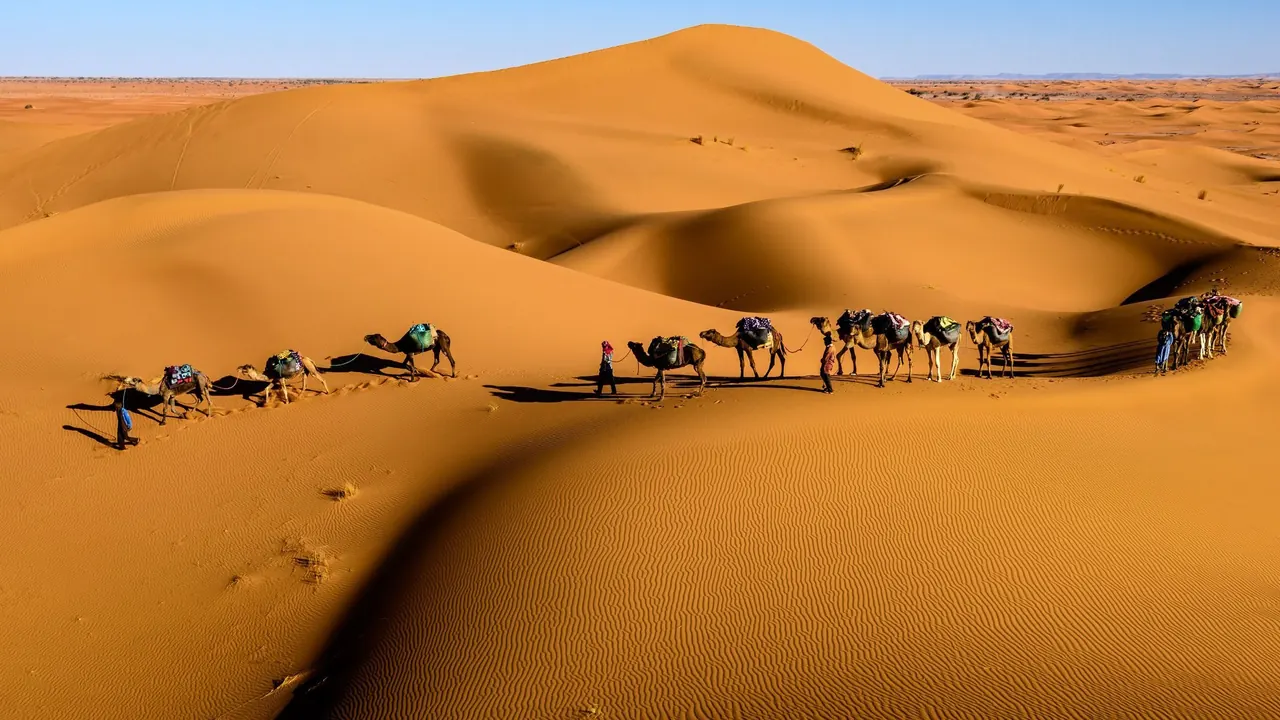
A camel caravan crossing the dunes near Zagora
- Nature & outdoors84
- Affordability70
- Culture & sights45
Photo: Sergey Pesterev, Pexels License
Match
34
Every category weighted equally
- Beach & sun33
- Culture & arts33
- Food & nightlife26
- Family trip38
- Outdoors43
- Relax & unwind37
- Shopping & style30
- On a budget38
Sahara in twelve categories
Our verdict on each, scored 0 to 100 against the same fixed benchmark cities, so a score means the same thing on every page.
Beaches & swimming. Scores 3 out of 100.
Food & drink. Scores 22 out of 100.
Culture & sights. Scores 45 out of 100.
Nightlife. Scores 4 out of 100.
Nature & outdoors. Scores 84 out of 100.
Day trips. Scores 38 out of 100.
Good for families. Scores 30 out of 100.
Getting around. Scores 22 out of 100.
Shopping & style. Scores 28 out of 100.
Affordability. Scores 70 out of 100.
Live music & performing arts. Scores 20 out of 100.
Wellness & relaxation. Scores 42 out of 100.
Sahara category by category
Beaches & swimming
3There is no sea anywhere near the Moroccan Sahara. The Atlantic coast is a full day's drive away across the Atlas, so swimming means the pool of a kasbah hotel or desert camp, and many of those are small plunge pools. After rains, a shallow seasonal lake sometimes appears near the dunes of Erg Chebbi and draws flamingos, but it is not somewhere to swim. Anyone who wants water on this trip should add the coast as a separate stop.
Food & drink
22Food here is simple and very repetitive. Most dinners are served in a camp or guesthouse: harira or vegetable soup, then a tagine of chicken, lamb or vegetables, with bread, fruit and endless mint tea. The local speciality is madfouna, sometimes called Berber pizza. It is a flatbread stuffed with spiced meat, onions and egg and baked in a sand-fired oven, and Rissani and the villages around Merzouga make it best.
The Tafilalet and Draa oases grow some of Morocco's finest dates, sold in heaps at the souks of Rissani and Zagora. Beyond that the range is narrow. There are few restaurants worth seeking out, alcohol is scarce outside hotels, and on a week-long trip the meals start to blur together.
Culture & sights
45The heritage here is earthen architecture. The ksar of Ait Benhaddou, near Ouarzazate, is a fortified village of mud-brick houses climbing a hill above a riverbed. It is the most famous sight in the region and has been a film location for decades. Ouarzazate's Taourirt kasbah, the crumbling kasbahs of the Skoura palm grove and the fortified villages lining the Draa Valley show the same tradition at different scales.
Further south and east are the ruins of Sijilmassa and the old ksour around Rissani, once a caravan hub on the trans-Saharan trade, and the Quranic library and green-glazed pottery of Tamegroute near Zagora. Each is rewarding. They are spread across hundreds of kilometres, though, and there are almost no museums, so the culture is seen in brief stops on long drives.
Nightlife
4There is no nightlife in any usual sense. Evenings in the dunes are spent around a fire under a very dark, star-filled sky, and they end early, because many camps wake guests before dawn to watch the sunrise. The towns of Ouarzazate, Zagora and Erfoud have a few hotel bars and nothing open late. Come for the quiet nights, not for going out.
Nature & outdoors
84Some of the finest desert landscape a traveller can easily reach is here. Erg Chebbi, by Merzouga, has apricot-coloured dunes rising to about 150m above the stony plain, and visitors ride camels in at dusk, sleep in a tented camp and climb the crests for sunrise. Erg Chigaga, beyond M'Hamid at the end of the Draa Valley, is larger and wilder. It can only be reached by 4x4 or on a multi-day camel trek, and it feels much more remote. Sandboarding, quad bikes and stargazing under truly dark skies round out the dunes.
The desert is not all sand. The Todra Gorge narrows to sheer limestone walls popular with climbers, the Dades Valley winds past strange eroded rock, and the volcanic Jebel Saghro has excellent winter trekking with mules. The palm groves along the Draa make green ribbons through bare, ochre hills. The season runs from October to April. Summer heat often passes 45°C and rules out most activity, and winter nights in the dunes fall close to freezing.
Day trips
38Outings from a desert base are modest and mostly local. From Merzouga, a half day reaches the Sunday and Thursday souk at Rissani, the Gnawa village of Khamlia and the fossil workshops of Erfoud. From Ouarzazate, visitors go to the Skoura palm grove, the Atlas film studios and over the mountains to the kasbah of Telouet.
Zagora is the base for Tamegroute and the Draa palm groves. The main bases sit a long day's drive apart, though, and there are no other cities, wine regions or islands within reach. Most visitors treat the region as a single loop rather than a base for day trips.
Good for families
30Older children often remember a night in the dunes for years: the camel ride in, sliding down the sand and a sky full of stars. The rest is harder going. Reaching the desert from Marrakech takes at least a full day on winding mountain roads, camps and villages are far from medical care, and there is almost nothing built for children apart from the film studios at Ouarzazate. Midday heat is fierce even in spring, and winter nights are cold. The trip suits school-age children on a well-planned loop with short daily drives. It does not suit toddlers.
Getting around
22Distance is the price of coming here. From Marrakech the road crosses the High Atlas by the twisting Tizi n'Tichka pass to Ouarzazate, and Merzouga lies most of another day's drive beyond. Intercity buses link the main towns but run infrequently, and they do not reach the camps or Erg Chigaga.
Most visitors join a driver-led tour or hire a car. The main roads are paved and quiet, but the stages are long, and the last stretch into the dunes is on foot, by camel or by 4x4. Within the small towns everything is walkable. Domestic flights to Ouarzazate, Zagora and Errachidia save time, but they are not frequent.
Shopping & style
28Shopping here means crafts and market produce, often with hard selling. Erfoud and Rissani are known for fossils and polished fossil stone, and Rissani's weekly souk sells dates, spices and livestock. Tamegroute makes a distinctive green-glazed pottery, and Berber rugs and silver jewellery turn up in cooperatives and roadside shops along the kasbah route. Guides often steer visitors into shops that pay them a commission, so expect long negotiations and judge quality carefully. There are no shopping streets or boutiques of any note.
Affordability
70The desert can be very cheap or surprisingly expensive, depending on how you travel. Simple auberges, guesthouse dinners, local buses and shared multi-day tours from Marrakech all cost little. Private drivers, 4x4 trips to the remote dunes and the comfortable or luxury tented camps are where budgets climb. Because nearly everything has to be booked as a package, prices are often less transparent than in Moroccan cities. Choosing a mid-range camp and sharing transport keeps the trip good value.
Live music & performing arts
20Music here is informal and rooted in place. In Khamlia, near Merzouga, families descended from West African Gnawa sing and play guembri and iron castanets for visitors. Camps finish the evening with drumming and Berber song around the fire, pleasant but mostly staged for guests. The region also has a few music festivals rooted in desert and nomad culture, at M'Hamid and around Merzouga. There is no theatre, concert hall or regular live-music venue anywhere.
Wellness & relaxation
42The restorative side of the desert is its stillness. Nights in a dune camp are silent and very dark, days follow the light, and nothing competes for your attention. Merzouga has an old local cure of being buried in hot sand, practised in high summer against aches and rheumatism. Towns such as Ouarzazate and Zagora have simple neighbourhood hammams, and the better kasbah hotels in Skoura and the Dades add pools and modest spas. There is no wider bathing or spa culture, so the rest here comes from the quiet rather than from treatments.
Where to stay in Sahara
Few visitors pick a single base here. A trip is usually a loop with stops a long day's drive apart, moving every night or two. On a first visit, Merzouga by Erg Chebbi is the stop that matters most. A night or two in a tented camp gives you the camel ride in, sunrise from the crests and very dark skies. The simple auberges in the village cost less and are close to Rissani and Khamlia. It suits couples, quiet stays and families with school-age children.
Ouarzazate, or the Skoura palm grove just beyond it, is the natural first night after crossing the Atlas. Kasbah hotels there have pools, and Ait Benhaddou and the film studios are nearby. The Dades Valley and Todra Gorge break the long drive east. They suit walkers and climbers, with guesthouses under the rock walls.
A second visit is best spent in the Draa Valley. Zagora is a plain town base for Tamegroute and the palm groves. M'Hamid is the starting point for Erg Chigaga, where camps are reached by 4x4 or camel and feel far more remote. This suits travellers who want solitude more than comfort. Nowhere in the region suits anyone looking for nightlife.
When should you go?
Pick a month to see what it is like. The climate figures are measured averages, not a forecast.
Sahara in July
Daytime high, °C
Rainfall in the month, mm
The whole year
Shaded against this destination’s own year: the deepest cell is its best month for that figure and the palest its weakest.
Where the figures come from
Sahara has no weather station within reach, so its figures come from a gridded climate model rather than a measured record, and read a broad area rather than one spot.
Temperature and rainfall are climate normals, averaged over the years shown. Sahara: 2001-2020 normals, NASA POWER reanalysis grid, no weather station within 90 km.
Before you go
| Measure | Sahara |
|---|---|
| Official language | Arabic, Standard Moroccan Tamazight |
| Currency | Moroccan Dirham (MAD) |
| Sockets | CE50 Hz |
| Driving side | Right |
| Time zone | UTC+1 |
| Emergency number | Police 19/112, ambulance 15, fire 15 |
| Main airport | Moulay Ali Cherif Airport (ERH)4 non-stop destinations |
| Public holidays this year | 11 days |
Compare Sahara with
Every comparison with a written verdict behind it.