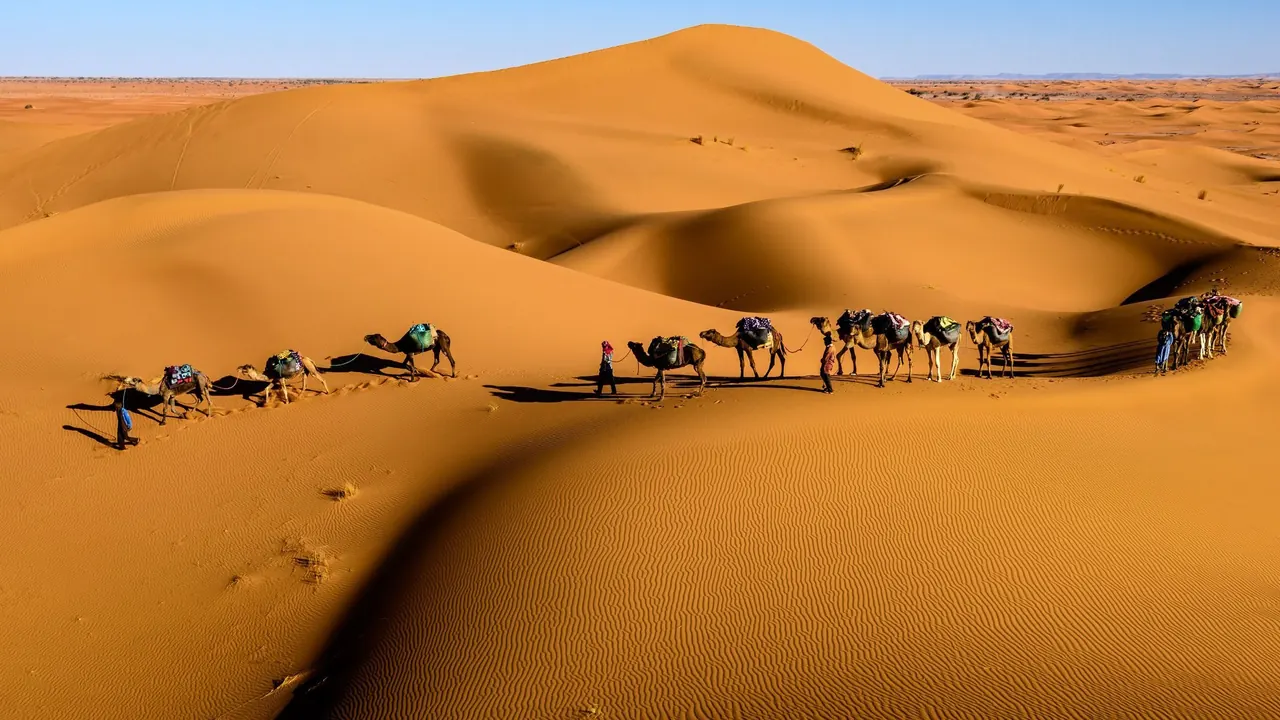
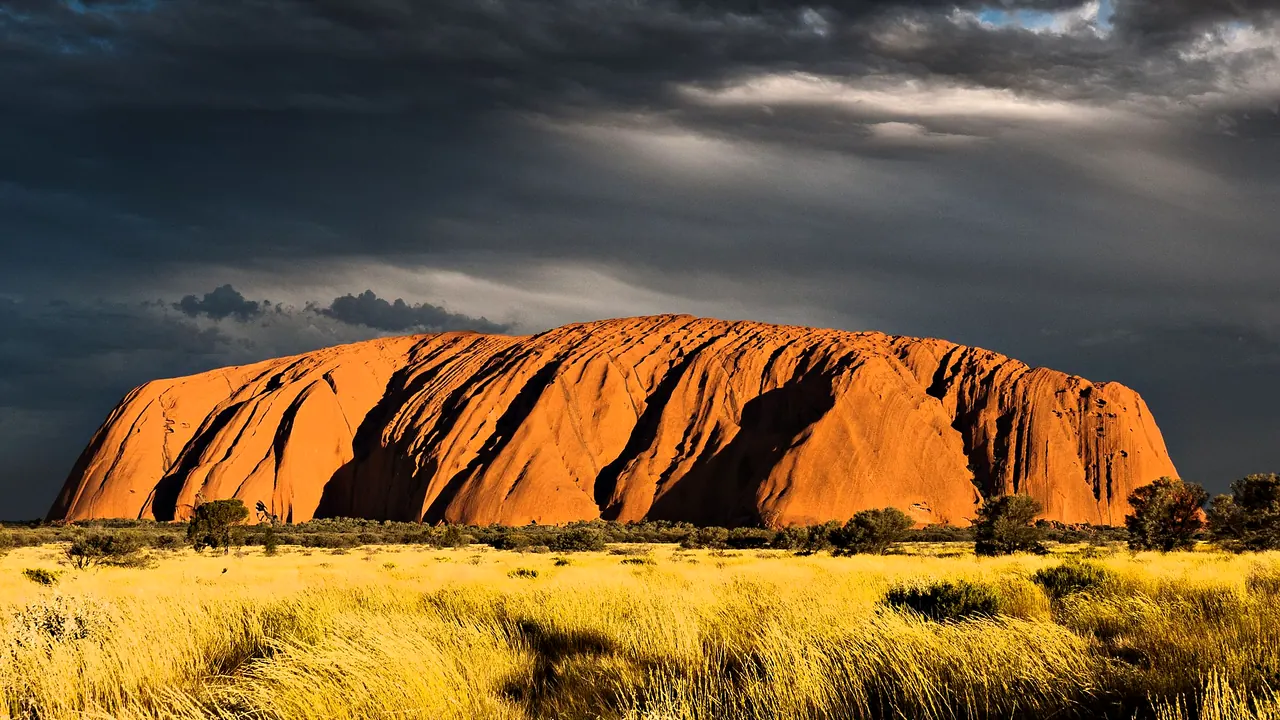
Photos: Sahara by Sergey Pesterev, Pexels License; Uluru by Weyf, CC0.
Sahara or Uluru?
Our verdict in twelve categories, each scored against the same fixed benchmark cities, and the climate month by month, so you can choose for your trip.
Choose Sahara for
- prices
- day trips
- live music and the arts
The Moroccan Sahara is the better pick for a traveller who wants a road trip through a whole region and would like it to stay affordable. A loop from Marrakech over the Atlas passes mud-brick ksour, kasbahs, palm-grove oases and market towns before it reaches the dunes of Erg Chebbi or the wilder Erg Chigaga. A mid-range camp and shared transport keep costs low. What it asks of you is time, because the drives are long.
Choose Uluru for
- getting around
- nightlife
Uluru suits someone with less time and a bigger budget who wants one extraordinary landscape done well. You fly into the airport beside Yulara, walk the base of the rock and the Valley of the Winds at Kata Tjuta, and learn the Anangu stories behind what you are seeing, all within two or three days from one compact resort. The trade-off is that there is little else to do and little choice, and everything is priced for how remote it is.
Scoreboard
Twelve categories on one fixed scale from 0 to 100. The shaded stretch is the gap between the two.
Your match
Pick a travel style or drag the sliders, and both match scores follow your weighting.
Wins on prices and day trips with your weighting.
Wins on getting around and nightlife with your weighting.
What matters to you?
Category by category
What the scores mean for a trip.
Beaches & swimming
Neither place has any sea, and swimming in both means a hotel pool. The difference is how far away the coast is. From the Moroccan desert the Atlantic is a long day's drive back across the Atlas, so you can add it to the same Moroccan trip by road. Uluru lies about 700km from the nearest shore in a straight line, so a beach means a flight to another part of Australia.
The water you do find is also different in kind. The seasonal lake near Erg Chebbi draws flamingos after rain, though it is no place to swim. At Uluru the waterholes are sacred sites, and you should look at them but never go in.
Food & drink
Both are thin on good food, but in different ways. In the Sahara you eat Moroccan home cooking in camps and guesthouses: harira, tagines and mint tea, and the meals soon start to repeat. Two things make the trip worthwhile, though: madfouna baked in sand ovens around Rissani and Merzouga, and heaps of dates from the Tafilalet and Draa oases in the souks. Alcohol is hard to find outside hotels.
At Uluru every meal comes from the restaurants and supermarket of one resort. The cooking is competent hotel food, at its best when it uses native ingredients such as wattleseed and quandong, or kangaroo and barramundi on the grill. There are no markets, but there is a full bar and a communal barbecue if you want to cook for yourself.
Culture & sights
The Sahara has a little more to see, and it is built heritage. You find it in the earthen ksar of Ait Benhaddou, Ouarzazate's Taourirt kasbah, the fortified villages of the Draa Valley, the ruins of Sijilmassa and the Quranic library at Tamegroute. These sites lie hundreds of kilometres apart, so you see them in short stops along long drives.
At Uluru the culture is a living one, read in the landscape rather than in buildings. Anangu Tjukurpa gives meaning to the caves and waterholes of the rock, and you can see rock art at Kulpi Mutitjulu and Kantju Gorge. The Cultural Centre and the ranger-led walks explain it well. Everything is in one park, and two or three days covers it.
Nightlife
Neither place offers a night out, and in both the evening ends early because of a sunrise start. In the Sahara the evening means a fire outside a dune camp under a very dark sky, and drinks are hard to come by. At Uluru it means a resort bar with a pool table and the occasional singer, which is more sociable but still very modest.
Nature & outdoors
These are two of the great desert landscapes, equally strong but very different. The Moroccan Sahara is a whole region of landscapes. There are the apricot dunes of Erg Chebbi, where you ride in by camel and sleep in a camp, and the remote sand sea of Erg Chigaga. Beyond the sand are the sheer walls of the Todra Gorge, the eroded rock of the Dades Valley and mule treks on Jebel Saghro.
Uluru packs its power into one park. The monolith rises about 350m from the plain, and you can walk the 10km around its base. The domes of Kata Tjuta give the best hike, through the Valley of the Winds. Everything is close together and easy to do in a short stay, but there is far less variety than across southern Morocco.
Day trips
The Sahara gives you far more to do beyond your base. From Merzouga you can reach the Rissani souk, the Gnawa village of Khamlia and the fossil workshops of Erfoud. Ouarzazate is a good base for the Skoura palm grove, the film studios and the kasbah of Telouet, and Zagora is the base for Tamegroute.
Uluru has almost nothing outside the park. Kata Tjuta lies inside it, Kings Canyon is about three and a half hours' drive each way, and Alice Springs is about 450km off. Anything further than the park has to be a separate stop.
Good for families
Both suit school-age children rather than toddlers, and in both the highlights are camel rides, open space and starry skies. In the Sahara the night in a dune camp, sliding down the sand, is the part children remember. Getting there means full days on mountain roads, though, and the camps are far from medical care.
Uluru is easier to handle day to day, with a small, safe resort, pools for the afternoons and ranger talks. Against that, flies and fierce midday heat make long walks hard for small legs.
Getting around
Uluru is much easier to reach. Ayers Rock airport sits just outside Yulara with direct flights from several Australian cities, and a free shuttle loops around the resort. The one gap is the park, about 20km away, where you need a hire car or a paid tour.
In the Sahara the distances shape the whole trip. You cross the High Atlas by the Tizi n'Tichka pass to Ouarzazate, and Merzouga is most of another day beyond. The buses are infrequent and do not reach the camps, so most people join a tour with a driver or hire a car.
Shopping & style
The Sahara has more to buy, though you have to work for it. Erfoud and Rissani are known for fossils, Rissani's weekly souk sells dates and spices, and Tamegroute makes green-glazed pottery. Berber rugs and silver turn up along the kasbah route, but expect hard selling and guides who earn commission from the shops.
At Uluru there is really only one thing worth buying: Aboriginal canvases and carved punu, sold at community-run outlets where the money reaches the artists. Beyond that it is souvenirs and outdoor clothing.
Affordability
This is the widest gap between the two. The Moroccan desert can be done cheaply with simple auberges, guesthouse meals and shared tours. Costs only climb if you choose private 4x4s and luxury camps.
Uluru is expensive whatever you do. One resort owns all the accommodation, everything arrives by truck, the flights in are rarely cheap and you need a park pass. Staying at the campground and cooking your own food helps, but it is still a costly place to stay.
Live music & performing arts
The Sahara's music has deeper roots. In Khamlia, families of Gnawa descent play the guembri and iron castanets, and festivals of desert and nomad music are held at M'Hamid and around Merzouga.
Uluru has only short Indigenous dance and didgeridoo sets put on for resort guests, which are pleasant but brief. Neither place has a theatre or a concert hall.
Wellness & relaxation
The Sahara is the more restful of the two. Its calm comes from silent nights in a dune camp, and it adds simple hammams in Ouarzazate and Zagora, kasbah hotels with pools and modest spas in Skoura and the Dades, and Merzouga's old summer cure of being buried in hot sand.
At Uluru the rest comes from the rhythm of the day, sunrise, the pool through the heat, then sunset. The only spa is at the top hotel, where treatments use native botanicals. Early starts for tours make it better for a short reset than a slow stay.
When should you go?
Pick your month. The climate figures are measured averages, not a forecast.
Sahara in July
Uluru in July
Daytime high, °C
Rainfall in the month, mm
Where the figures come from
Sahara has no weather station within reach, so its figures come from a gridded climate model rather than a measured record, and read a broad area rather than one spot.
Temperature and rainfall are climate normals, averaged over the years shown. Sahara: 2001-2020 normals, NASA POWER reanalysis grid, no weather station within 90 km. Uluru: 1991-2020 normals, Yulara (4.7 km from centre).
The two deserts have opposite seasons. In the Moroccan Sahara the comfortable months run from October to April. Days in the desert towns are mild in midwinter at around 16°C, but nights in the dunes come close to freezing. From June to August the heat climbs to about 42°C and rules out most walking and trekking. Rain hardly matters at any time of year, so the choice of month comes down to temperature alone.
Uluru is at its best from May to September, when days around Yulara sit near 20°C to 24°C, ideal for the base walk and Kata Tjuta, though nights are cold. From November to February highs stay around 38°C and the longer trails close by late morning. Those summer months are also the wettest, with December the peak at about 54mm. A Sahara trip fits the northern winter, and Uluru fits the northern summer.
Which traveller are you?
For a trip on a tight budget, the Sahara is the clear choice. In Morocco you decide how much to spend by picking modest rooms and sharing rides. At Uluru one owner sets every price, and even the flight in costs a lot.
On a relaxing and wellness trip, the Sahara gives you more room to slow down. You get several unhurried days between oasis villages and dune camps, with a steam bath or a quiet pool along the way. Uluru's short stay is built around dawn tours.
On a family trip with school-age children, Uluru asks less of everyone. A flight lands you close to your bed, and the whole stay happens in one place that is easy to manage. A Sahara loop means many hours in a car between stops.
Before you go
| Measure | Sahara | Uluru |
|---|---|---|
| Official language | Arabic, Standard Moroccan Tamazight | English |
| Currency | Moroccan Dirham (MAD) | Australian Dollar (AUD) |
| Sockets | CE50 Hz | I230 V, 50 Hz |
| Driving side | Right | Left |
| Time zone | UTC+1 | UTC+9:30 |
| Emergency number | Police 19/112, ambulance 15, fire 15 | 000 |
| Main airport | Moulay Ali Cherif Airport (ERH)4 non-stop destinations | Ayers Rock Connellan Airport (AYQ)3 non-stop destinations |
| Public holidays this year | 11 days | 12 days |
Where else could you go?
Every comparison below shares a destination with this one, so you can follow Sahara or Uluru somewhere new.
- Marrakechvs Sahara
- Kakaduvs Uluru
- Whitsundaysvs Uluru
- Petravs Sahara
- Dubaivs Sahara
- San Pedro de Atacamavs Sahara