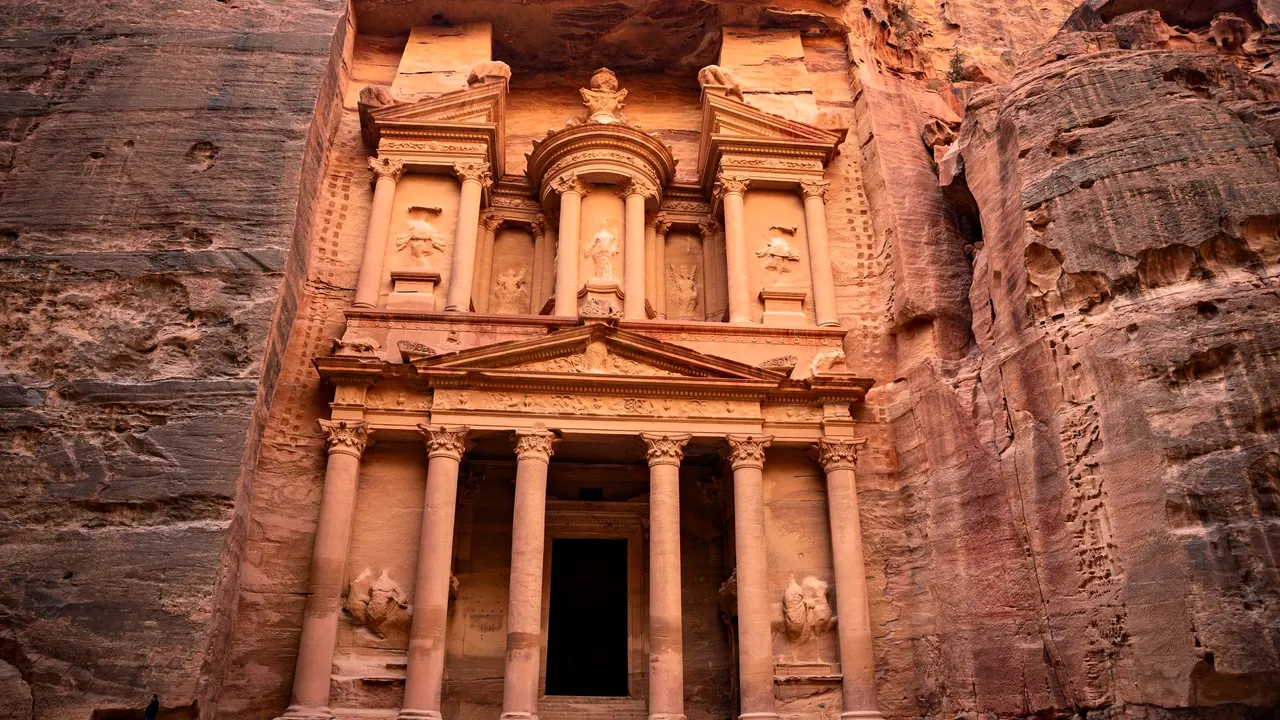
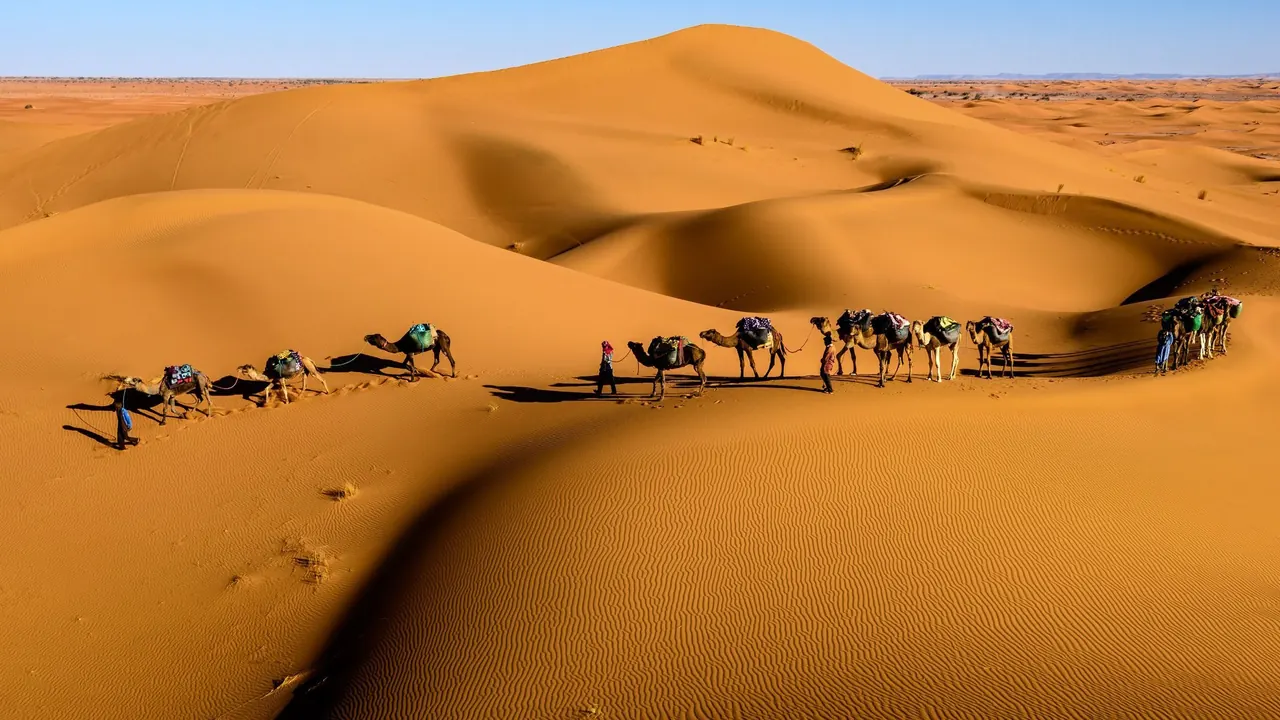
Photos: Petra by Yasir Gürbüz, Pexels License; Sahara by Sergey Pesterev, Pexels License.
Petra or Sahara?
Our verdict in twelve categories, each scored against the same fixed benchmark cities, and the climate month by month, so you can choose for your trip.
Choose Petra for
- culture and sights
- getting around
- beaches
Petra suits a traveller who wants one extraordinary place and will walk hard to see it. The Nabataean city carved into the sandstone fills two or three days on its own, from the Siq and the Treasury to the Monastery steps and the back trails, and the mountains around it give the walking real scale. You stay in Wadi Musa and accept two things: the town has little else to offer, and the entry fee makes this a costlier stop.
Choose Sahara for
- prices
- wellness
- shopping
The Moroccan Sahara rewards someone who has come for the desert itself rather than for a monument in it. The high points are a night among the dunes of Erg Chebbi or Erg Chigaga, the Todra and Dades gorges and the mud-brick kasbahs on the way, all strung out along a long road loop from Marrakech. It is cheaper if you travel simply, quieter in the evenings and better for rest. In return, the sights are smaller and lie many hours of driving apart.
Scoreboard
Twelve categories on one fixed scale from 0 to 100. The shaded stretch is the gap between the two.
Your match
Pick a travel style or drag the sliders, and both match scores follow your weighting.
Wins on culture and sights and getting around with your weighting.
Wins on prices and wellness with your weighting.
What matters to you?
Category by category
What the scores mean for a trip.
Beaches & swimming
Neither place offers a swim beyond a hotel or camp pool, and in both only some places have one. The real difference is how far away the sea is. From Petra, the Red Sea and its reefs at Aqaba are about two hours south and easy to add to a tour of Jordan. From the Moroccan desert, the Atlantic is a full day's drive beyond the Atlas, so the coast becomes a separate stage of the trip.
Food & drink
Both feed visitors simply, and neither has food worth travelling for, but the dishes differ. Around Petra it is Jordanian cooking: mezze, mansaf, Bedouin zarb from an underground pit, falafel and knafeh, plus cooking classes for anyone curious. In the Sahara, evenings bring soup and tagine in camp, made better by madfouna, the stuffed flatbread of Rissani, and by the dates of the Tafilalet and Draa oases.
Wadi Musa gives you a little more choice, with street counters and bakeries. Desert camp meals tend to repeat night after night. In both places, alcohol is mostly limited to hotels.
Culture & sights
The gap here is wide. Petra is a single site of world importance and needs two or three days: the Siq, the Treasury, the Royal Tombs, the Great Temple and the climb to the Monastery, with the Petra Museum and Little Petra to round it off.
The Sahara's heritage is real but quieter. It includes the earthen ksar of Ait Benhaddou, the kasbahs of Ouarzazate and Skoura, the ruins of Sijilmassa and the library at Tamegroute. These lie hundreds of kilometres apart and there are almost no museums, so they add interest to a road trip rather than give it a centre.
Nightlife
Neither offers a night out. In Petra, evenings in a conservative town mean dinner and shisha on a terrace, with a hotel bar at most. In the Sahara you spend them by a campfire under a very dark sky, and they end early for the sunrise. The choice is between a quiet evening in town and a night in the open desert.
Nature & outdoors
Both are superb for the outdoors, and the Sahara has the edge for sheer spectacle. The dunes of Erg Chebbi and the remote Erg Chigaga offer camel rides in, nights in camp and sandboarding. Around them are the Todra Gorge, the Dades Valley and winter treks on Jebel Saghro.
Petra's strength is walking in rock country. Trails lead to the High Place of Sacrifice and Jebel Haroun, the back route runs from Little Petra to the Monastery, and the Jordan Trail passes through. The ibex slopes of Dana and the red valleys of Wadi Rum are within reach, but as separate outings rather than on the doorstep.
Day trips
Petra's list of outings is short and mostly strung along one road. Shobak castle and the stone village of Dana lie to the north, with Wadi Rum and the Red Sea at Aqaba to the south. Kerak is better seen on the drive to or from Amman than as a return trip.
The Sahara gives you a little more, spread across its bases. From Merzouga, half a day covers the Rissani souk, the Gnawa village of Khamlia and the fossil workshops of Erfoud. From Ouarzazate you can reach the Skoura palm grove, the film studios and the kasbah of Telouet. The bases lie a long day's drive apart, though, so what you can see depends on where you sleep.
Good for families
Both suit older, sturdy children far better than toddlers, and neither has much built for families apart from the film studios at Ouarzazate. The adventure is different. At Petra it means climbing into tombs and walking the Siq on long, shadeless paths where strollers are useless. In the Sahara it means a camel ride and a night in the dunes, at the cost of long mountain drives and camps far from medical care.
Getting around
Both take planning, and both rely on cars and hired drivers. At Petra the effort is on foot: long walks and climbs inside the park, and taxis up the steep hill of Wadi Musa. Buses run to Amman and Aqaba. In the Sahara the effort is distance: long drives over the Tizi n'Tichka pass and on to Merzouga, few buses, and the last stretch to camp by camel or 4x4.
Shopping & style
The Sahara has more worth buying, though neither is a place to go shopping. Fossils from Erfoud and Rissani, the green-glazed pottery of Tamegroute, Berber rugs, and dates and spices from the Rissani souk give it real local character. You will need to bargain hard and avoid the shops that pay guides a commission.
Petra mostly offers trinkets, sold along the trails and repeated in Wadi Musa. The women's cooperatives selling embroidery are the one source of good-quality goods.
Affordability
The Sahara is the cheaper trip if you travel simply, with auberges, guesthouse meals, local buses and shared tours. Private drivers and luxury camps can make it expensive, though, and prices are rarely clear.
At Petra, rooms and street food are fairly priced, but the site's entry fee is among the steepest anywhere, and going beyond town needs a driver or a tour. A multi-day ticket or a combined pass bought before arriving in Jordan helps, but Petra stays the costlier stop.
Live music & performing arts
The Sahara has more live music, though neither place has a theatre, a concert hall or anything you could call a music scene. At Petra it comes down to a single event, Petra by Night. You walk a candlelit Siq to the Treasury, where Bedouin musicians play flute and rababa under the cliffs. It makes a fine evening, but apart from that, music is just a backdrop to dinner.
In the Sahara, music turns up in several forms across the trip. In Khamlia, Gnawa families with West African roots play the guembri and iron castanets for visitors. There are festivals of desert and nomad culture at M'Hamid and around Merzouga. Most nights in the dunes end with drumming around the fire, even if it is staged for guests.
Wellness & relaxation
The Sahara is the more restful of the two. Silent, dark nights in a dune camp, the pools and modest spas of kasbah hotels in Skoura and the Dades, local hammams and Merzouga's hot-sand cure make stillness the point of the stay.
At Petra, rest is how you recover from the trails. That means a tourist bathhouse in Wadi Musa for steam and a scrub, or a hotel spa, during a stay built around hard walking.
When should you go?
Pick your month. The climate figures are measured averages, not a forecast.
Petra in July
Sahara in July
Daytime high, °C
Rainfall in the month, mm
Where the figures come from
Petra's temperatures are measured 34 km from the centre, at Ma'An.
Petra's station stands 219 m above the city centre, so the centre is likely a little warmer than the figures say.
Petra has no rain gauge within 25 km of the centre, so its rainfall comes from a gridded climate dataset read at the destination rather than from a gauge further away.
Sahara has no weather station within reach, so its figures come from a gridded climate model rather than a measured record, and read a broad area rather than one spot.
Temperature and rainfall are climate normals, averaged over the years shown. Petra: 1991-2020 normals, Ma'An (33.9 km from centre). Sahara: 2001-2020 normals, NASA POWER reanalysis grid, no weather station within 90 km.
Neither place has a beach, so what matters is the weather for walking. At Petra, spring and autumn are best. April and October bring dry, sunny days that suit the long climbs. From June to September the site is rainless but hot, reaching 35°C in July and August on trails with almost no shade. Winter is cooler and the only wet season, with about 45mm of rain in January, and nights in the mountains can turn frosty.
The Sahara's figures are measured around its desert towns, and there the heat is fiercer and the air drier. Rain barely registers in any month, but summer highs reach 42°C in July, which rules out camel treks and hiking. The season runs from October to April, with mild winter days around 16°C and cold nights in the dunes. That gives the Sahara a longer winter window than Petra. Petra's higher ground stays a few degrees cooler through spring and summer, but even there the warm months are hard going.
Which traveller are you?
On a culture and arts trip, Petra wins clearly. One rock-cut city of tombs, temples and a theatre can fill several days. The Sahara's kasbahs and ksour are rewarding, but they come as short stops between long drives.
For a trip on a tight budget, the Sahara stretches further because its costs follow your choices. Share the transport, pick a modest camp and the days stay cheap. At Petra the biggest outlay is the entry fee, and no amount of thrift avoids it.
On a relaxing and wellness trip, choose the Sahara, where rest is the point of going. The desert sets a slow pace and asks little of you. Petra asks a great deal, and you only get to rest at the end of a hard day's walking.
Before you go
| Measure | Petra | Sahara |
|---|---|---|
| Official language | Arabic | Arabic, Standard Moroccan Tamazight |
| Currency | Jordanian Dinar (JOD) | Moroccan Dirham (MAD) |
| Sockets | BCFGJ230 V, 50 Hz | CE50 Hz |
| Driving side | Right | Right |
| Time zone | UTC+3 | UTC+1 |
| Emergency number | 911 | Police 19/112, ambulance 15, fire 15 |
| Elevation | 850 m | - |
| Main airport | King Hussein International Airport (AQJ)90 km from centre5 non-stop destinations | Moulay Ali Cherif Airport (ERH)4 non-stop destinations |
| Public holidays this year | - | 11 days |
By the numbers
| Measure | Petra | Sahara |
|---|---|---|
| Museums within 10 km | 2 | - |
| UNESCO World Heritage sites within 50 km | 1 | - |
Where else could you go?
Every comparison below shares a destination with this one, so you can follow Petra or Sahara somewhere new.