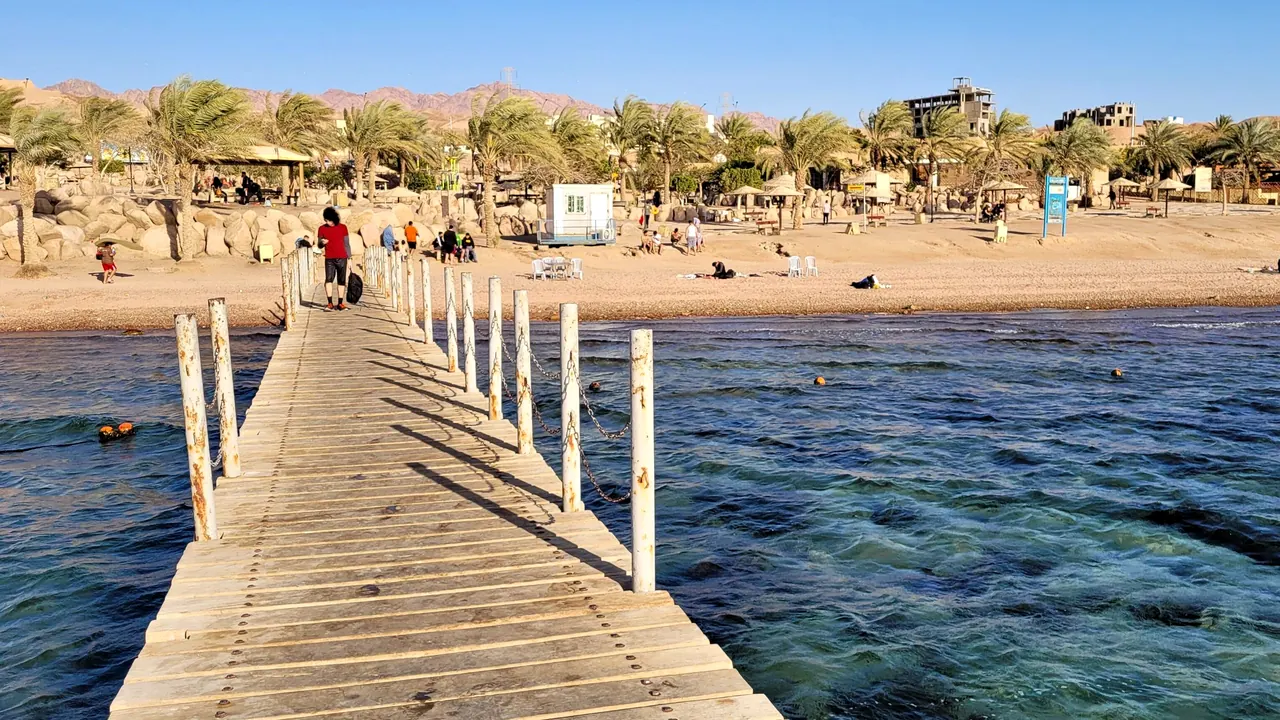
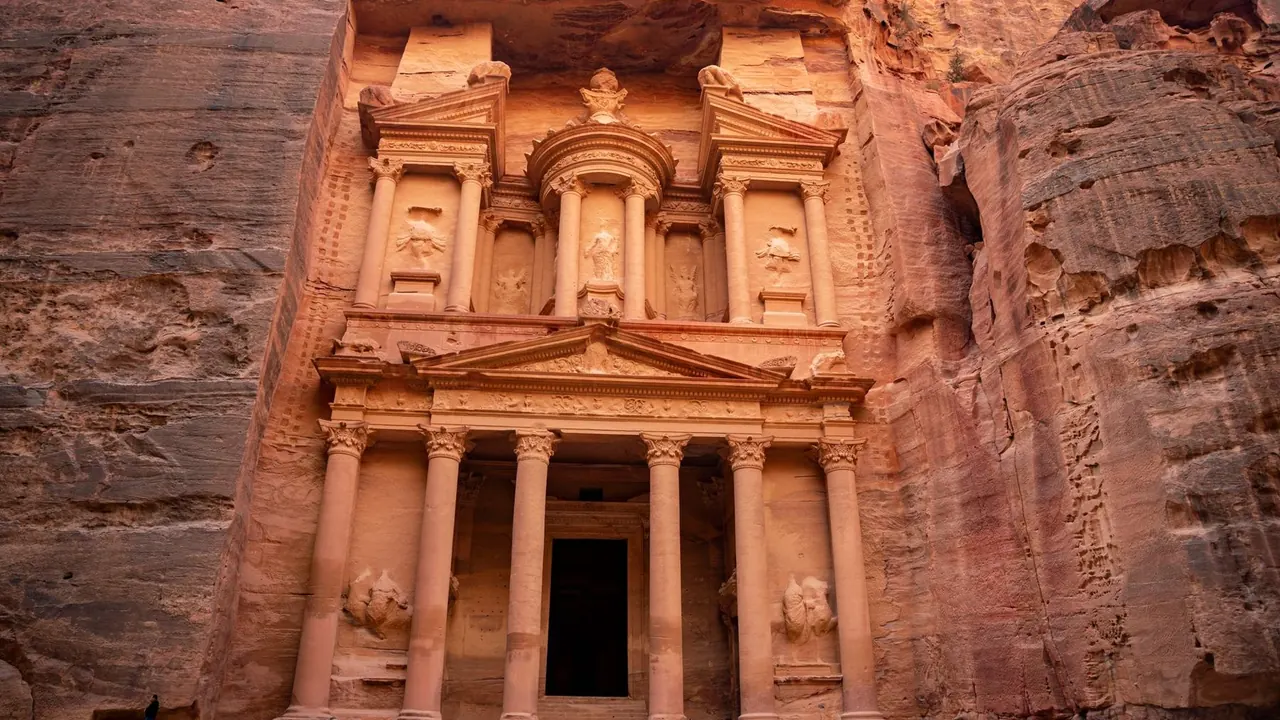
Photos: Aqaba by عباد ديرانية, CC BY-SA 4.0, cropped; Petra by Yasir Gürbüz, Pexels License.
Aqaba or Petra?
Our verdict in twelve categories, each scored against the same fixed benchmark cities, and the climate month by month, so you can choose for your trip.
Choose Aqaba for
- beaches
- day trips
- families
Aqaba suits travellers who want warm water and an easy pace. The Red Sea is swimmable all year, the reefs start a few metres from the shore, and the town works well as a resort base for families, snorkellers and divers. It also puts both Petra and Wadi Rum within reach for a day or a night away.
Choose Petra for
- culture and sights
- live music and the arts
Petra is for travellers who come for the sight itself. The Nabataean city needs two or three full days of walking and climbing to see properly, and the mountains around it make some of the best hiking in Jordan. Wadi Musa has very little else, so this is a demanding stop with one great reward rather than a place to unwind.
Scoreboard
Twelve categories on one fixed scale from 0 to 100. The shaded stretch is the gap between the two.
Your match
Pick a travel style or drag the sliders, and both match scores follow your weighting.
Wins on beaches and day trips with your weighting.
Wins on culture and sights and live music and the arts with your weighting.
What matters to you?
Category by category
What the scores mean for a trip.
Beaches & swimming
Aqaba has a real sea for swimming: clear, calm water and coral just off South Beach, with the resort and beach-club strips to the south giving loungers and a more relaxed dress code. The town beaches are narrow and coarse, so the draw is the snorkelling rather than the sand.
Petra is in the mountains and has no swimming apart from the pools at some Wadi Musa hotels. For the Red Sea you have to drive about two hours south to Aqaba.
Food & drink
Neither place is a reason to travel for food, but Aqaba gives you more to choose from. Its own dish is sayadieh, fish over spiced rice, and the old-town fish restaurants let you choose your catch. The resorts add some more polished dining, and alcohol is cheaper because of the tax-free status.
Wadi Musa feeds hungry hikers with mansaf, maqluba and zarb from the Bedouin pit oven, mostly at hotel buffets and roadside restaurants. Its most memorable flavours are the simple ones: sage tea at stalls inside the site, or a meal in a Bedouin camp.
Culture & sights
This is where Petra is in a different class. The rock-cut city fills two or three days, from the Siq and the Treasury to the Monastery, the High Place of Sacrifice and the Byzantine mosaics, and Little Petra and the site museum add to it.
Aqaba's heritage takes a morning: the Mamluk fort, the low ruins of early Islamic Ayla and the remains of a very early church. Visitors staying on the coast who care about history spend their time on the trip to Petra.
Nightlife
Both are quiet after dark, but Aqaba has a little more going on. There are resort bars, pubs for divers and expats, and beach clubs that sometimes hold DJ nights in the cooler months, along with families walking the corniche late. Wadi Musa has dinner, a shisha on a terrace and the odd hotel bar, and everyone goes to bed early before the next day on the trails.
Nature & outdoors
Both are excellent for the outdoors, but in different ways. In Aqaba the best of it is underwater: shore dives at the Japanese Garden, corals shallow enough for snorkellers and wrecks sunk as artificial reefs, with Wadi Rum about an hour inland.
Petra is a hiking destination. Trails run through Wadi Muthlim and up Jebel Haroun, the back route from Little Petra to the Monastery is a superb walk, and the Jordan Trail passes through. The ibex and juniper slopes of the Dana reserve are about an hour north.
Day trips
Aqaba is the better base for outings, mainly because Petra and Little Petra together make a full and rewarding day from the coast. Wadi Rum is also close for a desert night, although Eilat and Sinai are made awkward by the border crossings.
From Petra the choices are fewer: the lonely Crusader castle at Shobak combined with the stone village of Dana, Wadi Rum to the south, or Kerak if you are heading up the King's Highway anyway.
Good for families
Aqaba works as a simple resort vacation, with calm, shallow water, glass-bottomed boats that show children the reef, and hotel pools and kids' clubs. The summer heat is the main drawback.
Petra is better suited to older children who can walk all day. Scrambling into tombs feels like an adventure, but there is little shade, the Monastery climb is tough, pushchairs are no use beyond the main path, and Wadi Musa has nothing made for children.
Getting around
Aqaba's compact centre around the corniche, fort and markets can be walked when it is not too hot. The beaches and dive sites lie along the coast road, which means taxis, hotel shuttles or a hire car.
At Petra the walking is the trip itself: long distances on foot inside the park, with carts and animals covering only part of the main route. Wadi Musa climbs a steep hill, so higher hotels need a taxi to the gate, and anything beyond town needs a driver or a car.
Shopping & style
Aqaba's tax-free status is its one real advantage for shoppers: perfume, electronics and alcohol cost less than anywhere else in Jordan. The old market streets add spices, dates and Dead Sea mud and salts, although much of the craftwork on the stalls is mass-produced.
Petra has less to offer, mostly souvenirs on the trails and in Wadi Musa: Bedouin silver and bead jewellery, coins of doubtful age and bottles of coloured sand. The cooperative shops selling embroidery made by local women are where the purchases worth making are found.
Affordability
Aqaba is the more affordable of the two, especially if you live partly like a local. Fish meals and shawarma in town, taxis and simple central hotels all cost little, and drinks are cheaper than anywhere else in Jordan. A south-coast resort with dive courses and beach-club passes narrows the gap but doesn't close it.
Petra costs more for the same number of days. Foreign visitors pay one of the steepest heritage entry fees in the world. Wadi Musa also has no public transport worth using, so every outing beyond town means paying a driver or hiring a car. Its guesthouses and falafel counters are cheap, but they rarely make up for those two costs.
Live music & performing arts
Neither has a stage or concert scene, so you go to Amman for that. What differs is the one performance each offers. Petra has Petra by Night, with candles lighting the Siq and the Treasury square while rababa and flute play under the cliffs. In Aqaba it is hotel lounge bands, and the best moment is often Bedouin music around a fire on a trip out to Wadi Rum.
Wellness & relaxation
Aqaba is the place to slow down. It has traditional Turkish baths in town, full resort spas using Dead Sea mud and salt, and warm, dry winter days for doing very little.
Petra's bathhouses are built for tourists and are good for tired legs after the trails, and a few hotels have small spas. The days themselves are hard physical work, though, so a stay there is rarely restful.
When should you go?
Pick your month. The climate figures are measured averages, not a forecast.
Aqaba in July
Petra in July
Daytime high, °C
Rainfall in the month, mm
Where the figures come from
Petra's temperatures are measured 34 km from the centre, at Ma'An.
Petra's station stands 219 m above the city centre, so the centre is likely a little warmer than the figures say.
Petra has no rain gauge within 25 km of the centre, so its rainfall comes from a gridded climate dataset read at the city rather than from a gauge further away.
Temperature and rainfall are climate normals, averaged over the years shown. Aqaba: 1991-2020 normals, Eilat (5.8 km from centre). Petra: 1991-2020 normals, Ma'An (33.9 km from centre).
Aqaba is at its best from November to April. Days are dry and sunny, with highs in the low to mid twenties in midwinter, rain is almost unknown, and the sea stays at about 21°C or above, so swimming and snorkelling work all through the season. From May to September the heat is extreme, reaching 40°C in July and August. The sea is at its warmest then, but on land you can only be outdoors comfortably in the early morning.
Petra sits much higher and runs cooler. January highs are around 14°C, and winter brings nearly all of its rain, about 45mm in January, along with cold nights. April, May and October are the months for long days on the trails. Summer is hot there too, though less fierce than on the coast. April suits both places best, with November a good second choice for a trip that combines them.
Which traveller are you?
For a beach and sun trip, base yourself in Aqaba. Book on the south coast or at Tala Bay rather than in town, pack a mask and snorkel, and make Petra one early, long day out instead of moving inland.
On a culture and arts trip, sleep in Wadi Musa for at least two nights on a multi-day ticket. That way you can be at the gate early and reach the Monastery and back trails before the heat. Add Aqaba afterwards for a few days of rest.
On a family trip with children, stay in Aqaba and treat Petra as the big outing. Come between November and April, when the days are mild. Do Petra as one early day trip, or add a night in a Wadi Rum camp, rather than moving everyone to Wadi Musa.
Before you go
| Measure | Aqaba | Petra |
|---|---|---|
| Official language | Arabic | Arabic |
| Currency | Jordanian Dinar (JOD) | Jordanian Dinar (JOD) |
| Sockets | BCFGJ230 V, 50 Hz | BCFGJ230 V, 50 Hz |
| Driving side | Right | Right |
| Time zone | UTC+3 | UTC+3 |
| Emergency number | 911 | 911 |
| Elevation | 6 m | 850 m |
| Main airport | King Hussein International Airport (AQJ)9 km from centre5 non-stop destinations | King Hussein International Airport (AQJ)90 km from centre5 non-stop destinations |
By the numbers
| Measure | Aqaba | Petra |
|---|---|---|
| City population | 140,000 | - |
| People per km² | 3,733 | - |
| Museums within 10 km | 5 | 2 |
| UNESCO World Heritage sites within 50 km | 2 | 1 |
| Swim season, months above 21 °C | 12 months | - |
Where else could you go?
Every comparison below shares a destination with this one, so you can follow Aqaba or Petra somewhere new.