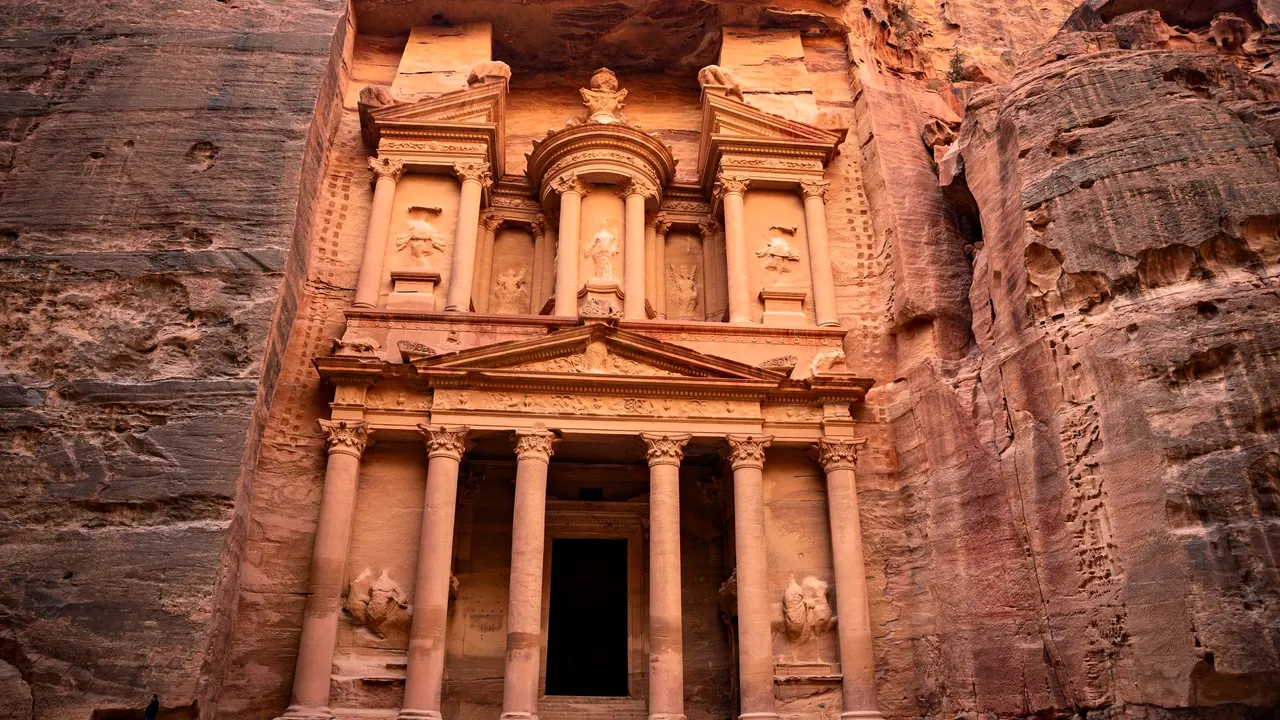
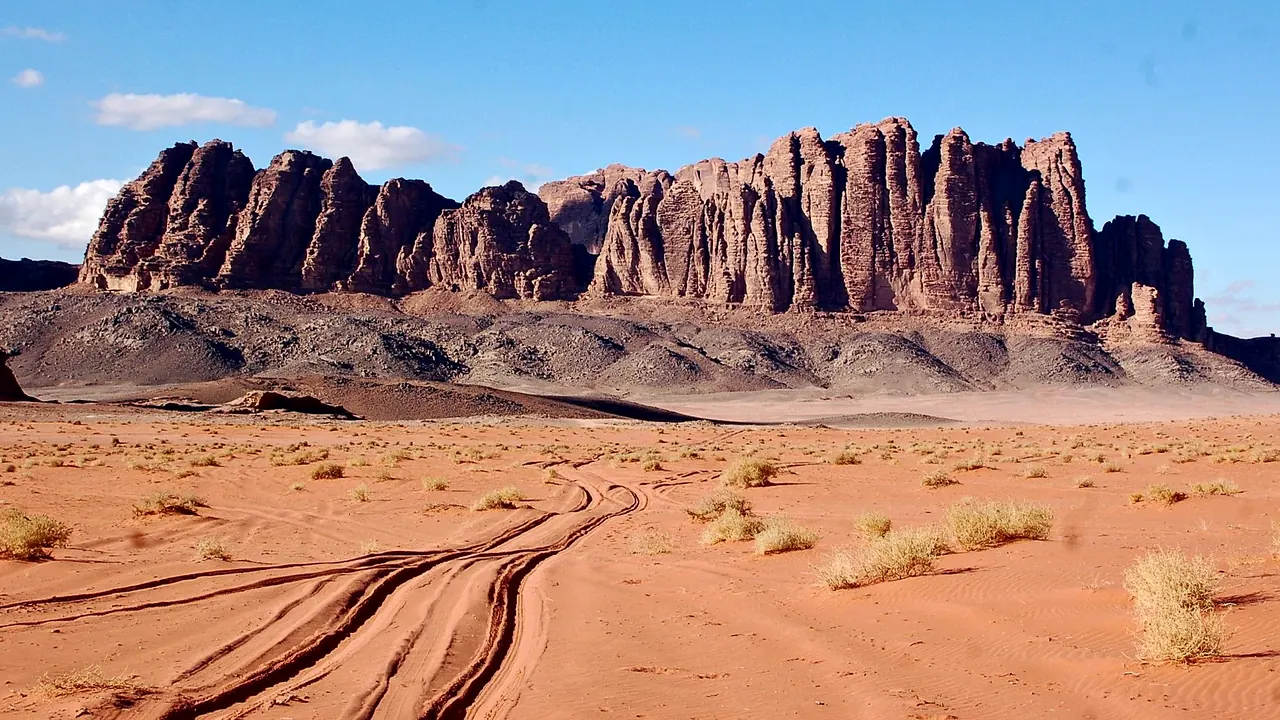
Photos: Petra by Yasir Gürbüz, Pexels License; Wadi Rum by twiga-swala, CC BY-SA 2.0, cropped.
Petra or Wadi Rum?
Our verdict in twelve categories, each scored against the same fixed benchmark cities, and the climate month by month, so you can choose for your trip.
Choose Petra for
- culture and sights
- shopping
- getting around
Choose Petra if the point of the trip is to stand in front of one of the great ancient sites of the world. The Nabataean city fills two or three days on foot, from the Siq and the Treasury to the Royal Tombs and the long climb to the Monastery, and the trails around it are fine walking country in their own right. Wadi Musa is a plain town, but it gives you more places to eat and more to buy than anywhere in the desert to the south.
Choose Wadi Rum for
- day trips
- beaches
- prices
Wadi Rum is for travellers who come for landscape rather than monuments. Red sand valleys, rock bridges and sheer cliffs are the whole show, best seen on foot, by camel or with a climbing rope, and a night in a Bedouin camp under a clear sky is the experience most people remember. A simple stay costs less, Aqaba's reefs are close, and Petra is near enough for a long day out, so Rum also works as the base for the south.
Scoreboard
Twelve categories on one fixed scale from 0 to 100. The shaded stretch is the gap between the two.
Your match
Pick a travel style or drag the sliders, and both match scores follow your weighting.
Too close to call, level with your weighting
Wins on culture and sights and shopping with your weighting.
Wins on day trips and beaches with your weighting.
What matters to you?
Category by category
What the scores mean for a trip.
Beaches & swimming
You can't swim in either place, but Wadi Rum is much better placed for the Red Sea. Aqaba's shore reefs are about an hour's drive away, so snorkelling makes a realistic day out, and many visitors simply end their trip on the coast.
From Petra the same coast is about two hours away, which makes it a separate stop rather than an outing. Locally, swimming means a pool at some Wadi Musa hotels, against a camp shower or a pool at one of the larger desert lodges.
Food & drink
Neither is a place to travel for food, and both serve zarb cooked in a pit and endless sweet sage tea. The difference is choice. Wadi Musa has a main road of restaurants serving mansaf and maqluba, falafel and shawarma counters, knafeh from the sweet shops and cooking classes.
In Wadi Rum you eat what your camp puts on the long table, generous but much the same each night. A beer with dinner is easier to find in Petra's hotels than in the desert.
Culture & sights
This is where the two are furthest apart. Petra is a whole Nabataean city carved into sandstone: the Siq opening onto the Treasury, the theatre, the Royal Tombs, the colonnaded street and the Monastery high above. Seeing it properly takes several days, and the museum by the gate and Little Petra add to it.
Wadi Rum's history is written on its rocks, in the carvings of Khazali Canyon and Anfashieh, with a small Nabataean temple and the Lawrence spring nearby. They are worth a look but fit easily into a jeep tour, and for a day of history the desert sends you back to Petra.
Nightlife
There is no night out to be had in either. In Wadi Musa an evening means dinner, a shisha on a terrace and perhaps a beer in a hotel bar. In Wadi Rum it means tea around the camp fire and a walk away from the lights to see the stars, which is the better memory of the two.
Nature & outdoors
Both are outstanding, but Wadi Rum is the purer landscape. Its sand valleys, granite and sandstone walls, rock bridges at Burdah and Um Fruth and high dunes are the reason to come, and the cliffs draw serious climbers as well as walkers heading up Jebel Umm ad Dami.
Petra gives you hiking around the monuments: the High Place of Sacrifice, Wadi Muthlim, the summit of Jebel Haroun and the back route from Little Petra to the Monastery. Dana's juniper slopes and ibex are about an hour north. It is superb walking, but the desert to the south has more space and variety.
Day trips
Wadi Rum has the better outings because its best one is Petra itself, close enough for a long day that can include Little Petra. Aqaba's seafront, fort and reefs are an easy hour south, and Shobak castle can be reached with an early start.
From Petra the choice is thinner. Shobak can be paired with the stone village of Dana, Kerak is better seen on the King's Highway on the way to Amman, and Wadi Rum is more rewarding as an overnight stay than as a return trip.
Good for families
Both suit sturdy school-age children rather than toddlers, and neither has anything built for families. At Petra the adventure is scrambling into tombs and walking the Siq, but the distances are long, shade is scarce and a pushchair is no use off the main path.
Wadi Rum's appeal is a camp night with camels, dunes and stars. The price is hours in an open 4x4, with few toilets and medical help far away. One or two nights there in spring or autumn works best.
Getting around
Both are hard work, in different ways. At Petra you walk everything inside the site, a long day of climbing, and the steep town means taxis between upper hotels and the gate. Buses at least link it to Amman and Aqaba.
In Wadi Rum you can't explore on your own at all. The sights lie across soft sand, so every outing is a booked ride with a Bedouin driver, which is easy to arrange but leaves you little freedom.
Shopping & style
Petra has more to buy, though it is still mostly souvenirs. Bedouin stalls along the trails sell silver and bead jewellery, and the cooperative shops in Wadi Musa, with embroidery by local women, are the best place to find something worth taking home.
Wadi Rum has only a few shops in Rum village and stalls at tour stops selling scarves, sand bottles and coffee pots. In both places, proper crafts mean waiting for Amman.
Affordability
Wadi Rum is easier on a budget. A basic camp with meals included is cheap, entry is cheap or covered by the national pass, and there is little else to spend on, though jeep tours and guides add up and the glass-domed camps are expensive.
Petra's big cost is the site, whose fee for foreign visitors is among the steepest anywhere unless a multi-day ticket or pass softens it. Wadi Musa's rooms and street food are fairly priced, but drivers to anything outside town push the total up.
Live music & performing arts
Neither has a theatre or a concert hall, so the music is what you meet on the spot. Petra has Petra by Night, with candles filling the Siq and Bedouin musicians playing rababa and flute below the Treasury. Wadi Rum's version is quieter: oud and song by the camp fire after dinner.
Wellness & relaxation
Neither is a place to come just to rest, and the two offer different kinds of rest. Petra is about recovering from the day you have just had. After hours on rock and sand, an evening of steam, scrubbing and massage in a Wadi Musa bathhouse sorts out tired legs, but the trails are waiting again the next morning.
Wadi Rum is the other way round. The days are easier on the body, since a driver does most of the moving, but there is almost no one to work on sore muscles afterwards. What it offers instead is the silence of the desert, a slow afternoon in the shade of the camp and an early night. If you want both, save the spa for the Dead Sea or Aqaba at the end of the trip.
When should you go?
Pick your month. The climate figures are measured averages, not a forecast.
Petra in July
Wadi Rum in July
Daytime high, °C
Rainfall in the month, mm
Where the figures come from
Petra's temperatures are measured 34 km from the centre, at Ma'An.
Petra's station stands 219 m above the city centre, so the centre is likely a little warmer than the figures say.
Petra has no rain gauge within 25 km of the centre, so its rainfall comes from a gridded climate dataset read at the destination rather than from a gauge further away.
Wadi Rum's temperatures are measured 75 km from the centre, at Ma'An.
Wadi Rum has no rain gauge within 25 km of the centre, so its rainfall comes from a gridded climate dataset read at the destination rather than from a gauge further away.
Temperature and rainfall are climate normals, averaged over the years shown. Petra: 1991-2020 normals, Ma'An (33.9 km from centre). Wadi Rum: 1991-2020 normals, Ma'An (74.5 km from centre).
The two share the same temperature pattern through the year. Spring, from March to May, and autumn, from September to November, are the seasons for both, warm enough for long days outdoors without being punishing. In July and August daytime highs reach 35°C, too hot for the walk to the Monastery or a full day in the dunes, and in winter days are cool at around 14°C, with nights near freezing. Sunshine is generous in both all year.
Where they differ is rain. Petra, up in the mountains, gets a real wet season, with about 45mm in January and showers from November to March. Wadi Rum stays almost dry even in winter. For the Red Sea at Aqaba, the obvious swim from Wadi Rum, the water ranges from about 21°C in late winter to 28°C in August, so a swim is possible in most months and warmest from June to October.
Which traveller are you?
For a culture and arts trip, Petra is the clear choice. The rock-cut city, with the Siq, the Treasury, the Royal Tombs and the Byzantine mosaics, fills days, while Wadi Rum's carvings and Lawrence sites are only short stops between drives.
On an outdoors trip, Wadi Rum has the edge. Its valleys, rock bridges and granite peaks offer climbing, scrambles up Jebel Burdah, multi-day camel treks and a famous stretch of the Jordan Trail, though Petra's hikes to Jebel Haroun come close.
On a trip on a tight budget, Wadi Rum goes further. A shared tent with dinner and breakfast is inexpensive and entry is cheap, whereas Petra's steep entry fee for foreign visitors makes it costly unless you buy a pass in advance.
Before you go
| Measure | Petra | Wadi Rum |
|---|---|---|
| Official language | Arabic | Arabic |
| Currency | Jordanian Dinar (JOD) | Jordanian Dinar (JOD) |
| Sockets | BCFGJ230 V, 50 Hz | BCFGJ230 V, 50 Hz |
| Driving side | Right | Right |
| Time zone | UTC+3 | UTC+3 |
| Emergency number | 911 | 911 |
| Elevation | 850 m | - |
| Main airport | King Hussein International Airport (AQJ)90 km from centre5 non-stop destinations | King Hussein International Airport (AQJ)5 non-stop destinations |
By the numbers
| Measure | Petra | Wadi Rum |
|---|---|---|
| Museums within 10 km | 2 | - |
| UNESCO World Heritage sites within 50 km | 1 | - |
| Swim season, months above 21 °C | - | 12 months |
Where else could you go?
Every comparison below shares a destination with this one, so you can follow Petra or Wadi Rum somewhere new.