Jordan
Wadi Rum
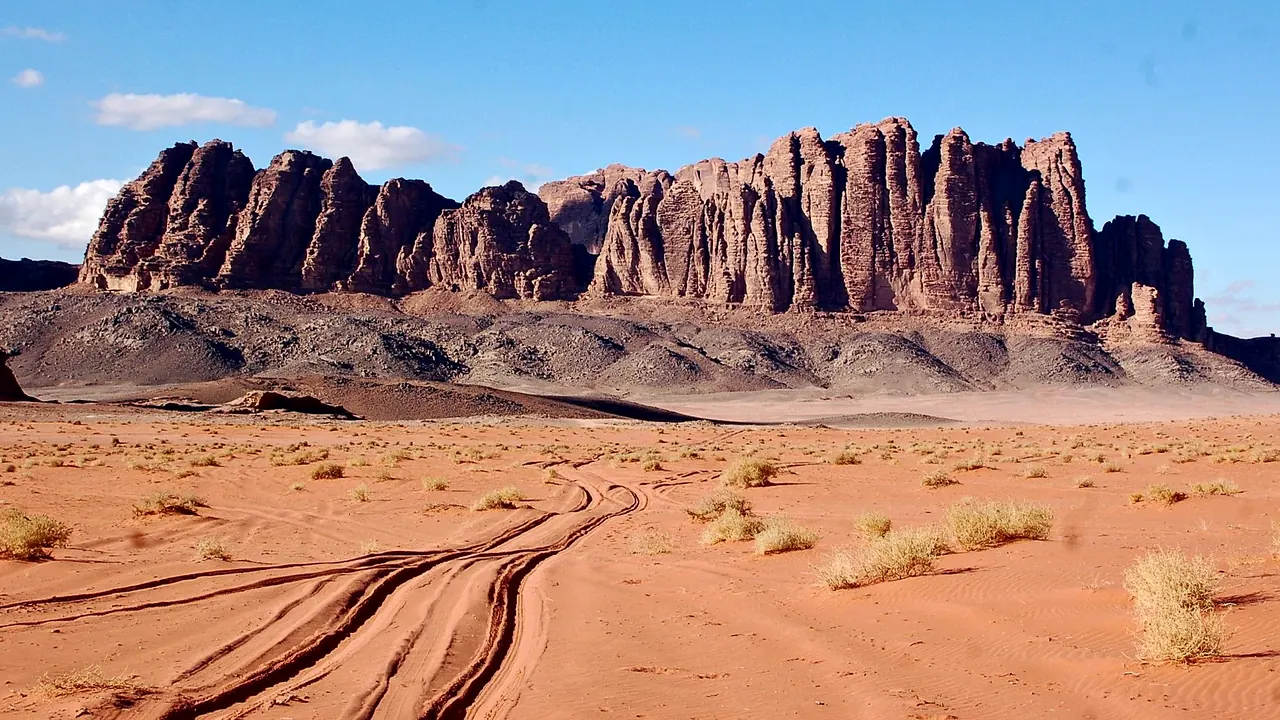
Jebel Rum above the red sand of Wadi Rum
- Nature & outdoors88
- Affordability58
- Day trips55
Photo: twiga-swala, CC BY-SA 2.0, cropped
Match
31
Every category weighted equally
- Beach & sun34
- Culture & arts27
- Food & nightlife22
- Family trip38
- Outdoors44
- Relax & unwind36
- Shopping & style24
- On a budget34
Wadi Rum in twelve categories
Our verdict on each, scored 0 to 100 against the same fixed benchmark cities, so a score means the same thing on every page.
Beaches & swimming. Scores 28 out of 100.
Food & drink. Scores 21 out of 100.
Culture & sights. Scores 25 out of 100.
Nightlife. Scores 3 out of 100.
Nature & outdoors. Scores 88 out of 100.
Day trips. Scores 55 out of 100.
Good for families. Scores 30 out of 100.
Getting around. Scores 22 out of 100.
Shopping & style. Scores 8 out of 100.
Affordability. Scores 58 out of 100.
Live music & performing arts. Scores 7 out of 100.
Wellness & relaxation. Scores 32 out of 100.
Wadi Rum category by category
Beaches & swimming
28Wadi Rum is a desert of sand and sandstone, and there is nowhere to swim in it. The nearest sea is the Red Sea at Aqaba, about an hour's drive south. The water there is warm most of the year, often around 24°C to 27°C, and the coral reefs along the south coast are good for snorkelling straight off the shore.
That makes it a day out or a separate stop on the trip, not part of life in the desert. Visitors who want both usually spend their last nights in Aqaba. In Wadi Rum, the most water you will see is a camp shower or a small hotel pool at one of the larger lodges.
Food & drink
21In Wadi Rum you eat at your camp, as part of the stay. Dinner is usually a buffet around a long table. The centrepiece is zarb, chicken, lamb and vegetables slow-cooked in a pit under the sand and dug up in front of the guests. It comes with rice, salads, hummus and flatbread, and sweet sage tea is poured all day, at camps and on jeep stops.
It is honest, generous cooking, but there is not much range, and Rum village has only a few simple places to eat. Alcohol is limited or absent. Anyone who wants to eat well should plan on Amman or Aqaba.
Culture & sights
25Wadi Rum's heritage is in its rocks. People have passed through this desert for thousands of years and left behind thousands of carvings and inscriptions: camels, hunters and early Arabic scripts. The best known are in Khazali Canyon and at Anfashieh, and they are a large part of why the valley is a UNESCO World Heritage site. Near Rum village there is a small ruined Nabataean temple, and the spring and rock house linked to T.E. Lawrence are regular stops on the tours.
These are worth seeing, but they are short stops on a drive through the landscape. There are no museums or historic buildings to fill a day.
Nightlife
3There is no nightlife here in the usual sense. An evening means dinner at the camp, tea around a fire and, if you walk a little way from the lights, one of the clearest night skies you will find anywhere. Most guests are asleep early, because the sunrise is the best part of the day.
Nature & outdoors
88This is the reason to come. Wadi Rum is a maze of wide valleys floored with red and ochre sand, walled by sandstone and granite mountains that rise sheer for hundreds of metres. In between are natural rock bridges such as Burdah and Um Fruth, narrow siq canyons and high dunes. Most visitors see it from a 4x4 with a Bedouin driver. Slower ways are better: walking, a camel trek over several days, or a dawn balloon flight.
The cliffs are a serious destination for traditional rock climbing, and scrambles such as Jebel Burdah or Jebel Umm ad Dami, Jordan's highest summit, reward fit walkers. The Jordan Trail crosses the desert on its last stretch to the Red Sea, and this is one of its best-known sections. The best months are March to May and September to November. Summer days are fiercely hot, and winter nights drop close to freezing.
Day trips
55The great day out is Petra. The rose-red Nabataean city is about one and a half to two hours' drive north, and many travellers combine the two places on the same trip. A long day there can also take in Little Petra, a smaller carved complex just beyond the main site, and the hill town of Wadi Musa.
The other easy outing is Aqaba, about an hour south. It has a seafront promenade, an Ottoman-era fort and the Red Sea. The Crusader castle at Shobak is just within reach if you leave early. Beyond these, the roads run through empty desert, so this is a short list built around one exceptional site.
Good for families
30For children of school age, a night in a desert camp is an adventure they will remember. They can ride a camel, run down a dune, climb onto a rock bridge and look at the stars. Bedouin hosts are warm with children, and the area feels safe.
But there is nothing actually made for children. Tours mean hours in the back of an open 4x4 over rough sand, and shade, toilets and medical help are scarce. Summer heat and cold winter nights are hard on small children. Most families do best with one or two nights in spring or autumn, as part of a longer Jordan trip.
Getting around
22Reaching Wadi Rum is simple by car on good desert highways, about an hour from Aqaba and under two from Petra. Public buses are few, so most visitors drive, take a taxi or have their camp arrange a transfer.
Inside the protected area, you cannot walk or drive yourself between the sights. They lie far apart across soft sand, and almost everyone is taken around by a local Bedouin driver in a 4x4, which camps arrange as a matter of course. That is easy enough, but it means every outing is a booked tour.
Shopping & style
8There is very little to buy here: a few shops in Rum village and small stalls at the tour stops selling keffiyeh scarves, bottles of layered coloured sand, silver jewellery and Bedouin coffee pots. For proper Jordanian crafts such as embroidery, ceramics and Dead Sea products, it is better to shop in Amman or Aqaba.
Affordability
58You can do Wadi Rum on a modest budget or spend a great deal. A simple Bedouin camp, with a shared tent, dinner and breakfast included, is inexpensive. Entry to the protected area is cheap, and free with the national tourist pass. Jeep tours, climbing guides and camel treks are paid for separately, and a full day adds up. At the top end, the glass-domed luxury camps charge international resort prices.
There is little to spend money on beyond your camp and your tours, so a stay is easy to budget.
Live music & performing arts
7The only live music most visitors hear is in the camps. After dinner, hosts often play the oud or the rababa, a one-stringed fiddle, and sing Bedouin songs by the fire. It is pleasant, but it is put on for guests, and there are no theatres or concert halls anywhere in the area.
Wellness & relaxation
32Wadi Rum has no bathing culture: no hot springs, no hammams, and at most a massage tent at one or two upmarket camps. What it does have is quiet. There is no traffic, no signal in places, long empty horizons, and evenings spent watching the light fade on the cliffs before the stars come out.
For a night or two that silence is restorative in its own right, especially in spring and autumn. Anyone who wants proper spa treatment usually heads to the hotels on the Dead Sea or in Aqaba.
Where to stay in Wadi Rum
Almost everyone sleeps in a desert camp, so you're choosing a kind of camp more than a place. The simple Bedouin camps, set against the cliffs in the open valleys, suit walkers, climbers and anyone on a modest budget. You get a shared tent, dinner from the sand pit and a fire, with a dark sky a few steps away. The glass-domed luxury camps suit couples and families who want a private bathroom and more comfort. They give you the same silence and the same stars. Rum village, under the walls of Jebel Rum, is the practical base for climbers, with local guides and the main routes close by. It is a plain working village, though, and not a pleasant place to linger.
One or two nights is enough for most visitors, and families especially do best with a short stay in spring or autumn. Your camp will arrange the 4x4 transfer in from the road, and from then on every outing is a guided tour, so where you sleep inside the protected area matters less than the season.
Most trips put Wadi Rum between two other bases. Wadi Musa, under two hours north, is where to stay for Petra. Aqaba, about an hour south, is the usual choice for the last nights, with the Red Sea, snorkelling and better food after the desert.
When should you go?
Pick a month to see what it is like. The climate figures are measured averages, not a forecast.
Wadi Rum in July
Daytime high, °C
Rainfall in the month, mm
The whole year
Shaded against this destination’s own year: the deepest cell is its best month for that figure and the palest its weakest.
Where the figures come from
Wadi Rum's temperatures are measured 75 km from the centre, at Ma'An.
Wadi Rum has no rain gauge within 25 km of the centre, so its rainfall comes from a gridded climate dataset read at the destination rather than from a gauge further away.
Temperature and rainfall are climate normals, averaged over the years shown. Wadi Rum: 1991-2020 normals, Ma'An (74.5 km from centre).
Before you go
| Measure | Wadi Rum |
|---|---|
| Official language | Arabic |
| Currency | Jordanian Dinar (JOD) |
| Sockets | BCFGJ230 V, 50 Hz |
| Driving side | Right |
| Time zone | UTC+3 |
| Emergency number | 911 |
| Main airport | King Hussein International Airport (AQJ)5 non-stop destinations |
By the numbers
| Measure | Wadi Rum |
|---|---|
| Swim season, months above 21 °C | 12 months |
Compare Wadi Rum with
Every comparison with a written verdict behind it.