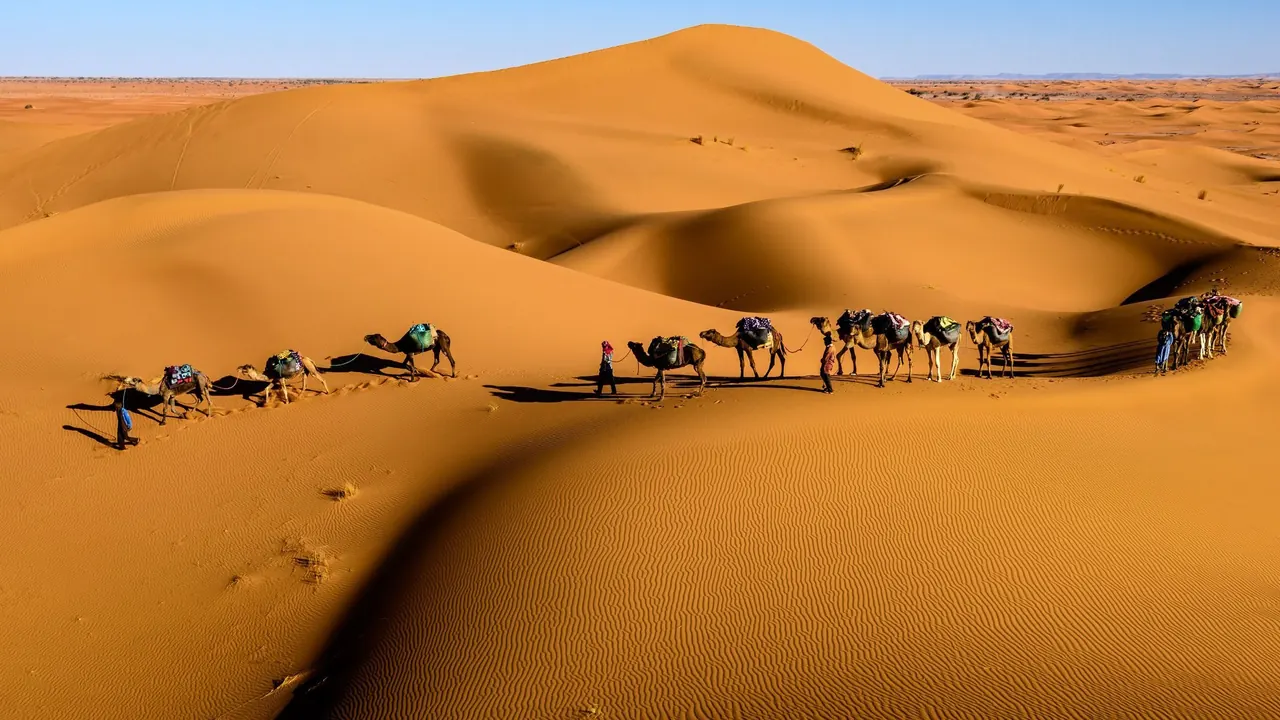
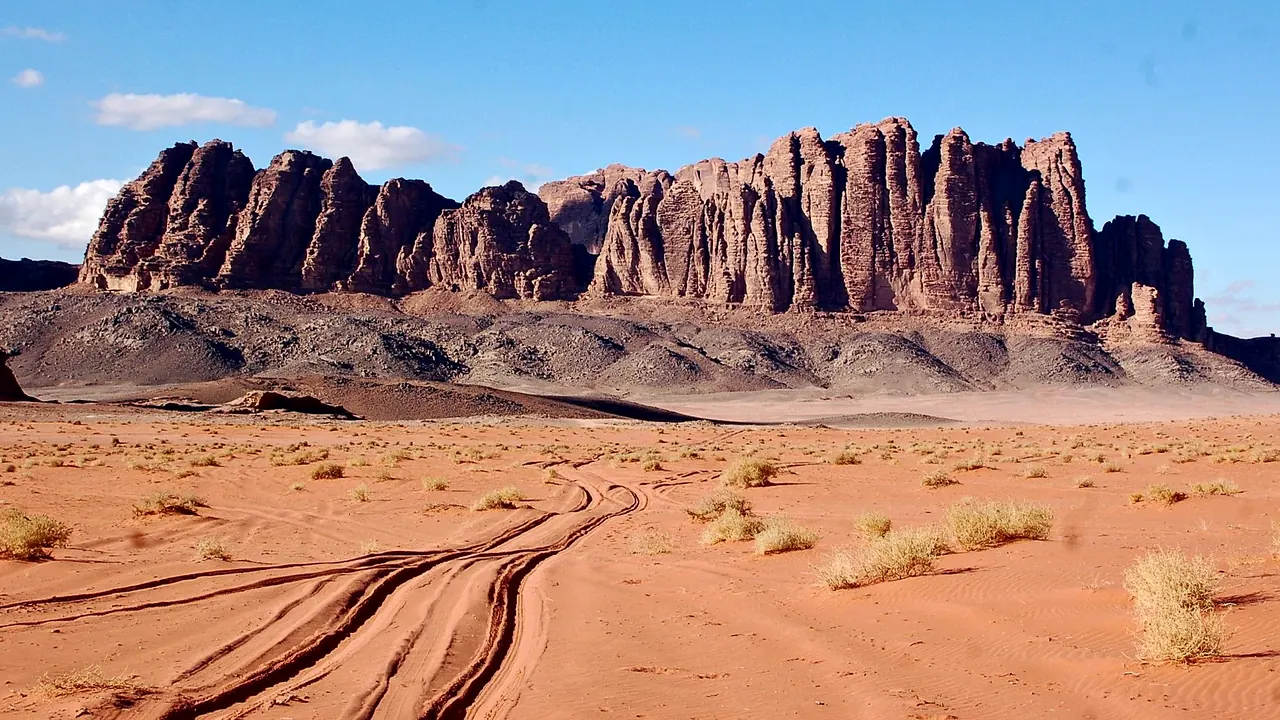
Photos: Sahara by Sergey Pesterev, Pexels License; Wadi Rum by twiga-swala, CC BY-SA 2.0, cropped.
Sahara or Wadi Rum?
Our verdict in twelve categories, each scored against the same fixed benchmark cities, and the climate month by month, so you can choose for your trip.
Choose Sahara for
- culture and sights
- shopping
- live music and the arts
The Moroccan Sahara suits a traveller who wants the desert as a long road journey with plenty to see on the way. The mud-brick ksar of Ait Benhaddou, the kasbahs of Skoura and the fortified villages of the Draa Valley line the route. There are Gnawa musicians at Khamlia, and fossils and Tamegroute pottery to take home. Simple auberges and shared tours keep the cost down. The price is time, because the bases lie long days apart.
Choose Wadi Rum for
- beaches
- day trips
- nature and the outdoors
Wadi Rum is the better pick for a shorter, more concentrated stay inside a wider trip to Jordan. Its sandstone cliffs, rock bridges and climbing routes are as striking as anything in Morocco. Petra is close enough for a day out, and the Red Sea reefs at Aqaba are an hour away, so you get the swim the Sahara cannot offer. What you give up is the chain of villages, crafts and music that fills the Moroccan drive.
Scoreboard
Twelve categories on one fixed scale from 0 to 100. The shaded stretch is the gap between the two.
Your match
Pick a travel style or drag the sliders, and both match scores follow your weighting.
Wins on culture and sights and shopping with your weighting.
Wins on beaches and day trips with your weighting.
What matters to you?
Category by category
What the scores mean for a trip.
Beaches & swimming
Neither is a beach destination, but only Wadi Rum has the sea within reach. Aqaba is about an hour south, with warm Red Sea water and coral reefs right off the shore, and many travellers spend their last nights there.
From the Moroccan Sahara the Atlantic is a full day's drive away across the Atlas. The seasonal lake near Erg Chebbi is for flamingos, not for swimming, so swimming means a kasbah hotel pool. If you want the coast, plan it as a separate stop.
Food & drink
Both feed you mainly at your camp, and in both the meals start to repeat after a few days. The Sahara's table is soup, tagine and mint tea. Its own speciality is madfouna, the stuffed flatbread baked in sand-fired ovens around Rissani and Merzouga, and the souks sell heaps of dates from the Tafilalet and Draa oases.
Wadi Rum's highlight is zarb: meat and vegetables slow-cooked in a pit under the sand and dug up in front of the guests, then served as a buffet with hummus, flatbread and sage tea. It is more of an occasion than a cuisine, and anyone who wants proper restaurants should plan to eat in Aqaba or Amman.
Culture & sights
The Moroccan Sahara has much more built heritage. Ait Benhaddou's mud-brick ksar, the Taourirt kasbah in Ouarzazate, the crumbling kasbahs of Skoura and the fortified villages of the Draa make the drive a tour of earthen architecture in itself. Further on are the caravan ruins of Sijilmassa and the Quranic library at Tamegroute.
Wadi Rum's history is carved into the rock: the inscriptions and drawings of camels and hunters in Khazali Canyon and at Anfashieh, a small Nabataean temple and the sites linked to T.E. Lawrence. They are worth seeing, but they take up an hour or two of a jeep tour, not whole days.
Nightlife
Neither has anywhere to go out after dark, and both turn in early so guests can get up for the sunrise. The only difference is that Ouarzazate, Zagora and Erfoud have a few hotel bars. In Wadi Rum the evening is the camp fire, sweet tea and a very clear sky full of stars.
Nature & outdoors
Both are outstanding desert, but of different kinds. The Sahara is about seas of sand: the tall apricot-coloured dunes of Erg Chebbi, reached by camel at dusk, and the wilder Erg Chigaga beyond M'Hamid. The Todra Gorge, the Dades Valley and winter trekking in the Jebel Saghro add rock and canyon.
Wadi Rum is mountains standing in sand: sheer sandstone and granite walls, rock bridges such as Burdah and Um Fruth, and narrow siq canyons. It is the stronger choice for traditional rock climbing and for summit scrambles such as Jebel Umm ad Dami, and walkers can follow one of the best-known sections of the Jordan Trail.
Day trips
Wadi Rum comes out ahead mostly because of Petra, under two hours' drive north. A long day there can also take in Little Petra, and Aqaba's Ottoman-era fort and seafront are an hour south. Shobak castle is possible if you leave early.
The Sahara's outings are smaller and local: Rissani's souk, the village of Khamlia and the fossil workshops of Erfoud from Merzouga, or Skoura and Telouet from Ouarzazate. Because the bases are a long day's drive apart, most people travel the region as one loop rather than making trips out from a single base.
Good for families
For school-age children both give the same lasting memory: a camel ride, a dune to run down and a night under the stars. In both places the heat, the cold nights and the distance from medical care need planning around.
The difference is how far you have to travel. The Moroccan dunes take at least a full day on mountain roads from Marrakech, while Wadi Rum is an hour from Aqaba, so a night or two there fits more easily into a family trip. Even so, its tours mean hours in the back of an open 4x4.
Getting around
Both mean relying on someone else's vehicle, but for different reasons. In the Sahara the problem is distance: long paved stages from Marrakech over the Tizi n'Tichka pass and on to Merzouga, by tour or hire car. Buses are infrequent, and domestic flights save time but are not frequent either.
Wadi Rum is quick to reach on good desert highways. Inside the protected area, though, you cannot walk or drive yourself between the sights, so every outing is a 4x4 trip with a Bedouin driver, arranged by your camp.
Shopping & style
The Sahara gives you far more to take home. There are fossils and polished fossil stone in Erfoud and Rissani, and dates and spices at Rissani's weekly souk. Tamegroute makes its green-glazed pottery, and the cooperatives along the kasbah route sell rugs and silver jewellery, though the shops where guides earn a commission call for patient bargaining.
Wadi Rum has little beyond keffiyeh scarves, bottles of coloured sand and coffee pots at the tour stops. For proper Jordanian crafts, wait until Amman or Aqaba.
Affordability
The Sahara stays cheaper because its basic costs are low all along the route. A bed, a meal and a seat in a vehicle cost little almost anywhere between Ouarzazate and Merzouga, and sharing transport keeps the long drives affordable. The catch is that so much is sold as a package that it is often hard to see what each part costs. The bill also jumps once you choose a private driver, a 4x4 out to Erg Chigaga or one of the more comfortable dune camps.
In Wadi Rum the costs are structured the other way round. A night in a plain Bedouin camp with meals included is cheap, and so is entry to the protected area. You cannot reach any of the sights without hiring a driver, though, so every day out is a bill of its own. Prices are clearer and there is little else to spend money on, but the upmarket domed camps cost as much as a beach resort.
Live music & performing arts
Music is informal in both places, but the Sahara has more of it, and more with real local roots. Families of Gnawa descent in Khamlia play the guembri and iron castanets, and festivals at M'Hamid and around Merzouga draw on desert and nomad culture. In Wadi Rum the music is the oud and rababa played by the camp fire after dinner, pleasant but put on for guests.
Wellness & relaxation
In both, the main source of rest is the silence. The Sahara adds a little more: simple neighbourhood hammams in Ouarzazate and Zagora, pools and modest spas at the better kasbah hotels in Skoura and the Dades, and Merzouga's old summer cure of burial in hot sand.
Wadi Rum has no hammams or hot springs and at most a massage tent at one or two upmarket camps. Its rest is the quiet of the cliffs at dusk, and people who want spa treatments head on to the Dead Sea or Aqaba.
When should you go?
Pick your month. The climate figures are measured averages, not a forecast.
Sahara in July
Wadi Rum in July
Daytime high, °C
Rainfall in the month, mm
Where the figures come from
Sahara has no weather station within reach, so its figures come from a gridded climate model rather than a measured record, and read a broad area rather than one spot.
Wadi Rum's temperatures are measured 75 km from the centre, at Ma'An.
Wadi Rum has no rain gauge within 25 km of the centre, so its rainfall comes from a gridded climate dataset read at the destination rather than from a gauge further away.
Temperature and rainfall are climate normals, averaged over the years shown. Sahara: 2001-2020 normals, NASA POWER reanalysis grid, no weather station within 90 km. Wadi Rum: 1991-2020 normals, Ma'An (74.5 km from centre).
Both are at their best in spring and autumn, and in neither does rain matter at any time of year. In the Moroccan Sahara, where most visitors stay, summer is much harsher, with July highs around 42°C that rule out almost any activity. The comfortable season runs from October to April. Midwinter days are mild enough for walking and sightseeing, but nights in the dunes fall close to freezing.
Wadi Rum is cooler at its peak, around 35°C in July and August, but that is still too hot for long walks. The months to go are March to May and September to November, and the days are long and sunny all year. Aqaba's Red Sea is the only place to swim. It is warm enough from May, reaches 28°C in August and is at its coolest, about 21°C, in late winter and early spring.
Which traveller are you?
On a beach and sun trip, Wadi Rum is the clear choice. The warm Red Sea at Aqaba, with coral reefs you can snorkel straight from the shore, is about an hour away, so a few desert nights can end on the coast. The Moroccan Sahara is a full day from any sea.
For a culture and arts trip, the Moroccan Sahara offers far more. It has the ksar of Ait Benhaddou, kasbahs through Skoura and the Draa, the caravan ruins of Sijilmassa, the library at Tamegroute and Gnawa music at Khamlia. Wadi Rum's rock carvings make a much shorter stop.
On a tight budget, the Sahara makes your money go further. Simple auberges, guesthouse meals, local buses and shared tours from Marrakech all keep costs low. Wadi Rum's basic camps are cheap too, but the bill climbs once you add jeep tours, guides and camel treks, which are paid for separately.
Before you go
| Measure | Sahara | Wadi Rum |
|---|---|---|
| Official language | Arabic, Standard Moroccan Tamazight | Arabic |
| Currency | Moroccan Dirham (MAD) | Jordanian Dinar (JOD) |
| Sockets | CE50 Hz | BCFGJ230 V, 50 Hz |
| Driving side | Right | Right |
| Time zone | UTC+1 | UTC+3 |
| Emergency number | Police 19/112, ambulance 15, fire 15 | 911 |
| Main airport | Moulay Ali Cherif Airport (ERH)4 non-stop destinations | King Hussein International Airport (AQJ)5 non-stop destinations |
| Public holidays this year | 11 days | - |
By the numbers
| Measure | Sahara | Wadi Rum |
|---|---|---|
| Swim season, months above 21 °C | - | 12 months |
Where else could you go?
Every comparison below shares a destination with this one, so you can follow Sahara or Wadi Rum somewhere new.
- Petravs Wadi Rum
- Dead Seavs Wadi Rum
- Atlas Mountainsvs Sahara
- Marrakechvs Sahara
- Petravs Sahara
- Dubaivs Sahara