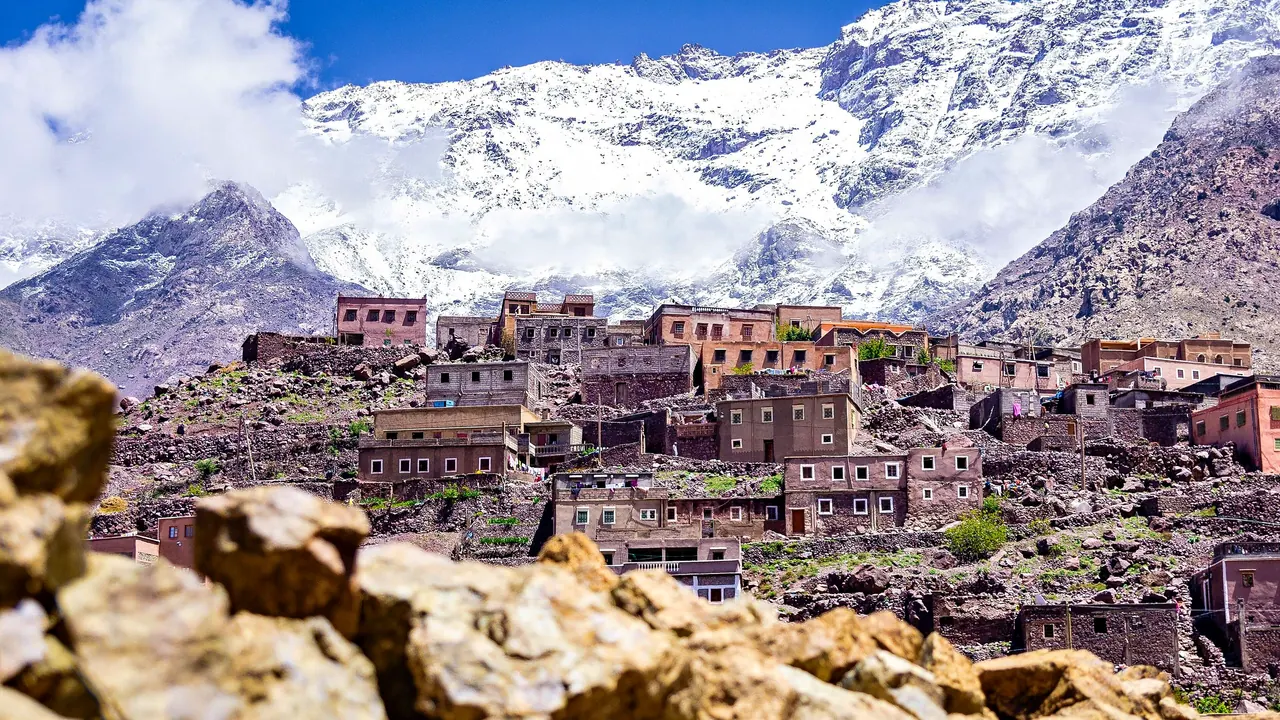
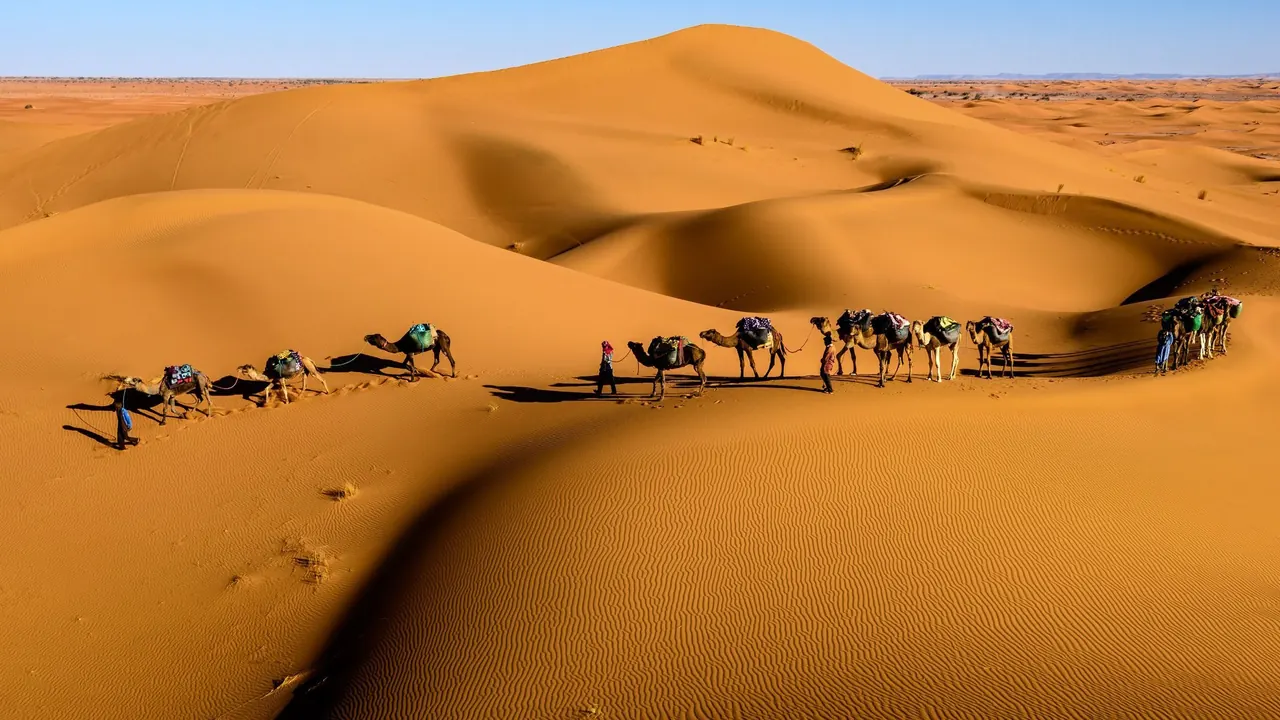
Photos: Atlas Mountains by Yann Macherez, CC BY-SA 4.0, cropped; Sahara by Sergey Pesterev, Pexels License.
Atlas Mountains or Sahara?
Our verdict in twelve categories, each scored against the same fixed benchmark cities, and the climate month by month, so you can choose for your trip.
Choose Atlas Mountains for
- day trips
- prices
- food and drink
Choose the Atlas Mountains if the point of the trip is walking. Toubkal from Imlil, the gentler paths of the Ait Bouguemez valley and the cedar forests of the Middle Atlas make this real trekking country, and guesthouses that include dinner keep it cheap. The range also sits within reach of Marrakech, Fes and Meknes, so it pairs easily with time in a city, and the guesthouse cooking has a little more variety.
Choose Sahara for
- live music and the arts
- culture and sights
- getting around
The Sahara is for travellers who want the dunes themselves: a camel ride into Erg Chebbi at dusk, a night in a tented camp, or the wilder sands of Erg Chigaga beyond M'Hamid. It works as a long loop from Marrakech more than as a base, with little else nearby, so it suits people who accept the driving and come between autumn and spring. Gnawa music in Khamlia and the old caravan country around Rissani give it a slightly stronger cultural thread.
Scoreboard
Twelve categories on one fixed scale from 0 to 100. The shaded stretch is the gap between the two.
Your match
Pick a travel style or drag the sliders, and both match scores follow your weighting.
Wins on day trips and prices with your weighting.
Wins on live music and the arts and culture and sights with your weighting.
What matters to you?
Category by category
What the scores mean for a trip.
Beaches & swimming
Neither has a beach, and both send you to the Atlantic coast for a separate stay. The Atlas does at least offer open water: cold river pools in the valleys and reservoir lakes such as Bin el Ouidane and Lalla Takerkoust. In the Sahara, swimming means a hotel or camp pool, often a small plunge pool, and the seasonal lake that sometimes forms near Erg Chebbi is there for flamingos, not for bathers.
Food & drink
Neither is a trip for eating, but the Atlas feeds you a little better. Guesthouse kitchens turn out charcoal-cooked tagines, Friday couscous, bread from clay ovens, and walnuts and honey from the valleys, and the Anti-Atlas adds argan oil and amlou.
The Sahara's menu is narrower: soup, a tagine, bread and mint tea, night after night in the camps. Its two real treats are madfouna, the stuffed flatbread baked in sand around Rissani and Merzouga, and the dates of the Tafilalet and Draa oases. In both, wine and restaurants worth a detour are scarce.
Culture & sights
The two regions share their best-known sights. Ait Ben Haddou and the Taourirt kasbah in Ouarzazate sit on the southern edge of the mountains, where the Atlas drops towards the desert, so either trip can include them. Both have mud-brick heritage spread over long drives and almost no museums.
The difference lies further out. The Atlas has the painted ceilings of Telouet, the twelfth-century mosque at Tinmel and the communal granaries of the Anti-Atlas. The Sahara adds caravan history: the ruins of Sijilmassa and the ksour around Rissani, the Quranic library and green pottery of Tamegroute, and the fortified villages of the Draa.
Nightlife
There is nothing to go out to in either, and only the setting of a quiet evening differs. In the Atlas it is dinner on a guesthouse terrace and an early night before a dawn start on the trail. In the Sahara it is a fire in the dunes and an early wake for sunrise, with a few hotel bars in Ouarzazate, Zagora and Erfoud as the only alternative.
Nature & outdoors
The Atlas is vertical country and the Sahara is open sand, and each is outstanding on its own terms. In the mountains you can climb Toubkal, the highest peak in North Africa, in two or three days from Imlil, or walk through walnut groves and terraced barley between red-earth villages. Elsewhere there are the Ouzoud falls and the cedar forest and macaques of the Middle Atlas. The heights stay cool in summer, and in winter there is simple skiing at Oukaimeden.
The desert gives you the apricot dunes of Erg Chebbi, the wilder Erg Chigaga that you can only reach by 4x4 or camel, and skies dark enough for serious stargazing. Its season runs from October to April, which is also when Jebel Saghro is good for trekking. The Todra and Dades gorges lie between the two and fit either itinerary.
Day trips
The Atlas has much more to reach from a base. From Imlil, Asni or the Ourika valley, the medina and palaces of Marrakech are around an hour or so away, and from Ifrane or Azrou you can reach Fes, Meknes and the Roman ruins of Volubilis.
The Sahara offers mostly local outings: the Rissani souk, the Gnawa village of Khamlia and the fossil workshops of Erfoud from Merzouga, or Skoura and Tamegroute from Ouarzazate and Zagora. There are no cities within easy reach, so most people drive it as one loop rather than making day trips.
Good for families
Both suit school-age children with a taste for adventure and neither suits toddlers. The Atlas is easier to keep short: a lodge with a pool in the Ourika valley is close to Marrakech, and mule walks, the Ouzoud falls and the Middle Atlas macaques fill the days.
The Sahara has the more memorable single night, with the camel ride, sand slides and a sky full of stars. Getting there takes at least a full day of winding roads, though, and the midday heat and distance from medical care demand more planning.
Getting around
Terrain slows you down in the Atlas, and distance does it in the Sahara. In the mountains the Tizi n'Tichka and Tizi n'Test passes twist for hours, and narrow valley roads can wash out after storms. Winter snow may close the high passes, and the last stage into a village such as Imlil is on foot with a mule.
The desert roads are paved and quiet, but the stages are long, with Merzouga most of another day's drive beyond Ouarzazate. Buses are infrequent and never reach the camps, and the final stretch is by camel or 4x4. Occasional flights to Ouarzazate, Zagora and Errachidia save time. Whichever you choose, you need a car, a driver or a tour.
Shopping & style
Rugs and argan point to the Atlas, and fossils and pottery to the Sahara. The mountains sell hand-knotted and flat-woven rugs from around Taznakht, argan oil and cosmetics from women's cooperatives, and cedar woodwork in the Middle Atlas. The desert has polished fossils from Erfoud and Rissani, the green-glazed pottery of Tamegroute and silver jewellery, though guides often steer you to shops that pay them commission.
Neither has shopping streets of any note. The weekly souks in Asni and Rissani deal mostly in produce and livestock, and that is reason enough to go.
Affordability
The Atlas is the cheaper and more predictable of the two. Village guesthouses include dinner and breakfast, grand taxis cost little, and even a mountain guide with a mule is within a modest budget.
The Sahara can be cheap on shared tours with simple auberges, but almost everything comes as a package, and prices are less transparent. Private 4x4 trips to the far dunes and comfortable camps raise the bill quickly.
Live music & performing arts
The Sahara offers visitors more music to hear. In Khamlia, Gnawa families play guembri and iron castanets, and festivals rooted in nomad culture take place around M'Hamid and Merzouga, while camp evenings end with drumming around the fire.
In the Atlas, music belongs to village life. Ahwash and Ahidous dances happen at weddings and harvests, the Imilchil marriage moussem takes place in late summer, and otherwise there is a guesthouse evening of drums. Neither has a theatre or concert hall.
Wellness & relaxation
Kasbah lodges in the Ourika valley and near Imlil give the Atlas a little more to add to the quiet: hammams, massage and pools, plus yoga and walking retreats in the foothills. Simple wood-fired hammams in the villages ease tired legs after a trek.
The Sahara relies more on stillness, and a dark, silent dune camp offers more of it than any mountain terrace. Beyond that, Ouarzazate and Zagora have plain neighbourhood hammams, and the kasbah hotels of Skoura and the Dades have modest spas. There is also Merzouga's old cure of being buried in hot sand, practised in high summer.
When should you go?
Pick your month. The climate figures are measured averages, not a forecast.
Atlas Mountains in July
Sahara in July
Daytime high, °C
Rainfall in the month, mm
Where the figures come from
Atlas Mountains has no weather station within reach, so its figures come from a gridded climate model rather than a measured record, and read a broad area rather than one spot.
Sahara has no weather station within reach, so its figures come from a gridded climate model rather than a measured record, and read a broad area rather than one spot.
Temperature and rainfall are climate normals, averaged over the years shown. Atlas Mountains: 1991-2020 normals, TerraClimate 4 km grid at the town, no weather station within 90 km. Sahara: 2001-2020 normals, NASA POWER reanalysis grid, no weather station within 90 km.
Around the trekking valleys where most visitors stay, the Atlas is at its best in April and May and again in September and October, when the days are mild enough for long walks. Winter is cold, with highs of about 8°C and snow on the peaks, and March and November bring the most rain. Summer holds up well. Highs stay near 28°C and July is almost completely dry.
The Sahara follows almost the opposite calendar, and there is little rain in any month. October, November, March and April bring warm, dry days for the dunes. December and January are mild by day, but nights in the camps drop close to freezing. June reaches 38°C and July about 42°C, which is too hot for camel treks or sightseeing. That makes the desert a trip for autumn to spring, while the mountains are the better choice in high summer.
Which traveller are you?
On a trip on a tight budget, the Atlas Mountains stretch money further. Trekking guesthouses fold dinner and breakfast into the room, and a guide with a mule is affordable, while desert trips are usually sold as packages whose prices are harder to read.
For an outdoors trip, both are excellent but in different ways. Pick the Atlas for summit days on Toubkal, valley treks and summer coolness. Pick the Sahara for dune nights at Erg Chebbi, sandboarding and winter trekking on Jebel Saghro.
On a culture and arts trip, the Sahara has a slight edge. The ruins of Sijilmassa, the library at Tamegroute and Gnawa families playing guembri in Khamlia add history and music that the mountains, with their village dances, rarely put in front of visitors.
Before you go
| Measure | Atlas Mountains | Sahara |
|---|---|---|
| Official language | Arabic, Standard Moroccan Tamazight | Arabic, Standard Moroccan Tamazight |
| Currency | Moroccan Dirham (MAD) | Moroccan Dirham (MAD) |
| Sockets | CE50 Hz | CE50 Hz |
| Driving side | Right | Right |
| Time zone | UTC+1 | UTC+1 |
| Emergency number | Police 19/112, ambulance 15, fire 15 | Police 19/112, ambulance 15, fire 15 |
| Main airport | Marrakesh Menara Airport (RAK)113 non-stop destinations | Moulay Ali Cherif Airport (ERH)4 non-stop destinations |
| Public holidays this year | 11 days | 11 days |
Where else could you go?
Every comparison below shares a destination with this one, so you can follow Atlas Mountains or Sahara somewhere new.
- Marrakechvs Atlas Mountains
- Marrakechvs Sahara
- Fesvs Atlas Mountains
- Petravs Sahara
- Wadi Rumvs Sahara
- Dubaivs Sahara