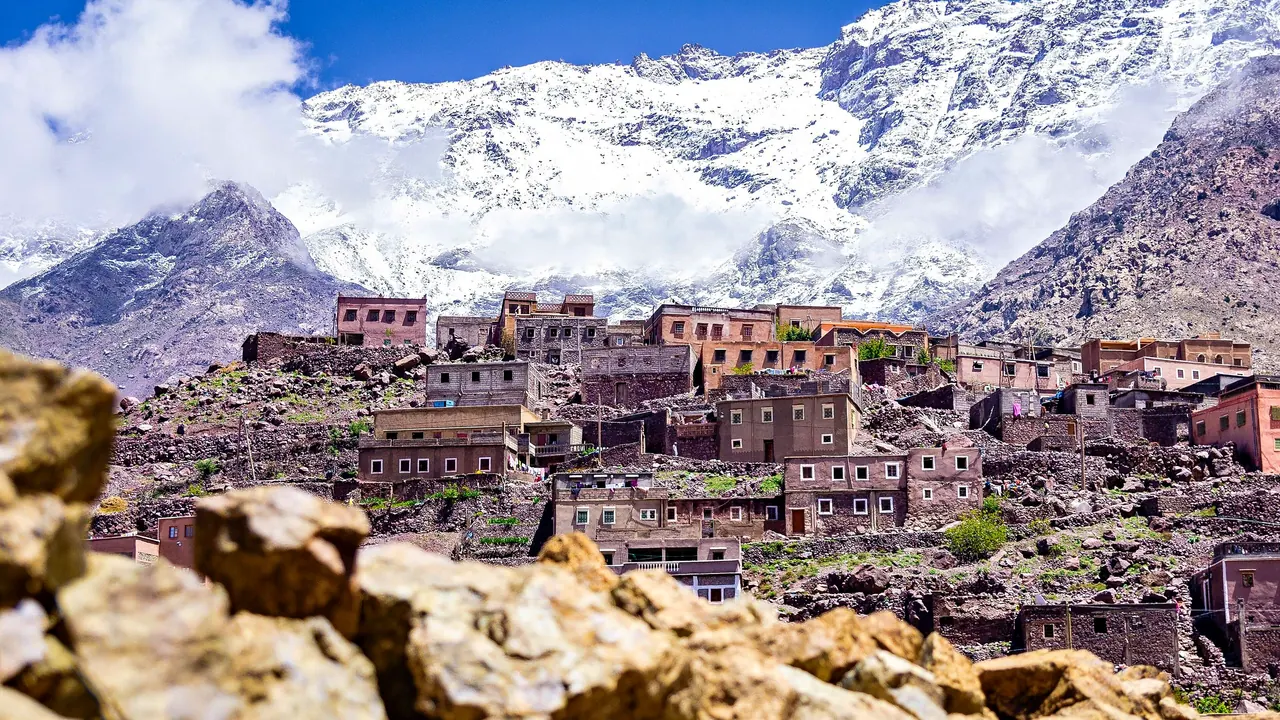
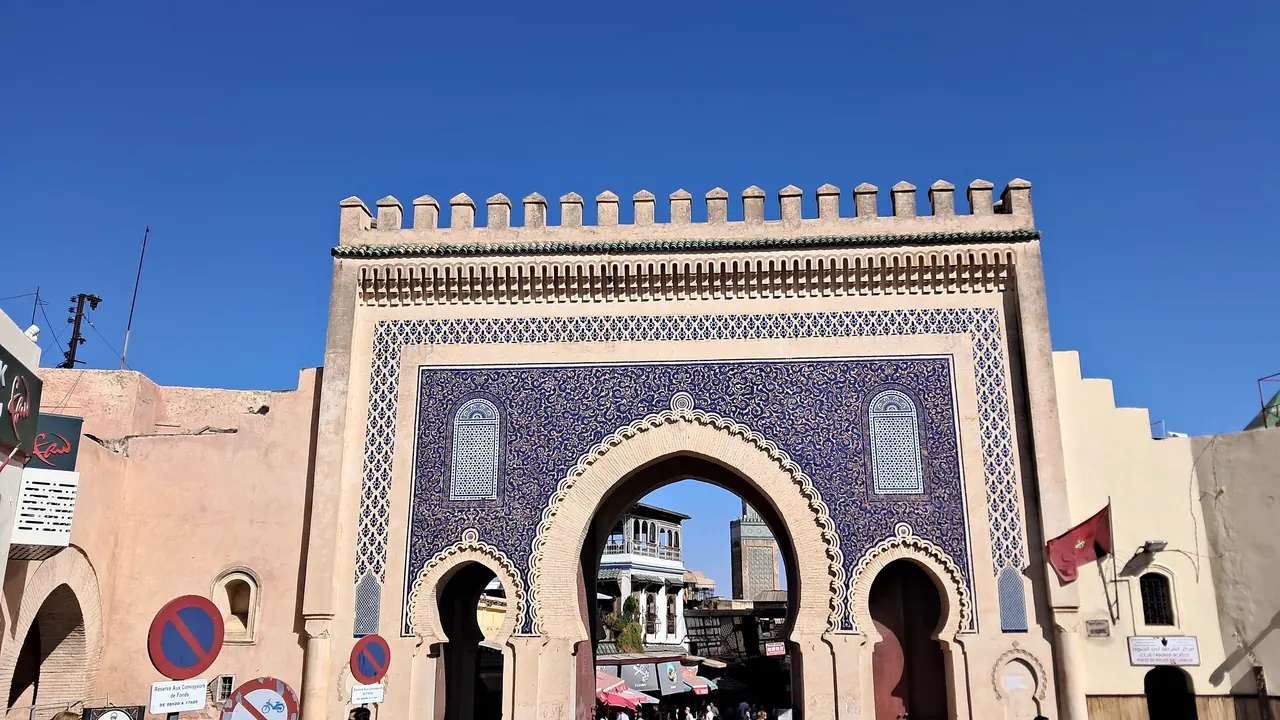
Photos: Atlas Mountains by Yann Macherez, CC BY-SA 4.0, cropped; Fes by Ideophagous, CC BY-SA 4.0, cropped.
Atlas Mountains or Fes?
Our verdict in twelve categories, each scored against the same fixed benchmark cities, and the climate month by month, so you can choose for your trip.
Choose Atlas Mountains for
- nature and the outdoors
- families
- prices
The Atlas Mountains suit walkers and travellers who want a slow trip through mountain country: Toubkal from Imlil, the Dades and Todra gorges, cedar forest around Azrou and nights in village guesthouses. In return you give up variety at the table, any evening life and easy transport. You will need a car or a driver, and long drives separate the sights, so most people pick one side of the range.
Choose Fes for
- culture and sights
- shopping
- food and drink
Choose Fes for a city base built around history and craft. Fes el-Bali, its Marinid madrasas and its workshop lanes fill several days on foot, and at the end of each one there is better cooking, a proper hammam and the comfort of a riad. The countryside is a side trip rather than the reason to come, but the Middle Atlas forests are about an hour away, so you can see some mountains without moving hotel.
Scoreboard
Twelve categories on one fixed scale from 0 to 100. The shaded stretch is the gap between the two.
Your match
Pick a travel style or drag the sliders, and both match scores follow your weighting.
Wins on nature and the outdoors and families with your weighting.
Wins on culture and sights and shopping with your weighting.
What matters to you?
Category by category
What the scores mean for a trip.
Beaches & swimming
Neither is a beach destination, as both lie a long way from the coast. Where they differ is the water you do get. The Atlas has cold river pools in its valleys and reservoir lakes such as Bin el Ouidane and Lalla Takerkoust. In Fes, swimming means a hotel pool or the small plunge pool in a riad courtyard, which is welcome in its hot summers.
Food & drink
Fes eats far better. Its old-city cooking includes pastilla, quince tagines and harira, often served as a long dinner in a riad dining room, and breakfast means bissara and sfenj in the medina lanes. A food lover can spend days exploring it.
In the Atlas you eat well but with little choice: the guesthouse tagine and couscous, walnuts and honey from the valleys, dates on the southern slopes, and much the same dishes again the next night. Wine is scarce in both places, though Fes at least has a few licensed places in the Ville Nouvelle.
Culture & sights
For sights, Fes is in another league. Fes el-Bali is a whole medieval city to explore on foot. The Bou Inania and Al-Attarine madrasas, the Chouara tannery and the Nejjarine fountain are all a short walk from one another.
The Atlas has its own heritage of earth and stone, with Ait Ben Haddou, the painted ceilings of Telouet and the mosque at Tinmel. Each one takes a long mountain drive, though, and the stepped villages are more part of the scenery than sights to tour.
Nightlife
Neither place is for going out, but Fes at least has a few hotel bars and licensed lounges in the Ville Nouvelle. In the Atlas the evening ends with tea on a terrace under a dark, starry sky, and most people are asleep early before a dawn walk.
Nature & outdoors
This is where the Atlas earns its place. Toubkal from Imlil, the walnut groves and terraced valleys, the Ait Bouguemez, the Dades and Todra gorges and the Ouzoud falls are enough for days of trekking. In winter there is simple skiing at Oukaimeden.
Fes has the Middle Atlas close by, with cedar forest and macaques around Azrou and the caves of Tazekka. These are day outings by car rather than a reason to come, though, and in the city itself nature means olive-covered hills and the view from the Marinid tombs.
Day trips
Both have good day trips, and the two overlap: Meknes, Volubilis and Ifrane are within reach of Fes and also of a Middle Atlas base around Azrou. The difference is that Fes is one fixed base, with a train to Meknes. In the Atlas, what you can reach depends on which side of the range you sleep. From the Ourika valley or Imlil it is Marrakech, and from Ouarzazate it is the kasbah route and the edge of the desert.
Good for families
Neither is easy with small children, but the Atlas gives older ones more to do: short walks with a mule, macaques in the cedar forest, the Ouzoud falls and a night in a kasbah. The price is long, twisting roads and basic medical care away from the towns.
Fes asks more of a family. The steep medina lanes are shared with donkeys, touts are persistent, the tannery quarter smells strongly and summer afternoons are very hot. The best way to manage is short outings from a riad with a pool.
Getting around
Fes is much simpler. You walk the medina, porters carry luggage from the gates, petit taxis link the old city with the Ville Nouvelle and the station, and Meknes is on the railway.
The Atlas needs a hired car, a driver or a tour, and crossing the Tizi n'Tichka or Tizi n'Test pass takes hours. Shared grand taxis leave only when full, and winter snow can close the high passes. Once you reach Imlil, everyone goes on foot.
Shopping & style
Fes is a workshop city. Leather, copper, Fassi pottery, zellige and cedar carving are made behind the counters along whole lanes, and you can spend days browsing and bargaining.
The Atlas sells crafts where they are made instead: Berber rugs from around Taznakht, argan oil from women's cooperatives and fossils along the roads near Ouarzazate. Its weekly souks are for livestock and produce, though, and there is nothing like a shopping street.
Affordability
Both are cheap. In the Atlas the guesthouse rate usually includes dinner and breakfast, and a guide with a mule is affordable, so a simple trek costs little. In Fes, street food, petit taxis and entry to the madrasas cost very little, and modest riads give a lot of character for the money.
What pushes the bill up differs. In the mountains it is private drivers and the luxury kasbah lodges. In the city it is the grand restored riads, guides and alcohol.
Live music & performing arts
Fes has a real musical tradition to hear, Andalusian classical and Sufi devotional music. Its Festival of World Sacred Music fills palace gardens once a year, and there are occasional concerts outside it.
In the Atlas, music is part of village life: Ahwash and Ahidous dances at weddings and harvests, the Imilchil moussem in late summer and drumming after a guesthouse dinner. There are no stages at all.
Wellness & relaxation
For hammams and spas, Fes is the better stay. Every medina quarter has a public hammam, many riads run calmer ones of their own, and the hot springs of Moulay Yacoub and Sidi Harazem are close by.
The Atlas offers a different kind of rest: silence, weak mobile signal, days that follow the light and roof terraces above terraced fields. Lodges near Imlil and in the Ourika valley have pools and massage, but the village hammams are basic.
When should you go?
Pick your month. The climate figures are measured averages, not a forecast.
Atlas Mountains in July
Fes in July
Daytime high, °C
Rainfall in the month, mm
Where the figures come from
Atlas Mountains has no weather station within reach, so its figures come from a gridded climate model rather than a measured record, and read a broad area rather than one spot.
Fes's station stands 171 m above the city centre, so the centre is likely a little warmer than the figures say.
Fes has no rain gauge within 25 km of the centre, so its rainfall comes from a gridded climate dataset read at the destination rather than from a gauge further away.
Fes's sunshine is measured 52 km from the centre, at Meknes.
Temperature and rainfall are climate normals, averaged over the years shown. Atlas Mountains: 1991-2020 normals, TerraClimate 4 km grid at the town, no weather station within 90 km. Fes: 1999-2020 (sunshine 1991-2020, rainfall 1991-2020) normals, Fes-Sais (12.4 km from centre).
In the main valleys of the Atlas, where most visitors stay, winter is cold. January days reach only about 8°C and snow covers the high peaks. Spring and autumn are the walking seasons, though March and November bring the most rain. From June to August the mountains are dry, with days around 28°C, pleasant for trekking while the plains below are baking.
Fes is the opposite. Its winters are mild enough for walking the medina, but November and December are the wettest months, with up to 80mm. July and August reach 36°C, which is too hot for afternoons in the lanes, even with long sunny days. March to May and October are the best months in the city. So summer favours the mountains, and winter favours Fes.
Which traveller are you?
For a culture and arts trip, Fes is the clear choice. Fes el-Bali, the Marinid madrasas and the city's Andalusian and Sufi music are all within walking distance. The Atlas spreads its kasbahs and granaries across long drives and has very few museums.
On an outdoors trip, head for the Atlas. Climbing Toubkal from Imlil, trekking in the Ait Bouguemez or walking the Dades and Todra gorges can fill a week. From Fes, the Middle Atlas forests are only a day out by car.
On a shopping trip, Fes wins easily. Leather, copper, Fassi pottery and cedar carving are made and sold in its medina lanes. The Atlas has rugs and argan oil from village cooperatives, but no streets of shops to browse.
Before you go
| Measure | Atlas Mountains | Fes |
|---|---|---|
| Official language | Arabic, Standard Moroccan Tamazight | Arabic, Standard Moroccan Tamazight |
| Currency | Moroccan Dirham (MAD) | Moroccan Dirham (MAD) |
| Sockets | CE50 Hz | CE50 Hz |
| Driving side | Right | Right |
| Time zone | UTC+1 | UTC+1 |
| Emergency number | Police 19/112, ambulance 15, fire 15 | Police 19/112, ambulance 15, fire 15 |
| Elevation | - | 408 m |
| Main airport | Marrakesh Menara Airport (RAK)113 non-stop destinations | Fes Saïss International Airport (FEZ)13 km from centre35 non-stop destinations |
| Public holidays this year | 11 days | 11 days |
By the numbers
| Measure | Atlas Mountains | Fes |
|---|---|---|
| Population | - | 1,167,842 |
| People per km² | - | 3,650 |
| Museums within 10 km | - | 2 |
| UNESCO World Heritage sites within 50 km | - | 2 |
Where else could you go?
Every comparison below shares a destination with this one, so you can follow Atlas Mountains or Fes somewhere new.
- Marrakechvs Atlas Mountains
- Chefchaouenvs Fes
- Rabatvs Fes
- Tangiervs Fes
- Casablancavs Fes
- Saharavs Atlas Mountains