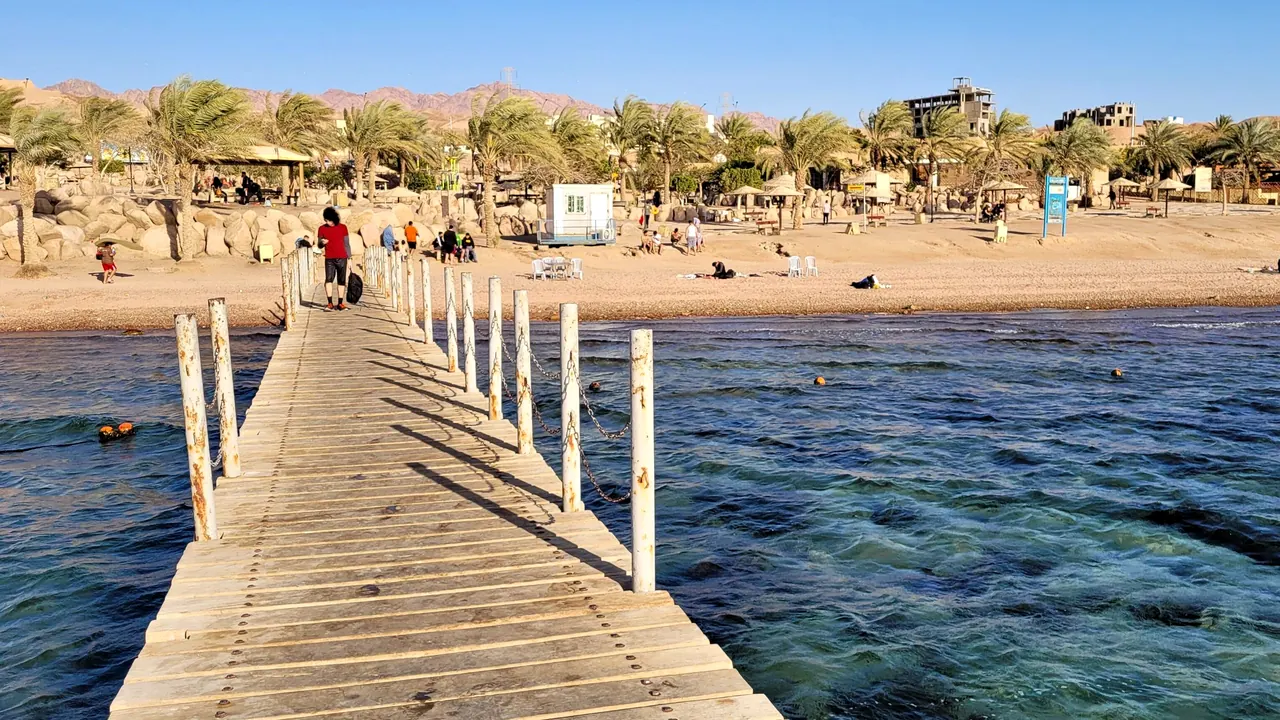
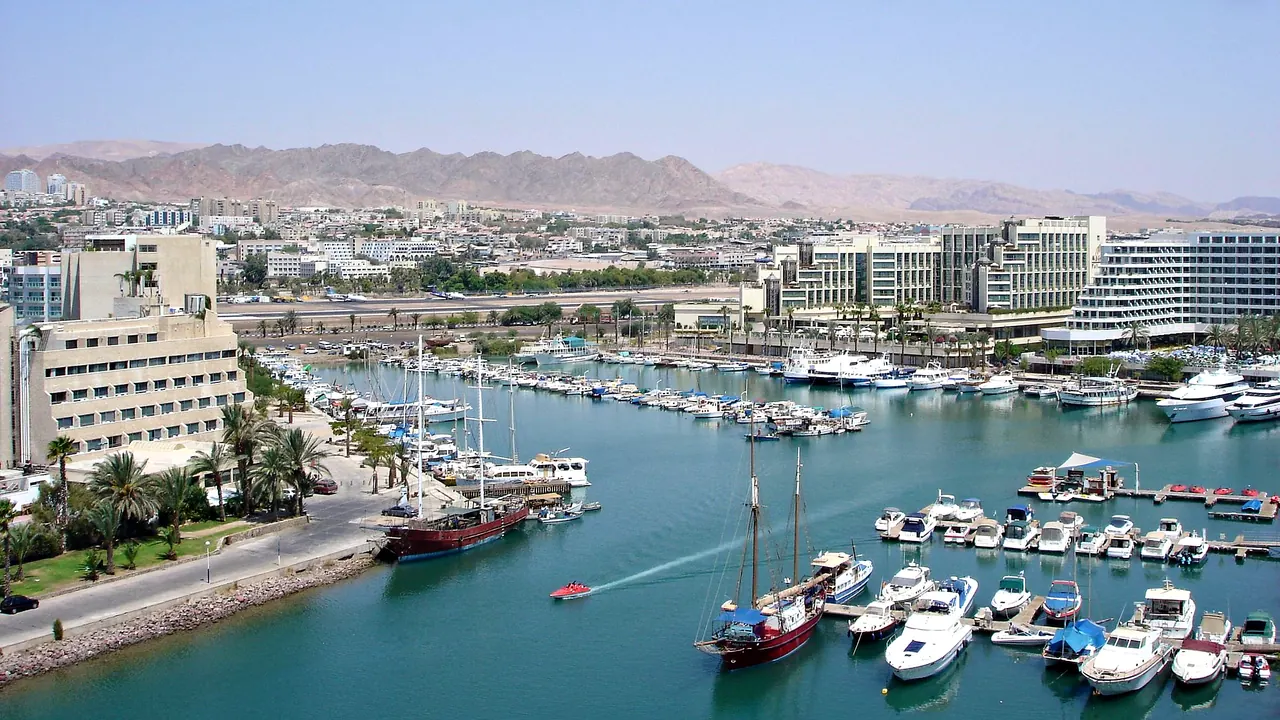
Photos: Aqaba by عباد ديرانية, CC BY-SA 4.0, cropped; Eilat by Tango7000, Public domain.
Aqaba or Eilat?
Our verdict in twelve categories, each scored against the same fixed benchmark cities, and the climate month by month, so you can choose for your trip.
Choose Aqaba for
- prices
- culture and sights
- day trips
Aqaba suits a traveller who wants the Red Sea as a base for Jordan's desert. Petra and Wadi Rum are both within easy reach by road, the reefs off South Beach start a few strokes from shore, and the local side of town, with its falafel, fish restaurants and simple hotels, keeps costs down. Evenings are quiet and the town beaches are conservative, so it suits divers, hikers and people who like an early night better than anyone after a scene.
Choose Eilat for
- nightlife
- getting around
- families
Choose Eilat for an easier, more complete beach resort. The centre around the lagoon and North Beach is compact enough to walk, there is far more to keep children busy, and on busy weekends the promenade fills with bars and late parties. It costs considerably more and has almost nothing historic in town, but for sun, reef and an evening out it is the more polished option.
Scoreboard
Twelve categories on one fixed scale from 0 to 100. The shaded stretch is the gap between the two.
Your match
Pick a travel style or drag the sliders, and both match scores follow your weighting.
Too close to call, 2 points apart
Wins on prices and culture and sights with your weighting.
Wins on nightlife and getting around with your weighting.
What matters to you?
Category by category
What the scores mean for a trip.
Beaches & swimming
Both towns swim in the same warm, clear gulf, with reefs a few steps from shore, so the water itself is equal. Eilat's shore works better as a beach. North Beach has loungers and watersport rentals right in town, and at Coral Beach jetties take you straight out over living coral.
In Aqaba the free town beaches are narrow, coarse and conservative in dress, so most visitors pay to use the resort and beach-club stretches south of town or at Tala Bay. The snorkelling off South Beach is just as rewarding. What Aqaba lacks is the beach life around it.
Food & drink
Neither town is worth the trip for its food, but they eat differently. Aqaba keeps a local Jordanian table: sayadieh, the spiced fish and rice dish, fish chosen by weight near the old town, and hummus breakfasts with cardamom coffee.
Eilat's meals lean on hotel buffets and promenade steakhouses, sushi and pizza, and the better eating is at the hummus counters and skewer grills in the older neighbourhoods. Aqaba gives you a local dish to seek out, while Eilat gives you more international choice.
Culture & sights
Neither is a heritage stop, but Aqaba at least fills a morning. It has the Mamluk fort by the water, the excavated walls of early Islamic Ayla, a small museum and the remains of one of the oldest known purpose-built churches. Eilat is a young town of hotel towers and malls with almost nothing historic to visit. For history it relies on the Timna copper workings or a trip across the border, which in practice means Aqaba and Petra.
Nightlife
Eilat is the one with a night out. On summer weekends and in school breaks the promenade and lagoon fill with bars, pubs and beach parties, and a few clubs keep going past midnight. The music is mainstream pop and dance, though, and midweek in the quieter months it can feel thin.
Aqaba's evenings belong to families walking the corniche and to shisha cafés. Drinking is limited to resort bars, a few diver pubs and the occasional DJ night at a south-coast beach club, and most visitors turn in early before a dive or a desert trip.
Nature & outdoors
Both share the coral and the granite mountains, but Aqaba has the bigger prize inland: Wadi Rum, an hour away, with red sandstone peaks, natural arches and Bedouin camps under very dark skies. Underwater it adds shore dives at the Japanese Garden and wrecks laid down as artificial reefs, one of them a sunken tank.
Eilat's outdoors are close at hand and well organised. It has marked trails through the Red Canyon in the Eilat Mountains, the sandstone formations of Timna half an hour north and some of the world's most easily reached reef diving. Birders have a reason of their own to come, since the spring and autumn migrations pass over the town.
Day trips
Petra is the great outing from both, about two hours away, but from Aqaba it is a simple drive within Jordan, with Little Petra added the same day. From Eilat it means a border crossing and usually an organised tour, which makes for a long day even when the formalities are handled for you.
Eilat's other options are Timna, the Arava kibbutzim and a short hop across to Aqaba's fort and souk, because the empty Negev cuts it off from the rest of Israel. Aqaba has few other outings either, and visitors save the Dead Sea and Amman for a route north.
Good for families
Eilat is built for family vacations in a way Aqaba is not. Besides the calm sea and hotel kids' clubs, children can watch the reef through glass at the underwater observatory with its shark and turtle tanks, see dolphins in their sheltered bay and skate at a mall ice rink.
Aqaba has the same calm, shallow water, glass-bottomed boats and resort pools, and Jordanians welcome children everywhere, including in restaurants late in the evening. Beyond that there is little for them to do, so a night in a Wadi Rum camp often ends up being the highlight for older children.
Getting around
Eilat's hotels, North Beach, the promenade and the malls are all a short walk from each other, and buses and taxis cover the run south to the reef beaches. In Aqaba only the old centre around the fort and markets is walkable, and the resorts and dive sites strung along the coast to Tala Bay mean taxis, shuttles or a hire car. In both towns the desert needs a car or a tour, and for much of the year the midday heat makes walking hard.
Shopping & style
Aqaba's shopping is limited to the old market streets around the centre, which sell spices, dates, Dead Sea mud and salts, and bottles of sand layered into desert scenes. Its tax-free status makes perfume, electronics and alcohol cheaper than elsewhere in Jordan. Still, there is no fashion, and real handwork such as woven rugs or embroidery is hard to find among the mass-produced souvenirs.
Eilat gives a shopper clearly more to do. Its VAT-free malls by the lagoon carry chain fashion, sportswear, electronics and cosmetics, and the promenade stalls sell swimwear and sunglasses. Jewellery set with blue-green Eilat stone makes a local keepsake. Little of it will be new to a visitor from abroad, but it easily fills a hot afternoon, while most people in Aqaba buy a few spices and leave it there.
Affordability
Aqaba is the far cheaper base, at least on its local side. Street food, the town's fish restaurants, taxis and simple central hotels cost little, though the resort strip, dive courses, desert tours and the entrance to Petra push a comfortable beach stay towards Mediterranean resort prices.
Eilat is expensive throughout. Hotels, meals and tours cost more than at typical European resorts, and prices peak during Jewish festivals, school vacations and summer weekends. Midweek stays, self-catering apartments and hummus counters help, and the VAT exemption softens restaurant bills, but Eilat still costs clearly more.
Live music & performing arts
Neither town has a theatre or a concert season, but Eilat offers a little more. It has its long-running jazz festival by the Red Sea, concerts by Israeli performers during the festivals and the summer season, and musicians in the promenade bars. In Aqaba live music means a singer in a hotel lounge, and the performance most visitors remember is Bedouin music around a fire in Wadi Rum.
Wellness & relaxation
Both are places to unwind in the winter sun rather than spa destinations, and the resort hotels in each have spas using Dead Sea mud and salts. The difference is in kind. Aqaba has traditional Turkish baths in town for a simple steam, scrub and massage. In Eilat, how restful it feels depends on when you go: peaceful midweek in the quieter months, noisy when festivals and school vacations fill the town.
When should you go?
Pick your month. The climate figures are measured averages, not a forecast.
Aqaba in July
Eilat in July
Daytime high, °C
Rainfall in the month, mm
Temperature and rainfall are climate normals, averaged over the years shown. Aqaba: 1991-2020 normals, Eilat (5.8 km from centre). Eilat: 1991-2020 normals, Eilat (0.9 km from centre).
The two towns sit a few kilometres apart at the head of the same gulf and share one climate, so the weather never decides between them. Both are almost completely dry, with no month above 4mm of rain, and sunshine is plentiful even in midwinter.
The best stretch is November to April, when days run from about 21°C in midwinter into the high twenties in spring. That is warm enough for the beach and still comfortable for walking, hiking and desert trips, and the sea stays swimmable through the coolest months. From May to October the heat is fierce, with highs of 40°C in July and August, so anything on land has to happen at dawn or dusk. The sea is warmest then, at 28°C in August, which makes summer a vacation spent mostly in the water.
Which traveller are you?
On a trip on a tight budget, Aqaba is the clear choice. Falafel breakfasts, fish meals in the town restaurants, taxis and simple central hotels all cost little, and drinks are cheap in its tax-free zone. Eilat is expensive even before diving or tours.
For a food and nightlife trip, Eilat comes out ahead, though neither town is a strong pick. Its promenade and lagoon fill with bars, clubs and beach parties on summer weekends. Aqaba's evenings mean shisha cafés, a stroll on the corniche and an early night.
On a family trip with children, Eilat is the easier choice. An underwater observatory, a dolphin bay, hotel kids' clubs and a walkable centre keep days simple. Aqaba has calm water and glass-bottomed boats but little else for children apart from a desert camp.
Before you go
| Measure | Aqaba | Eilat |
|---|---|---|
| Official language | Arabic | Hebrew |
| Currency | Jordanian Dinar (JOD) | New Israeli Sheqel (ILS) |
| Sockets | BCFGJ230 V, 50 Hz | CHM230 V, 50 Hz |
| Driving side | Right | Right |
| Time zone | UTC+3 | UTC+2, UTC+3 in summer |
| Emergency number | 911 | Police 100, fire 102 |
| Elevation | 6 m | 16 m |
| Main airport | King Hussein International Airport (AQJ)9 km from centre5 non-stop destinations | Ramon International Airport (ETM)20 km from centre2 non-stop destinations |
By the numbers
| Measure | Aqaba | Eilat |
|---|---|---|
| City population | 140,000 | 51,935 |
| People per km² | 3,733 | 612 |
| Museums within 10 km | 5 | 6 |
| UNESCO World Heritage sites within 50 km | 2 | 2 |
| Swim season, months above 21 °C | 12 months | 12 months |
Where else could you go?
Every comparison below shares a destination with this one, so you can follow Aqaba or Eilat somewhere new.