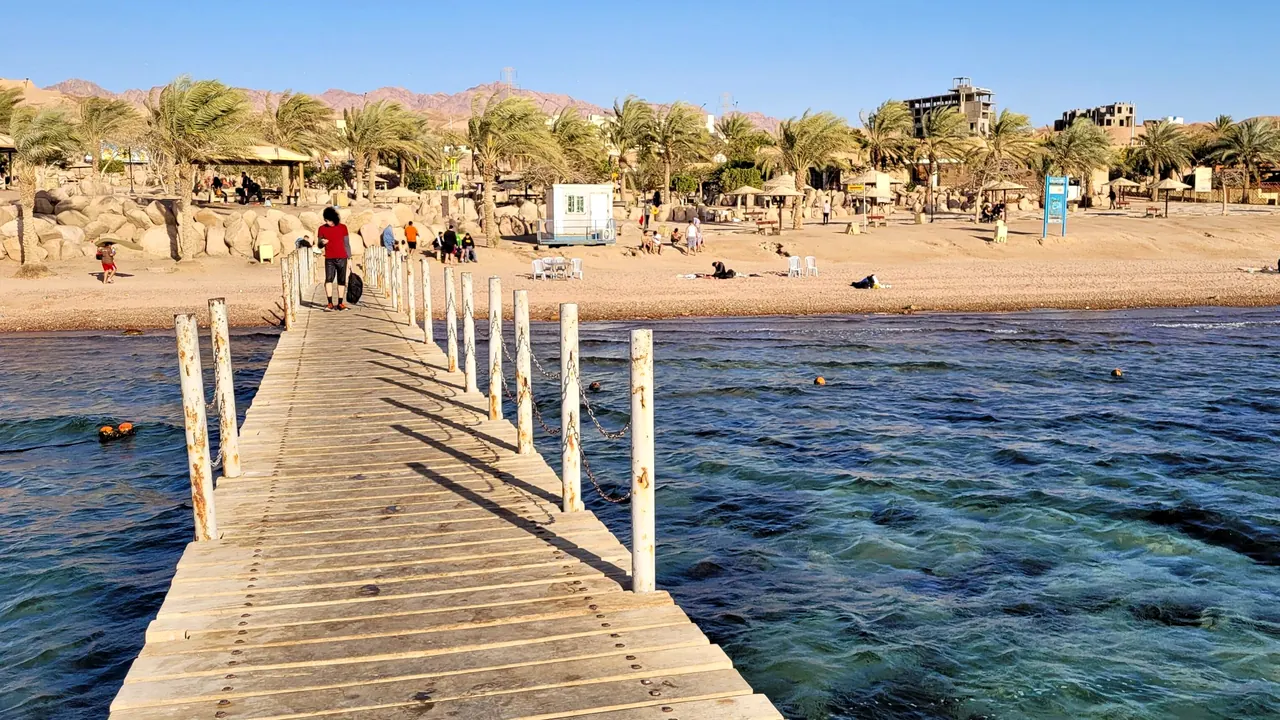
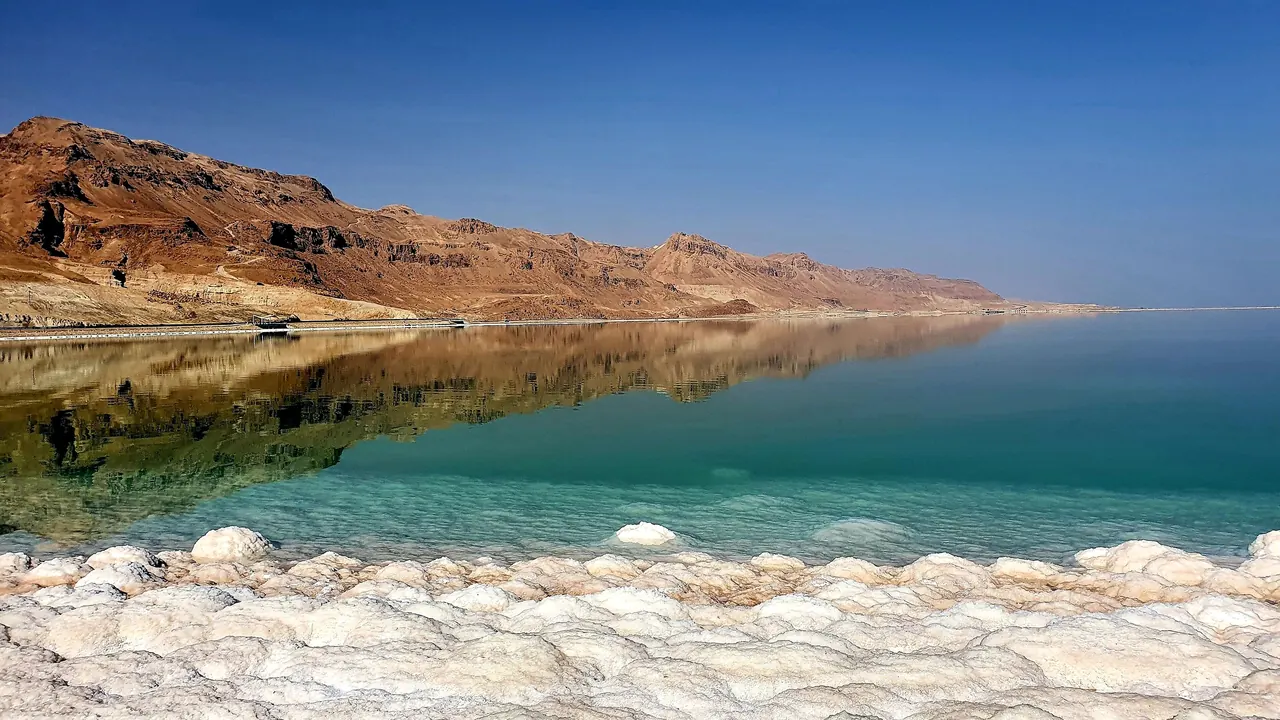
Photos: Aqaba by عباد ديرانية, CC BY-SA 4.0, cropped; Dead Sea by Anagoria, CC BY-SA 4.0, cropped.
Aqaba or Dead Sea?
Our verdict in twelve categories, each scored against the same fixed benchmark cities, and the climate month by month, so you can choose for your trip.
Choose Aqaba for
- prices
- food and drink
- shopping
Aqaba suits travellers who want warm, clear water with coral a few strokes from the shore, a dive or snorkel most days, and Wadi Rum and Petra within reach for the rest of the week. It is the cheaper of the two and has a real town, with fish restaurants and evenings on the corniche. It is also the easier resort week for families.
Choose Dead Sea for
- wellness
- culture and sights
- getting around
The Dead Sea is for a slower, restorative stay built around floating, black mud and mineral pools in the Ein Bokek spa hotels. Masada and the springs of Ein Gedi are the outings, and Jerusalem is an hour or so up the road. You pay more, eat mostly at the hotel buffet and give up ordinary swimming, but nowhere else offers this kind of bathing.
Scoreboard
Twelve categories on one fixed scale from 0 to 100. The shaded stretch is the gap between the two.
Your match
Pick a travel style or drag the sliders, and both match scores follow your weighting.
Wins on prices and food and drink with your weighting.
Wins on wellness and culture and sights with your weighting.
What matters to you?
Category by category
What the scores mean for a trip.
Beaches & swimming
Aqaba gives you a real swim. The Gulf water is clear and calm, and reefs begin a few metres out along South Beach, so a snorkel turns every dip into a reef visit. The sand is the weak point: the town beaches are narrow, busy and conservative in dress, so most visitors use the resort and beach-club stretches towards Tala Bay.
At the Dead Sea you float rather than swim, spending a quarter of an hour on your back before the salt starts to sting, then rinsing under a freshwater shower. The beaches at Ein Bokek are well kept, with shade, lifeguards and a shallow shore, but anyone who wants to swim lengths or snorkel will end up in the pool.
Food & drink
Neither is a place to travel for food, but Aqaba at least has a town to eat in. You can pick your fish by weight near the old town, try sayadieh with spiced rice and onion, and eat falafel breakfasts and shawarma from the counters, and its tax-free status makes drinks cheaper.
At the Dead Sea most meals come with the hotel's half-board: large Israeli breakfast spreads and dinner buffets that are often kosher. There are a few grills in the Ein Bokek malls and kibbutz dining rooms that serve their own dates. Keen eaters save their appetite for a day in Jerusalem.
Culture & sights
Masada gives the Dead Sea the stronger heritage close at hand: Herod's fortress on its desert mesa, the Roman siege ramp below, a museum at the foot and a sunrise climb up the Snake Path. Qumran, where the Dead Sea Scrolls were found, and the ancient synagogue mosaic at Ein Gedi add two more outings.
Aqaba's own sights fill a morning in an otherwise modern town: the Mamluk fort, the low walls of early Islamic Ayla and a small museum. For heritage it relies on Petra, two hours inland.
Nightlife
Both are quiet after dark, but Aqaba has a little more going on. Families walk the corniche, people sit in shisha cafés and eat late, there are pubs for divers, and the south-coast beach clubs hold the odd DJ night in the cooler months. At the Dead Sea an evening means the hotel bar or a stroll along the Ein Bokek promenade, and anyone who wants more drives to Jerusalem.
Nature & outdoors
Aqaba has the edge because it offers two very different landscapes. Under the water there are shore dives and snorkelling at the Japanese Garden and over the wrecks sunk south of town. Inland, the red sandstone and Bedouin camps of Wadi Rum are about an hour away.
The Dead Sea offers one striking setting: pale Judean cliffs above a milky turquoise sea, spring-fed waterfalls and ibex at Ein Gedi, and salt caves at Mount Sodom. It is a place for canyon walks rather than diving, and in summer the heat limits walking to first light in both places.
Day trips
Each has one great day out and little after it, and the difference lies in what that day is. From Aqaba it is Petra, the Nabataean city cut into rose-red cliffs about two hours away, usually with Little Petra added. Eilat and Sinai are close on the map, but the borders make them awkward outings.
From the Dead Sea it is Jerusalem, an hour or so uphill, with the Old City, the Western Wall, the Church of the Holy Sepulchre and the Israel Museum, which can fill two days. Arad, Beersheba and the crater rim at Mitzpe Ramon round out a shorter list.
Good for families
Aqaba is the easier choice with children. It has calm, shallow water at the edges, glass-bottomed boats over the reef and kids' clubs at the resorts, and local custom welcomes children in restaurants late into the evening. A night in a Wadi Rum camp is a highlight for older children.
At the Dead Sea the water itself is the problem, because it hurts badly in eyes and grazes. Young children get only a short float under close watch, and the hotel pool becomes the real playground. The waterfall trail at Ein Gedi and the cable car up Masada are the outings that work.
Getting around
The Dead Sea is simpler to get around. One good road, Route 90, links Ein Bokek, Masada and Ein Gedi within about forty minutes, and in Ein Bokek the hotels, beaches and malls sit along a short, flat promenade. Buses run, but a car or organised tours are what make sightseeing work.
Aqaba's centre is small enough to walk, but the heat makes that hard for much of the year. The resorts, dive sites and Tala Bay are strung along the coast road, which means taxis, shuttles or a hire car, and Petra and Wadi Rum need a tour or a driver.
Shopping & style
Aqaba has a little more to browse: old market streets with spices, dates, Bedouin textiles and sand bottles, plus tax-free electronics, perfume and alcohol, though most of the crafts are mass-produced. The Dead Sea has its cosmetics, meaning mud, salts and creams sold in the Ein Bokek malls and factory shops, and dates from kibbutz shops, and nothing beyond that. Dead Sea products are sold in both places, so there is no need to buy them twice.
Affordability
Aqaba is by far the cheaper base, at least at street level. Falafel, fish meals, taxis and simple hotels in the centre cost little, and drinks are cheaper because the town is tax-free. The resort strip, dive courses and the entrance to Petra still push a comfortable stay up to about what a Mediterranean resort costs.
The Dead Sea is expensive almost everywhere. Hotel rates are high and climb at weekends and Jewish festivals, eating out costs a lot, and the parks at Masada and Ein Gedi charge entry. Kibbutz guesthouses and hostels are the way to spend less, and the free public beaches at Ein Bokek mean the float itself costs little.
Live music & performing arts
Neither has a stage worth planning around, and in both an evening's entertainment means a singer in the hotel lounge. What differs is the one memorable exception: Bedouin music around the fire at a Wadi Rum camp from Aqaba, and the occasional open-air event in the desert by the Dead Sea. For concerts or theatre, Aqaba points you to Amman and the Dead Sea to Jerusalem.
Wellness & relaxation
Wellness is the reason most people go to the Dead Sea. A stay means floating in the mineral water, baking black mud dry on your skin and soaking in warm sulphur pools, and the filtered sun below sea level has long drawn people with psoriasis. The Ein Bokek hotels are built around spas, and Ein Gedi offers a quieter kibbutz version.
Aqaba is restful rather than healing, with simple Turkish baths in town and resort spas that use mud and salt brought from the Dead Sea. Visitors there who want a true bathing cure travel north to the Dead Sea's Jordanian shore and the hot springs of Ma'in.
When should you go?
Pick your month. The climate figures are measured averages, not a forecast.
Aqaba in July
Dead Sea in July
Daytime high, °C
Rainfall in the month, mm
Temperature and rainfall are climate normals, averaged over the years shown. Aqaba: 1991-2020 normals, Eilat (5.8 km from centre). Dead Sea: 1991-2020 normals, Ghor El Safi (21.1 km from centre).
The two share almost the same desert calendar, and both are at their best from October to April. January highs are about 21°C in Aqaba and only slightly warmer at the Dead Sea. The heat builds through May and June, and July and August are fierce in both places. The Dead Sea peaks at 42°C in July, so outings then are for early morning only, and June and September are only a little kinder. Spring and late autumn give the best balance of warm days and comfortable walking.
The difference shows in winter. Aqaba stays almost completely dry and sunny, and its sea never drops much below 21°C, so a winter beach trip works there. By August the water is about 28°C. Around the Ein Bokek hotels, where most Dead Sea visitors stay, winter brings a little rain, up to about 18mm in March, and noticeably fewer hours of sunshine. It is still mild and pleasant, but the sky is less reliably bright than on the Red Sea shore.
Which traveller are you?
For a relaxing and wellness trip, the Dead Sea is the clear choice. Days revolve around floating, mud wraps and heated mineral pools in the Ein Bokek spa hotels while the light changes on the mountains across the water. Aqaba's spas simply borrow Dead Sea mud and salts.
On a beach and sun trip, Aqaba wins because its water is made for swimming: clear, calm, warm all year and with coral a few metres from the shore. The Dead Sea gives a memorable float and hotel loungers, but no real swim.
On a tight budget, Aqaba makes money go much further, with cheap falafel, fish meals, taxis, simple central hotels and tax-free drinks. At the Dead Sea, resort rates and costly meals leave kibbutz guesthouses and hostels as the only real way to save.
Before you go
| Measure | Aqaba | Dead Sea |
|---|---|---|
| Official language | Arabic | Hebrew |
| Currency | Jordanian Dinar (JOD) | New Israeli Sheqel (ILS) |
| Sockets | BCFGJ230 V, 50 Hz | CHM230 V, 50 Hz |
| Driving side | Right | Right |
| Time zone | UTC+3 | UTC+2, UTC+3 in summer |
| Emergency number | 911 | Police 100, fire 102 |
| Elevation | 6 m | - |
| Main airport | King Hussein International Airport (AQJ)9 km from centre5 non-stop destinations | Ben Gurion International Airport (TLV)111 non-stop destinations |
By the numbers
| Measure | Aqaba | Dead Sea |
|---|---|---|
| Population | 140,000 | - |
| People per km² | 3,733 | - |
| Museums within 10 km | 5 | - |
| UNESCO World Heritage sites within 50 km | 2 | - |
| Swim season, months above 21 °C | 12 months | - |
Where else could you go?
Every comparison below shares a destination with this one, so you can follow Aqaba or Dead Sea somewhere new.