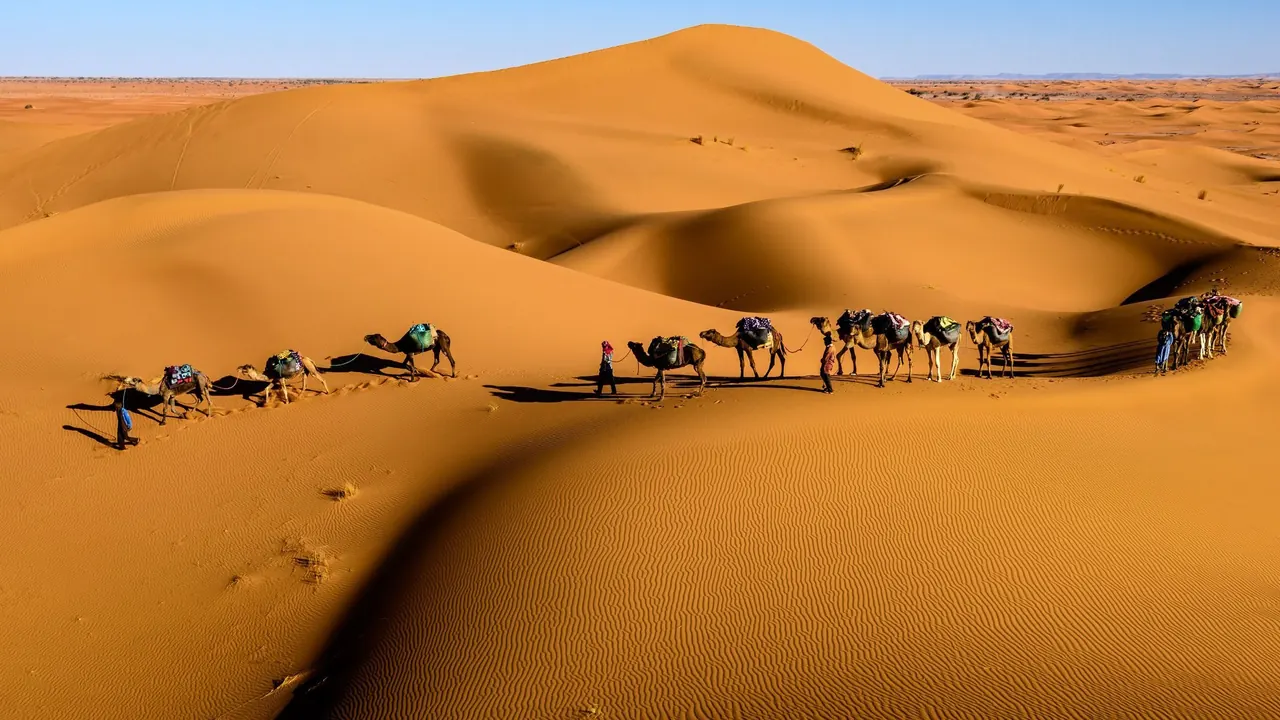
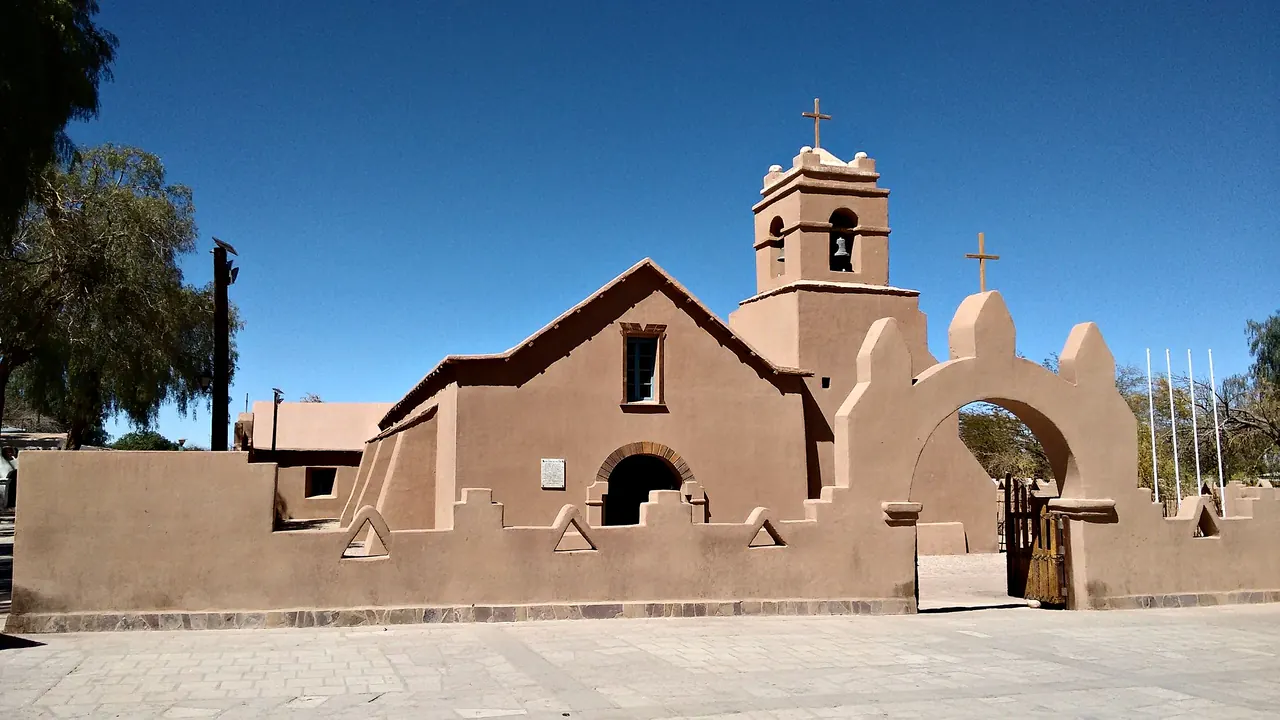
Photos: Sahara by Sergey Pesterev, Pexels License; San Pedro de Atacama by MarcosEscalier, CC BY-SA 4.0, cropped.
Sahara or San Pedro de Atacama?
Our verdict in twelve categories, each scored against the same fixed benchmark cities, and the climate month by month, so you can choose for your trip.
Choose Sahara for
- prices
- culture and sights
- day trips
The Moroccan Sahara suits a traveller who wants a journey rather than a base. You drive a loop through mud-brick ksour, the Draa and Dades valleys and caravan-town souks, and the trip ends with a camel ride into the dunes of Erg Chebbi or Erg Chigaga. It has more heritage, crafts and Gnawa music along the way, it is easier with school-age children, and it costs far less. The trade-off is long days on the road and a season that shuts down in the summer heat.
Choose San Pedro de Atacama for
- wellness
- nature and the outdoors
- beaches
San Pedro de Atacama is the better choice if landscape matters more than anything else. From one small adobe village you reach salt flats, geysers, high lagoons and volcanoes, and the weather is good in every month. Hot springs give you somewhere to recover between excursions. You pay for it, though: the village is expensive, most sights need a tour, and you will spend a lot of time at serious altitude. Apart from the scenery, there is little to do.
Scoreboard
Twelve categories on one fixed scale from 0 to 100. The shaded stretch is the gap between the two.
Your match
Pick a travel style or drag the sliders, and both match scores follow your weighting.
Wins on prices and culture and sights with your weighting.
Wins on wellness and nature and the outdoors with your weighting.
What matters to you?
Category by category
What the scores mean for a trip.
Beaches & swimming
Neither is a place to swim, and the difference is only in what replaces the sea. In the Sahara it is the small plunge pool of a kasbah hotel or desert camp. The Atlantic is a full day's drive over the Atlas, and the seasonal lake near Erg Chebbi is for watching flamingos, not for swimming.
San Pedro has a more unusual option: floating in the dense salt water of Laguna Cejar or the Baltinache pools. It is cold, there is no shade, and an hour is plenty.
Food & drink
In both places food is fuel for the next excursion, and in both the menus start to repeat within a few nights. In the Sahara you eat most meals in camps and guesthouses: harira, tagine and mint tea. The highlights are madfouna baked in sand-fired ovens around Rissani and Merzouga, and the dates of the Tafilalet and Draa oases. Alcohol is hard to find outside hotels.
San Pedro offers more choice along Caracoles. Kitchens there cook with quinoa, llama, goat cheese and rica-rica, and a pisco sour is easy to find. It has no markets or street food, though, so the Sahara's souks are the better place to see local produce.
Culture & sights
The Sahara has far more to see. The hillside ksar of Ait Benhaddou, Ouarzazate's Taourirt kasbah, the crumbling kasbahs of Skoura and the fortified villages of the Draa all show the same earthen tradition. The caravan ruins of Sijilmassa and the Quranic library at Tamegroute add history from the trans-Saharan trade. The drawback is distance: each sight is a brief stop on a long drive, and there are almost no museums.
San Pedro's heritage fits into a half-day bike ride. You can see the adobe church with its cactus-wood ceiling, the hilltop Pukará de Quitor, where the Atacameño people resisted the Spanish, and the round adobe dwellings of Tulor. All three are worth the time, but they are a backdrop to the landscape, not a reason to come.
Nightlife
Neither has a night out in the usual sense. In the Sahara, evenings mean a campfire in the dunes, an early bed and a pre-dawn call for the sunrise, with only a few hotel bars in Ouarzazate or Erfoud. San Pedro is slightly more social: a handful of bars on Caracoles serve pisco sours around fire pits to travellers comparing tours, although the village is quiet before midnight. In both places the dark sky is the main attraction, and in San Pedro an astronomy tour with telescopes is how most people spend an evening.
Nature & outdoors
Both are outstanding desert landscapes, but San Pedro has more variety, closer together. The Valle de la Luna is half an hour away, and flamingos feed on the Salar de Atacama. Higher up are the El Tatio geysers, the Miscanti and Miñiques lagoons beneath volcanoes, and peaks such as Lascar for acclimatised walkers. Clear weather holds all year, and altitude is the only real limit.
The Sahara is the place for a classic sea of sand. Erg Chebbi's dunes reach about 150m, and Erg Chigaga is wilder and more remote. Beyond the sand are the walls of the Todra Gorge and the mule treks of Jebel Saghro. Its season, however, ends with the summer heat.
Day trips
The Sahara has more half-day outings, because each stop on the loop has its own. From Merzouga you can reach Rissani's Sunday or Thursday souk, the Gnawa village of Khamlia and the fossil workshops of Erfoud. Ouarzazate leads to the Skoura palm grove and over the mountains to Telouet, and Zagora is the base for Tamegroute. The bases are a long day's drive apart, so these work as side trips along a route, not as outings from one hotel.
From San Pedro, almost every excursion heads into the landscape, and few places nearby are worth visiting for their own sake. Toconao, an oasis village of white volcanic stone, is a short drive south. The old church at Chiu Chiu and the copper pit at Chuquicamata are about two hours north. Uyuni, across the Bolivian border, takes several days.
Good for families
With school-age children, the Sahara is the easier of the two because its best moments happen close to ground level. Children can ride a camel into Erg Chebbi, slide down the dunes and sleep under the stars, and the film studios at Ouarzazate break up the drive. The difficulties are long mountain roads, fierce midday heat, cold nights and the distance from medical care, so it is no place for toddlers.
San Pedro offers children similar thrills: sandboarding, floating in a salt lagoon and seeing Saturn through a telescope. The main excursions, though, start before dawn and spend hours above 4,000m. At that height altitude sickness and bitter cold are real risks for young children.
Getting around
Both are hard to get around without help, but the effort comes in different forms. The Sahara means moving on almost every day. You cross the Tizi n'Tichka pass and drive long stages between Ouarzazate, Zagora and Merzouga, usually with a hired driver or your own car. Buses are infrequent, and the last stretch to camp is by camel or 4x4.
In San Pedro you unpack once in a village you can cross on foot in ten minutes. Each morning, minibus tours leave from Caracoles, and you can cycle to the Valle de la Luna. Getting there takes about an hour and a half from Calama airport.
Shopping & style
The Sahara has more worth buying, though you have to bargain for it. Look for fossils and polished stone in Erfoud and Rissani, green-glazed pottery in Tamegroute, Berber rugs and silver along the kasbah route, and dates and spices at Rissani's weekly souk. Expect guides to steer you into shops that pay them commission.
San Pedro has one craft market and the shops along Caracoles. They sell alpaca jumpers, woven textiles and lapis lazuli jewellery, much of it the same as elsewhere in the region. A warm layer is the one purchase you will actually use, on the freezing dawn tours.
Affordability
The Sahara costs much less. Simple auberges, guesthouse meals and shared tours from Marrakech keep a trip cheap. Prices only climb with private 4x4s and luxury tented camps, and because most things are sold as packages, compare what is included before you book.
San Pedro is expensive for a village and dearer than most of Chile, because everything is trucked across the desert. Since few sights can be reached without a tour or a car, excursions and park fees take up much of the budget. Set lunches, self-catering and cycling help reduce costs.
Live music & performing arts
The Sahara has more music worth hearing. In Khamlia, near Merzouga, Gnawa families of West African descent sing for visitors and play the guembri and iron castanets. Separately, a few festivals at M'Hamid and around Merzouga celebrate the region's own desert and nomad culture. The drumming and Berber song around the camp fire is pleasant but mostly staged for guests, and there is no theatre or concert hall anywhere.
In San Pedro, live music usually means panpipes and charango in a restaurant on a busy evening. The traditional costumed dances belong to the village's religious festivals, above all the feast of San Pedro and San Pablo and Carnival, so you will only see them if your dates match.
Wellness & relaxation
San Pedro has more to offer. The Termas de Puritama, hot pools stepping down a reed-filled canyon, are half an hour away, and the upmarket lodges add spas, massage and yoga. The catch is the schedule: pre-dawn alarms and thin, dry air wear you out unless you plan some empty days.
In the Sahara, rest comes from silence rather than treatments. Dune camps are completely still. Ouarzazate and Zagora have simple neighbourhood hammams, and a few kasbah hotels in Skoura and the Dades add pools and small spas.
When should you go?
Pick your month. The climate figures are measured averages, not a forecast.
Sahara in July
San Pedro de Atacama in July
Daytime high, °C
Rainfall in the month, mm
Where the figures come from
Sahara has no weather station within reach, so its figures come from a gridded climate model rather than a measured record, and read a broad area rather than one spot.
San Pedro de Atacama has no weather station within reach, so its figures come from a gridded climate model rather than a measured record, and read a broad area rather than one spot.
Temperature and rainfall are climate normals, averaged over the years shown. Sahara: 2001-2020 normals, NASA POWER reanalysis grid, no weather station within 90 km. San Pedro de Atacama: 1991-2020 normals, TerraClimate 4 km grid at the town, no weather station within 90 km.
Around the main desert towns, the Sahara's season runs from October to April. By July the days reach about 42°C and most outdoor activity becomes impossible. In January, daytime highs of about 16°C are good for walking kasbahs and riding camels, but nights in the dune camps drop close to freezing, so pack warm layers. Rain is rarely a factor in any month.
San Pedro barely changes through the year. Daytime highs stay between about 19°C in June and July and 26°C around New Year, and nights are cold all year round. January and February bring the only rain, about 14mm a month, from occasional altiplano storms. The rest of the year is almost completely dry. The two seasons work in opposite directions: the Sahara's ideal winter months fall in San Pedro's slightly stormier summer, and San Pedro's clear mid-year months are when the Sahara is too hot to visit.
Which traveller are you?
On a tight budget, the Sahara is the clear choice. Simple auberges, guesthouse dinners, local buses and shared tours from Marrakech cost little. San Pedro is dearer than most of Chile, and tours and park fees add up fast.
For a culture and arts trip, choose the Sahara. Ait Benhaddou, the Skoura kasbahs, the Sijilmassa ruins and Tamegroute's library and pottery fill a whole route, and Gnawa music plays in Khamlia. San Pedro's church and two ruins take half a day.
For an outdoors trip, San Pedro edges ahead. Lunar valleys, flamingo lagoons, El Tatio's geysers and climbable volcanoes all sit close to one base, and the weather holds all year. The Sahara's dunes and gorges are superb, but they are spread out and closed by summer heat.
Before you go
| Measure | Sahara | San Pedro de Atacama |
|---|---|---|
| Official language | Arabic, Standard Moroccan Tamazight | Spanish |
| Currency | Moroccan Dirham (MAD) | Chilean Peso (CLP) |
| Sockets | CE50 Hz | CL220 V, 50 Hz |
| Driving side | Right | Right |
| Time zone | UTC+1 | UTC-4, UTC-3 in summer |
| Emergency number | Police 19/112, ambulance 15, fire 15 | Police 133/134, ambulance 131, fire 132 |
| Elevation | - | 2,407 m |
| Main airport | Moulay Ali Cherif Airport (ERH)4 non-stop destinations | El Loa Airport (CJC)86 km from centre3 non-stop destinations |
| Public holidays this year | 11 days | 16 days |
By the numbers
| Measure | Sahara | San Pedro de Atacama |
|---|---|---|
| Population | - | 5,347 |
| People per km² | - | 2,325 |
| Museums within 10 km | - | 1 |
| UNESCO World Heritage sites within 50 km | - | 1 |
Where else could you go?
Every comparison below shares a destination with this one, so you can follow Sahara or San Pedro de Atacama somewhere new.
- Saltavs San Pedro de Atacama
- Marrakechvs Sahara
- La Pazvs San Pedro de Atacama
- Mendozavs San Pedro de Atacama
- Cuscovs San Pedro de Atacama
- Vina del Marvs San Pedro de Atacama