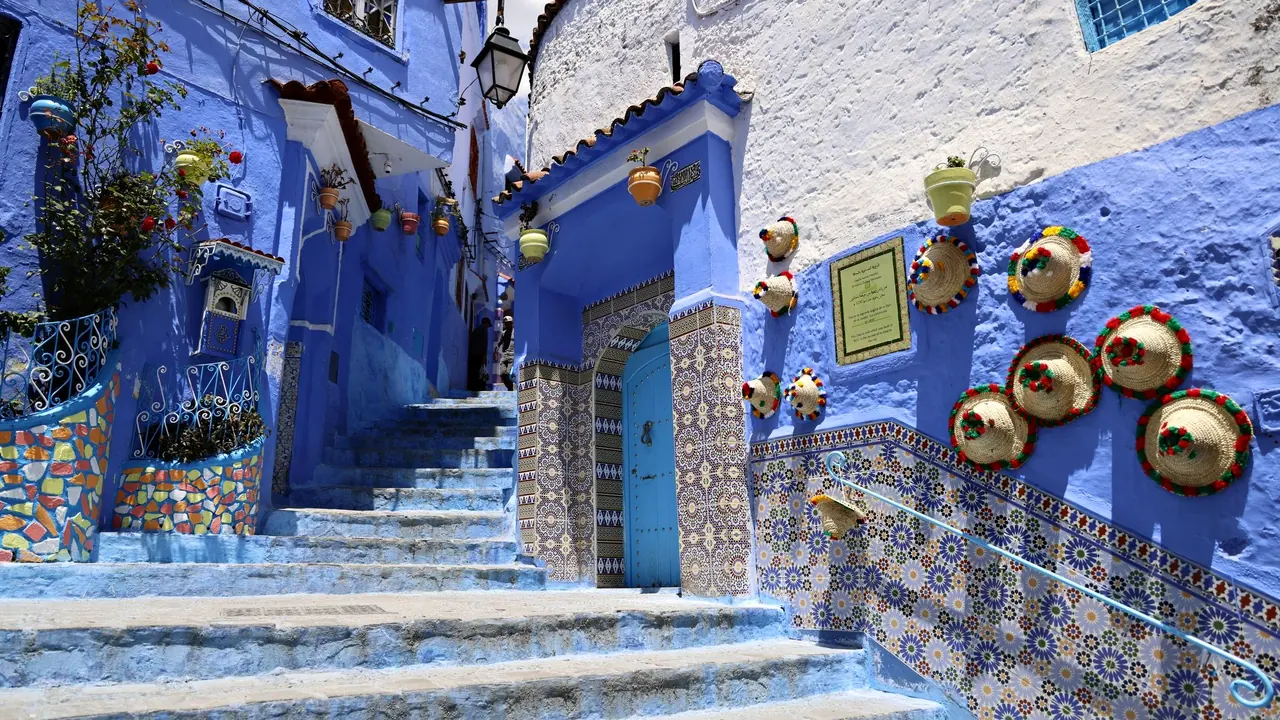
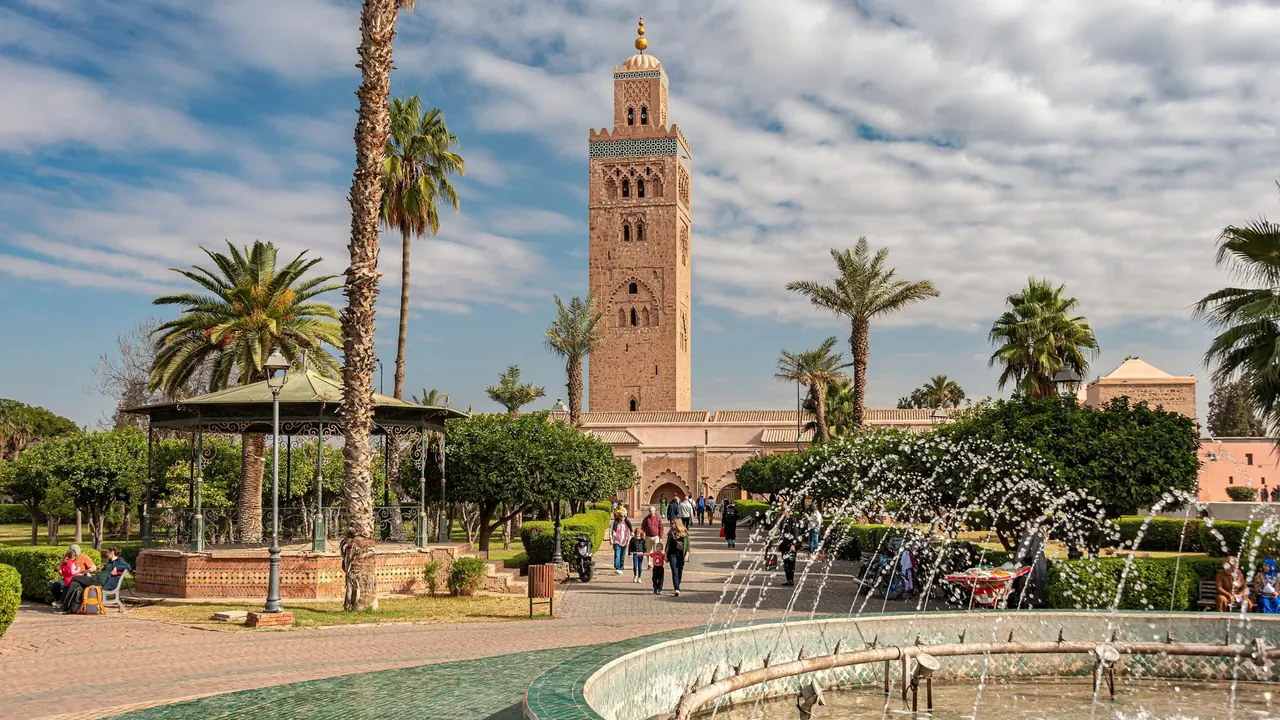
Photos: Chefchaouen by Christophe RASCLE, Pexels License; Marrakech by Jorge Franganillo, CC BY 2.0, cropped.
Chefchaouen or Marrakech?
Our verdict in twelve categories, each scored against the same fixed benchmark cities, and the climate month by month, so you can choose for your trip.
Choose Chefchaouen for
- getting around
- beaches
- prices
Chefchaouen suits a slower, cheaper trip built around walking: a couple of days photographing the blue lanes of the medina, then a guided hike in the Rif or a day at the waterfalls beyond Akchour. It is for travellers who want quiet evenings, cool mountain air and low costs, and who don't mind simple food and no nightlife at all.
Choose Marrakech for
- shopping
- culture and sights
- food and drink
For a city with more depth, go to Marrakech. Its palaces, madrasa and souks fill several full days of sightseeing and shopping. The cooking is richer, the hammam and spa culture is far more developed, and Gueliz and Hivernage offer at least a night out. The crowded medina asks for more patience, but it gives a great deal more back.
Scoreboard
Twelve categories on one fixed scale from 0 to 100. The shaded stretch is the gap between the two.
Your match
Pick a travel style or drag the sliders, and both match scores follow your weighting.
Wins on getting around and beaches with your weighting.
Wins on shopping and culture and sights with your weighting.
What matters to you?
Category by category
What the scores mean for a trip.
Beaches & swimming
Neither is a beach destination, but Chefchaouen at least has the Mediterranean within reach. The long grey-sand beach at Oued Laou is about an hour and a quarter away and the water is warm by late summer. The cold river pools at Akchour are closer to hand.
From Marrakech the nearest real beach is windy, cool Essaouira on the Atlantic, close to three hours away. In practice swimming means a riad plunge pool or a hotel pool, which is worth weighing when you book for the summer heat.
Food & drink
Marrakech eats far better. Tanjia slow-cooked in the embers of a hammam furnace, mechoui lamb from underground ovens and the evening grill stalls of Jemaa el-Fna give it dishes and a street-food scene that Chefchaouen cannot match. Gueliz adds international choice and licensed restaurants.
Chefchaouen's square serves a short, repeated menu of tagines and couscous, so the rewards are small and local: Rif goat cheese wrapped in palm leaf, bissara for breakfast and bread from the communal ovens. Both cities eventually run out of variety, but Chefchaouen does so within a few days.
Culture & sights
Chefchaouen's blue medina is one photogenic sight rather than a list of them. The kasbah on Outa el-Hammam is the only formal visit, and the walk up to the Spanish Mosque at sunset rounds it off. A day or two covers it all.
Marrakech has the monuments for a longer stay: the Koutoubia, the Ben Youssef Madrasa, the Saadian Tombs, the Bahia and El Badi palaces, and the Jardin Majorelle with the Yves Saint Laurent museum. Both medinas are mainly walls and lanes, but only in Marrakech does the walk take in a run of great Islamic buildings.
Nightlife
Chefchaouen goes silent after dinner and mint tea in the square, and alcohol is limited to a couple of hotel bars. Marrakech is no party city either, but Hivernage and Gueliz have lounge bars, rooftop terraces and a few large clubs that stay open late, and Jemaa el-Fna keeps the old town lively well into the evening.
Nature & outdoors
Both are good bases for the outdoors, but on different scales. In Chefchaouen the trails start at the edge of the medina and climb into the Rif. Talassemtane National Park is forty minutes away, with its gorge, the God's Bridge rock arch and cedar forests where Barbary macaques live, though the paths are poorly marked and a guide helps.
Marrakech's landscapes lie an hour or more out of town: the High Atlas valleys of Ourika and Imlil, the two-day climb of Toubkal, winter skiing at Oukaimeden, and the Agafay desert with dawn balloon flights. Marrakech offers more variety and bigger mountains. Chefchaouen lets you walk straight out of your door.
Day trips
Neither town is a strong base for excursions, but they fail in different ways. From Chefchaouen there is a proper city within easy reach: Tetouan, a little over an hour down the road, has an old medina that is white rather than blue, much bigger and almost free of tour groups, with its Spanish-built streets and the beach at Martil to fill the rest of the day. Beyond that there is only quiet Ouezzane, and Tangier and Fes make better next stops than return trips.
Marrakech is the other way round. Its easy outings are rural rather than urban, such as the weekly village markets at Asni and Amizmiz or the Almohad mosque at Tinmel, standing alone in the Nfis valley. The places most people actually want to see, Essaouira on the Atlantic and the kasbahs of Ait Benhaddou, are far enough away to need a night there.
Good for families
Chefchaouen's walled medina has little traffic and a slow pace. In Marrakech the lanes are crowded and shared with motorbikes and donkey carts. That calm makes the blue town the easier stop with children, though its steep, stepped lanes rule out pushchairs and older children will probably enjoy the river pools at Akchour most.
Marrakech has more to keep children busy, from camel rides in the palm grove to the acrobats of Jemaa el-Fna and a water park on the city's edge. Persistent sellers and the summer heat tire families quickly, though, so a riad or hotel with a pool becomes the place to retreat to.
Getting around
Chefchaouen is easier to manage simply because it is small. You can cross the medina on foot in fifteen minutes, though the steep stairs and polished steps are hard going with luggage. The catch is reaching it at all, with no railway and long road journeys from Tangier or Fes.
Marrakech's medina is a maze of unnamed alleys shared with motorbikes and carts. Getting out to Gueliz or Majorelle means agreeing a fare with a petit taxi first or working out a bus network that confuses newcomers.
Shopping & style
Marrakech is one of Morocco's great shopping cities. Its souks are organised by trade, the Mellah has its spice stalls, Gueliz has design boutiques and Sidi Ghanem has decorators' showrooms, though the bargaining can be long and wearing.
Chefchaouen offers a smaller, gentler version: Rif blankets, djellabas, baskets and blue pigment, often sold by weavers working at looms in their shopfronts. The pressure to buy is mild, but the range soon repeats.
Affordability
Both are cheap by European standards, but Chefchaouen is cheaper and easier to keep cheap, because its main pleasure is free and there is little expensive to tempt you. In Marrakech the palaces, food stalls and taxis cost little, but boutique riads, palace hotels, licensed alcohol and high opening prices in the souks can push a budget up quickly.
Live music & performing arts
Marrakech has the only real performance of the two, and it happens outdoors: gnawa musicians, drummers and storytellers in Jemaa el-Fna every evening, plus the Popular Arts Festival. Chefchaouen has occasional Andalusian music around festivals and little else. Neither city has a concert hall or a theatre season.
Wellness & relaxation
Marrakech is the better place to be pampered. There is a public hammam in every quarter, many riads and hotels run spa hammams with argan oil massages and rhassoul clay wraps, and riad courtyards offer an escape from the noisy lanes.
Chefchaouen's hammams are simple neighbourhood steam rooms and polished spa treatments are rare. Even so, the town itself is restful in a way the Marrakech medina never is, with cool mountain air, roof terraces and a slow pace.
When should you go?
Pick your month. The climate figures are measured averages, not a forecast.
Chefchaouen in July
Marrakech in July
Daytime high, °C
Rainfall in the month, mm
Where the figures come from
Chefchaouen has no weather station within reach, so its figures come from a gridded climate model rather than a measured record, and read a broad area rather than the city itself.
Temperature and rainfall are climate normals, averaged over the years shown. Chefchaouen: 2001-2020 normals, NASA POWER reanalysis grid, no weather station within 90 km. Marrakech: 1991-2020 normals, Marrakech (5.1 km from centre).
Chefchaouen has a short, clear best season. May, June and September are dry and warm enough for the lanes and the hill paths. From October to April the rain is heavy, peaking at 141mm in November, and the mountain days turn cool and grey. July and August are dry but hot, around 35°C. This is also when the sea at Oued Laou reaches about 23°C and a beach day is worth making.
Marrakech is dry for most of the year and sunny even in winter, so its comfortable months fall almost the opposite way round. From October to April the days are mild, with winter highs near 19°C that are ideal for long walks through the medina. Summer is harsh, with highs around 38°C that push sightseeing into the early morning and evening. Spring and autumn are the most pleasant time to head into the Atlas.
Which traveller are you?
On a trip on a tight budget, Chefchaouen goes further. Guesthouses cost very little, wandering the blue medina is free, and shared grand taxis reach Akchour cheaply. Marrakech has cheap stalls too, but they sit beside palace hotels and expensive licensed alcohol.
On a shopping trip, Marrakech is the obvious pick. Its souks are arranged lane by lane for leather, metalwork, carpets and spices, and Gueliz and Sidi Ghanem add design boutiques. Chefchaouen's blankets and Rif weavings start repeating after a few streets.
For a culture and arts trip, choose Marrakech. The Ben Youssef Madrasa, the Bahia and El Badi palaces, the Saadian Tombs and Majorelle fill several days, and the gnawa musicians of Jemaa el-Fna add live performance. Chefchaouen's kasbah and blue lanes take a day.
Before you go
| Measure | Chefchaouen | Marrakech |
|---|---|---|
| Official language | Arabic, Standard Moroccan Tamazight | Arabic, Standard Moroccan Tamazight |
| Currency | Moroccan Dirham (MAD) | Moroccan Dirham (MAD) |
| Sockets | CE50 Hz | CE50 Hz |
| Driving side | Right | Right |
| Time zone | UTC+1 | UTC+1 |
| Emergency number | Police 19/112, ambulance 15, fire 15 | Police 19/112, ambulance 15, fire 15 |
| Elevation | 564 m | 465 m |
| Main airport | Tangier Ibn Battuta Airport (TNG)86 km from centre50 non-stop destinations | Marrakesh Menara Airport (RAK)6 km from centre113 non-stop destinations |
| Public holidays this year | 11 days | 11 days |
By the numbers
| Measure | Chefchaouen | Marrakech |
|---|---|---|
| City population | 46,168 | 1,002,697 |
| People per km² | 2,998 | 4,360 |
| Museums within 10 km | 1 | 14 |
| UNESCO World Heritage sites within 50 km | 1 | 1 |
| Swim season, months above 21 °C | 3 months | - |
Where else could you go?
Every comparison below shares a destination with this one, so you can follow Chefchaouen or Marrakech somewhere new.
- Tangiervs Chefchaouen
- Fesvs Chefchaouen
- Essaouiravs Marrakech
- Rabatvs Chefchaouen
- Agadirvs Marrakech
- Casablancavs Marrakech