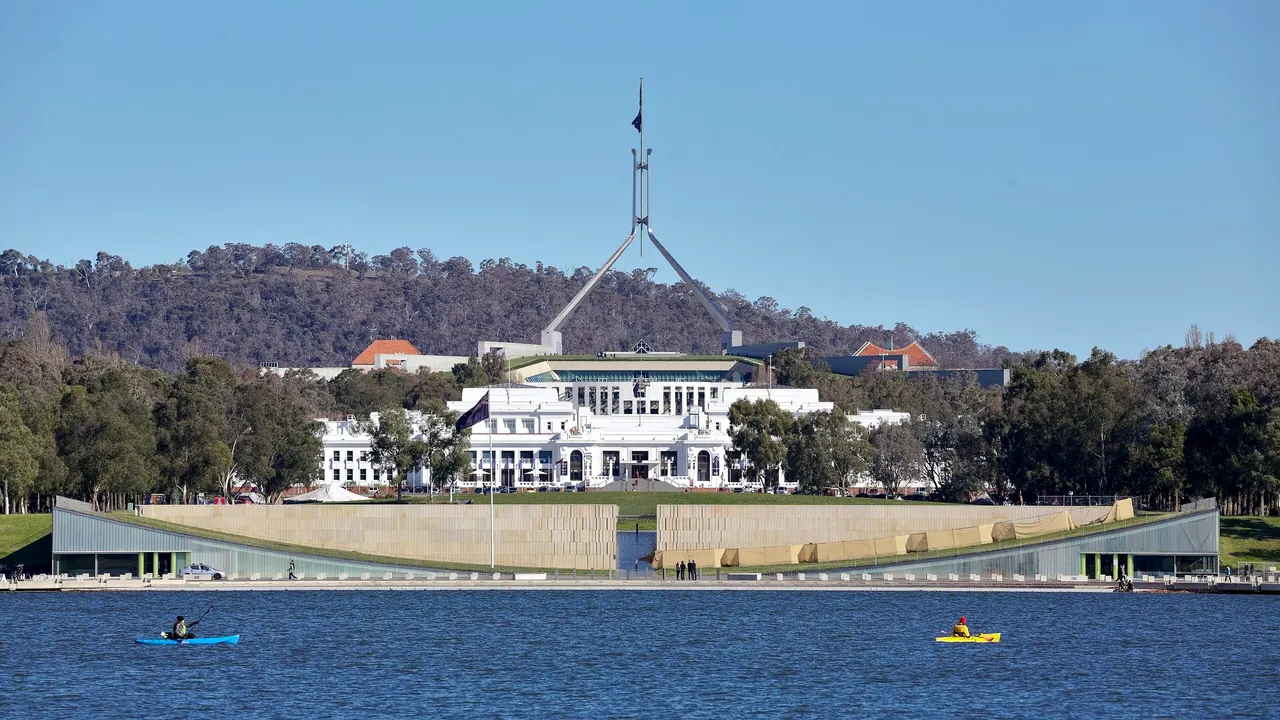
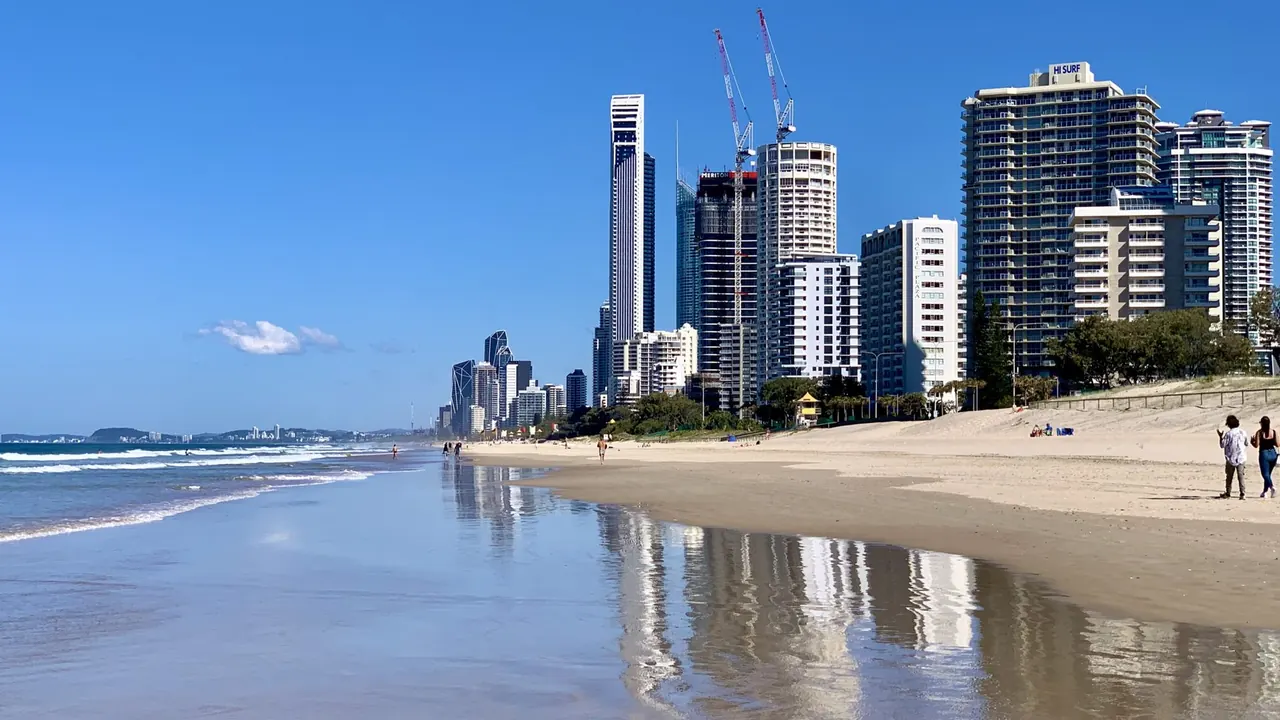
Photos: Canberra by Thennicke, CC BY-SA 4.0, cropped; Gold Coast by Kgbo, CC BY-SA 4.0, cropped.
Canberra or Gold Coast?
Our verdict in twelve categories, each scored against the same fixed benchmark cities, and the climate month by month, so you can choose for your trip.
Choose Canberra for
- culture and sights
- live music and the arts
- prices
Canberra suits a traveller who wants to understand Australia rather than lie in the sun. Parliament House, the War Memorial and the National Gallery's Aboriginal and Torres Strait Islander collection all stand within Griffin's planned landscape around the lake, and the bush hills and cool-climate wineries are close by. It is best for a quiet, unhurried few days, ideally with a car. Bear in mind that it has no coast at all.
Choose Gold Coast for
- beaches
- nightlife
- families
Pick the Gold Coast when the sea is the point of the trip. Patrolled surf beaches run the whole length of the city, the theme parks make it one of the easiest family vacations in the country, and the World Heritage rainforest at Springbrook and Lamington is an hour or so inland. The nights are livelier too. Anyone after museums will find little there and will end up taking the train to Brisbane.
Scoreboard
Twelve categories on one fixed scale from 0 to 100. The shaded stretch is the gap between the two.
Your match
Pick a travel style or drag the sliders, and both match scores follow your weighting.
Wins on culture and sights and live music and the arts with your weighting.
Wins on beaches and nightlife with your weighting.
What matters to you?
Category by category
What the scores mean for a trip.
Beaches & swimming
Canberra is about two hours from the sea, over the Clyde Mountain to Batemans Bay. A swim in town means river spots such as Casuarina Sands or Kambah Pool, which have no lifeguards, and Lake Burley Griffin is often closed by algae after hot weather.
The Gold Coast is the opposite case. A continuous run of golden sand with surf lifesaving clubs stretches from tower-backed Surfers Paradise to the grassy headland at Burleigh and the sheltered points at Rainbow Bay and Greenmount. For calm water, families with small children have the Broadwater and the creek mouths at Tallebudgera and Currumbin.
Food & drink
Neither city is worth travelling to for its food, and both rely on good coffee and weekend brunch. The difference is in kind. Canberra's strength is the cool-climate wine country around Murrumbateman, along with the Asian kitchens on Dickson's Woolley Street and the quieter restaurant strips of Kingston and Manuka. The Gold Coast eats outdoors: prawns, Moreton Bay bugs and fish and chips on the sand, cafés in Burleigh, and craft breweries tucked into the estates behind the beaches.
Culture & sights
Canberra is far ahead here, because holding the nation's institutions is what the city exists for. The Parliamentary Triangle contains Parliament House, Old Parliament House, the National Gallery, the Portrait Gallery and the National Library. The War Memorial stands at the end of Anzac Parade, and Griffin's lake-centred plan is best seen from Mount Ainslie.
The Gold Coast has the HOTA gallery on the Nerang River and the view from SkyPoint, and little else in the way of museums or old buildings. A visitor there who wants a day of culture goes to Brisbane.
Nightlife
The Gold Coast offers much the bigger night out. Cavill Avenue and Orchid Avenue in Surfers Paradise have loud, young clubs that keep going into the small hours. Broadbeach has calmer cocktail and wine bars, and Burleigh and Miami have rooftop terraces and taprooms for a sunset drink.
Canberra's evenings centre on Lonsdale Street in Braddon and the laneways of Civic, with small breweries, pubs and cocktail bars. They end early, especially outside university term and parliamentary sitting weeks.
Nature & outdoors
Both cities have real outdoor appeal, but the Gold Coast's is richer. In Canberra, the bush hills of Black Mountain, Mount Ainslie and Red Hill start at the edge of the suburbs, and kangaroos graze on them at dusk. Namadgi's granite summits above 1,800m offer long hikes, rock art and snow in winter.
The Gold Coast combines the sea with World Heritage subtropical rainforest at Springbrook and Lamington, which has waterfalls, ancient trees and the glow-worm cave at Natural Bridge. Offshore are the famous point breaks at Snapper Rocks and Kirra, and humpback whales pass close to the coast from about June to November.
Day trips
The Gold Coast has the stronger outings because it has real destinations within reach. Brisbane's South Bank and galleries are a train ride away, Byron Bay and its lighthouse are an hour's drive south, and Tamborine Mountain combines a village of galleries with small distilleries. From Canberra, a day out is a quieter country drive to the cellar doors of the Yass Valley, gold-rush Braidwood or the Victorian streets of Goulburn. These are pleasant if you have a car, but none is a reason to plan a trip around.
Good for families
Canberra is a calm, safe city for children. Questacon can fill a whole day, Tidbinbilla has kangaroos and emus along short walks, and the playground at the Arboretum comes with wide views. It has no beach or theme park, though, and a car makes days much simpler.
The Gold Coast caters for children on a different scale. Dreamworld, Movie World, Sea World and two water parks are all in the north, children can meet koalas at Currumbin, and there are patrolled beaches and pool resorts everywhere. The parks are spread out, so it pays to plan one big day at a time.
Getting around
Canberra's sights sit apart on wide landscaped avenues around the lake. Civic, Braddon and the Parliamentary Triangle are each easy on foot, but linking them is a long walk in summer heat or winter wind. The light rail only comes into Civic from the north, buses thin out in the evenings and at weekends, and the off-road bike paths around the water are the pleasant way across.
On the Gold Coast it is simpler if you stay on the coastal strip. The G:link light rail runs through Southport, Surfers Paradise and Broadbeach and meets the Brisbane train at Helensvale, and the beachfront is flat and easy to walk or cycle. The rainforest inland and the towns over the border still need a hire car, just as Namadgi and the wineries do from Canberra.
Shopping & style
Canberra's best buys come from the Old Bus Depot Markets in Kingston on a Sunday morning, where local makers sell crafts and jewellery. The national museum and gallery shops are also good for Aboriginal art prints and Australian design. Beyond those, there is the Canberra Centre mall and a few independent shops in Braddon.
The Gold Coast gives a shopper more to get round. Surf labels and board shops run the length of the coast, Harbour Town sells discounted brands and Pacific Fair has the big chains. The night markets at Surfers Paradise and Coolangatta and the weekend market at Carrara add stalls, though neither city has a luxury street.
Affordability
Both cities charge full Australian prices for meals, drinks and taxis, so the difference lies in where you can save. In Canberra the savings come from the free national institutions and hotel rooms that get cheaper at weekends. On the Gold Coast they come from self-catering apartments and free beaches, but theme-park tickets add up quickly for a family.
Live music & performing arts
Both have a modest stage life, and many major tours skip them both. Canberra has a symphony orchestra season, partly in Llewellyn Hall, touring shows at the Canberra Theatre Centre, and the National Folk Festival at Easter as the high point of its year. On the Gold Coast, live music happens in pubs, surf clubs and brewery venues, with HOTA's outdoor stage and festival weekends such as Blues on Broadbeach. For opera or orchestral concerts, people go to Brisbane.
Wellness & relaxation
The Gold Coast gives you more to build a restful trip around. It has resort day spas in Main Beach and Broadbeach, health retreats in the rainforest around Tamborine Mountain and Currumbin Valley, and slow southern suburbs with dawn yoga on the grass. Canberra's restorative quality is simply its quiet, with calm mornings by the lake and early evenings, but it has only a few spas.
When should you go?
Pick your month. The climate figures are measured averages, not a forecast.
Canberra in July
Gold Coast in July
Daytime high, °C
Rainfall in the month, mm
Where the figures come from
Gold Coast's sunshine is measured 75 km from the centre, at Brisbane Airport.
Temperature and rainfall are climate normals, averaged over the years shown. Canberra: 1991-2020 normals, Canberra (6.7 km from centre). Gold Coast: 1991-2020 normals, Gold Coast Seaway (13 km from centre).
Canberra has four real seasons. January reaches about 30°C and has long, sunny days. That suits a river swim but makes the walks between the national institutions hard work. July highs of around 12°C and frosty mornings make winter brisk but clear. Autumn, from March to April, and spring, from October to November, are the most comfortable times for walking the city and the hills. Rain is moderate in every month.
The Gold Coast stays warm all year. Summer is the wet season, with about 200mm of rain in January, and the sea is warmest at 27°C in February. Winter brings drier, sunny days in the low twenties and a sea of around 21°C, which most people still find fine for swimming. The dry, bright stretch from July to October is the best time to combine the beach with rainforest walks. Late summer is best for warm water if you don't mind the downpours.
Which traveller are you?
On a beach and sun trip, the Gold Coast wins outright. Its golden sand runs from Main Beach to Coolangatta, with flagged, patrolled swimming and a sea warm enough all year. Canberra offers only river banks, and algae often closes its lake.
For a culture and arts trip, Canberra is the clear choice. Parliament House, the War Memorial, the National Gallery and the National Museum are all grouped around the lake, and most of them are free. The Gold Coast has one main gallery at HOTA and very little heritage.
On a food and nightlife trip, the Gold Coast comes out ahead. Meals are of a similar standard in both cities, but Surfers Paradise has clubs that run into the small hours and Burleigh has sunset bars. Canberra winds down after a quiet drink in Braddon.
Before you go
| Measure | Canberra | Gold Coast |
|---|---|---|
| Official language | English | English |
| Currency | Australian Dollar (AUD) | Australian Dollar (AUD) |
| Sockets | I230 V, 50 Hz | I230 V, 50 Hz |
| Driving side | Left | Left |
| Time zone | UTC+10, UTC+11 in summer | UTC+10 |
| Emergency number | 000 | 000 |
| Elevation | 578 m | 12 m |
| Main airport | Canberra Airport (CBR)6 km from centre11 non-stop destinations | Gold Coast Airport (OOL)20 km from centre19 non-stop destinations |
| Public holidays this year | 13 days | 11 days |
By the numbers
| Measure | Canberra | Gold Coast |
|---|---|---|
| City population | 381,488 | 607,665 |
| People per km² | 809 | 433 |
| Museums within 10 km | 20 | 2 |
| UNESCO World Heritage sites within 50 km | 0 | 1 |
| Swim season, months above 21 °C | - | 12 months |
Where else could you go?
Every comparison below shares a destination with this one, so you can follow Canberra or Gold Coast somewhere new.
- Brisbanevs Gold Coast
- Byron Bayvs Gold Coast
- Noosavs Gold Coast
- Sydneyvs Canberra
- Melbournevs Canberra
- Sydneyvs Gold Coast