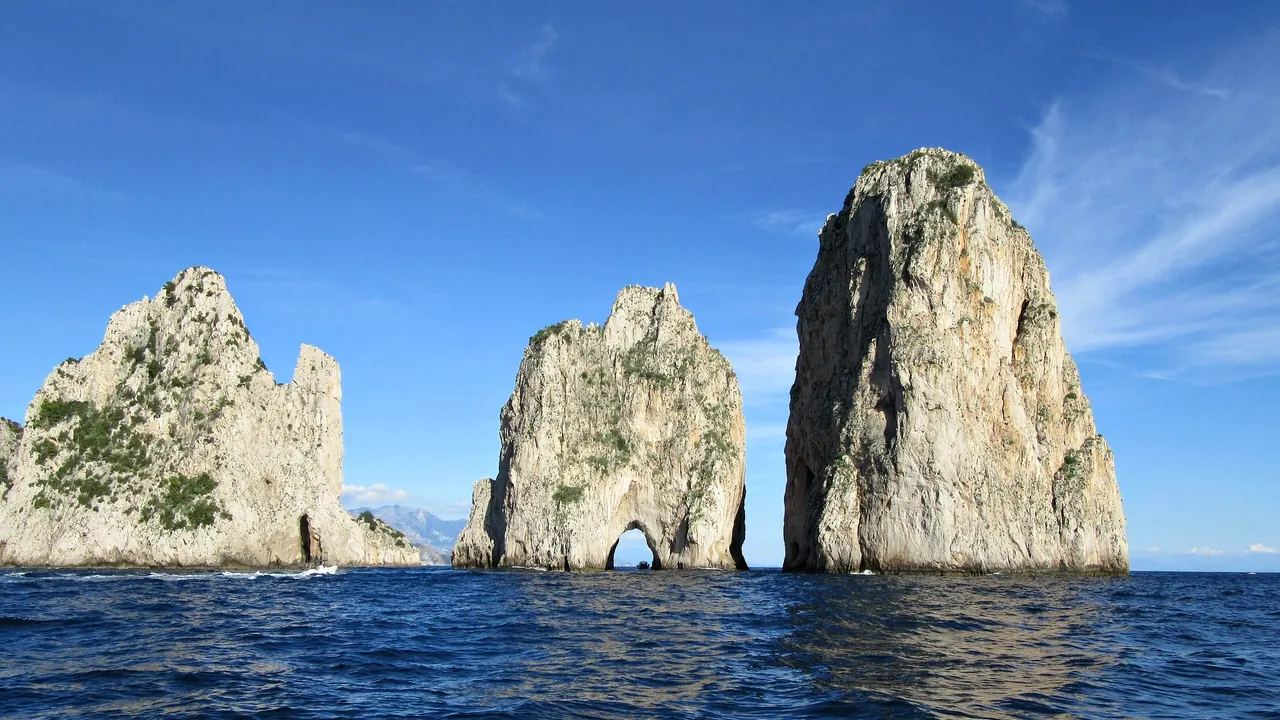
Photos: Capri by Sheeba Samuel, CC BY-SA 4.0, cropped.
Capri or Corsica?
Our verdict in twelve categories, each scored against the same fixed benchmark cities, and the climate month by month, so you can choose for your trip.
Choose Capri for
- shopping
- getting around
- day trips
Capri suits a short, polished stay in which everything is within reach of the Piazzetta: dressed-up evenings, luxury boutiques, clifftop walks and a boat round the island, with Naples, Sorrento and the Amalfi Coast a ferry ride away. You give up wide sandy beaches and any sense of space, and you pay heavily for the privilege, but you never need a car.
Choose Corsica for
- families
- nature and the outdoors
- beaches
Corsica is the better choice for a longer trip built around beaches and mountains. Its southern coves of pale sand, the high granite interior and the walking, diving and canyoning go far beyond anything on Capri, and families with young children will find it much easier. The price is distance: you need a car, accept slow winding roads, and choose a base rather than seeing the whole island from one spot.
Scoreboard
Twelve categories on one fixed scale from 0 to 100. The shaded stretch is the gap between the two.
Your match
Pick a travel style or drag the sliders, and both match scores follow your weighting.
Wins on shopping and getting around with your weighting.
Wins on families and nature and the outdoors with your weighting.
What matters to you?
Category by category
What the scores mean for a trip.
Beaches & swimming
Corsica is far stronger for beaches. In the far south, Palombaggia, Santa Giulia and Rondinara are wide strips of pale sand on turquoise water, the Agriates coves are wilder, and the west coast offers quieter granite inlets. A car opens up a wide choice.
Capri has almost no sand, only the small pebble coves at the two marinas and rock platforms with ladders into deep water, mostly run as bathing clubs. Its pleasure is the swimming itself, off the rocks at Punta Carena or from a boat under the Faraglioni, in water that is exceptionally clear but crowded for space in high summer.
Food & drink
Corsica gives you more to eat your way through. Its cooking comes from the mountains, with cured pork such as lonzu and figatellu, brocciu in everything from omelettes to fiadone, chestnut flour and wild boar, plus serious wine from Patrimonio and Sartène and lively morning markets in Ajaccio and Bastia.
Capri's table is shorter: caprese salad, ravioli capresi, torta caprese, lemons, clams and fried anchovies. It is pleasant in the trattorias of Anacapri under lemon pergolas, but the restaurants round the Piazzetta charge for the view, and there are no markets to explore.
Culture & sights
Corsica offers more sightseeing, spread across a road trip: Bonifacio's old town on its white cliffs, the citadels of Calvi and Corte, Napoleon's birthplace and the Italian paintings of the Palais Fesch in Ajaccio, and the carved standing stones of Filitosa.
Capri has a compact set of fine sites rather than towns to explore. Tiberius's Villa Jovis, Villa San Michele and the Certosa make a good two days, set among whitewashed lanes and the Gardens of Augustus, and then the island's cultural offer is largely done.
Nightlife
Neither island is built for a big night out, but Capri's evenings have a sharper focus. Everything gathers in the Piazzetta after the day-trippers' ferries leave, with dressed-up aperitivo and then piano bars where Neapolitan songs run late, glamorous and costly rather than wild.
Corsica's evenings are long dinners and harbour terraces, spread across the island. In July and August a few large open-air clubs open in the hills behind Porto-Vecchio and Calvi has busy beach bars, so it has the dance floors Capri lacks, but only in those places and that season.
Nature & outdoors
Corsica is a different scale of landscape. Peaks above 2,700m stand within sight of the sea, and the GR20, the red granite of the Calanques de Piana, the Restonica lakes, the forests of the interior and the diving round the Lavezzi islands give an active traveller far more than a week's worth.
Capri's scenery is famous and close at hand: the Faraglioni, the Arco Naturale, the Sentiero dei Fortini along the western coast and the chairlift up Monte Solaro. A boat round the island to the Blue Grotto and some snorkelling round it off, but it all fits into a few days.
Day trips
Capri sits in the middle of one of Italy's richest bays, and that is its advantage. Sorrento, Naples, Positano, Amalfi and Ischia are all reached by boat, and Pompeii or Herculaneum make a long but possible day, though everything depends on calm seas and the summer timetable.
Corsica's outings are its own towns and villages: Sartène, the craft villages of the Balagne, Cap Corse, Corte by the island railway, or the short ferry from Bonifacio to Sardinia. Slow mountain roads mean each base has only a handful of trips within easy reach.
Good for families
Corsica works much better with children. Calm, shallow bays around Porto-Vecchio, campsites and resort villages with pools, river pools and easy walks make for a relaxed beach and outdoor vacation, as long as you settle in one base and avoid long, twisting drives.
Capri is hard work for families: steep steps, narrow lanes, packed buses and swimming from rocks into deep water. Older children who swim well will enjoy the boat trip, the Blue Grotto and the Monte Solaro chairlift, ideally from a calmer base in Anacapri, but small children are better off elsewhere.
Getting around
Capri is far simpler. Ferries land at Marina Grande, the funicular climbs to Capri town, and small buses and open taxis link the rest, so a car is never needed. The catch is steep walking and long summer queues, which ease if you stay overnight.
On Corsica a car is close to essential. Roads are narrow and winding, journeys take longer than the map suggests, buses are infrequent, and the narrow-gauge railway between Ajaccio, Corte, Bastia and Calvi, though lovely, leaves out the south.
Shopping & style
For a small island, Capri is a real shopping destination. Via Camerelle and Via Vittorio Emanuele are lined with luxury boutiques, and the local crafts, from sandals made to measure while you wait to linen, ceramics and island perfumes, give it character.
Corsica's shopping is about food and craft to take home: charcuterie, cheese, chestnut flour, honey, wine and hand-forged knives from the Ajaccio and Bastia markets and the Balagne villages. Beyond a few summer boutiques in Porto-Vecchio and Calvi, there is little else.
Affordability
Neither island is cheap in summer, but Corsica gives more room to economise. Campsites, inland villages, market food and the shoulder months of June and September bring costs down, though car hire and ferry crossings add to the bill.
Capri is among the most expensive places to stay in Italy, with scarce rooms, pricey terraces and bathing clubs. Cheap buses, free walks and Anacapri's simple trattorias help, and sleeping in Sorrento or Naples saves money at the cost of the island's evenings.
Live music & performing arts
Corsica has more to listen to, mainly its own polyphonic singing, unaccompanied male voices heard in churches in summer, along with the jazz festival in Calvi, guitar evenings among the Patrimonio vineyards and small theatres in Ajaccio and Bastia.
Capri has no theatre or season at all, only occasional summer concerts at the Certosa or Villa San Michele and Neapolitan songs in the late piano taverns. For opera, you take the boat to Naples.
Wellness & relaxation
The two are broadly level, and neither has a bathing tradition to plan around, so rest on both comes from hotel spas and pace. The difference is in the setting. Capri's calm is limited to early mornings and evenings in Anacapri's gardens and terraces, once the day-trippers have gone, with Ischia's thermal baths across the bay.
Corsica's quiet comes from space: long lunches, siestas and mountain villages that fall silent after dark, plus a few simple old thermal springs such as Pietrapola inland.
When should you go?
Pick your month. The climate figures are measured averages, not a forecast.
Capri in July
Corsica in July
Daytime high, °C
Rainfall in the month, mm
Where the figures come from
Capri has no rain gauge within 25 km of the centre, so its rainfall comes from a gridded climate dataset read at the destination rather than from a gauge further away.
Capri's sunshine is measured 58 km from the centre, at Grazzanise.
Temperature and rainfall are climate normals, averaged over the years shown. Capri: 2005-2025 (sunshine 1991-2020, rainfall 1991-2020) normals, Capri (3.6 km from centre). Corsica: 1991-2020 normals, Ajaccio (5.1 km from centre).
Both islands are swimming destinations from June to early October, with the sea at its warmest in August, when Capri's water reaches about 26°C and Corsica's is a degree cooler. Midsummer afternoons are hot on both, close to 30°C, which on Capri's steep lanes makes early mornings and evenings the time to walk. Corsica is the sunnier and drier of the two in summer, with July almost rainless, while at low altitude its heat is the reason hikers prefer spring and early autumn.
The two part ways in the cooler half of the year. Capri turns wet from October, and November is its rainiest month at around 146mm, so the island is at its best from May to September. Corsica's rain is lighter and more evenly spread through winter and spring, which leaves April, May and October as comfortable months for walking and touring its towns, even if the sea is too cool for most swimmers then.
Which traveller are you?
On a family trip with children, Capri works only for a short stay with older, strong swimmers, because every day means steps and deep water. Corsica lets a family settle into one beach base for a week, with gentle water close by.
For an outdoors trip, Capri gives a few days of short, steep walks and a boat outing, all managed without a car. Corsica fills a week or two for serious walkers and divers, moving between high mountains and coast.
On a shopping trip, Capri is the place. A few lanes around the Piazzetta hold designer labels and island-made goods, enough to fill an afternoon between swims. In Corsica, shopping mostly means food to take home, bought along the way.
Before you go
| Measure | Capri | Corsica |
|---|---|---|
| Official language | Italian | French |
| Currency | Euro (EUR) | Euro (EUR) |
| Sockets | CFL230 V, 50 Hz | CE230 V, 50 Hz |
| Driving side | Right | Right |
| Time zone | UTC+1, UTC+2 in summer | UTC+1, UTC+2 in summer |
| Emergency number | 112 | 112 |
| Main airport | Naples International Airport (NAP)131 non-stop destinations | Ajaccio Napoléon Bonaparte airport (AJA)29 non-stop destinations |
| Public holidays this year | 13 days | 11 days |
By the numbers
| Measure | Capri | Corsica |
|---|---|---|
| Population | 12,903 | 355,486 |
| People per km² | 1,241 | 41 |
| Swim season, months above 21 °C | 5 months | 4 months |
Where else could you go?
Every comparison below shares a destination with this one, so you can follow Capri or Corsica somewhere new.
- Positanovs Capri
- Amalfi Coastvs Capri
- Sardiniavs Corsica
- Cinque Terrevs Corsica
- Pugliavs Capri
- Sicilyvs Capri