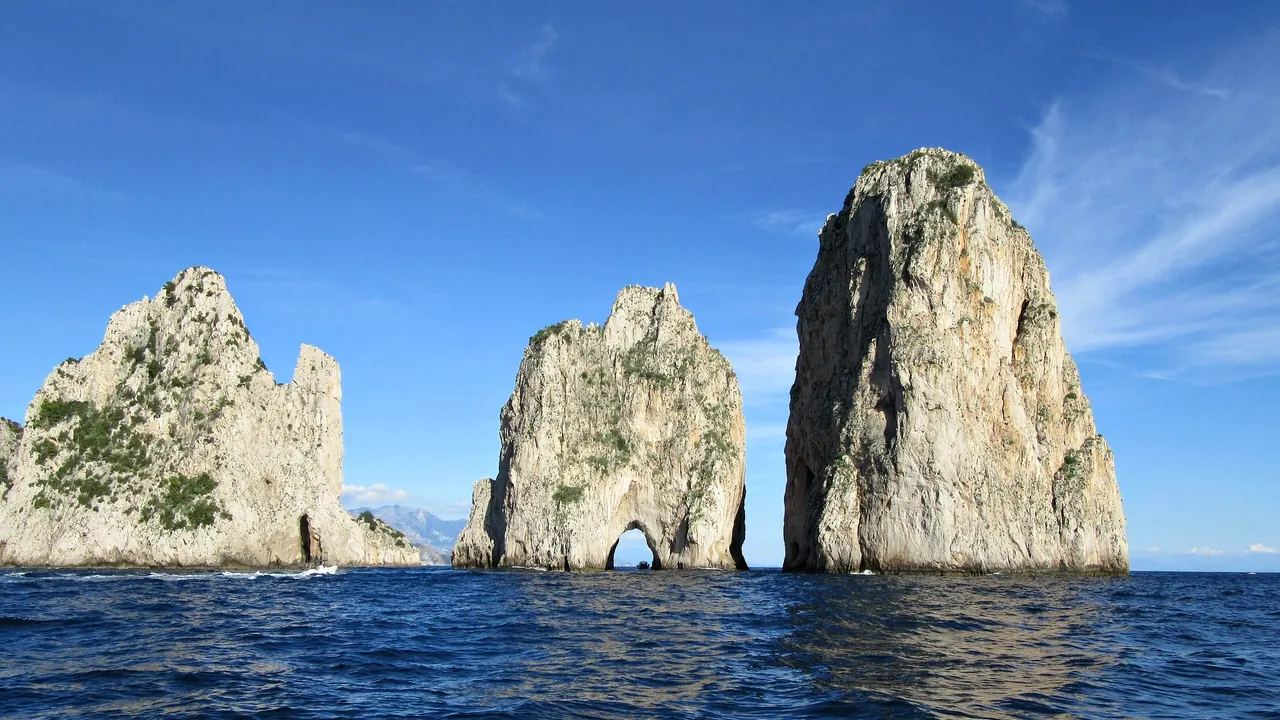
Photos: Capri by Sheeba Samuel, CC BY-SA 4.0, cropped.
Capri or Korčula?
Our verdict in twelve categories, each scored against the same fixed benchmark cities, and the climate month by month, so you can choose for your trip.
Choose Capri for
- shopping
- day trips
- getting around
Capri suits a short, polished stay where scenery and setting matter more than the bill. The limestone cliffs, the Faraglioni and the walks to the Arco Naturale are on a different scale of drama, and the island is compact enough to cover on foot, by funicular and by bus. Naples, Sorrento, Pompeii and the Amalfi Coast are all within reach by boat. Add the Piazzetta evenings and the luxury lanes off it, and it rewards a traveller who wants glamour and variety in a few days and accepts paying heavily for both.
Choose Korčula for
- prices
- families
- culture and sights
Korčula is the better choice for a longer, slower summer by the sea. There is more swimming and it is easier, from the sandy, shallow bays at Lumbarda to the clear pebble bay of Pupnatska Luka. The walled old town has more history packed into it, families are better served, and staying in village apartments and eating in konobas costs far less. In return you get quiet evenings, little to buy beyond wine and olive oil, and a long island where a hired car or scooter helps.
Scoreboard
Twelve categories on one fixed scale from 0 to 100. The shaded stretch is the gap between the two.
Your match
Pick a travel style or drag the sliders, and both match scores follow your weighting.
Too close to call, level with your weighting
Wins on shopping and day trips with your weighting.
Wins on prices and families with your weighting.
What matters to you?
Category by category
What the scores mean for a trip.
Beaches & swimming
Capri has hardly any sand. Swimming means small pebble coves at the two marinas, or concrete and rock platforms run as bathing clubs, with ladders straight into deep blue water. The finest swims are off the rocks at Punta Carena or from a boat under the Faraglioni, which is wonderful for confident swimmers but cramped in high summer.
Korčula has more coast to use and more variety along it. Lumbarda has true sandy beaches with shallow water, which is rare on this part of the Adriatic. Pupnatska Luka on the south coast is a fine pebble bay, and taxi boats run out to the pine-covered islet of Badija. Going a little further along the shore usually finds you space.
Food & drink
The two islands eat about equally well, but they are known for different things. Capri gave the world insalata caprese and has its own ravioli with caciotta and marjoram, the almond torta caprese and lemons in almost everything. The catch is that tables near the Piazzetta charge for the view, so the better meals are in the Anacapri trattorias under lemon pergolas.
Korčula cooks plain Dalmatian food: grilled fish, black risotto and lamb or octopus slow-cooked under the peka bell. Wine is what sets it apart. Grk from Lumbarda is a grape found almost nowhere else, Pošip comes from the vineyards around Čara and Smokvica, and the oysters of Ston are a short trip away.
Culture & sights
Korčula has the stronger single sight in its walled old town, laid out in a herringbone of streets on a small peninsula. It has St Mark's Cathedral with its Tintoretto, the town museum and a claimed Marco Polo house, and the Vela Spila cave sits at the far end of the island.
Capri's heritage is spread out rather than concentrated. There are the cliff-top ruins of Tiberius's Villa Jovis, Axel Munthe's Villa San Michele in Anacapri and the Certosa monastery. All three are good, but they are separate stops rather than a historic town to wander, and on both islands two days is enough.
Nightlife
Capri's evenings have more going on. Once the last ferries leave, the Piazzetta fills with dressed-up people at aperitivo, and later the piano taverns keep Neapolitan song and table-top dancing going until late. Korčula's equivalent is a cocktail on the town walls at sunset and a few harbour bars open late in high summer. Neither island has real clubs, and on Korčula, people who want a party take a boat to another island.
Nature & outdoors
Capri's landscape is the more striking. It is a sheer limestone block with the Faraglioni stacks, the Arco Naturale and cliffs dropping hundreds of metres, and the chairlift up Monte Solaro, the Sentiero dei Fortini and the Blue Grotto by boat all fit into a few days.
Korčula is gentler and greener, with pine, holm oak, olives and vineyards along a low central ridge suited to walking, cycling and kayaking among the islets. Its wilder country lies across the water: the climb up Sveti Ilija on Pelješac, the windsurfing strait at Viganj and the forested lakes of Mljet.
Day trips
Capri is the better base for days out, because what lies within a short boat ride is bigger and more varied. In a single week you can spend a day in Naples with its museums and old centre, walk the streets of Pompeii buried by Vesuvius, and visit the cliff towns of the Amalfi Coast, three quite different trips that don't repeat each other.
Korčula's outings are smaller and more like the island itself: the walls and oyster beds of Ston, the lake monastery on Mljet and a catamaran to Hvar, while Dubrovnik and Split are long days away. On both islands every outing depends on the boats, which run less often outside summer, and on Capri rough seas can cancel sailings altogether.
Good for families
Korčula is much the easier island with children. The sandy, shallow bays near Lumbarda make a natural base, every konoba welcomes children, and short boat trips to the islets keep older ones busy. Heat and ferry journeys still need planning.
Capri works less well. Swimming means ladders into deep water, the town is a maze of steps that defeats a pushchair, and the buses and funicular are packed in summer. Teenagers who swim well will enjoy the Blue Grotto and the chairlift, but with small children the mainland coast is a better bet.
Getting around
Capri is small enough that nobody needs a car. A funicular climbs from Marina Grande to the town in minutes, and little buses and open-topped taxis connect everything else. The drawbacks are steep walking and long queues in July and August.
Korčula is long and narrow, with one main road from Lumbarda to Vela Luka, infrequent buses and the best coves down steep side roads. Hiring a car or scooter makes a real difference, while taxi boats handle the short hops around Korčula Town.
Shopping & style
For somewhere so small, Capri has a remarkable concentration of Italian and international fashion houses along Via Camerelle and Via Vittorio Emanuele. It also has its own crafts: made-to-measure sandals, linen, ceramics and perfumes from local flowers.
Korčula has none of that. Its best purchases are edible: bottles of Grk and Pošip, olive oil, herb liqueurs and cukarini biscuits, plus a few craft and jewellery studios in the old town.
Affordability
Korčula costs far less. Summer prices in and around the old town are typical of a popular Dalmatian island, but apartments in Lumbarda or the villages, inland konobas and the quieter months of June and September bring costs down a long way.
Capri is among the most expensive stays in the Mediterranean, from hotels to sunbeds and boat trips. The cheap buses, free walks and Anacapri bakeries help, and staying on the mainland saves money but means missing the island's evenings.
Live music & performing arts
Neither island has a theatre or a concert season, but Korčula has something of its own to see. The Moreška sword dance is performed in Korčula Town through the summer, older sword dances survive in village feast days, and klapa choirs sing in churches and squares.
On Capri there are occasional summer concerts at the Certosa or Villa San Michele and Neapolitan song late at night in the taverns. For opera you take the boat to Naples.
Wellness & relaxation
For unwinding, the two islands are about level, and on both a spa means the wellness area of a hotel, because there are no thermal springs. Where they differ is in when the calm comes. On Capri, quiet arrives early in the morning and in the evening, once the day-trippers have gone, and it is best enjoyed from a base in Anacapri. For real thermal bathing, Ischia is across the bay.
On Korčula the calm lasts all day in the vineyard villages, especially in June and September, and it suits a slow week of long lunches and evenings with nothing planned.
When should you go?
Pick your month. The climate figures are measured averages, not a forecast.
Capri in July
Korčula in July
Daytime high, °C
Rainfall in the month, mm
Where the figures come from
Capri has no rain gauge within 25 km of the centre, so its rainfall comes from a gridded climate dataset read at the destination rather than from a gauge further away.
Capri's sunshine is measured 58 km from the centre, at Grazzanise.
Korčula's temperatures are measured 69 km from the centre, at Mostar.
Korčula has no rain gauge within 25 km of the centre, so its rainfall comes from a gridded climate dataset read at the destination rather than from a gauge further away.
Temperature and rainfall are climate normals, averaged over the years shown. Capri: 2005-2025 (sunshine 1991-2020, rainfall 1991-2020) normals, Capri (3.6 km from centre). Korčula: 1991-2020 normals, Mostar (69.2 km from centre).
Both islands are summer places with the same basic shape: dry and sunny from June to August, then rain building from September and peaking in November. The sea is warm enough for swimming from June into September on both. Capri keeps it a little longer, into early October, and peaks at about 26°C in August. The difference is in the heat. Korčula's summer days run hotter, reaching 33°C in July and August, which makes midday walking hard work, while Capri tops out a few degrees lower and is easier on its steep lanes.
For walking and sightseeing, May and late September to October are the comfortable months on both islands. Winter is milder on Capri, with highs around 13°C against Korčula's 9°C in January, but Capri is also the wetter of the two in late autumn, with about 146mm falling in November.
Which traveller are you?
On a family trip with children, Korčula allows a slow week in one place, with beach mornings, shady afternoons and an easy boat ride when anyone gets restless. On Capri, families end up planning every day around crowds, heat and stairs, which leaves little room to settle.
For a trip on a tight budget, Korčula makes a full week possible, with enough left over for eating out, a scooter and boats to the islets. On Capri, a tight budget usually turns a stay into a day visit, which means missing the island at its best.
On a shopping trip, Capri gives you shopping that fits around the rest of the stay. You can browse fashion and island crafts between a morning swim and the evening aperitivo, and resort clothes suit the dressed-up evenings. On Korčula, shopping comes down to a cellar-door visit and a few bottles for the ferry home.
Before you go
| Measure | Capri | Korčula |
|---|---|---|
| Official language | Italian | Croatian |
| Currency | Euro (EUR) | Euro (EUR) |
| Sockets | CFL230 V, 50 Hz | CF230 V, 50 Hz |
| Driving side | Right | Right |
| Time zone | UTC+1, UTC+2 in summer | UTC+1, UTC+2 in summer |
| Emergency number | 112 | 112 |
| Main airport | Naples International Airport (NAP)131 non-stop destinations | Dubrovnik Ruđer Bošković Airport (DBV)76 non-stop destinations |
| Public holidays this year | 13 days | 14 days |
By the numbers
| Measure | Capri | Korčula |
|---|---|---|
| Population | 12,903 | - |
| People per km² | 1,241 | - |
| Swim season, months above 21 °C | 5 months | 5 months |
Where else could you go?
Every comparison below shares a destination with this one, so you can follow Capri or Korčula somewhere new.