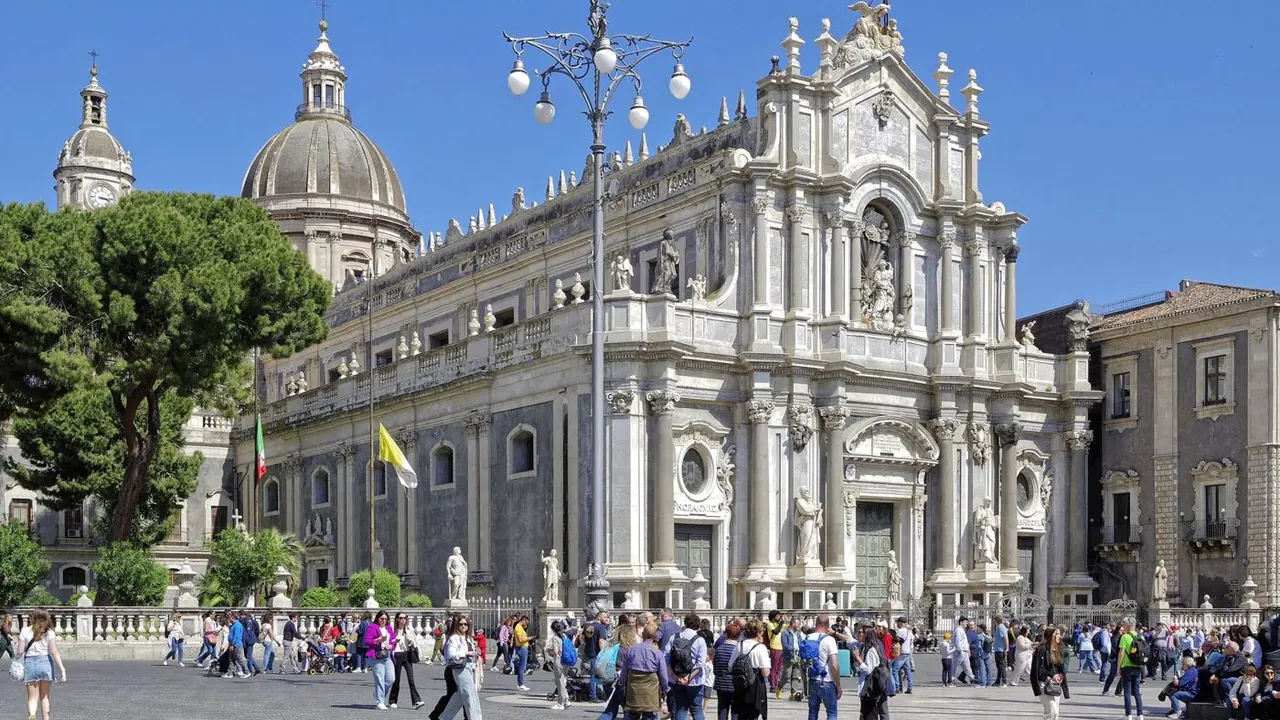
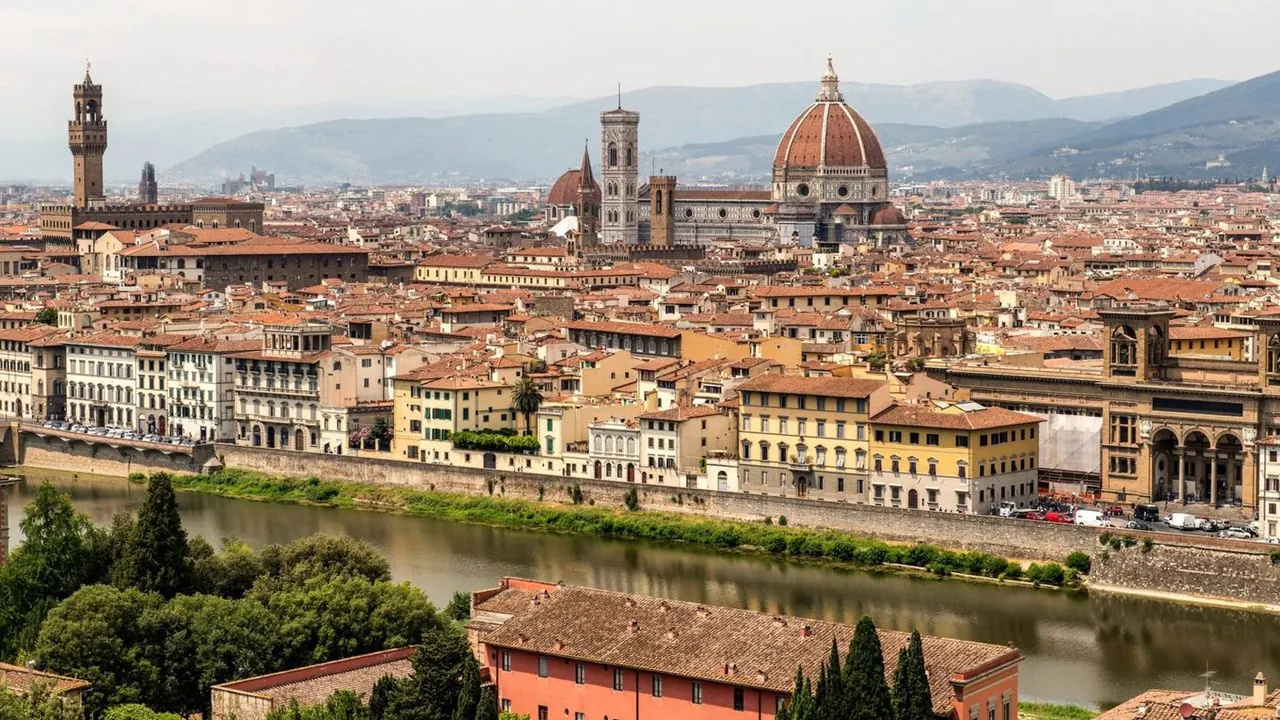
Photos: Catania by Berthold Werner, CC BY-SA 4.0, cropped; Florence by Wolfgang Weiser, Pexels License.
Catania or Florence?
Our verdict in twelve categories, each scored against the same fixed benchmark cities, and the climate month by month, so you can choose for your trip.
Choose Catania for
- beaches
- nature and the outdoors
- prices
Catania suits travellers who want the sea, a volcano and a lively Sicilian street life on a sensible budget. You can swim off the lava rocks of the Riviera dei Ciclopi in the morning, walk old craters on Etna in the afternoon and eat arancini in the lanes around Piazza Bellini at night. It is rougher round the edges, louder and harder to get around, but it gives you far more outdoors and coast.
Choose Florence for
- culture and sights
- getting around
- shopping
For a trip built around art, architecture and the Tuscan countryside, Florence is the clear choice. The Uffizi, the Duomo and the Accademia sit within a short walk of one another, and Siena, Pisa, Lucca and Chianti are all easy day trips. Expect to pay more and to forget about the beach, but the craft shopping and the depth of what there is to see are hard to match anywhere.
Scoreboard
Twelve categories on one fixed scale from 0 to 100. The shaded stretch is the gap between the two.
Your match
Pick a travel style or drag the sliders, and both match scores follow your weighting.
Too close to call, 1 point apart
Wins on beaches and nature and the outdoors with your weighting.
Wins on culture and sights and getting around with your weighting.
What matters to you?
Category by category
What the scores mean for a trip.
Beaches & swimming
The gap here is huge. Catania has two kinds of coast right on its doorstep. To the south are the broad sands and beach clubs of La Playa, and to the north are the black basalt rocks of Aci Castello and Aci Trezza, where you climb down ladders into very clear water beside the sea stacks.
Florence is inland, so swimming means a hotel pool or a full day on the train to the lounger-lined beaches of the Versilia. If the sea is part of the plan, Catania delivers it every day, and Florence only as a separate excursion.
Food & drink
Both are excellent places to eat, and both do their best cooking casually rather than in fine dining. In Catania that means street food: cone-shaped arancini, fried crispelle, granita with brioche for breakfast, horse meat grilled on Via Plebiscito and swordfish from La Pescheria. Etna's volcanic wines go with all of it.
Florence is about meat, bread and olive oil: thick bistecca, ribollita, lampredotto from the carts and Chianti Classico by the glass. Expect fish and pastries in Catania and beef and Tuscan reds in Florence, and keep away from the set menus around the Duomo.
Culture & sights
Florence is in a different league. Botticelli and Leonardo at the Uffizi, the David in the Accademia, the Bargello's sculpture and the Pitti Palace together make one of the densest collections of Renaissance art in the world, and the smaller chapels and churches are just as rewarding.
Catania's appeal is its townscape: a late-baroque city of dark lava stone and pale limestone, the Benedictine monastery of San Nicolò l'Arena and a Roman theatre tucked among the streets. The museums are modest and two or three days are enough, unless you are there for the great Sant'Agata procession in February.
Nightlife
Catania stays out later and louder. Its university crowd fills the lanes around Piazza Bellini and Via Gemmellaro with outdoor drinking well past midnight, and in summer the beach clubs on La Playa turn into open-air dance floors.
Florence's evenings are gentler: aperitivo, then a wine bar on Piazza Santo Spirito or around Sant'Ambrogio, with the night winding down fairly early. Neither city has much serious club culture, but Catania is the one for dancing.
Nature & outdoors
Etna gives Catania the edge. A smoking volcano of about 3,300m sits less than an hour away, with a cable car, trails across lava flows and side craters, and small ski slopes in winter. Add the Alcantara Gorge to wade through and snorkelling or kayaking around the sea stacks, and you have real variety.
Florence's countryside is gentler and cultivated: olive terraces at Fiesole, cycling lanes through Chianti, and further out the forests of the Casentino and the marble peaks of the Apuan Alps. It is lovely for walking, but it is not dramatic in the way Etna is.
Day trips
Both make superb bases, but Florence has more first-rank towns closer together. Siena, Pisa, Lucca, San Gimignano and the Chianti villages are all within easy reach, and Bologna is a short high-speed train ride away, with rail covering the main towns well.
Catania's list is strong as well: Ortigia and the Greek theatre at Siracusa, Taormina, the baroque towns of Noto, Modica and Ragusa Ibla, and the mosaics at Piazza Armerina. The distances are longer and the buses thinner, though, so a car matters more in Sicily.
Good for families
Neither is an easy city with children, but they work in different ways. Catania's family days happen outside the centre: shallow sand at La Playa, crater walks on Etna and the Etnaland water park. Inside the city, traffic and a lack of shade make it tiring.
Florence keeps children busy in town, with climbing the dome, the secret passages of Palazzo Vecchio, the globes at the Museo Galileo and the Boboli Gardens. Beyond that there is little apart from the Pinocchio park at Collodi.
Getting around
Florence is far easier. The Duomo, the Uffizi, Ponte Vecchio and the Pitti Palace are all a short walk apart, the main station is in the centre, and trains carry you straight out on day trips. A car is only useful for the hill villages.
Catania's centre is walkable along Via Etnea, but beyond it the single metro line and slow buses struggle in heavy traffic. Most visitors end up hiring a car for Etna and the baroque towns, and then find parking a battle.
Shopping & style
Florence is a real shopping city, built on craft: leather from San Lorenzo and small workshops, marbled paper, goldsmiths on the Ponte Vecchio, gilders and restorers in the Oltrarno, and luxury fashion along Via de' Tornabuoni.
Catania is better for markets than for shops. La Fiera and La Pescheria are entertaining, but Via Etnea is mostly chains. The things worth carrying home are Bronte pistachio cream, Etna wine and Caltagirone ceramics.
Affordability
Catania goes noticeably further for your money. Street food makes a full meal for little, rooms in the old centre are reasonable for most of the year, and the baroque streets cost nothing to wander. The extra costs come from a hire car, summit excursions and summer sunbeds.
Florence is expensive for its size. Central hotels are dear from spring to autumn, and the entry fees for the big museums and the dome climb add up. Lampredotto stalls, market lunches and walking everywhere help, but it remains the costlier stay.
Live music & performing arts
The two are close, and both lean towards opera. Catania is Bellini's city, with a grand opera house named after him, a museum of his manuscripts and the old marionette theatre of knights and Saracens, which is something Florence lacks.
Florence, where opera was born around 1600, has the Maggio Musicale festival and a resident orchestra, though most visitors end up at tourist-pitched concerts in churches. In both cities, jazz and theatre won't fill a week of evenings.
Wellness & relaxation
Florence offers a little more calm. Its own spas are limited to hotels, but early mornings in the Boboli and Bardini gardens help, and Montecatini Terme and the sulphur pools of Saturnia and Bagno Vignoni are within reach, along with farm stays in the hills.
Catania is noisy and has no bathing tradition. Rest there comes from long lunches, a slow granita and perhaps a few nights in a quieter village on Etna's slopes.
When should you go?
Pick your month. The climate figures are measured averages, not a forecast.
Catania in July
Florence in July
Daytime high, °C
Rainfall in the month, mm
Where the figures come from
Catania's sunshine is measured 88 km from the centre, at Messina.
Florence has no rain gauge within 25 km of the centre, so its rainfall comes from a gridded climate dataset read at the city rather than from a gauge further away.
Florence's sunshine is measured 71 km from the centre, at Pisa / S. Giusto.
Temperature and rainfall are climate normals, averaged over the years shown. Catania: 1991-2020 normals, Catania / Fontanarossa (5.2 km from centre). Florence: 1995-2020 (sunshine 1991-2020, rainfall 1991-2020) normals, Firenze / Peretola (5.6 km from centre).
Catania is the warmer and drier of the two for most of the year. From June to October the sea is warm enough for swimming, reaching about 26°C in August, and the summer is almost rainless. July and August are very hot, with highs around 32°C, so sightseeing in the streets is best kept to mornings and evenings. Rain returns in autumn and is heaviest in late autumn and early winter, though winter days stay mild enough for walking.
Florence has no sea, and its seasons are more pronounced. Summer is hot and crowded in the stone streets, while autumn is the wettest time, with November bringing around 124mm of rain. Winter is cool, with highs near 11°C. The best months for walking the centre and the hills are April, May and late September, when Catania is also pleasant but already warm enough to swim from June.
Which traveller are you?
On a beach and sun trip, Catania is the obvious pick. You can choose sand or rock depending on the day, the sea stays warm from early summer well into autumn, and Isola Bella is close by. From Florence, the coast is a whole day's outing.
For a culture and arts trip, Florence wins easily. The Uffizi, the Bargello, Brunelleschi's dome and the frescoes at San Marco could fill a week. Catania's baroque streets and Roman remains are handsome, but two or three days covers them.
On a shopping trip, choose Florence. Much of what it sells is still made by hand in the city, and the antique dealers of Via Maggio and the Sant'Ambrogio flea market are good for a slow browse. Catania will fill your suitcase with food, not clothes.
Before you go
| Measure | Catania | Florence |
|---|---|---|
| Official language | Italian | Italian |
| Currency | Euro (EUR) | Euro (EUR) |
| Sockets | CFL230 V, 50 Hz | CFL230 V, 50 Hz |
| Driving side | Right | Right |
| Time zone | UTC+1, UTC+2 in summer | UTC+1, UTC+2 in summer |
| Emergency number | 112 | 112 |
| Elevation | 7 m | 50 m |
| Main airport | Catania-Fontanarossa Airport (CTA)4 km from centre96 non-stop destinations | Florence Airport, Peretola (FLR)6 km from centre46 non-stop destinations |
| Public holidays this year | 13 days | 13 days |
By the numbers
| Measure | Catania | Florence |
|---|---|---|
| City population | 311,584 | 360,930 |
| People per km² | 1,704 | 3,528 |
| Museums within 10 km | 25 | 141 |
| UNESCO World Heritage sites within 50 km | 3 | 4 |
| Swim season, months above 21 °C | 5 months | - |
Where else could you go?
Every comparison below shares a destination with this one, so you can follow Catania or Florence somewhere new.