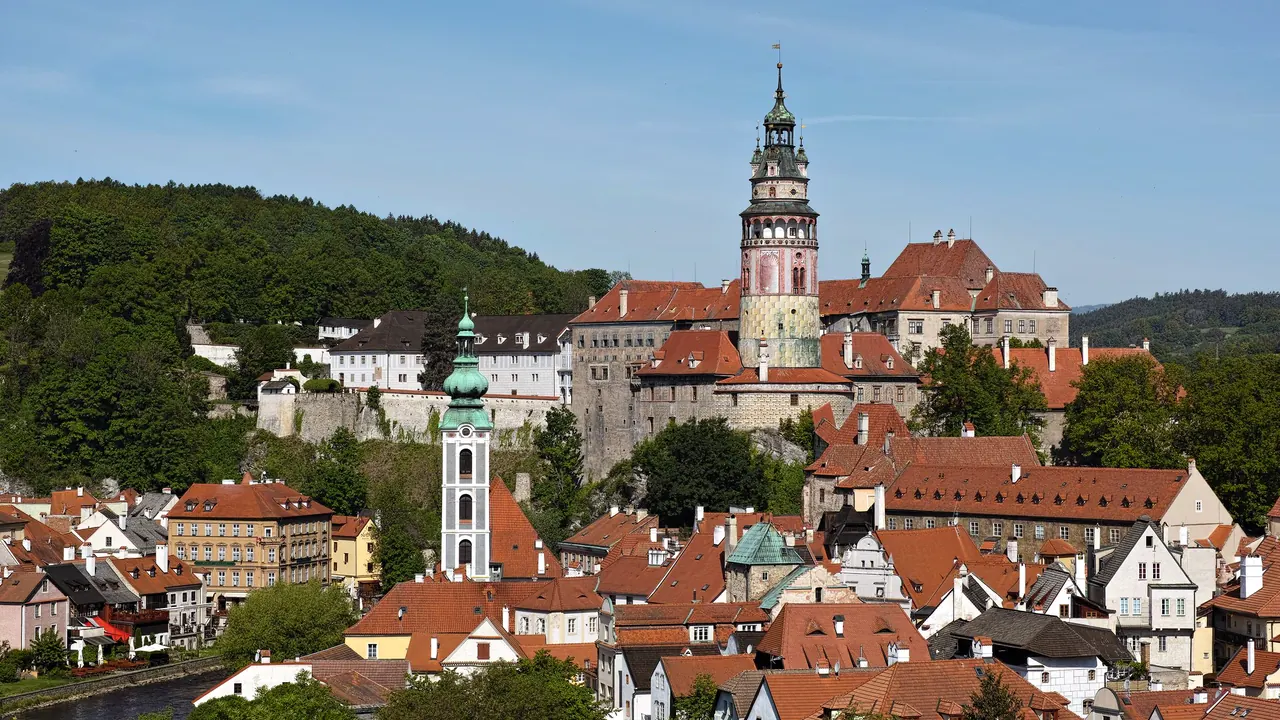
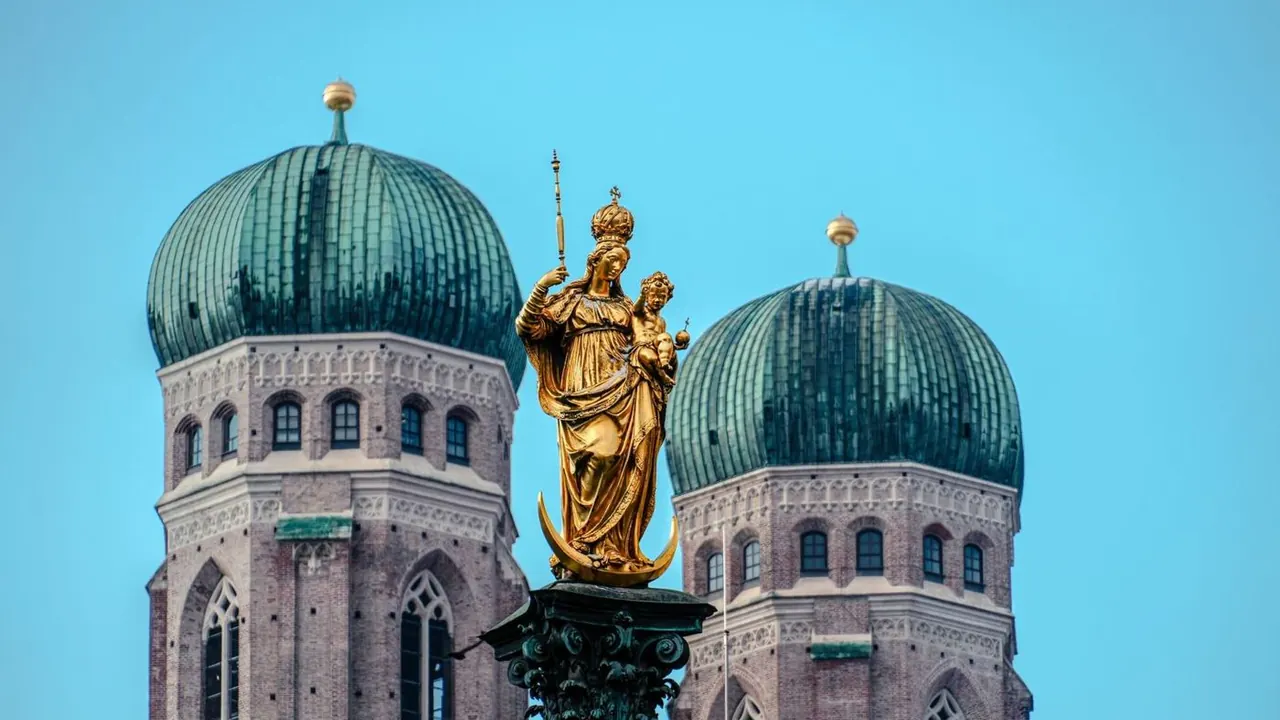
Photos: Cesky Krumlov by Xth-Floor, CC BY-SA 4.0, cropped; Munich by 0xd1ma, Pexels License.
Cesky Krumlov or Munich?
Our verdict in twelve categories, each scored against the same fixed benchmark cities, and the climate month by month, so you can choose for your trip.
Choose Cesky Krumlov for
- prices
Cesky Krumlov suits a slow, small-scale stay: a castle town on a bend of the Vltava where the whole townscape is the sight, evenings are a beer by the river and the day's adventure is floating downstream in a canoe. It is far easier on the wallet than Munich and works best as two quiet nights, ideally with a car for the South Bohemian castles and the Bohemian Forest.
Choose Munich for
- live music and the arts
- shopping
- nightlife
Munich is the place for a fuller trip with more to do each day. Great art collections, a world-class opera house, beer gardens, proper nights out, thermal baths and the Alps an hour away by train give it far more range, and its transport makes a week of excursions effortless. The price is that it costs a good deal more, above all for a hotel room.
Scoreboard
Twelve categories on one fixed scale from 0 to 100. The shaded stretch is the gap between the two.
Your match
Pick a travel style or drag the sliders, and both match scores follow your weighting.
Wins on prices with your weighting.
Wins on live music and the arts and shopping with your weighting.
What matters to you?
Category by category
What the scores mean for a trip.
Beaches & swimming
Neither is a beach destination, and both send swimmers to inland water for a short summer season. From Cesky Krumlov that means driving about half an hour to the grassy and sandy shores of the Lipno reservoir, since the Vltava in town belongs to the rafts.
Munich makes summer swimming a little easier. The Isar's gravel banks at the Flaucher are right in the city, and the clear Starnberger See and Ammersee are under an hour away by S-Bahn, so a lake afternoon fits into a city day without a car.
Food & drink
The two eat in a similar way: roast pork, dumplings and beer, in both cases brewed locally for centuries. In Cesky Krumlov the meal comes in a vaulted cellar or on a river terrace, often with trout or forest game, but the choice is narrow and many menus are aimed at day-trippers.
Munich turns the same tradition into a real reason to visit. Its brewery beer halls and chestnut-shaded beer gardens, the Viktualienmarkt for snacks and cheese, serious coffee-and-cake afternoons and a group of starred restaurants give you far more variety across a week.
Culture & sights
Munich has the greater depth. The Kunstareal alone holds old masters at the Alte Pinakothek, Greek and Roman sculpture at the Glyptothek and the Blue Rider painters at the Lenbachhaus, and the Residenz, Nymphenburg and the Deutsches Museum add days more. Its old town is handsome, but much of it was rebuilt after the war.
Cesky Krumlov offers what Munich cannot: an intact Renaissance and Baroque town, its painted houses and huge castle untouched as a whole. The Cloak Bridge, the Baroque theatre with its original stage machinery and the Schiele centre are well worth seeing, but a day or two covers it all.
Nightlife
After dinner Cesky Krumlov winds down to a few pubs and backpacker cellar bars, with summer terraces by the Vltava the liveliest it gets. There are no clubs, and out of season the lanes are empty early.
Munich offers a proper night out. Beer halls are the classic start, Glockenbachviertel and Gärtnerplatz have cocktail and gay bars, Schwabing has student pubs, and a few serious techno clubs run until morning at weekends. During Oktoberfest the whole city becomes one large party.
Nature & outdoors
Cesky Krumlov's outdoors starts at the door. You can canoe the wooded meanders of the Vltava straight into town, and Klet, the spruce woods of the Bohemian Forest and the cycle path around Lipno are all close by. The landscape is soft rather than dramatic.
Munich has the bigger range. The Alps rise an hour south, with the Zugspitze, the Wetterstein and Tegernsee reachable by train for real mountain hiking and downhill skiing. Back in town, the English Garden, the Eisbach surfers and the Isar cycle paths add green space that a small town has no need for.
Day trips
Munich is the far stronger base. Salzburg, Nuremberg, Regensburg and Innsbruck are all within about two hours by train, and Neuschwanstein, Herrenchiemsee and painted villages such as Oberammergau make classic outings without a car.
Cesky Krumlov has a good South Bohemian circuit: the arcaded square of České Budějovice, the white castle at Hluboká, the farmhouses of Holašovice and the monastery at Zlatá Koruna just along the river. The list is shorter, and most of it needs a car.
Good for families
Munich is much the easier choice with children. The zoo along the Isar, the hands-on Deutsches Museum, the transport museum and beer gardens with playgrounds fill days, and buses and trains take pushchairs.
Cesky Krumlov has storybook appeal, with the bears in the castle moat and a gentle raft trip that most children love, plus the Lipno treetop walk nearby. But steep cobbles make pushchairs hard work, and once the castle and the river are done there is little else aimed at young visitors.
Getting around
Both centres are pedestrian and easy on foot, although Cesky Krumlov's cobbles and the climb to the castle take more effort than flat Munich.
The real difference is beyond the old town. Munich's U-Bahn, S-Bahn, trams and buses run as one integrated network out to Nymphenburg, the lakes and the airport, and regional trains reach the mountains. From Cesky Krumlov, links to the forest and the smaller castles are thin, so most visitors hire a car or join tours.
Shopping & style
Cesky Krumlov's lanes sell souvenirs and not much else: Bohemian glass, garnet jewellery, marionettes and the local green moldavite, with a few ceramics workshops.
Munich is a serious shopping city. There are luxury houses on Maximilianstrasse, department stores along Kaufingerstrasse, independent design shops in Glockenbach and Schwabing, and Dallmayr's long-established delicatessen. Specialist tailors sell dirndls and lederhosen, and in December the Christmas markets fill the old town with craft stalls.
Affordability
Cesky Krumlov costs much less. Family guesthouses in the old houses, Czech meals and local beer stay moderately priced, though rooms with castle views and each separately ticketed castle tour push the bill up.
Munich is Germany's most expensive city, and hotels are the biggest cost, especially during Oktoberfest and trade fairs. Beer garden picnics, free parks and lakes, and token Sunday museum fees help, but they will not bring it close to the Czech town.
Live music & performing arts
Both have a historic court theatre, and the comparison says a lot. Munich's rococo Cuvilliés Theatre still stages chamber opera, while Cesky Krumlov's Baroque theatre holds only a few performances a year and is mostly seen on a tour.
Beyond that, Munich is in a different league. The Bavarian State Opera, three orchestras of real standing, the Gärtnerplatztheater, jazz clubs and big concerts at the Olympic Park run through most of the year. Cesky Krumlov's offer is mainly summer: the revolving open-air theatre in the castle garden and a classical music festival.
Wellness & relaxation
Munich has a real bathing culture. There are the vaulted Art Nouveau pools and steam bath of the Müller'sches Volksbad, textile-free public saunas with infusion rituals, and the huge thermal complex at Erding about forty minutes away.
Cesky Krumlov has a few hotel wellness rooms and beer baths, with Třeboň's peat baths within reach for a day. What it offers instead is stillness once the tour buses leave, which some travellers will find more restful than any spa.
When should you go?
Pick your month. The climate figures are measured averages, not a forecast.
Cesky Krumlov in July
Munich in July
Daytime high, °C
Rainfall in the month, mm
Where the figures come from
Cesky Krumlov's temperatures are measured 50 km from the centre, at Grainet-Rehberg.
Cesky Krumlov has no rain gauge within 25 km of the centre, so its rainfall comes from a gridded climate dataset read at the city rather than from a gauge further away.
Temperature and rainfall are climate normals, averaged over the years shown. Cesky Krumlov: 1991-2020 normals, Grainet-Rehberg (50.3 km from centre). Munich: 1991-2020 normals, München (1.9 km from centre).
The two share a central European climate, with Munich a couple of degrees milder all year. Both are at their best from May to September, when highs reach about 23°C in Cesky Krumlov and 25°C in Munich in July and August, warm enough for a lake swim and long evenings outdoors, though never too hot for walking. Summer is also the wettest season in both, with frequent showers and thunderstorms: Munich gets around 120mm in each month from June to August, and Cesky Krumlov peaks at about 111mm in July. Munich also has a little more sunshine through the summer.
Winter is cold and grey in both, with daytime highs of only a few degrees from December to February, and the short days give little sun. Late spring and September suit walking best, while the river trips, Lipno and Munich's alpine lakes are mostly for June to early September.
Which traveller are you?
On a culture and arts trip, Cesky Krumlov gives you one intact townscape and its castle, seen in a day or two, but Munich is the clear choice. The Pinakotheks, the Residenz and the Deutsches Museum fill the days, and the State Opera and three orchestras fill the evenings.
For a food and nightlife trip, Cesky Krumlov has a beer on a river terrace and a few cellar pubs, and then the town goes to sleep. Munich is well ahead, with beer halls, the Viktualienmarkt and starred kitchens, then Glockenbachviertel bars and weekend techno clubs until late.
On a trip on a tight budget, Cesky Krumlov goes further. Its main sight, the painted old town and the castle courtyards, costs nothing to wander, so a room just outside the centre and a single castle tour make a cheap stay. In Munich the hotel takes most of the money.
Before you go
| Measure | Cesky Krumlov | Munich |
|---|---|---|
| Official language | Czech | German |
| Currency | Czech Koruna (CZK) | Euro (EUR) |
| Sockets | CE230 V, 50 Hz | CF230 V, 50 Hz |
| Driving side | Right | Right |
| Time zone | UTC+1, UTC+2 in summer | UTC+1, UTC+2 in summer |
| Emergency number | 112 | 112 |
| Elevation | 492 m | 519 m |
| Main airport | Václav Havel Airport Prague (PRG)143 km from centre178 non-stop destinations | Munich Airport (MUC)29 km from centre210 non-stop destinations |
| Public holidays this year | 13 days | 12 days |
By the numbers
| Measure | Cesky Krumlov | Munich |
|---|---|---|
| City population | 12,797 | 1,505,036 |
| People per km² | 576 | 4,844 |
| Museums within 10 km | 4 | 75 |
| UNESCO World Heritage sites within 50 km | 2 | 1 |
Where else could you go?
Every comparison below shares a destination with this one, so you can follow Cesky Krumlov or Munich somewhere new.
- Innsbruckvs Munich
- Salzburgvs Munich
- Praguevs Cesky Krumlov
- Salzburgvs Cesky Krumlov
- Hallstattvs Cesky Krumlov
- Nurembergvs Munich