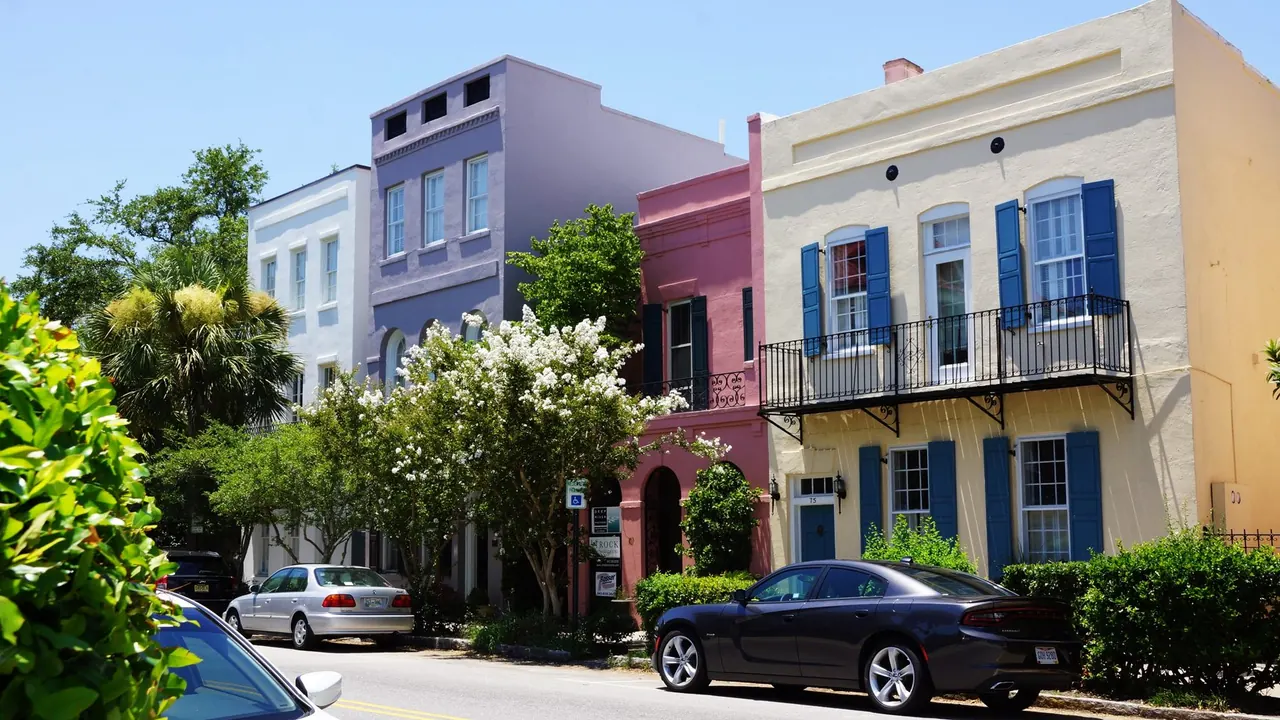
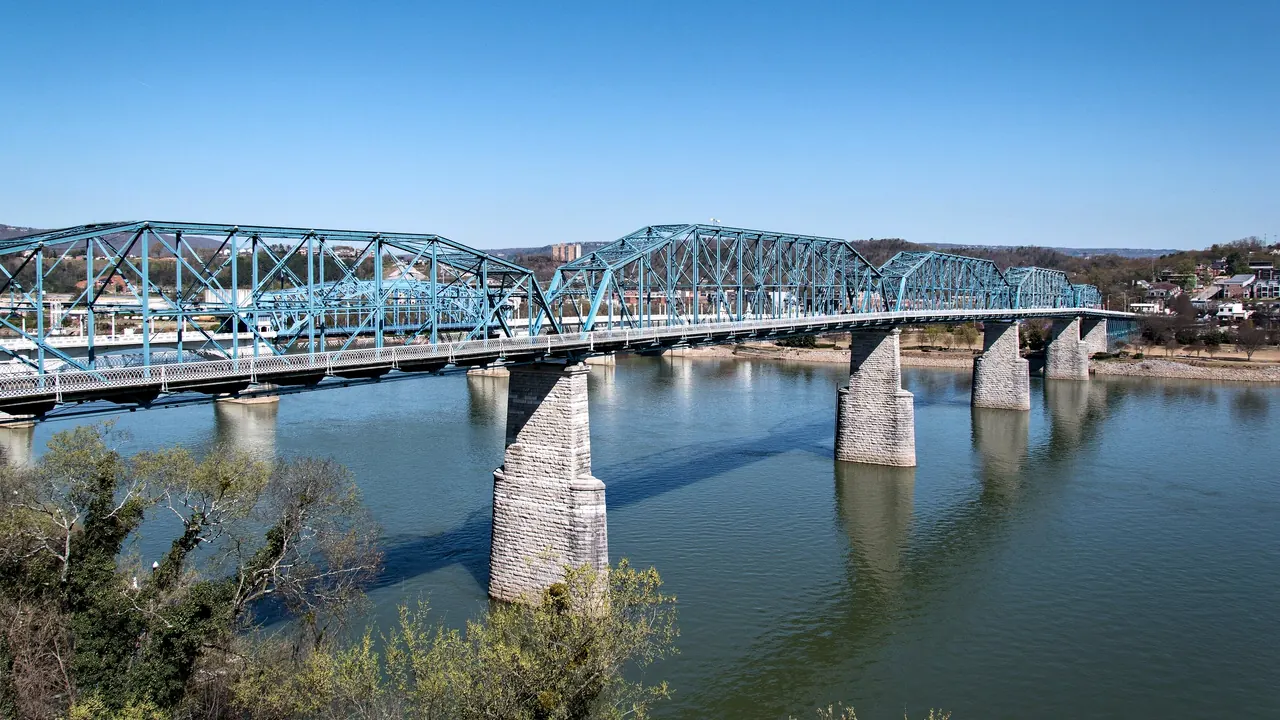
Photos: Charleston by NealVickers, CC BY-SA 4.0, cropped; Chattanooga by Ɱ, CC BY-SA 4.0, cropped.
Charleston or Chattanooga?
Our verdict in twelve categories, each scored against the same fixed benchmark cities, and the climate month by month, so you can choose for your trip.
Choose Charleston for
- beaches
- food and drink
- shopping
Charleston suits a trip built around old streets, serious Southern cooking and time on the sand. The historic peninsula, the plantation houses along the Ashley River and a Lowcountry table rooted in Gullah Geechee traditions fill the days. Three barrier-island beaches are close enough that you can split most days between town and sea. It is the more expensive of the two, and you will want a car for anything beyond the old town.
Choose Chattanooga for
- nature and the outdoors
- prices
- families
If you would rather spend your days on rock, river and trail than in house museums, Chattanooga is the better choice. Lookout Mountain, the Tennessee River Gorge and the Ocoee whitewater are all close to town, families get a first-rate aquarium and a mountain full of attractions aimed at children, and the bills run lower. Dinners and evenings out are pleasant but simple, and there is no sea.
Scoreboard
Twelve categories on one fixed scale from 0 to 100. The shaded stretch is the gap between the two.
Your match
Pick a travel style or drag the sliders, and both match scores follow your weighting.
Wins on beaches and food and drink with your weighting.
Wins on nature and the outdoors and prices with your weighting.
What matters to you?
Category by category
What the scores mean for a trip.
Beaches & swimming
This is Charleston's strongest advantage over Chattanooga. It has a choice of real Atlantic beaches within half an hour of town: surfy Folly with its pier, quiet Sullivan's Island backed by dunes and forts, the broader Isle of Palms, and long empty stretches on Kiawah and Seabrook. The water is tidal and greenish rather than clear, but it is warm for half the year.
Chattanooga sits hundreds of kilometres inland, so swimming means a roped-off area at Chickamauga Lake or Harrison Bay, or a cool creek pool on the plateau. They are good for an hour on a hot afternoon, but they are no reason to pack a beach bag.
Food & drink
Both cities cook Southern food, but Charleston takes it a great deal further. Lowcountry dishes such as she-crab soup, shrimp and grits, Frogmore stew and Carolina Gold rice are served everywhere from restored townhouse dining rooms to whole-hog barbecue pits, with oysters and fried seafood out on Shem Creek. The best tables there need booking well ahead.
Chattanooga's cooking is plainer and comes from inland: meat-and-three plates, catfish, smoked brisket and biscuits, with a few chef-led places and breweries on the Southside. Neither city offers much street food or international cooking, but only Charleston is worth planning a trip around for its food.
Culture & sights
In Charleston the town itself is the main sight. You can walk for hours past the piazza houses, steeples and walled gardens south of Broad Street, and the house museums, the Old Slave Mart Museum and the International African American Museum face the city's history of slavery directly. The boat to Fort Sumter takes you to where the Civil War began.
Chattanooga's history comes from later in that war and from the railways. The 1863 battlefields sit up on Lookout Mountain and Missionary Ridge, and the old Terminal Station survives on the Southside. The Hunter Museum and the Walnut Street Bridge are its highlights, but the sights are more spread out and less atmospheric between them.
Nightlife
Neither city has much of a club scene, but Charleston's evenings have more energy. Upper King Street fills on weekends with rooftop bars, cocktail rooms and oyster bars, and the French Quarter has quieter wine bars and old taverns. Folly Beach adds a few bars on the sand.
Chattanooga's evenings revolve around breweries and patios on the Southside and Main Street, with Station Street the only block that gets really lively. It suits a beer and a conversation, and most places are winding down well before Charleston's 2am closing time.
Nature & outdoors
Chattanooga is built around steep terrain. Lookout, Signal and Raccoon mountains rise straight from the river, the sandstone bluffs draw climbers from across the East, and the Tennessee River Gorge, the Ocoee rapids, Cloudland Canyon and Fall Creek Falls give you weeks of hiking, biking and paddling.
Charleston's Lowcountry is flat and watery instead: spartina marsh, tidal creeks and live oaks hung with Spanish moss. Kayaking among dolphins, fishing, and birding or spotting alligators in the ACE Basin are its gentler pleasures, and summer mosquitoes are a real nuisance there.
Day trips
Charleston's outings are closer and more varied. The Ashley River plantations, including Middleton Place, Magnolia and Drayton Hall, are half an hour out, McLeod Plantation is on James Island, Beaufort and the Gullah sea islands make a quiet day, and Savannah's squares are about two hours down the coast.
From Chattanooga, the big draws are whole cities, Nashville and Atlanta, each a long day's drive. Between them sit Huntsville's rocket centre, the Jack Daniel's town of Lynchburg, Sewanee and the Chickamauga battlefield. In both cities every trip needs a car.
Good for families
Chattanooga is the more child-centred city. The two-building Tennessee Aquarium and the Creative Discovery Museum are in the middle of downtown, and Lookout Mountain stacks up the steep Incline Railway, the underground waterfall at Ruby Falls and Rock City. The carousel and splash fountains in Coolidge Park and the old Lake Winnepesaukah amusement park round it out.
Charleston works well too, with its aquarium, climbing around the carrier at Patriots Point and the boat to Fort Sumter, and it has the beaches Chattanooga lacks. Its house tours will lose younger children quickly, though.
Getting around
Both have a walkable core with a free downtown shuttle, and both turn into car towns beyond it. The difference is how much lies within reach on foot. In Charleston, nearly everything a visitor wants is on the flat peninsula, with pedicabs to fill the gaps, so you only need a car for beach and plantation days.
In Chattanooga, the riverfront, Bluff View and the Southside are walkable, and the Walnut Street Bridge links them to the North Shore. But Lookout Mountain, the trails and the climbing areas, which are why most people come, all need a car, so most visitors hire one for the whole stay.
Shopping & style
Charleston gives you a proper shopping street. King Street runs from antiques dealers and galleries at the lower end, past fashion brands, to independent design shops at the top, and the sweetgrass baskets woven by Gullah artisans at City Market make a souvenir with real roots.
Chattanooga's shops are fewer and more scattered, across Warehouse Row, the boutiques on Frazier Avenue and a large mall outside town. It is the better place to buy climbing and camping gear, but little else.
Affordability
Chattanooga is the easier city on the wallet, though neither is cheap. Its hotels and casual meals cost less than Charleston's, and many of its parks, trails and riverfront walks are free. A hire car and full-price family attractions on Lookout Mountain still add up steadily.
Charleston charges big-city rates for rooms on the historic peninsula, and even more on spring and autumn weekends, and its well-known restaurants and paid house tours push costs up further. Staying in Mount Pleasant saves money but means driving in each day.
Live music & performing arts
For most of the year the two are broadly similar, with a historic theatre, a small orchestra and a few music bars each. Charleston pulls ahead in late spring, when Spoleto Festival USA and Piccolo Spoleto fill the city with opera, dance, chamber music and jazz for more than two weeks. Its Gullah storytelling and song performances are something you will not find in Chattanooga.
Chattanooga's offer is steadier and lower-key: shows and the symphony in the gilded Tivoli Theatre, and country, bluegrass and Americana bands in Southside bars. Nashville is close enough to make the better music trip.
Wellness & relaxation
Charleston is the place to slow right down. The old town keeps an unhurried pace, with shaded walled gardens, quiet church courtyards and long evenings by the water at White Point Garden. The resort spas out on Kiawah Island can fill a whole day of pampering.
Chattanooga is a city for being active, and its spas are limited to a few in hotels and some day spas. Rest comes between climbs and paddles, on an afternoon by the river or a porch in Bluff View. Neither city has a bathing culture worth travelling for.
When should you go?
Pick your month. The climate figures are measured averages, not a forecast.
Charleston in July
Chattanooga in July
Daytime high, °C
Rainfall in the month, mm
Temperature and rainfall are climate normals, averaged over the years shown. Charleston: 1991-2020 (sunshine 1981-2010) normals, Charleston Airport (16.1 km from centre). Chattanooga: 1991-2020 (sunshine 1981-2010) normals, Lovell Field (6.3 km from centre).
Charleston is the warmer and sunnier of the two for most of the year, with mild winters that still allow comfortable walking. The Atlantic is warm enough to swim from May into October and peaks at about 28°C in July and August. Those midsummer months bring humid highs of 33°C and the year's heaviest rain, close to 170mm a month in thundery downpours, so April, May and October are the sweet spot for both the streets and the beach.
Chattanooga follows the same hot summer, but its winters are noticeably cooler, with January highs around 11°C. Rain is spread more evenly through the year and is actually heaviest from December to March, at about 130mm a month, while late summer and autumn are drier. April and May, then late September and October, are the best months for its trails and climbing, with warm days, plenty of sun and colour in the wooded hills in autumn.
Which traveller are you?
On a beach and sun trip, Charleston wins easily. Folly Beach, Sullivan's Island and Isle of Palms are all within about half an hour, and the sea stays warm from late spring into autumn. Chattanooga can only offer lake swimming areas and creek pools.
For an outdoors trip, Chattanooga is the clear choice. Climbing on sandstone bluffs, hang gliding from Lookout Mountain, whitewater on the Ocoee and canyon-rim hikes are all close by. Charleston's flat marshland is better suited to gentle kayaking with dolphins than to anything more demanding.
On a family trip with children, Chattanooga has the edge. The Tennessee Aquarium, the Incline Railway, Ruby Falls, Rock City and an old-fashioned amusement park make for days built around children. Charleston has its own aquarium and an aircraft carrier to explore, and its trump card is the beach.
Before you go
| Measure | Charleston | Chattanooga |
|---|---|---|
| Currency | US Dollar (USD) | US Dollar (USD) |
| Sockets | AB120 V, 60 Hz | AB120 V, 60 Hz |
| Driving side | Right | Right |
| Time zone | UTC-5, UTC-4 in summer | UTC-5, UTC-4 in summer |
| Emergency number | 911 | 911 |
| Elevation | 6 m | 206 m |
| Main airport | Charleston International Airport (CHS)16 km from centre56 non-stop destinations | Chattanooga Metropolitan Airport (Lovell Field) (CHA)6 km from centre15 non-stop destinations |
| Public holidays this year | 12 days | 13 days |
By the numbers
| Measure | Charleston | Chattanooga |
|---|---|---|
| City population | 150,227 | 181,099 |
| People per km² | 532 | 484 |
| Museums within 10 km | 19 | 7 |
| UNESCO World Heritage sites within 50 km | 0 | 0 |
| Swim season, months above 21 °C | 6 months | - |
Where else could you go?
Every comparison below shares a destination with this one, so you can follow Charleston or Chattanooga somewhere new.
- Savannahvs Charleston
- Myrtle Beachvs Charleston
- Atlantavs Chattanooga
- Pigeon Forgevs Chattanooga
- Gatlinburgvs Chattanooga
- Nashvillevs Chattanooga