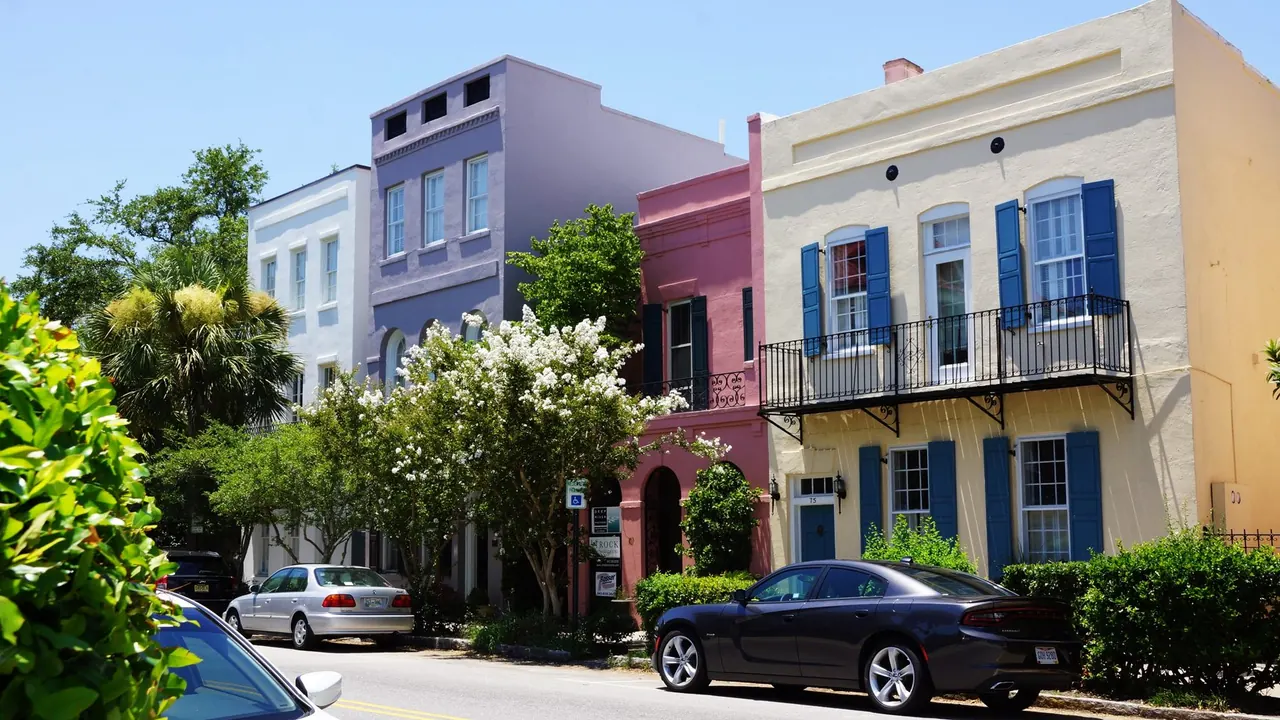

Photos: Charleston by NealVickers, CC BY-SA 4.0, cropped; St. Louis by Holly Cheng, CC BY 2.0, cropped.
Charleston or St. Louis?
Our verdict in twelve categories, each scored against the same fixed benchmark cities, and the climate month by month, so you can choose for your trip.
Choose Charleston for
- beaches
- shopping
- wellness
Charleston suits travellers who want a handsome old town and the sea in one trip. You can spend mornings walking the cobbled lanes and walled gardens south of Broad Street and afternoons on the barrier-island beaches. The Lowcountry cooking is among the best reasons to travel in the American South. It costs more, and you need a car beyond the peninsula, but the setting rewards a couple who like to eat well and walk slowly.
Choose St. Louis for
- live music and the arts
- prices
- families
St. Louis makes more sense for families and anyone keeping an eye on the bill. The free zoo, science centre and art museum in Forest Park, the climbable City Museum and the Arch's tram pods keep children busy, and rooms cost noticeably less. It is also the stronger choice for evenings of music, with a renowned symphony, the open-air Muny and blues rooted in the city's own history. There is no sea, though, and almost everything means driving.
Scoreboard
Twelve categories on one fixed scale from 0 to 100. The shaded stretch is the gap between the two.
Your match
Pick a travel style or drag the sliders, and both match scores follow your weighting.
Wins on beaches and shopping with your weighting.
Wins on live music and the arts and prices with your weighting.
What matters to you?
Category by category
What the scores mean for a trip.
Beaches & swimming
This is the clearest gap between the two. Charleston has three barrier-island beaches close by, each with its own character: surfy Folly, quiet Sullivan's Island with its dunes and old forts, and the resort-style Isle of Palms. Kiawah and Seabrook have longer, emptier stretches. The water is tidal and greenish rather than clear, but it is warm through the summer.
St. Louis is hundreds of kilometres from any coast. In summer, cooling off means a pool or a long drive to an Ozark reservoir.
Food & drink
Charleston is the stronger place to eat. Lowcountry cooking, shaped by Gullah Geechee and West African traditions, gives you shrimp and grits, she-crab soup and winter oyster roasts, served everywhere from restored townhouse dining rooms to whole-hog barbecue pits. The catch is range, and the good tables need booking well ahead.
St. Louis cooking is humbler but cheaper and more varied. Toasted ravioli and Provel pizza on the Hill, ribs, frozen custard, and Bosnian and Vietnamese kitchens on South Grand make it easy to eat well without planning around reservations.
Culture & sights
Charleston comes out slightly ahead because the whole peninsula is the sight. You walk past Rainbow Row, the Battery and the piazza-fronted single houses, then go inside the Aiken-Rhett house or take the boat to Fort Sumter. The theme throughout is the history of slavery and the Civil War.
St. Louis offers set pieces rather than an intact old town. You get the Gateway Arch, the Old Courthouse of the Dred Scott case, the mosaics of the Cathedral Basilica and the free collections of Forest Park. Its museums are larger, but its historic streets are scattered across several neighbourhoods.
Nightlife
Neither city is a reason to travel for nightlife, and the difference is mainly one of layout. Charleston gathers its bars on upper King Street, with rooftops, cocktail rooms and big weekend groups, plus a few beach bars on Folly.
St. Louis spreads out across Soulard's taverns and blues bars, the dance bars of Washington Avenue and the late-night Grove. It has more dancing, but you will need taxis between areas.
Nature & outdoors
Charleston's outdoors are on the water. You can kayak through spartina marsh creeks among dolphins, look for alligators in the ACE Basin or cycle out on Kiawah, all in a flat landscape of live oaks and tidal creeks.
St. Louis gives you more relief and less water life. There are wooded Ozark foothills, river bluffs and caves at Castlewood, the pools of Johnson's Shut-Ins, the Katy Trail for cyclists and wintering bald eagles near Alton. It is pleasant country rather than a draw on its own.
Day trips
Charleston's outings are more closely knit and more memorable. The Ashley River plantations and McLeod Plantation are about half an hour away, while Savannah and Beaufort's Gullah sea islands each make a fine full day.
St. Louis has the single most remarkable site, the ancient mound city at Cahokia, only twenty minutes across the river. Beyond it the outings are gentler: French colonial Ste. Genevieve, the German wine towns of Hermann and Augusta, and Lincoln's Springfield. Both cities need a car for almost all of these.
Good for families
St. Louis is the better bet with children. The City Museum's slides and rooftop tunnels are unlike anything in Charleston, the zoo and science centre cost nothing, and a ball game at Busch Stadium makes an easy evening.
Charleston's aquarium, Patriots Point and the boat to Fort Sumter fill a few days well, and its beaches are a real advantage in summer. Small children tire quickly of the house tours, though.
Getting around
Charleston is easier for a visitor on foot. Most of what you want sits on a flat peninsula about 3km across, with pedicabs and a free shuttle filling the gaps, though beaches and plantations still need a car.
St. Louis has MetroLink linking the airport, Forest Park and downtown. Its neighbourhoods are far apart, however, and the Hill, Soulard and South Grand all mean driving. The upside is that roads are uncongested and parking is easy.
Shopping & style
Charleston has the better shopping, mostly along one street. King Street runs from antiques and galleries through fashion brands to independent design shops, and the sweetgrass baskets woven at City Market are a genuine local craft to take home.
St. Louis has no comparable central street. The vintage and record shops of Cherokee Street and the Loop's student boutiques make a pleasant afternoon, but big names live in the suburban malls.
Affordability
St. Louis is the cheaper stay by a fair margin. Hotels downtown and in the Central West End cost less, and its headline museums and zoo are free. You should still budget for a hire car.
Charleston's peninsula inns charge like a much bigger city, especially on spring and autumn weekends. Paid house and plantation tours also add up. Staying in Mount Pleasant saves money but means driving in daily.
Live music & performing arts
St. Louis is the stronger city for a night out at a show. The long-established symphony plays in the ornate Powell Hall, the Fox stages touring musicals, and the Muny fills Forest Park with summer theatre. On top of that, blues bars in Soulard carry on a tradition tied to Chuck Berry and W.C. Handy.
Charleston comes into its own for about two weeks each late spring, when Spoleto Festival USA takes over the town. For the rest of the year it offers the Dock Street Theatre, the Gaillard Center and Gullah storytelling.
Wellness & relaxation
Neither city has a bathing tradition, but Charleston is the more restful of the two. Its resort spas on Kiawah, shaded courtyards and slow evenings at White Point Garden suit an unhurried trip.
In St. Louis, calm comes from a quiet morning in the Missouri Botanical Garden's Japanese garden. Its spas and yoga studios in Clayton are purely local.
When should you go?
Pick your month. The climate figures are measured averages, not a forecast.
Charleston in July
St. Louis in July
Daytime high, °C
Rainfall in the month, mm
Temperature and rainfall are climate normals, averaged over the years shown. Charleston: 1991-2020 (sunshine 1981-2010) normals, Charleston Airport (16.1 km from centre). St. Louis: 2006-2020 (sunshine 1981-2010, rainfall 1991-2020) normals, Cahokia / Maplewood Park (7.2 km from centre).
Charleston is warm enough for the beach from May to October, when the Atlantic peaks at about 28°C in July and August. High summer is hot and wet, with afternoons around 33°C and up to 173mm of rain a month from June to September, so walking the old streets is far nicer in April and May or in October and November. Winters stay mild at about 16°C, which makes it a fair choice for a sightseeing trip even in January.
St. Louis has much sharper seasons. Winter days hover around 5°C, and spring is the wettest time, with April and May each bringing about 120mm of rain. Summer is about as hot as in Charleston but has no sea to cool off in, so late May, September and early October are the most comfortable months for a city visit. Charleston also gets noticeably more sunshine through the winter months.
Which traveller are you?
For a beach and sun trip, Charleston wins easily. Folly Beach, Sullivan's Island and Isle of Palms are all within about half an hour of the historic centre. St. Louis sits far inland, and its rivers are not for swimming.
On a family trip with young children, St. Louis has more to offer. The City Museum's tunnels and slides, the free zoo and science centre in Forest Park and a big theme park nearby outdo Charleston's aquarium and aircraft carrier, and they cost less.
On a tight budget, St. Louis is the easier city. Hotels are cheaper, the major Forest Park museums are free, and barbecue and Bosnian grills make eating out inexpensive. Charleston's peninsula inns and well-known restaurants charge big-city prices.
Before you go
| Measure | Charleston | St. Louis |
|---|---|---|
| Currency | US Dollar (USD) | US Dollar (USD) |
| Sockets | AB120 V, 60 Hz | AB120 V, 60 Hz |
| Driving side | Right | Right |
| Time zone | UTC-5, UTC-4 in summer | UTC-6, UTC-5 in summer |
| Emergency number | 911 | 911 |
| Elevation | 6 m | 149 m |
| Main airport | Charleston International Airport (CHS)16 km from centre56 non-stop destinations | St. Louis Lambert International Airport (STL)20 km from centre64 non-stop destinations |
| Public holidays this year | 12 days | 14 days |
By the numbers
| Measure | Charleston | St. Louis |
|---|---|---|
| City population | 150,227 | 301,578 |
| People per km² | 532 | 1,764 |
| Museums within 10 km | 19 | 18 |
| UNESCO World Heritage sites within 50 km | 0 | 1 |
| Swim season, months above 21 °C | 6 months | - |
Where else could you go?
Every comparison below shares a destination with this one, so you can follow Charleston or St. Louis somewhere new.
- Savannahvs Charleston
- Myrtle Beachvs Charleston
- Wilmingtonvs Charleston
- St. Augustinevs Charleston
- Bransonvs St. Louis
- Kansas Cityvs St. Louis