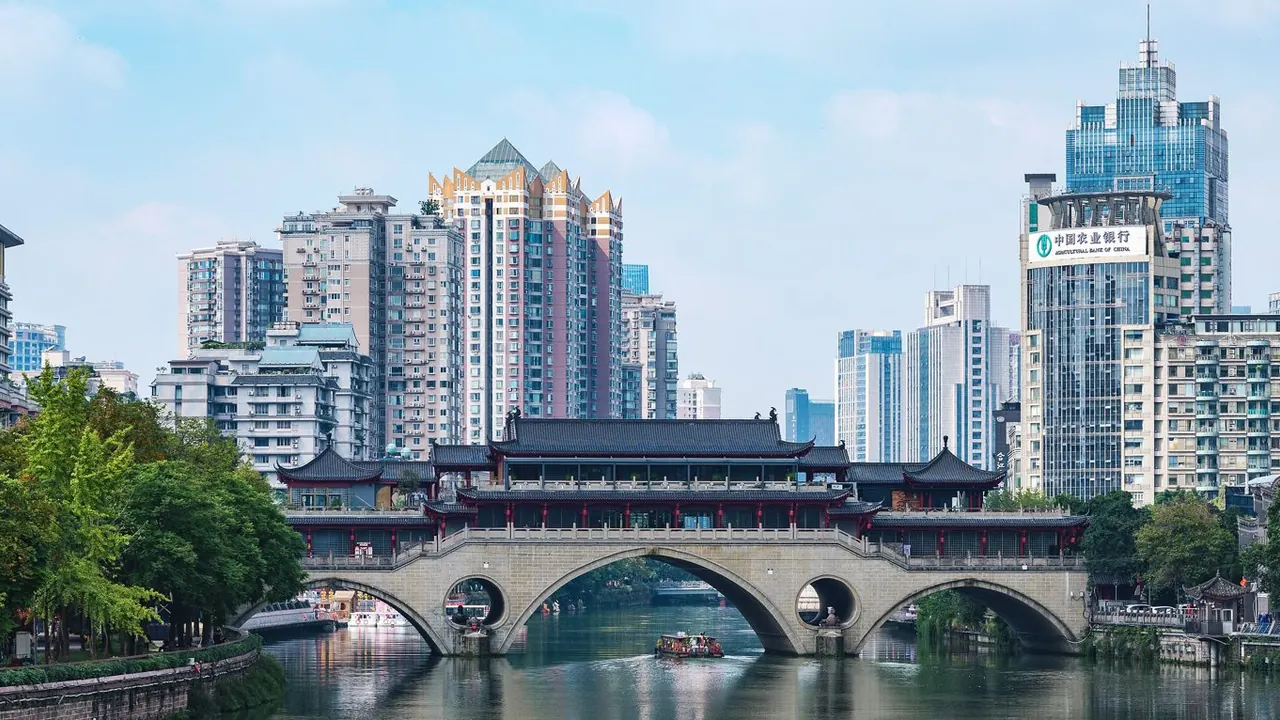
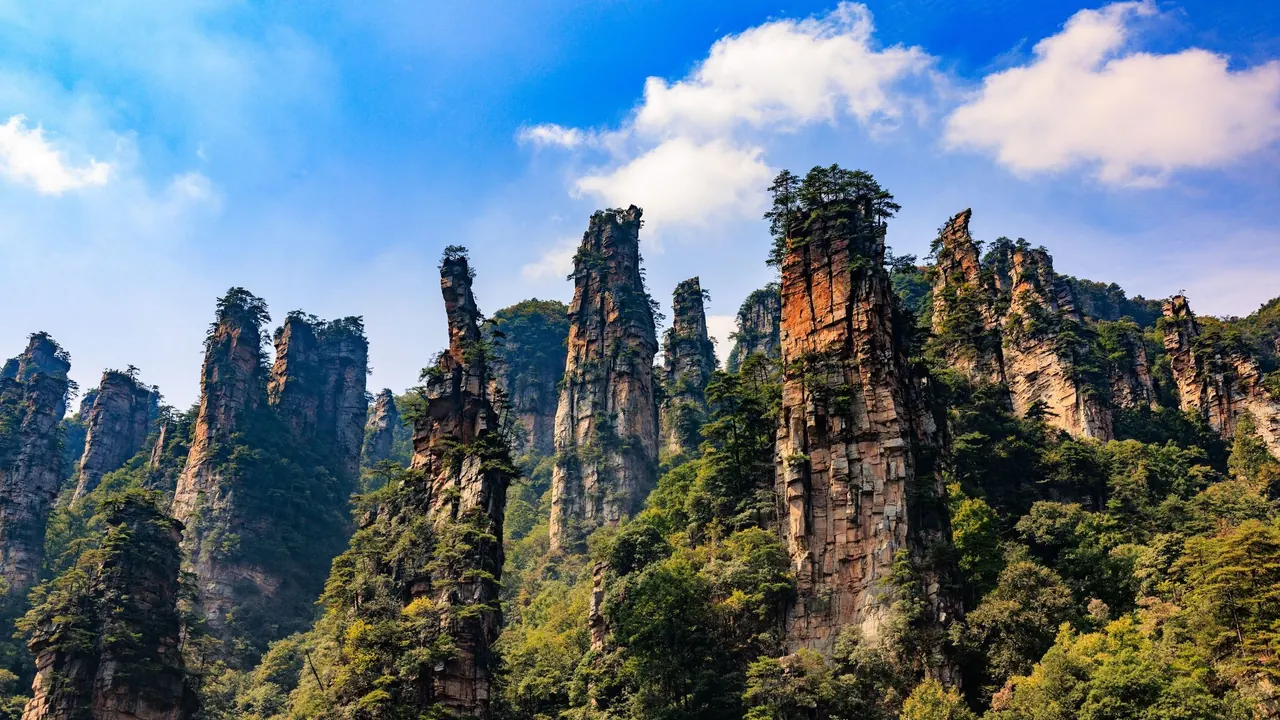
Photos: Chengdu by TurnOnTheNight, CC BY-SA 4.0, cropped; Zhangjiajie by David Tran, Pexels License.
Chengdu or Zhangjiajie?
Our verdict in twelve categories, each scored against the same fixed benchmark cities, and the climate month by month, so you can choose for your trip.
Choose Chengdu for
- nightlife
- shopping
- food and drink
Chengdu suits the traveller who wants a city to live in for a few days: long Sichuan dinners, teahouse afternoons in People's Park, temples and museums, late nights by the Jin River and a metro that makes it all easy. It also works as a base, with Leshan, Dujiangyan and Sanxingdui each about an hour out, and the pandas in the city itself.
Choose Zhangjiajie for
- nature and the outdoors
Zhangjiajie is a trip for the scenery and very little else. The sandstone pillars of Wulingyuan, the cliff paths of Tianmen Mountain and the glass bridges make it one of the most striking mountain landscapes in China. Choose it if you will happily rise at dawn, climb stone steps all day and go to bed early, and treat the town as a place to sleep between viewpoints.
Scoreboard
Twelve categories on one fixed scale from 0 to 100. The shaded stretch is the gap between the two.
Your match
Pick a travel style or drag the sliders, and both match scores follow your weighting.
Wins on nightlife and shopping with your weighting.
Wins on nature and the outdoors with your weighting.
What matters to you?
Category by category
What the scores mean for a trip.
Beaches & swimming
Neither city has a coast anywhere near it, so for swimming both come down to hotel pools. The difference is in what replaces the beach: Chengdu has leisure water parks for its humid summers, while Zhangjiajie offers river rafting in the gorges and boat rides on Baofeng Lake.
Food & drink
Chengdu is one of China's great eating cities, the source of Sichuan cooking with its numbing pepper, red-oil cold dishes and late-night beef-tallow hotpot, and its lanes are full of small family counters. There is real range too, from fierce to smoky and sweet-and-sour, plus park teahouses and some fine dining.
Zhangjiajie's western Hunan food is worth trying, especially sanxiaguo stew and wood-smoked bacon, but the choice is narrow. Near the park gates in Wulingyuan, meals are mostly generic food for tour groups, so the good eating is in the city's evening food streets.
Culture & sights
Chengdu has no historic core, but it has a solid set of sights: the Wuhou Shrine, Du Fu Thatched Cottage, the working Wenshu Monastery and Qingyang Palace, and the Jinsha and Sichuan museums. Allow three or four days for them.
Zhangjiajie's town offers half a day at most, with the quiet Ming-era Puguang Temple and a Tujia folk-customs park. Its heritage lies further out, in places like Fenghuang and Laosicheng.
Nightlife
Chengdu is known across China for staying out late. A hotpot dinner leads on to the neon bars and clubs along the Jin River, or to craft beer and cocktails in Yulin, and the snack streets keep going past midnight.
Zhangjiajie goes to bed early because its visitors are up at dawn for the parks. A beer at a riverside bar or a karaoke room is about the limit, and Wulingyuan is quieter still.
Nature & outdoors
Zhangjiajie is the reason many people travel to this part of China. The UNESCO-listed forest of sandstone pillars at Wulingyuan, often wrapped in mist, and the Heaven's Gate arch on Tianmen Mountain right above the town are scenery on a scale Chengdu cannot match. The paths are paved and stepped and crowded at peak times, but the views are extraordinary.
Chengdu itself sits on a flat, hazy basin floor with riverside greenways. Its nature lies an hour or more away, on the Taoist trails of Qingcheng, the cloud-forest climb of Emeishan and the bamboo panda country towards Wolong.
Day trips
Chengdu makes the stronger base. The Leshan Giant Buddha, the ancient Dujiangyan irrigation works and the Sanxingdui bronze masks are each about an hour away, and old market towns like Huanglongxi and Pingle, Emeishan and even Chongqing are all within reach.
Zhangjiajie has three excellent outings, the riverside old town of Fenghuang, cliff-top Furong Town and the UNESCO-listed ruins of Laosicheng. Beyond these, most nearby places offer more mountains rather than a change of scene.
Good for families
Chengdu has the panda base, which most children remember for years, plus a zoo, an aquarium park, amusement parks and big parks where local families gather. Spicy food and a sprawling city take some planning, but the metro helps.
Zhangjiajie is pure adventure for older children, with swinging cable cars, glass walkways, a lift on a cliff face and macaques by the path. Almost nothing is designed for them, though, and long queues and steep steps make it hard work with toddlers or pushchairs.
Getting around
Chengdu's metro is the deciding difference. It is clean, signed in English and reaches the panda base, the main sights, both airports and the rail stations, with cheap taxis and shared bikes for the rest.
In Zhangjiajie the forest park lies about 30km from town, reached by bus, taxi or a hired driver. Park shuttles, cable cars and lifts are confusing and mostly signed in Chinese, which is why many visitors split their stay between Wulingyuan and the city.
Shopping & style
Chengdu is a fashion-conscious city with busy luxury malls around Chunxi Road, the traditional-style quarter by the Daci Temple, and local buys such as Shu brocade, Sichuan embroidery and mountain teas.
Zhangjiajie has souvenir streets, dried mushrooms and smoked bacon, with Tujia xilankapu weaving and Miao silver the only real finds.
Affordability
Both are cheap places to spend a few days, with low-cost hotels, meals and taxis. What differs is where the money goes. In Chengdu most temples and museums cost little or nothing, so the bills come from hotpot, cocktails and train trips to Leshan. In Zhangjiajie the separately ticketed park pass, cable cars, lifts and glass bridges quickly become the biggest cost.
Live music & performing arts
Chengdu has more going on in the evening. Sichuan opera variety shows with face-changing and fire-spitting play every night, and its livehouses host indie bands and Sichuan-dialect hip-hop, one of the liveliest small-venue scenes in China.
Zhangjiajie offers large staged spectacles of Tujia and Miao folklore, including an open-air show beneath Tianmen's cliffs. They are colourful but made for tour groups, and the town has no music scene of its own.
Wellness & relaxation
Slowing down is part of Chengdu's local culture. Afternoons in bamboo chairs at the teahouses of People's Park, mahjong, ear-cleaning and cheap massage give a stay real pauses, even if the megacity surrounds them.
Zhangjiajie is a place of early starts and thousands of steps. Rest there means a foot massage after the trails, a hotel spa or a hot spring outside town, rather than an easy pace.
When should you go?
Pick your month. The climate figures are measured averages, not a forecast.
Chengdu in July
Zhangjiajie in July
Daytime high, °C
Rainfall in the month, mm
Where the figures come from
Zhangjiajie has no weather station within reach, so its figures come from a gridded climate model rather than a measured record, and read a broad area rather than the city itself.
Temperature and rainfall are climate normals, averaged over the years shown. Chengdu: 1991-2020 normals, Chengdu (4.5 km from centre). Zhangjiajie: 2001-2020 normals, NASA POWER reanalysis grid, no weather station within 90 km.
Both cities are at their best in spring and autumn, but their wet seasons fall at different times. In Chengdu the heavy rain comes in high summer, peaking at 211mm in August, when the days are hot and muggy as well. Winter there is dry but cool, grey and short on sunshine, fine for eating and teahouses but dull for views. April, May and October are the comfortable months for walking the city.
Zhangjiajie gets its rain earlier and in larger amounts, with May and June the wettest months at well over 200mm each, which brings mist to the pillars but also slippery steps. It is a few degrees colder than Chengdu in winter, with highs around 7°C in January and snow sometimes on the peaks. September and October are the safest bet for the mountains, drier than spring and with daytime highs in the low to mid twenties.
Which traveller are you?
For an outdoors trip, Zhangjiajie is the clear choice. Days on the walkways of Yuanjiajie and Tianzi Mountain, the cliff paths of Tianmen and rafting on the mountain rivers outclass the forested trails Chengdu reaches at Qingcheng and Emeishan.
On a food and nightlife trip, Chengdu wins easily. It is the home of Sichuan cooking, from hotpot to dan dan noodles, and its evenings run late through snack streets and the bars around Jiuyanqiao, while Zhangjiajie is quiet by ten.
On a family trip with children, Chengdu is easier, with the panda base, a zoo, an aquarium and safe parks, all reached by metro. Zhangjiajie thrills older children with cable cars and glass walkways but tires small ones on endless stairs.
Before you go
| Measure | Chengdu | Zhangjiajie |
|---|---|---|
| Official language | Putonghua | Putonghua |
| Currency | Yuan Renminbi (CNY) | Yuan Renminbi (CNY) |
| Sockets | ACI220 V, 50 Hz | ACI220 V, 50 Hz |
| Driving side | Right | Right |
| Time zone | UTC+8 | UTC+8 |
| Emergency number | Police 110, ambulance 120, fire 119 | Police 110, ambulance 120, fire 119 |
| Elevation | 500 m | 170 m |
| Main airport | Chengdu Shuangliu International Airport (CTU)16 km from centre77 non-stop destinations | Zhangjiajie Hehua International Airport (DYG)5 km from centre31 non-stop destinations |
| Public holidays this year | 6 days | 6 days |
By the numbers
| Measure | Chengdu | Zhangjiajie |
|---|---|---|
| City population | 20,937,757 | 1,517,027 |
| People per km² | 1,456 | 159 |
| Museums within 10 km | 10 | 0 |
| UNESCO World Heritage sites within 50 km | 0 | 1 |
Where else could you go?
Every comparison below shares a destination with this one, so you can follow Chengdu or Zhangjiajie somewhere new.
- Chongqingvs Chengdu
- Chongqingvs Zhangjiajie
- Guilinvs Zhangjiajie
- Yangshuovs Zhangjiajie
- Lijiangvs Chengdu
- Xi'anvs Zhangjiajie