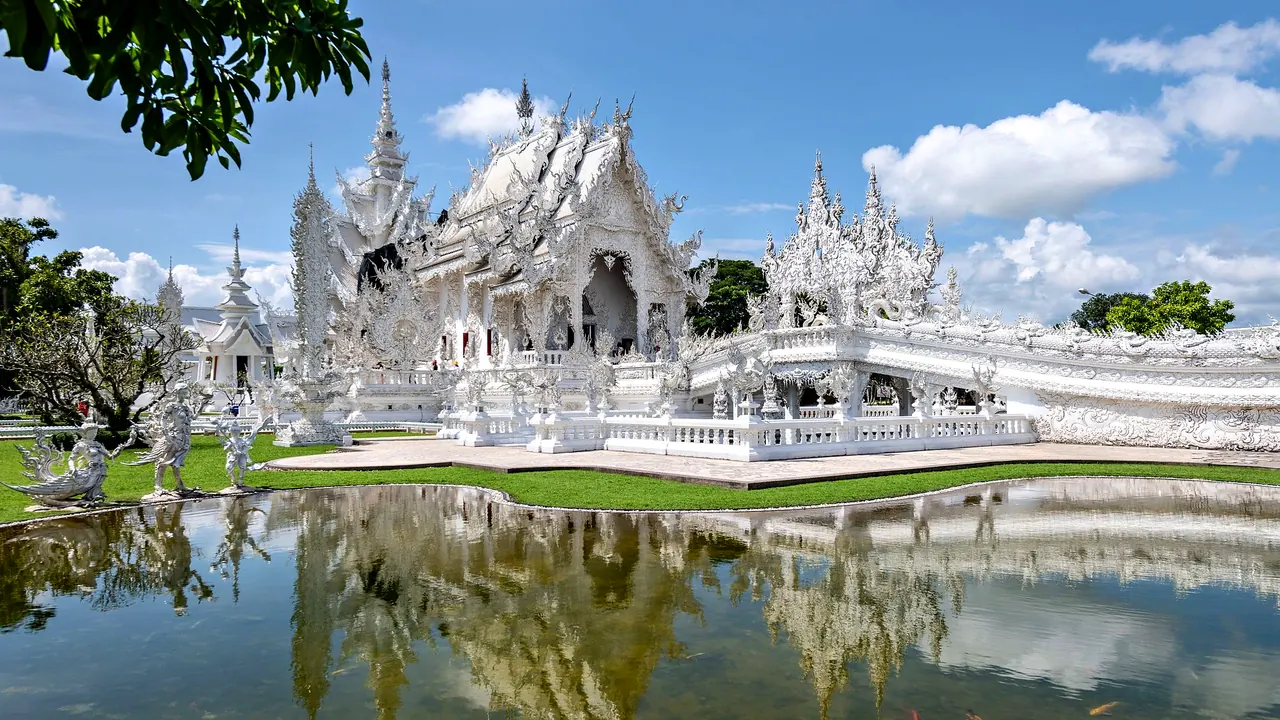
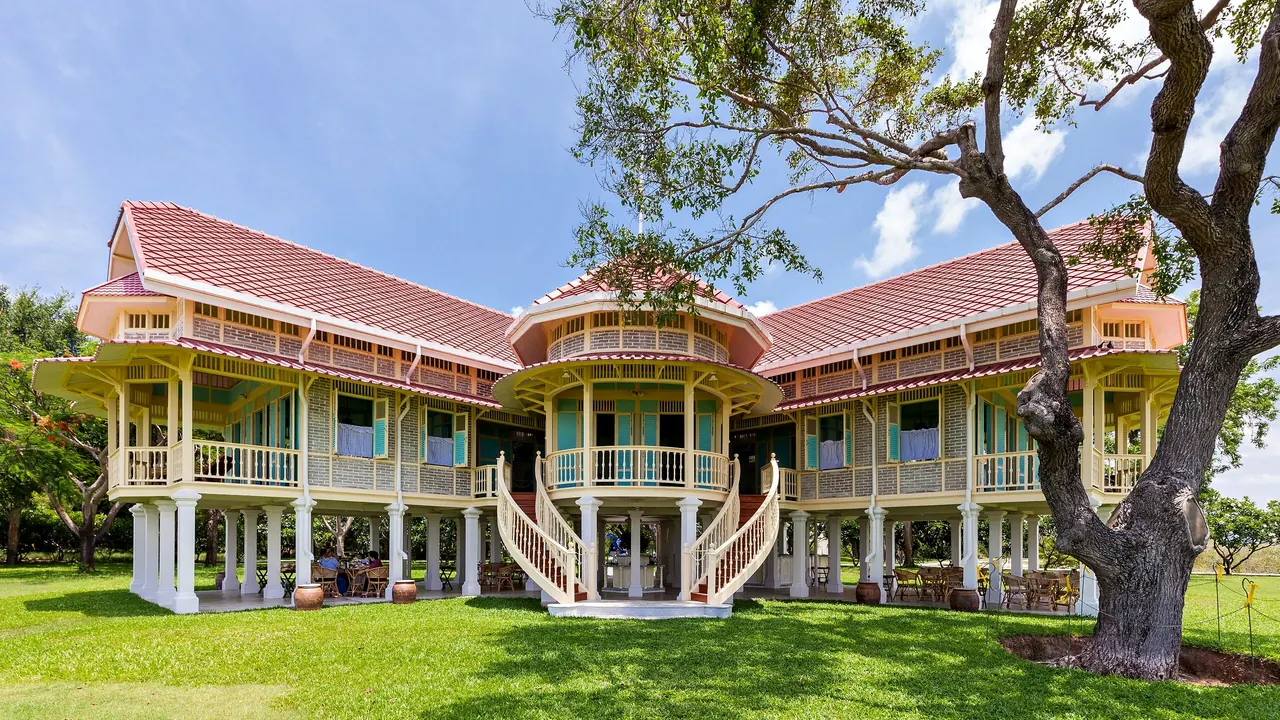
Photos: Chiang Rai by Kirandeep Singh Walia, Pexels License; Hua Hin by allPhoto Bangkok, Pexels License.
Chiang Rai or Hua Hin?
Our verdict in twelve categories, each scored against the same fixed benchmark cities, and the climate month by month, so you can choose for your trip.
Choose Chiang Rai for
- culture and sights
- prices
- nature and the outdoors
Chiang Rai suits travellers who want hill country and a cheap, slow trip built around temples and landscape. The White Temple, the Blue Temple and the Black House give it a modern art character Hua Hin cannot match, and the tea hills of Doi Mae Salong and Doi Tung are close by. Day-to-day costs are among the lowest in Thailand. It is a place for going out to see things rather than lying still, and it has no coast at all.
Choose Hua Hin for
- beaches
- families
- wellness
Pick Hua Hin if the trip is about the sea and about resting. Its long sandy beach and calm, warm Gulf water, together with resort pools and kids' clubs, make it far easier with children. Its destination spas and massage culture make it the better place to unwind. Sightseeing is thinner, mostly royal history and a palace or two, but Khao Sam Roi Yot and Phetchaburi make good outings when you want a break from the beach.
Scoreboard
Twelve categories on one fixed scale from 0 to 100. The shaded stretch is the gap between the two.
Your match
Pick a travel style or drag the sliders, and both match scores follow your weighting.
Wins on culture and sights and prices with your weighting.
Wins on beaches and families with your weighting.
What matters to you?
Category by category
What the scores mean for a trip.
Beaches & swimming
There is no contest here. Chiang Rai lies far inland in the northern hills, so swimming means a hotel pool, a forest waterfall pool or a reservoir on a hot afternoon.
Hua Hin is built around its main beach, several kilometres of pale sand running from the old fishing pier to Khao Takiab. Khao Tao, the pine-shaded Suan Son Pradipat and the empty stretches towards Pranburi are there for quieter days. The Gulf is warm and calm, though the water is often milky rather than clear and jellyfish appear at some times of year.
Food & drink
Both cities eat cheaply and well at their markets, but from different kitchens. Chiang Rai serves northern Thai food: khao soi, nam ngiao, sai ua sausage and chilli dips with sticky rice. It also has a deep café culture, fed by coffee and oolong grown in the surrounding hills.
Hua Hin's strength is seafood, chosen by weight at the stilted restaurants by the pier and grilled or stir-fried with chilli and basil, plus the night market on Dechanuchit Road. It also has more European and resort dining for a longer stay, where Chiang Rai's range runs thin after a few days.
Culture & sights
Chiang Rai has the more distinctive sightseeing. The White Temple, the Blue Temple and the Black House are contemporary works unlike anything else in Thailand. Wat Phra Kaew, where the Emerald Buddha was found, adds older Lanna history.
Hua Hin's sights trace its past as a royal seaside retreat: the red-and-cream railway station, the teak palace of Maruekhathaiyawan and the monkey-filled temple hill at Khao Takiab. The main palace is a working residence that visitors can rarely enter, and there are no museums of note, so the sights fill less of a stay.
Nightlife
Neither is a destination for nights out, but Hua Hin has more going on after dark. The lanes around Soi Bintabaht stay lively past midnight with beer bars and sports screens, though the scene there caters largely to older Western men. Rooftop and beachfront bars suit a sunset drink.
Chiang Rai has a short street of small bars near the clock tower playing reggae or acoustic covers, and beer tables at the night bazaar. The town is mostly asleep by midnight, so evenings are dinner and a drink or two.
Nature & outdoors
The two are close here and differ mostly in kind. Chiang Rai is green hill country of forest, farms and villages. Within an hour or so there is the Khun Korn waterfall, trekking through hill-tribe villages and the tea terraces of Doi Mae Salong. A longer drive reaches the sunrise cloud sea on Phu Chi Fa and the broad Mekong at the Golden Triangle. From late winter into spring, smoke from burning fields spoils the views for weeks.
Hua Hin's outdoors is wilder and better for wildlife. An hour south, Khao Sam Roi Yot rises in limestone peaks out of marsh and mangrove, with the cave pavilion at Phraya Nakhon. Inland, the rainforest of Kaeng Krachan shelters gibbons, hornbills and wild elephants. The bay adds kitesurfing from about February to May, though the heat keeps most activity to the early mornings.
Day trips
Each fills two or three days with outings, though nothing is famous enough to come for on its own. From Chiang Rai the usual loop runs north to the old walled town of Chiang Saen, the Golden Triangle viewpoint and the border market at Mae Sai. The Yunnanese tea village of Doi Mae Salong makes a separate day.
Hua Hin's best outing is Phetchaburi, an hour north, with its hilltop palace, the Khao Luang cave temple and some of Thailand's finest temple murals. Damnoen Saduak and the canal town of Amphawa make a longer day. Hua Hin's trips lean towards palaces and old towns, Chiang Rai's towards border country and hill villages.
Good for families
Chiang Rai is friendly to children but has little built for them, so a family trip there depends on the sights themselves. The mirrored White Temple and the elephant sanctuaries can hold a child for a morning, and grazing at the night market makes an easy supper. The hill outings suit older children who can cope with hours on the road better than toddlers. With little ones, avoid the smoky months of late winter and spring.
Hua Hin is easier because most of the day happens in one place. The beach, the warm shallows and the hotel grounds are all together, so a tired toddler is never far from a nap. When the sand loses its charm, the sheep farms and storybook European parks inland and the monkeys on Khao Takiab are a short taxi ride away. The drawbacks are the heat around noon and a town laid out for cars rather than prams, with a main road that is hard to cross on foot.
Getting around
Both are hard work without a car, scooter or driver, for different reasons. Chiang Rai has a small, flat centre around the clock tower, but its temples and hills are spread across the countryside, so tuk-tuks, a hired driver or a scooter do most of the work.
Hua Hin is a long ribbon along the Phetkasem highway. Green songthaews run up and down the strip, but the highway is daunting to cross on foot, and the national parks and Phetchaburi need a car and driver.
Shopping & style
Shopping is mostly markets in both, with no design or luxury scene in either. Chiang Rai's night bazaar and the Saturday walking street on Thanalai Road sell hill-tribe textiles, silver and carved wood, and Doi Mae Salong oolong makes the best souvenir. Hua Hin's weekend art-and-craft markets offer handmade jewellery and ceramics under the trees, while its malls and tailors cover everyday needs.
Affordability
Both are cheap by Western standards, but Chiang Rai stretches a budget further. Guesthouses, market meals and even the garden cafés cost very little, and the main expense is a driver or tours to the sights out of town.
Hua Hin's market food, songthaews and massages are similarly cheap. Costs climb along the beachfront, though, where resorts charge international rates, imported drinks are heavily taxed and Thai weekenders push room rates up on Fridays and Saturdays.
Live music & performing arts
Neither city has a concert, theatre or opera season, so performance should not decide between them. What Chiang Rai does offer is traditional: Lanna dance on the night bazaar stage and khantoke dinners pairing northern food with dancing. Hua Hin's live music is mostly cover bands and resort dance shows, with a long jazz connection through the royal family.
Wellness & relaxation
Hua Hin is the better place to rest. It has some of Asia's best-known destination spas, offering detox, yoga and fitness programmes in seafront gardens, a spa in almost every resort and massages under the trees on the beach.
Chiang Rai's appeal is its slow small-town pace, plus something Hua Hin lacks: natural hot springs at Pong Phrabat and Mae Kachan for a simple soak, along with meditation retreats in the countryside. Its smoky season in late winter and spring is the time it feels least restful.
When should you go?
Pick your month. The climate figures are measured averages, not a forecast.
Chiang Rai in July
Hua Hin in July
Daytime high, °C
Rainfall in the month, mm
Where the figures come from
Hua Hin's sunshine is measured 83 km from the centre, at Prachuap Khirikhan.
Temperature and rainfall are climate normals, averaged over the years shown. Chiang Rai: 1991-2020 (sunshine 1961-1990) normals, Chiang Rai (1 km from centre). Hua Hin: 1961-1990 (sunshine 1981-2010, rainfall 1981-2010) normals, Hua Hin (1.8 km from centre).
Chiang Rai is at its best from November to February, with almost no rain, long sunny days and highs that stay comfortable for walking around temples. March and April turn hot, peaking at 35°C, and this is also the season of smoke haze from field burning. The monsoon arrives in May and builds to a peak in August with 390mm, when the sunshine drops by nearly half.
Hua Hin has a similar dry season, roughly December to April, but its heat is steadier and has no sharp spring peak. The sea stays at 27°C or more all year, so there is no month when swimming is out of season. Its wettest month comes later, in October with 221mm, and its summer months are much drier than Chiang Rai's. Midwinter suits both cities, while May to September clearly favours Hua Hin.
Which traveller are you?
For a beach and sun trip, Hua Hin is the only choice of the two. It has kilometres of pale sand, a calm Gulf warm enough to swim in any month and quieter beaches towards Pranburi. Chiang Rai lies deep in the hills and has only pools and waterfalls.
On a culture and arts trip, Chiang Rai has more to see. The White Temple, the Blue Temple and the Black House are modern temple art found nowhere else, and Lanna temples and the ruins at Chiang Saen are nearby. Hua Hin's palaces fill a day or two.
On a family trip with young children, Hua Hin is far easier. Resorts with big pools and kids' clubs, gentle sea, two water parks and pony rides on the beach keep children busy close to base. Chiang Rai has Singha Park and elephant sanctuaries, but long drives between them.
Before you go
| Measure | Chiang Rai | Hua Hin |
|---|---|---|
| Official language | Thai | Thai |
| Currency | Baht (THB) | Baht (THB) |
| Sockets | ABCF220 V, 50 Hz | ABCF220 V, 50 Hz |
| Driving side | Left | Left |
| Time zone | UTC+7 | UTC+7 |
| Emergency number | Police 191, ambulance 1669, fire 199 | Police 191, ambulance 1669, fire 199 |
| Elevation | 390 m | 9 m |
| Main airport | Mae Fah Luang - Chiang Rai International Airport (CEI)8 km from centre4 non-stop destinations | Suvarnabhumi Airport (BKK)150 km from centre150 non-stop destinations |
By the numbers
| Measure | Chiang Rai | Hua Hin |
|---|---|---|
| City population | 70,610 | 59,369 |
| People per km² | 1,159 | 687 |
| Museums within 10 km | 4 | 0 |
| UNESCO World Heritage sites within 50 km | 0 | 0 |
| Swim season, months above 21 °C | - | 12 months |
Where else could you go?
Every comparison below shares a destination with this one, so you can follow Chiang Rai or Hua Hin somewhere new.
- Pattayavs Hua Hin
- Bangkokvs Hua Hin
- Chiang Maivs Chiang Rai
- Luang Prabangvs Chiang Rai
- Siem Reapvs Hua Hin
- Krabivs Hua Hin