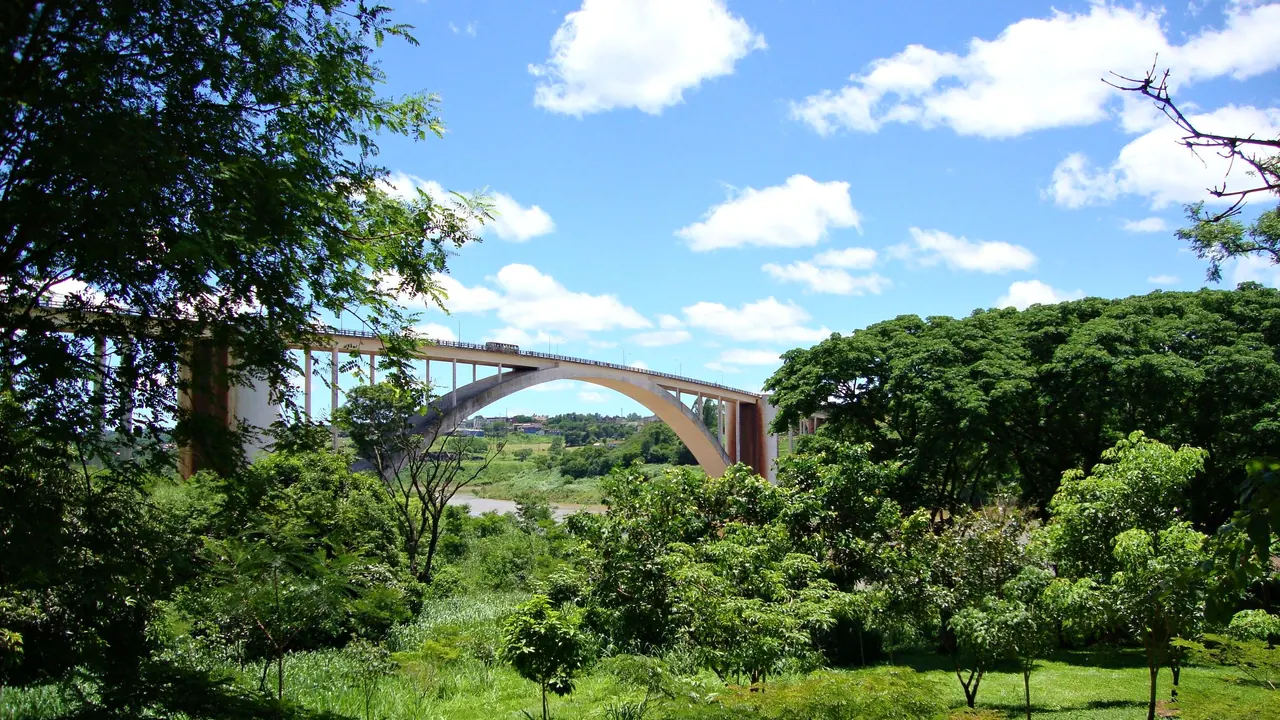
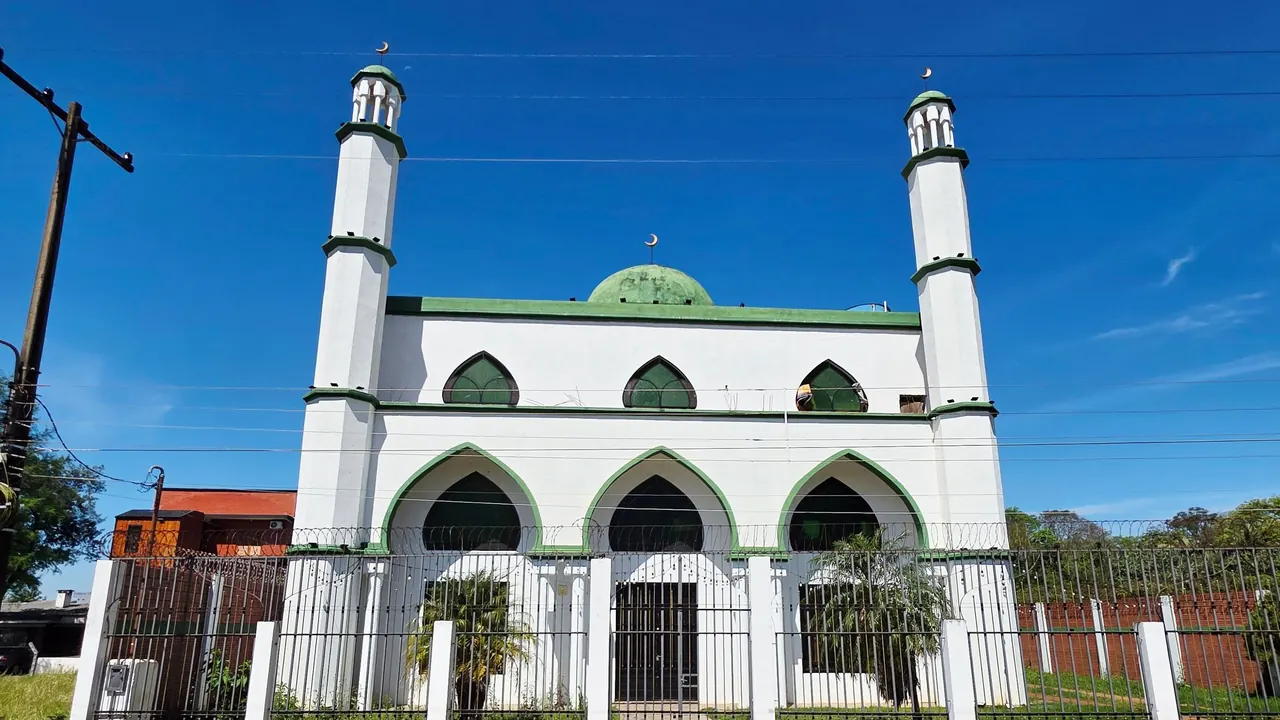
Photos: Ciudad del Este by Liam King, CC BY 2.0, cropped; Encarnación by Horacio Cambeiro, CC BY-SA 3.0, cropped.
Ciudad del Este or Encarnación?
Our verdict in twelve categories, each scored against the same fixed benchmark cities, and the climate month by month, so you can choose for your trip.
Choose Ciudad del Este for
- nature and the outdoors
- shopping
- food and drink
Ciudad del Este is the better base for travellers who come for the Iguazú Falls and the forest of the triple frontier, with a side order of duty-free shopping. It is a working border town with little to see in itself and quiet, unappealing streets after dark, but the falls, the Itaipu dam and the Saltos del Monday are all close. That makes it a practical, cheap place to sleep between big outdoor days, especially with a car or a driver.
Choose Encarnación for
- beaches
- getting around
- nightlife
Encarnación suits a slower summer trip built around the river and the past. Its sandy beaches on the Paraná, the evening crowds on the Costanera and the carnival give it a seasonal life that its northern neighbour lacks, and the Jesuit missions of Trinidad and Jesús are an easy outing. Pick it for beach days, mission ruins and an unhurried pace rather than for natural spectacle.
Scoreboard
Twelve categories on one fixed scale from 0 to 100. The shaded stretch is the gap between the two.
Your match
Pick a travel style or drag the sliders, and both match scores follow your weighting.
Wins on nature and the outdoors and shopping with your weighting.
Wins on beaches and getting around with your weighting.
What matters to you?
Category by category
What the scores mean for a trip.
Beaches & swimming
Encarnación is the only one of the two where a beach day makes sense. Its Costanera runs along sandy river beaches such as Playa San José, an easy walk from the centre, and from December to March they fill with families, music and tereré into the evening. The water is brownish and the sand largely man-made, but it is a proper summer scene.
Ciudad del Este, by contrast, offers only a few simple banks on the Paraná and the Itaipu reservoir where locals bathe on hot weekends, and its city lake is not for swimming. Most visitors cool off in a hotel pool.
Food & drink
The two eat much alike, with chipa from street baskets, sopa paraguaya, grilled meat and tereré at the core, and neither has much fine dining. The difference lies in the immigrant layer. Ciudad del Este's Lebanese and Chinese traders, plus the Brazilians across the river, bring shawarma, Arab bakeries, Cantonese kitchens and buffets by weight.
Encarnación's influences are German, Ukrainian and Japanese, felt in bakeries, cold meats and beer out in the farming colonies, while its waterfront leans to pizza, burgers and grills for summer crowds.
Culture & sights
Neither city is a place for sightseeing, though Encarnación has a little more to fill an afternoon. It has a grid of plazas, a cathedral, a few small museums and the Costanera, built over the old lower town that the Yacyretá reservoir flooded.
Ciudad del Este, founded in 1957 as a frontier trading post, has the striking concrete roof of the Cathedral of San Blas and the lakeside promenade, and its interest is mostly the border market itself. In both, the real heritage lies outside town.
Nightlife
Encarnación has the livelier evenings, at least in summer, when the riverfront stays busy late, beach bars play music and big clubs fill after midnight with Paraguayans and Argentines, reaching a peak on carnival weekends. Out of season it shrinks to a few bars in the centre.
Ciudad del Este empties once the shops shut, and its microcentro is best avoided on foot at night. What there is, a few weekend bars and clubs, terraces and the casino, lies along the avenues away from the market, and some overnight visitors cross to the Brazilian side instead.
Nature & outdoors
This is where Ciudad del Este pulls far ahead. The Iguazú Falls, about 30km away, can be seen from catwalks in Brazil and walkways up to the Devil's Throat in Argentina, surrounded by protected Atlantic forest full of birds, butterflies and coatis. Nearer town are the Saltos del Monday and forest reserves around the Itaipu reservoir.
Encarnación's nature is gentler and closer to home: the vast Paraná at sunset, a waterfront path for running and cycling, and some kayaking and fishing. Wilder forest at San Rafael means a long drive on rural roads.
Day trips
Encarnación has the stronger list of outings, mainly because the UNESCO-listed missions of Trinidad and Jesús are only about 30km and 40km away. Posadas, San Ignacio Miní and the German-founded colonies among the yerba mate fields round it out.
From Ciudad del Este those same missions are too far for a comfortable day. Its trips are of a different kind: the Itaipu dam, a three-country hop to Foz do Iguaçu and Puerto Iguazú, and the Bertoni house and museum in the forest above the river.
Good for families
Encarnación is the easier city to spend time in with children, at least in summer. The beaches are shallow at the edges and lifeguarded in season, and the Costanera has play areas and room for scooters, although there are no zoos or theme parks.
Ciudad del Este has the bigger highlights, with coatis on the falls paths, soaking boat rides and the walk-through aviaries of the bird park. The city itself, however, is loud, crowded and awkward with a pushchair, so families tend to treat it as a base and plan every outing with a driver.
Getting around
Ciudad del Este is the harder of the two to move around. Its commercial centre is compact, but walking it means squeezing past stalls, touts, motorbikes and pickpockets on broken pavements, and the basic local buses are little use to a visitor. Itaipu and the Saltos del Monday are on the Paraguayan side, but the Iguazú Falls mean border controls and traffic that can back up badly on the Friendship Bridge, so a car or hired driver makes the region far easier.
Encarnación is much simpler. Its small grid centre leads down to the Costanera and the beaches on foot, summer heat aside, and taxis and ride-hailing cover the rest. A short international train even crosses to Posadas, though the missions still take a long-distance bus and a walk, or a car.
Shopping & style
Ciudad del Este exists to sell, and its multi-storey stores and galleries near the bridge are crammed with electronics, cameras, perfumes and spirits at low duty. It rewards a buyer after one specific item who checks for fakes and warranties, but it has nothing for fashion or crafts.
Encarnación's shopping is a smaller and more practical version aimed at Argentines crossing the bridge. It does have the edge for something local, such as ñandutí lace, leather and tereré gourds.
Affordability
Both are very cheap by international standards, with low-cost chipa, set lunches and well-priced hotels. In Ciudad del Este the hidden costs are park entry at the falls on the Brazilian and Argentine sides and the taxis or drivers needed to get anywhere.
Encarnación's sights are closer and cheaper to reach, with modest entry to the missions, but waterfront hotels fill up and charge more in high summer and on carnival weekends.
Live music & performing arts
Encarnación has more to attend, thanks largely to the Carnaval Encarnaceno, Paraguay's best-known carnival, when feathered troupes and drummers parade over several summer weekends. A modest municipal theatre and riverside summer concerts add a little more.
Ciudad del Este has no theatre or concert season of note. Its live music comes down to Paraguayan harp and polka in restaurants and the odd touring act, with slightly more on offer in Foz do Iguaçu.
Wellness & relaxation
Neither city has a spa or bathing culture, but Encarnación is the more restful place to be. Long siestas, tereré in the shade and sunsets over the wide Paraná set an unhurried rhythm. Ciudad del Este is all traffic and trade, with calm limited to the lakeside in the evening, and travellers wanting rest near the falls usually book a forest resort across the border.
When should you go?
Pick your month. The climate figures are measured averages, not a forecast.
Ciudad del Este in July
Encarnación in July
Daytime high, °C
Rainfall in the month, mm
Where the figures come from
Ciudad del Este's sunshine is measured 28 km from the centre, at Iguazu Aerodrome.
Temperature and rainfall are climate normals, averaged over the years shown. Ciudad del Este: 1992-2020 (sunshine 1991-2020, rainfall 1991-2020) normals, Foz Do Iguacu Aeroporto (3.4 km from centre). Encarnación: 1991-2020 normals, Encarnacion (3.8 km from centre).
The two cities share almost the same climate: hot, humid summers, mild winters and rain spread through the year rather than a dry season. From November to March both reach the low 30s, with Ciudad del Este peaking at 33°C in January. That is warm enough for Encarnación's river beaches but tiring for long walks at midday, and it is when the falls near Ciudad del Este run fullest after heavy rain. October is the wettest month in both, at around 229mm in Encarnación, with plenty of showers in December and January too.
June to August is the cooler, drier stretch, with highs near 22°C in Encarnación in July and only 76mm of rain in Ciudad del Este that month. These are the best months for walking the falls trails or the mission ruins in comfort, though the beaches empty. Encarnación tends to see a little more sunshine through the winter, while Ciudad del Este is greyer in June.
Which traveller are you?
On a beach and sun trip, Encarnación is the clear pick. Its Costanera has sandy river beaches within walking distance of the centre, with summer crowds, volleyball and music. Ciudad del Este has only a few local riverbanks and hotel pools.
For an outdoors trip, Ciudad del Este wins easily. The Iguazú Falls are a short drive across the bridge, with Atlantic forest, coatis, toucans and boat rides into the spray, and the Saltos del Monday and Itaipu reserves are closer still.
On a shopping trip, Ciudad del Este is the place. Its microcentro is a dense duty-free market for electronics, perfumes and spirits that draws buyers from two countries. Encarnación's commercial streets near the bridge are a smaller, more practical version.
Before you go
| Measure | Ciudad del Este | Encarnación |
|---|---|---|
| Official language | Spanish, Guarani | Spanish, Guarani |
| Currency | Guarani (PYG) | Guarani (PYG) |
| Sockets | C220 V, 50 Hz | C220 V, 50 Hz |
| Driving side | Right | Right |
| Time zone | UTC-3 | UTC-3 |
| Emergency number | 911 | 911 |
| Elevation | 185 m | 91 m |
| Main airport | Guaraní International Airport (AGT)24 km from centre | Teniente Ramon A. Ayub Gonzalez International Airport (ENO)12 km from centre |
| Public holidays this year | 12 days | 12 days |
By the numbers
| Measure | Ciudad del Este | Encarnación |
|---|---|---|
| Population | 350,000 | 106,842 |
| People per km² | 2,349 | 333 |
| Museums within 10 km | 1 | 6 |
| UNESCO World Heritage sites within 50 km | 1 | 2 |
Where else could you go?
Every comparison below shares a destination with this one, so you can follow Ciudad del Este or Encarnación somewhere new.
- Foz do Iguacuvs Ciudad del Este
- Puerto Iguazuvs Ciudad del Este
- Puerto Iguazuvs Encarnación
- Foz do Iguacuvs Encarnación
- Asunciónvs Encarnación
- Asunciónvs Ciudad del Este