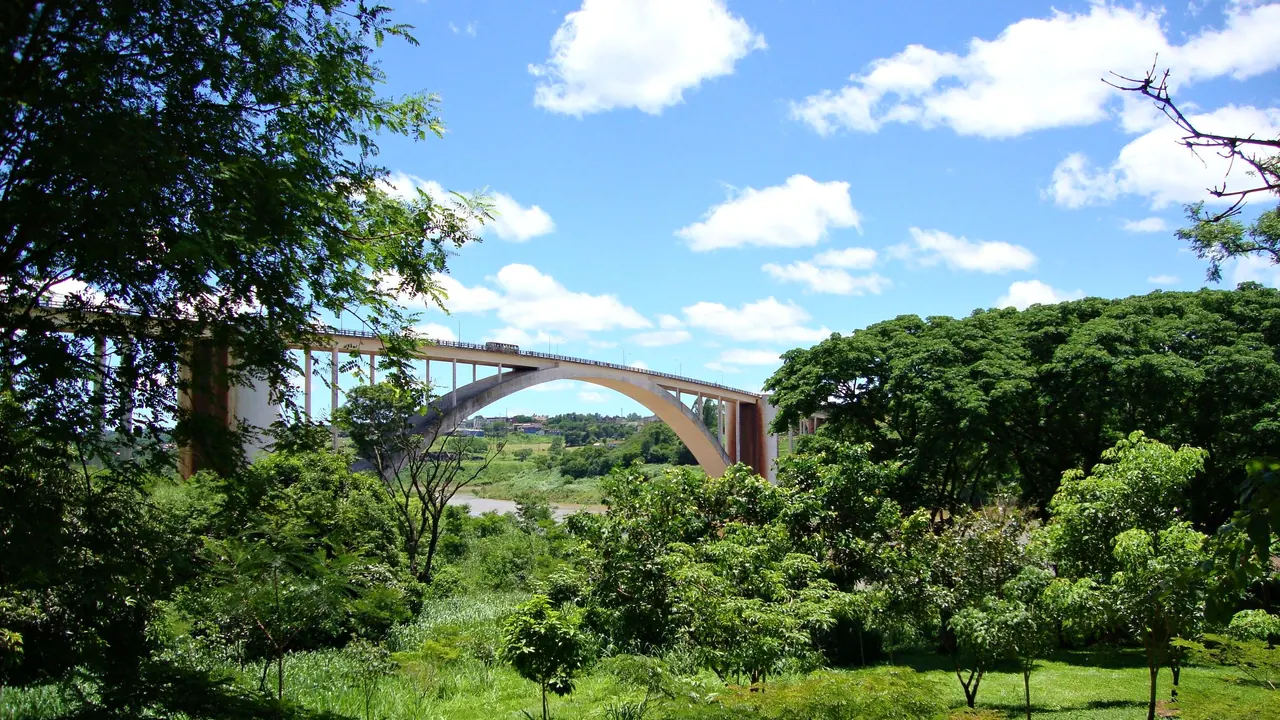
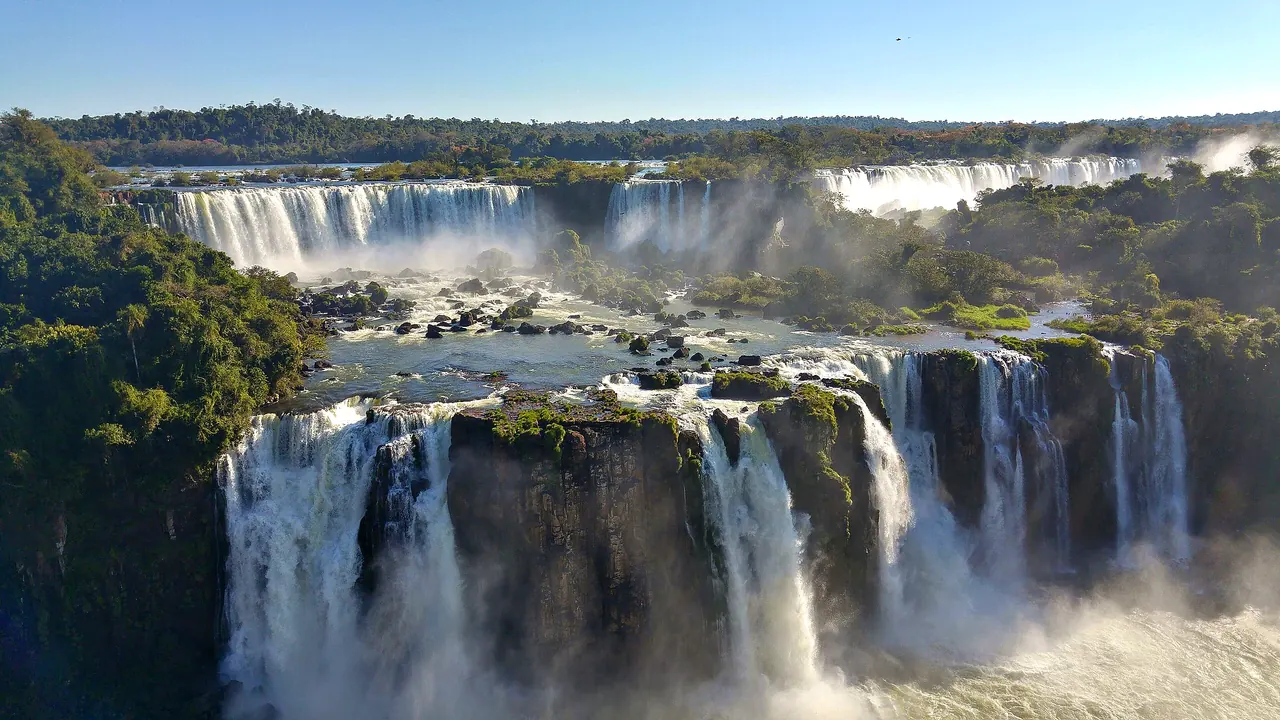
Photos: Ciudad del Este by Liam King, CC BY 2.0, cropped; Foz do Iguacu by Gabriel Resende Veiga, CC BY-SA 4.0, cropped.
Ciudad del Este or Foz do Iguacu?
Our verdict in twelve categories, each scored against the same fixed benchmark cities, and the climate month by month, so you can choose for your trip.
Choose Ciudad del Este for
- shopping
- prices
- day trips
Ciudad del Este suits the traveller who is mainly there to buy something and to keep costs down. Its microcentro of multi-storey stores and street stalls is the reason it exists, rooms and meals on the Paraguayan side are cheaper than across the river, and from here the Itaipu dam, the Saltos del Monday and the Bertoni museum are all short outings. Expect a town that empties at dusk, streets that are hard work on foot, and a border to cross for the falls.
Choose Foz do Iguacu for
- families
- culture and sights
- nature and the outdoors
For a first visit to the Iguazú Falls, especially with children, Foz do Iguaçu is the easier and more rewarding base. The Brazilian park entrance, the bird park and the big pool hotels are all on one road out of town, the falls walkway is gentle enough for small legs, and the city adds a few odd sights of its own in the mosque, the Buddhist temple and the Three Frontiers obelisk. It costs a little more, and it still sends you over the bridge if you want the shopping.
Scoreboard
Twelve categories on one fixed scale from 0 to 100. The shaded stretch is the gap between the two.
Your match
Pick a travel style or drag the sliders, and both match scores follow your weighting.
Wins on shopping and prices with your weighting.
Wins on families and culture and sights with your weighting.
What matters to you?
Category by category
What the scores mean for a trip.
Beaches & swimming
Neither town has a beach worth planning around. Both sit far inland on the Paraná, and in both a hot afternoon usually ends in the hotel pool.
What little there is differs slightly. Ciudad del Este has a few plain sandy riverbanks where local families bathe, and its city lake is for strolling only. From Foz, the lakeside towns on the Itaipu reservoir have built proper sandy beaches with lifeguarded swimming areas, half an hour to an hour away by car.
Food & drink
Eating is about equally modest in both, and both lean on an Arab community for their best everyday food: shawarma, esfihas and kibbeh are easy to find on either bank.
Ciudad del Este adds a distinctly Paraguayan layer, with warm chipa from street vendors, sopa paraguaya, mandioca and tereré passed around everywhere, plus Cantonese and Taiwanese kitchens from its Chinese community. Foz is the place for a full Brazilian churrascaria evening with rodízio, and its easy access to Puerto Iguazú brings Argentine parrillas and Malbec within reach for dinner.
Culture & sights
Foz do Iguaçu gives a curious visitor more to see, though neither town has an old quarter. Its Itaipu tours go across the crest and into the dam, and the white-domed Omar Ibn Al-Khattab mosque, the Chen Tien Buddhist temple facing Paraguay and the Three Frontiers obelisk add a short, unusual circuit.
Ciudad del Este, founded only in 1957, has the concrete-roofed Cathedral of San Blas and the Lago de la República promenade, and little more. Its real interest is the spectacle of the border market, with traders from five or six nations side by side, rather than any building.
Nightlife
Evenings are quiet in both, and the difference is mostly one of feel. Ciudad del Este shuts down when the shops close, its centre turns deserted and best avoided on foot, and going out means a few bars, clubs and beer terraces out in the residential districts, plus the casino.
Foz has a single walkable strip of bars and terraces with a student crowd from Thursday to Saturday, and a short taxi ride to Puerto Iguazú's small bar cluster. Most visitors on either side end the day with a long dinner after an early start at the falls.
Nature & outdoors
Both are bases for the same falls, but Foz do Iguaçu is the one built around them. The Brazilian park entrance is on its doorstep, the cliff-edge walkway gives the great panorama, and the park adds rafting, kayaking, cycling and jungle walks to the boat rides into the spray, with caimans alongside the coatis and toucans.
From Ciudad del Este the falls mean a border crossing and some 30km of road, which costs time. In return it has its own wild corners close by: the tall, powerful Saltos del Monday just south of town and the forest reserves with birdwatching around the Itaipu reservoir.
Day trips
Ciudad del Este has the fuller list of short outings. The Itaipu dam can be toured from the Paraguayan side at Hernandarias, the Moisés Bertoni house and museum sits in forest above the Paraná, and both Foz and Puerto Iguazú are across the river for a change of country.
From Foz, the outings are mostly the border towns themselves: Puerto Iguazú paired with the Argentine falls, and Ciudad del Este for a shopping run. In both, the Jesuit missions are the great prize, and in both they lie too far for a comfortable day.
Good for families
Foz do Iguaçu is far easier with children. The short, gentle walkway with a lift at the end, the bird park right at the park gate and the resort hotels with pools on the same road mean a family can see the best of the region with little travel, though boat rides have minimum ages and summer brings mosquitoes.
Ciudad del Este reaches the same falls and bird park, but only by crossing the bridge each time. At home it offers a loud, crowded shopping district with uneven pavements and heavy traffic, which is hard going with a pushchair, so families there tend to hire a driver and keep the market visits short.
Getting around
Foz do Iguaçu is the simpler place to move around. A direct city bus runs from the urban terminal out to the falls and the bird park, and the compact centre is walkable, even if Itaipu and the Argentine side still call for a taxi or transfer.
Ciudad del Este's centre is small but hard to walk, with stalls, touts, motorbikes, broken pavements and pickpockets, and its local buses are of little use to a visitor. Almost every outing means a taxi or driver plus a border check, and traffic on the Friendship Bridge can back up badly.
Shopping & style
This is Ciudad del Este's strongest card. Low import duties fill the microcentro by the bridge with electronics, cameras, perfume, spirits and toys, sold from a few quiet air-conditioned stores and a great many bargaining stalls, and buyers who check models and warranties can do well.
Foz's shopping is largely a trip to its neighbour, plus duty-free shops at the border, a large mall and souvenirs such as Brazilian gemstones and hammocks. Neither town has boutique streets or a design scene, and anyone after Paraguayan crafts like ñandutí lace will find them more easily elsewhere.
Affordability
Ciudad del Este is the cheaper bed for the night. Business hotels with pools cost well under their Brazilian equivalents, grilled-meat lunches and set menus are cheap, and imported goods are the city's whole reason for being.
Foz is still inexpensive day to day, with affordable buffets, churrascarias and buses, and its cheap direct bus to the falls saves on taxis. Wherever you stay, the park fees, boat rides and Itaipu tours are what really fill the budget.
Live music & performing arts
Neither town has a stage worth planning an evening around, with no opera, orchestra or theatre season on either bank.
The live music differs in style. In Ciudad del Este it is Paraguayan harp, guarania and polka played in restaurants and at local festivities, small and genuinely local. In Foz it is the big dinner show, where tour groups watch samba, tango and Paraguayan harp in a single staged sweep across the continent.
Wellness & relaxation
Ciudad del Este gives a tired traveller very little to work with. It has no spa or bathing culture, and the town runs on traffic and trading noise, so rest comes down to a hotel pool, an evening stroll by the Lago de la República or a tereré in the shade.
Across the river, the hotel does the work instead. The large resorts on the road to the falls in Foz, and the few inside the park, have spas, gardens and pools well away from the town. A quiet day between visits to the walkways is easy to arrange there, so anyone hoping to build real rest into this trip will find it far more readily on the Brazilian bank.
When should you go?
Pick your month. The climate figures are measured averages, not a forecast.
Ciudad del Este in July
Foz do Iguacu in July
Daytime high, °C
Rainfall in the month, mm
Where the figures come from
Ciudad del Este's sunshine is measured 28 km from the centre, at Iguazu Aerodrome.
Temperature and rainfall are climate normals, averaged over the years shown. Ciudad del Este: 1992-2020 (sunshine 1991-2020, rainfall 1991-2020) normals, Foz Do Iguacu Aeroporto (3.4 km from centre). Foz do Iguacu: 1992-2020 (sunshine 1991-2020, rainfall 1991-2020) normals, Foz Do Iguacu Aeroporto (2.6 km from centre).
The two cities sit either side of the same river and share exactly the same climate, so the choice between them makes no difference to when you go. From October to March days run hot and humid, with highs around 30°C to 33°C, and this is also the wettest stretch: October brings about 227mm of rain, and December and January are nearly as wet. That rain is what fills the falls, and the summer months also have the most sunshine, so the spray is at its heaviest and the forest at its greenest, but long walks in the heat are tiring.
June to August is the gentler season, with highs near 23°C to 26°C and July the driest month at about 76mm. It is the most comfortable time for walking the trails at the falls or the streets of either town, though the falls run lower and June is the greyest month. April, May and September sit in between, warm without the worst of the summer heat, though May can be surprisingly wet.
Which traveller are you?
On a family trip with children, Foz do Iguaçu is clearly the better base. The bird park and the short Brazilian walkway with its lift are both on the falls road beside the resort hotels, while Ciudad del Este's crowded, traffic-heavy centre offers little to children beyond the lakeside park.
For a shopping trip, Ciudad del Este wins outright. It is the discount market itself, with electronics, perfume, spirits and cosmetics in calm department stores and noisy galleries alike. From Foz the same shops are a bridge crossing away, with queues at the border both ways.
On a trip on a tight budget, Ciudad del Este stretches money further. Business hotels with pools, asado lunches and street chipa cost less than their Brazilian equivalents, although taxis and drivers add up and park entry fees for the falls are the same whichever town you stay in.
Before you go
| Measure | Ciudad del Este | Foz do Iguacu |
|---|---|---|
| Official language | Spanish, Guarani | Portuguese |
| Currency | Guarani (PYG) | Brazilian Real (BRL) |
| Sockets | C220 V, 50 Hz | CN60 Hz |
| Driving side | Right | Right |
| Time zone | UTC-3 | UTC-3 |
| Emergency number | 911 | Police 190, ambulance 192, fire 193 |
| Elevation | 185 m | 164 m |
| Main airport | Guaraní International Airport (AGT)24 km from centre | Cataratas International Airport (IGU)12 km from centre10 non-stop destinations |
| Public holidays this year | 12 days | 14 days |
By the numbers
| Measure | Ciudad del Este | Foz do Iguacu |
|---|---|---|
| Population | 350,000 | 285,415 |
| People per km² | 2,349 | 462 |
| Museums within 10 km | 1 | 1 |
| UNESCO World Heritage sites within 50 km | 1 | 1 |
Where else could you go?
Every comparison below shares a destination with this one, so you can follow Ciudad del Este or Foz do Iguacu somewhere new.
- Puerto Iguazuvs Foz do Iguacu
- Puerto Iguazuvs Ciudad del Este
- Encarnaciónvs Foz do Iguacu
- Encarnaciónvs Ciudad del Este
- Asunciónvs Ciudad del Este
- Asunciónvs Foz do Iguacu