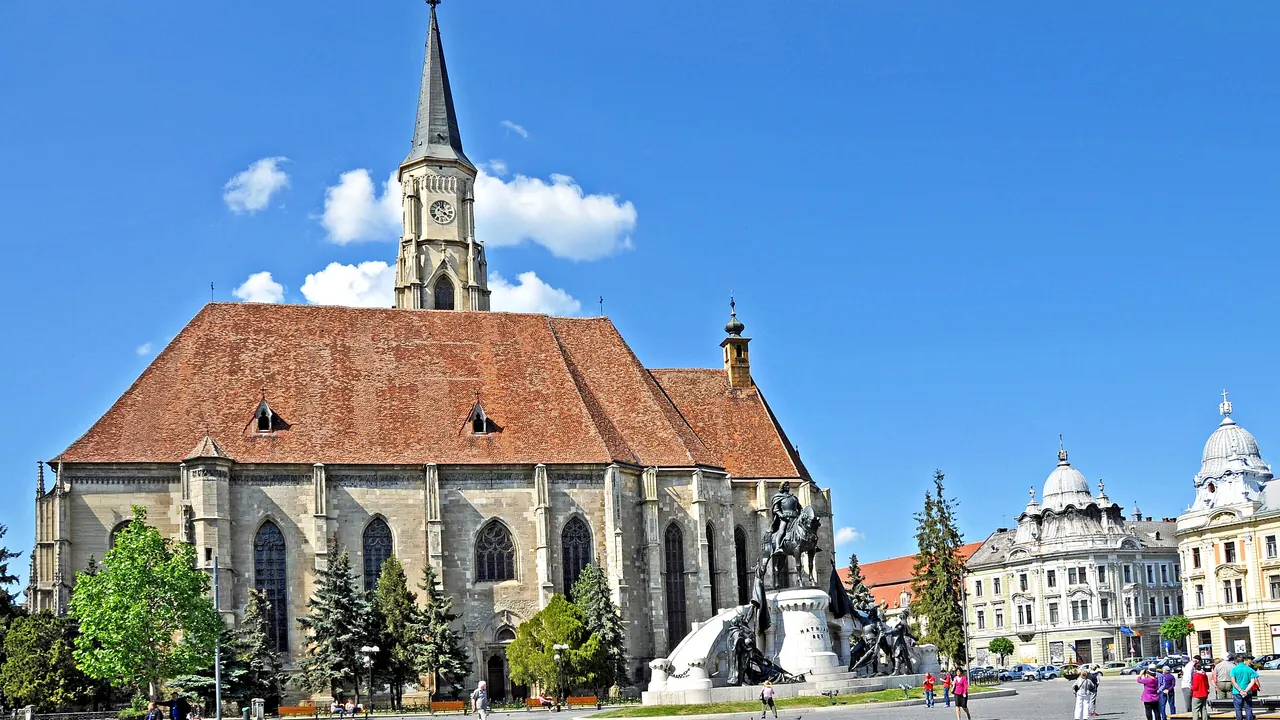
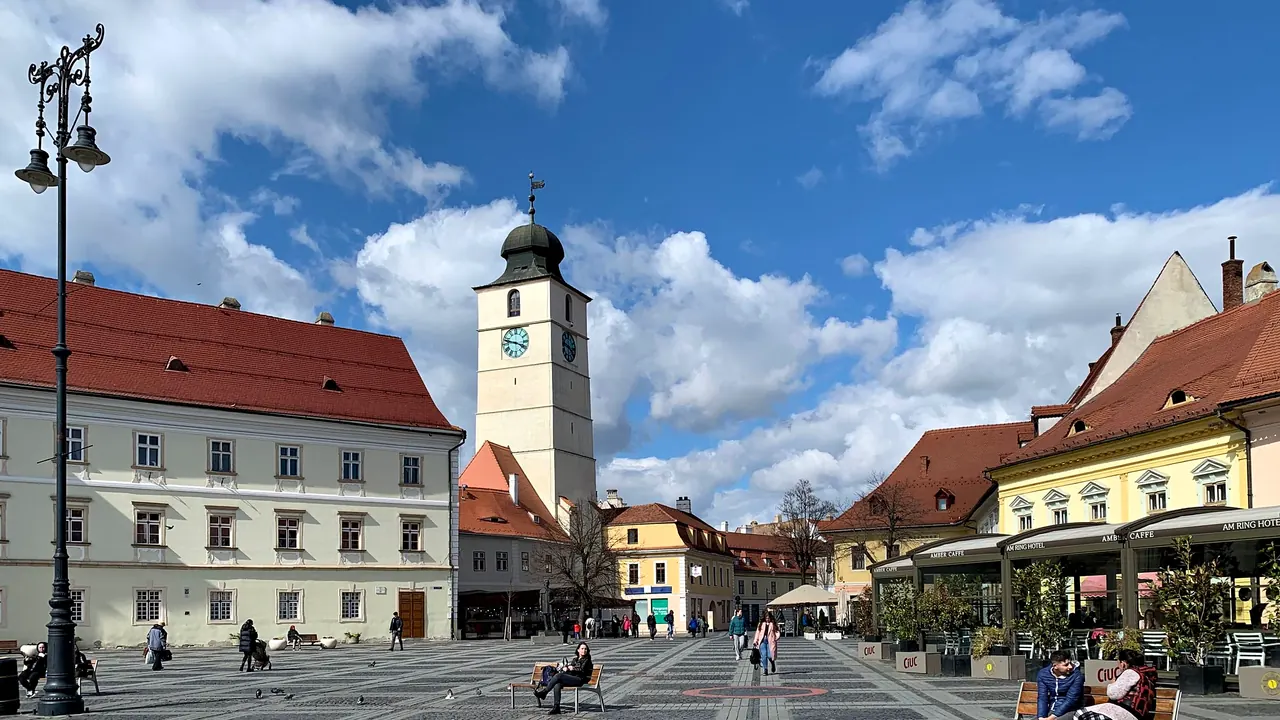
Photos: Cluj-Napoca by Dennis G. Jarvis, CC BY-SA 2.0, cropped; Sibiu by Chainwit., CC BY 4.0, cropped.
Cluj-Napoca or Sibiu?
Our verdict in twelve categories, each scored against the same fixed benchmark cities, and the climate month by month, so you can choose for your trip.
Choose Cluj-Napoca for
- nightlife
- live music and the arts
- food and drink
Cluj-Napoca suits travellers who want a city with some life after dark and a full stage calendar. Its large student population keeps the bars around Piața Muzeului busy for most of the year, its Romanian and Hungarian opera houses offer more music and dance than Sibiu does, and its cafés and markets give you a little more choice at the table. It makes a better lively long weekend than a base for exploring.
Choose Sibiu for
- culture and sights
- day trips
- nature and the outdoors
Pick Sibiu if the town itself and the country around it are the point of the trip. The three squares of the Upper Town and the Saxon rooftops make a more complete old centre, and the Fagaras and Cindrel ranges are close by. Sighisoara and the fortified churches are an easy drive. Evenings are quieter, and Ocna Sibiului gives you a real spa tradition nearby.
Scoreboard
Twelve categories on one fixed scale from 0 to 100. The shaded stretch is the gap between the two.
Your match
Pick a travel style or drag the sliders, and both match scores follow your weighting.
Wins on nightlife and live music and the arts with your weighting.
Wins on culture and sights and day trips with your weighting.
What matters to you?
Category by category
What the scores mean for a trip.
Beaches & swimming
Neither city has a beach, and the Black Sea is a long day's travel from both. Summer swimming means salt lakes: the outdoor lakes at Turda, about forty minutes from Cluj, or the lakes at Ocna Sibiului, about 20km from Sibiu, where the water is dense enough to float in and warms up well in high summer. Either one is a pleasant afternoon, not a reason to choose the city.
Food & drink
Both cities cook in the same filling Transylvanian style, with sarmale, sour soups and papanași, so the difference lies at the edges. Cluj goes a little further. Its students support a serious specialty coffee scene around Piața Unirii and Piața Muzeului, and the Mihai Viteazul market sells farm cheese and smoked meats.
Sibiu's strength is the country on its doorstep. The shepherd villages of the Marginimea Sibiului supply sheep's cheese, smoked meats and brandy, and you eat in vaulted cellars around the squares. Neither city has much fine dining or international cooking.
Culture & sights
Sibiu is the more rewarding town to look at. The Large Square, Small Square and Huet Square, with the Council Tower, the Lutheran Cathedral, the Bridge of Lies and the attic windows that locals call the eyes of the city, make it one of the best-preserved Saxon centres. The Brukenthal Museum and the ASTRA open-air museum add enough depth for two or three days.
Cluj's centre is handsome, but it feels more like a set of fine pieces than a whole: St Michael's Church and the Matthias Corvinus statue on Piața Unirii, the art museum in the Bánffy Palace and the Tailors' Bastion. Its open-air ethnographic museum in the Hoia hills is a close match for ASTRA, but the whole adds up to a day or two.
Nightlife
Cluj is clearly the place for a night out. Students make up about a fifth of the people who live there, so the cellar bars and terraces around Piața Muzeului and Strada Iuliu Maniu stay full late. A few clubs play electronic music in old industrial and courtyard spaces until morning.
Sibiu has the same mix of student cellar bars and craft beer on a smaller scale. It suits a drink after dinner rather than a night that runs until dawn. In both cities term time is livelier than high summer.
Nature & outdoors
Sibiu has the mountains. The Fagaras range, the highest in Romania at over 2,500m, the hiking and modest skiing at Paltinis and the summer drive up the Transfagarasan to Balea Lake put real Carpathian scenery within easy reach.
Cluj's countryside is gentler. It has the Făget woods for walking and biking, Turda Gorge for a half-day canyon hike, and the karst plateaus and caves of the Apuseni further west. Around both cities you need a car for the best of it.
Day trips
Sibiu is the better base for the classic Transylvanian outings. Sighisoara is about an hour and a half away and the fortified churches such as Biertan are closer still. Alba Iulia and Corvin Castle are an easy run west on the motorway.
From Cluj, the best-known towns are closer to three hours away and work better with an overnight stay. Its own list is shorter, but it has the outing everyone takes, the Turda Salt Mine, along with the Bánffy Castle at Bonțida and the village of Rimetea below its limestone crag.
Good for families
Both cities are calm, safe and small enough to manage with children, and neither has much built for them. The difference is the big outing. From Cluj it is the Turda Salt Mine, with its underground lake and a Ferris wheel deep below ground. In Sibiu it is the ASTRA museum, with the zoo and playgrounds of Dumbrava park beside it.
Sibiu's traffic-free squares are easy with small children, but its stairways are hard going with a pushchair.
Getting around
Both centres are compact and easy to walk, so the difference is in the layout. Cluj is flat around Piața Unirii and has buses, trolleybuses and a tram line for the wider city, though traffic is heavy at rush hour. Sibiu is smaller and largely pedestrianised, but getting between the Upper and Lower Town means steep lanes and steps.
From either city, slow regional trains make a hired car the practical way into the countryside.
Shopping & style
Neither city is worth visiting for shopping, and both are best for Transylvanian crafts such as embroidered blouses and painted ceramics. Cluj adds a few independent design shops in its pedestrian streets and the ethnographic museum's shop. Sibiu has craft shops along Nicolae Balcescu Street and a summer pottery fair. Each city's best shopping comes with the Christmas market on its main square.
Affordability
Both are inexpensive by European standards, with Sibiu a shade cheaper. Cluj's tech and university economy pushes restaurant and room prices above the Romanian norm, though opera and theatre seats are still a bargain. In Sibiu, guesthouses near the old town and hearty meals cost little if you stay away from the terraces on the main square.
Both get more expensive at their peaks: Cluj during its big summer music festivals, and Sibiu during the June theatre festival and the Christmas market season.
Live music & performing arts
Cluj has the fuller year-round calendar. It has two opera companies, one Romanian and one Hungarian, two theatres and the Transylvania State Philharmonic, which means opera, ballet or a concert on most nights. In summer, some of Eastern Europe's largest music festivals fill the stadium area and a castle estate nearby.
Sibiu's stage life is narrower, but it has a bigger peak: the Radu Stanca National Theatre and the International Theatre Festival each June, when performances fill the halls, churches and squares. In both cities, music and dance work better than plays for visitors who don't speak Romanian.
Wellness & relaxation
Sibiu is the better choice for slowing down. Ocna Sibiului, about 20km away, has been a spa resort since the 19th century, with salt lakes for floating and mud cures. Paltinis offers clean mountain air for a quiet stay.
Cluj relies on hotel wellness centres and on the salt mine air and outdoor lakes at Turda. Its student crowd makes it less restful, though the Botanical Garden and the lake in Central Park are quiet places to sit for a while.
When should you go?
Pick your month. The climate figures are measured averages, not a forecast.
Cluj-Napoca in July
Sibiu in July
Daytime high, °C
Rainfall in the month, mm
Temperature and rainfall are climate normals, averaged over the years shown. Cluj-Napoca: 1991-2020 normals, Cluj-Napoca (2.4 km from centre). Sibiu: 1991-2020 normals, Sibiu (0 km from centre).
The two cities have almost the same climate, so when you go matters more than which one you pick. July and August are warm, with highs around 27°C. That is warm enough to float in the salt lakes at Turda or Ocna Sibiului, but June and July are also the wettest months, with close to 100mm in Sibiu. From December to February daytime highs sit barely above freezing. That suits the Christmas markets better than long walks.
For walking the streets and the hills, May and September are the best months, with highs of about 21°C and less rain than midsummer. Cluj gets noticeably more sunshine through the summer months, and Sibiu is a touch milder in winter, but neither difference is big enough to decide the trip.
Which traveller are you?
For a food and nightlife trip, Cluj-Napoca is the clear choice. Its students keep the bars and clubs around Piața Muzeului going late in term time. Its specialty coffee and market produce also give you a little more range at the table than Sibiu.
On an outdoors trip, Sibiu puts you closer to real mountains. The Fagaras ridges, the glacial lakes and the Transfagarasan road are within a drive, and Paltinis has easy summer hiking. Cluj's hills and the Apuseni plateaus are gentler and more spread out.
For a culture and arts trip, Sibiu has the stronger old town, with its Saxon squares, the Brukenthal Museum, the ASTRA open-air museum and the fortified churches nearby. Choose Cluj instead if opera, ballet and concerts matter more to you than sightseeing.
Before you go
| Measure | Cluj-Napoca | Sibiu |
|---|---|---|
| Official language | Romanian | Romanian |
| Currency | Romanian Leu (RON) | Romanian Leu (RON) |
| Sockets | CF230 V, 50 Hz | CF230 V, 50 Hz |
| Driving side | Right | Right |
| Time zone | UTC+2, UTC+3 in summer | UTC+2, UTC+3 in summer |
| Emergency number | 112 | 112 |
| Elevation | 356 m | 415 m |
| Main airport | Avram Iancu Cluj International Airport (CLJ)7 km from centre53 non-stop destinations | Sibiu International Airport (SBZ)5 km from centre11 non-stop destinations |
| Public holidays this year | 17 days | 17 days |
By the numbers
| Measure | Cluj-Napoca | Sibiu |
|---|---|---|
| City population | 286,598 | 134,308 |
| People per km² | 1,640 | 1,110 |
| Museums within 10 km | 6 | 12 |
| UNESCO World Heritage sites within 50 km | 0 | 2 |
Where else could you go?
Every comparison below shares a destination with this one, so you can follow Cluj-Napoca or Sibiu somewhere new.
- Brasovvs Sibiu
- Brasovvs Cluj-Napoca
- Bucharestvs Sibiu
- Belgradevs Sibiu
- Belgradevs Cluj-Napoca
- Bucharestvs Cluj-Napoca