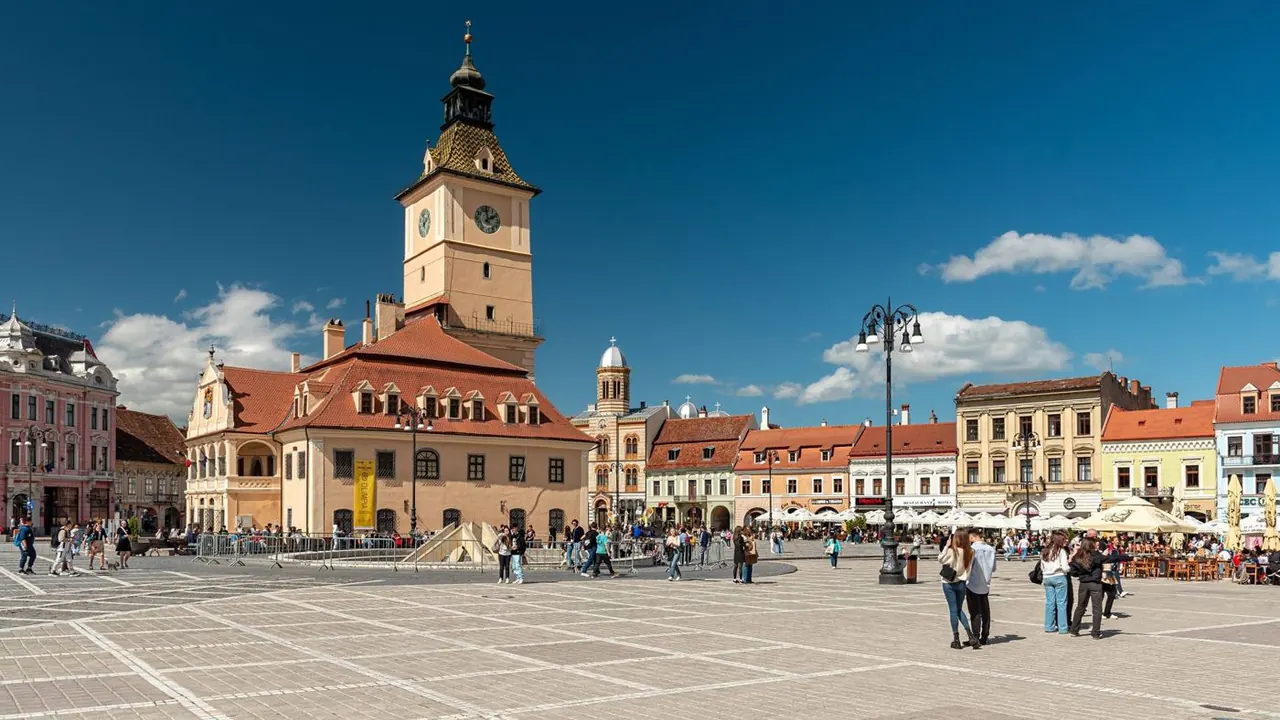
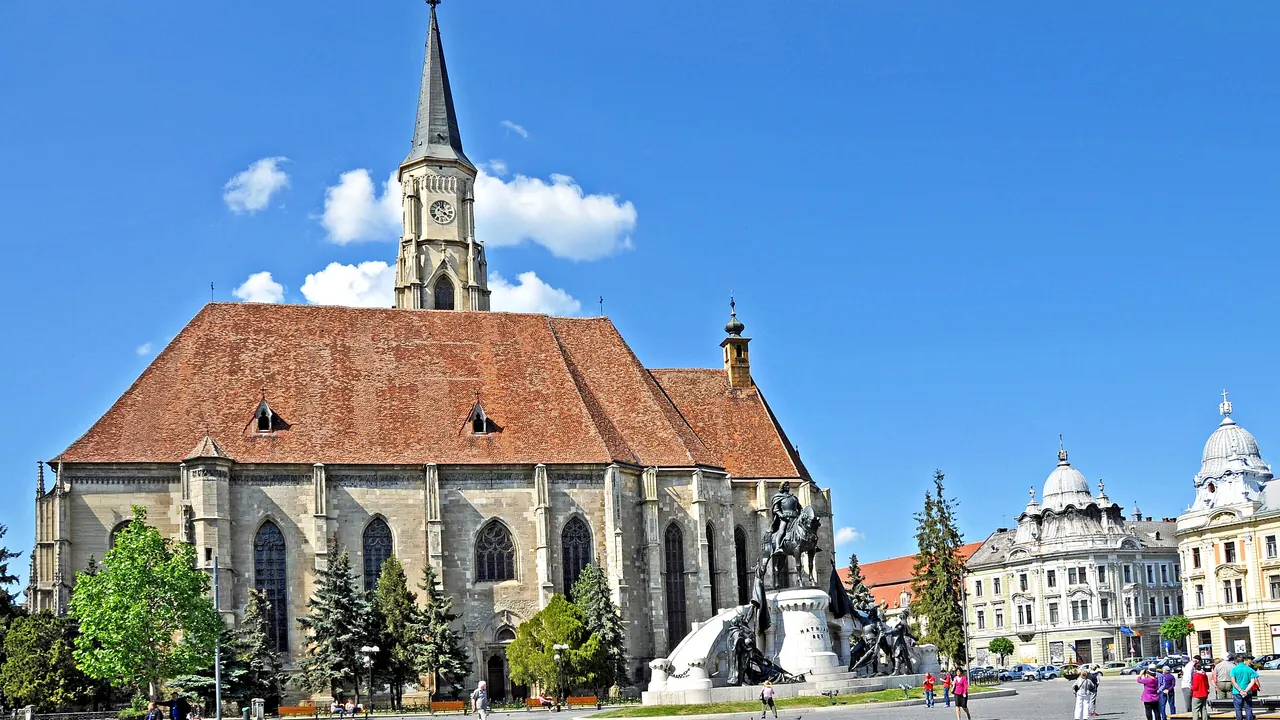
Photos: Brasov by Jorge Franganillo, CC BY 2.0, cropped; Cluj-Napoca by Dennis G. Jarvis, CC BY-SA 2.0, cropped.
Brasov or Cluj-Napoca?
Our verdict in twelve categories, each scored against the same fixed benchmark cities, and the climate month by month, so you can choose for your trip.
Choose Brasov for
- day trips
- nature and the outdoors
- families
Brasov is the pick for travellers who want the mountains and the castles of Transylvania on the doorstep. Tampa hill rises straight from the old walls, Poiana Brasov and the Bucegi are close, and Bran, Rasnov and the Saxon fortified churches make easy outings. The walled Saxon old town around the Black Church also gives it the stronger sightseeing core. Families and walkers will find more to fill their days here.
Choose Cluj-Napoca for
- live music and the arts
- nightlife
- food and drink
Cluj-Napoca suits people who care more about evenings than trailheads. Its large student population keeps the bars and cafés around Piața Muzeului full, and it has two opera houses, two theatres and big summer music festivals. It also eats a little better, with specialty coffee and well-stocked markets. For a lively city stay with culture after dark, Cluj is the better choice.
Scoreboard
Twelve categories on one fixed scale from 0 to 100. The shaded stretch is the gap between the two.
Your match
Pick a travel style or drag the sliders, and both match scores follow your weighting.
Wins on day trips and nature and the outdoors with your weighting.
Wins on live music and the arts and nightlife with your weighting.
What matters to you?
Category by category
What the scores mean for a trip.
Beaches & swimming
Neither city is anywhere near the sea, and neither should be chosen for swimming. What differs is the summer dip. Brasov has its large indoor and outdoor water park and cold mountain lakes, while Cluj has the outdoor salt lakes at Turda, where the water holds you up, plus lidos and reservoirs on the city's edge.
Food & drink
Both serve hearty Transylvanian cooking, and you will find ciorbă, sarmale and papanași in each. Brasov's food is solid, with Saxon touches in the smoked sausages, sheep's cheese from the hills, and cellar dining rooms under the merchant houses of Council Square.
Cluj eats somewhat better. Its students support a real specialty coffee scene around Piața Unirii, Piața Mihai Viteazul market is good for farm cheese and smoked meats, and local Târnave whites are on most wine lists. Neither city has much international or fine dining.
Culture & sights
Brasov has the more memorable historic core. Its walled Saxon town is still laid out around Council Square, the Black Church with its Anatolian carpets dominates the skyline, and the Weavers' Bastion, the towers and the Schei quarter fill out a day or two of walking.
Cluj's centre is handsome too, with St Michael's Church, the Corvinus statue and the Bánffy Palace art museum. Its strength is the Ethnographic Museum and its open-air village of wooden houses in the Hoia hills. There is less here that stops you in your tracks.
Nightlife
Cluj is the livelier place after dark, because roughly a fifth of its residents are students. Bars around Piața Muzeului and Strada Iuliu Maniu stay full late, and a few clubs in old industrial spaces play electronic music until morning, best in term time.
Brasov's evenings are gentler. Cellar bars and craft beer pubs around Council Square and Republicii Street suit a drink after dinner, and most nights are over well before the small hours. In winter the ski crowd adds some après-ski noise.
Nature & outdoors
Brasov is the real mountain town of the two. Tampa hill rises straight from the old walls, Poiana Brasov is about 12km up the road, and the Bucegi plateaus and the limestone ridge of Piatra Craiului are within an hour. The surrounding Carpathian forests also offer guided bear watching from hides.
Cluj's setting is softer, with the Făget and Hoia woods on the edge of town and Turda Gorge for a half-day hike. The Apuseni karst and caves are rewarding but need a car and an early start.
Day trips
From Brasov the famous names are close. Bran Castle and the Rasnov fortress are about half an hour away, the fortified churches of Prejmer and Harman are just outside town, Peles Castle at Sinaia is about an hour off, and Sighișoara and Viscri make full days out.
Cluj has one standout outing, the Turda Salt Mine with its underground lake. Alba Iulia's star-shaped citadel, Bánffy Castle at Bonțida and the village of Rimetea fill other days, but Sighișoara and Sibiu are about three hours away and work better as overnight stops.
Good for families
Brasov gives children more variety. The Tampa cable car, a forest rope adventure park, a water park for wet days, castles that fire the imagination and a bear sanctuary near Zarnesti cover a week easily, with sledging at Poiana Brasov in winter. The steep cobbled lanes are hard work with a pushchair, though.
Cluj relies on the Turda Salt Mine, with its Ferris wheel and play areas underground, plus rowing boats in Central Park and the Botanical Garden. It works better as a stop on a wider trip than as a base.
Getting around
Both centres are easy on foot, but the cities work differently. Brasov's walled old town takes about a quarter of an hour to cross, and buses run up to Poiana Brasov. Cluj's centre is flat, and its trams, trolleybuses and nearby airport serve a larger city with real rush-hour traffic.
In both, the countryside is where it gets slow. Rural buses are sparse, so a hire car or a tour helps for the castles and villages around Brasov and is close to essential for the Apuseni beyond Cluj.
Shopping & style
Shopping is a small part of a visit to either city. Brasov's Republicii Street mixes chains with Dracula souvenirs, and its best buys are plum brandy, honey and sheep's cheese. Cluj has a few independent fashion and design shops and folk crafts from the ethnographic museum shop, and its Christmas market on Piața Unirii is the busiest time of year.
Affordability
Both are cheap by European standards, and your money goes far in either. Brasov is slightly easier on the wallet, with the main extra costs at Council Square restaurants and peak-season lift passes. Cluj's tech and university economy keeps its prices among the highest in Romania, and rooms become scarce and expensive during its big summer festivals, although opera seats there are a bargain.
Live music & performing arts
Cluj has far more on stage. Romanian and Hungarian companies run parallel operas and theatres, including the ornate house on Piața Avram Iancu, and the Transylvania State Philharmonic adds a concert season. In summer the city hosts some of Eastern Europe's largest music festivals.
Brasov's offer is regional by comparison. It has a philharmonic, a small opera company and Romanian-language drama, and its highlight is an organ recital in the Black Church in summer.
Wellness & relaxation
Neither city has a bathing tradition, so relaxing comes from the slow pace more than from spas. Brasov has the more appealing hotel spas up at Poiana Brasov, with mountain views and a water park sauna in town. Cluj looks to Turda, where people breathe the salty mine air and float in the salt lakes, and its Botanical Garden is a quiet place to slow down.
When should you go?
Pick your month. The climate figures are measured averages, not a forecast.
Brasov in July
Cluj-Napoca in July
Daytime high, °C
Rainfall in the month, mm
Where the figures come from
Brasov has no rain gauge within 25 km of the centre, so its rainfall comes from a gridded climate dataset read at the city rather than from a gauge further away.
Temperature and rainfall are climate normals, averaged over the years shown. Brasov: 2016-2025 (rainfall 1991-2020) normals, Brasov (3 km from centre). Cluj-Napoca: 1991-2020 normals, Cluj-Napoca (2.4 km from centre).
The two cities share almost the same inland climate, so the calendar works the same way in both. Late spring to early autumn is the walking season, with July and August highs of about 27°C, warm but rarely too hot for the streets. Early summer is also the wettest stretch in both, when afternoon showers are common. Cluj catches a little more rain, with about 91mm in June. Neither has a beach season to plan around.
Winters are cold and snowy, with January highs close to freezing. In Brasov that is the ski season at Poiana Brasov, while in Cluj it is mostly time for indoor sights and the stage. Cluj's records show the long sunny days of July against short, grey midwinter days. September is a fine month in either city, still warm with far less rain, and autumn colour on Brasov's beech slopes is a bonus there.
Which traveller are you?
On an outdoors trip, Brasov is the base to choose. Real mountains start at the edge of town, so a hike, a ride or a wildlife outing needs no long drive. From Cluj, the serious walking country takes a car and an early start.
For a food and nightlife trip, Cluj-Napoca is the better bet. A large student crowd keeps the old centre going late, especially in term time, and its coffee and market produce give it a slight edge at the table as well.
On a family trip with children, Brasov keeps young ones busier. Short, easy outings fill each day, there is a fallback for rainy weather, and a week passes without long drives. Cluj suits a night or two on a wider Transylvanian loop rather than a whole stay.
Before you go
| Measure | Brasov | Cluj-Napoca |
|---|---|---|
| Official language | Romanian | Romanian |
| Currency | Romanian Leu (RON) | Romanian Leu (RON) |
| Sockets | CF230 V, 50 Hz | CF230 V, 50 Hz |
| Driving side | Right | Right |
| Time zone | UTC+2, UTC+3 in summer | UTC+2, UTC+3 in summer |
| Emergency number | 112 | 112 |
| Elevation | 600 m | 356 m |
| Main airport | Brașov-Ghimbav International Airport (GHV)9 km from centre14 non-stop destinations | Avram Iancu Cluj International Airport (CLJ)7 km from centre53 non-stop destinations |
| Public holidays this year | 17 days | 17 days |
By the numbers
| Measure | Brasov | Cluj-Napoca |
|---|---|---|
| City population | 237,589 | 286,598 |
| People per km² | 1,281 | 1,640 |
| Museums within 10 km | 8 | 6 |
| UNESCO World Heritage sites within 50 km | 1 | 0 |
Where else could you go?
Every comparison below shares a destination with this one, so you can follow Brasov or Cluj-Napoca somewhere new.
- Sibiuvs Brasov
- Sibiuvs Cluj-Napoca
- Bucharestvs Brasov
- Belgradevs Cluj-Napoca
- Bucharestvs Cluj-Napoca
- Varnavs Brasov