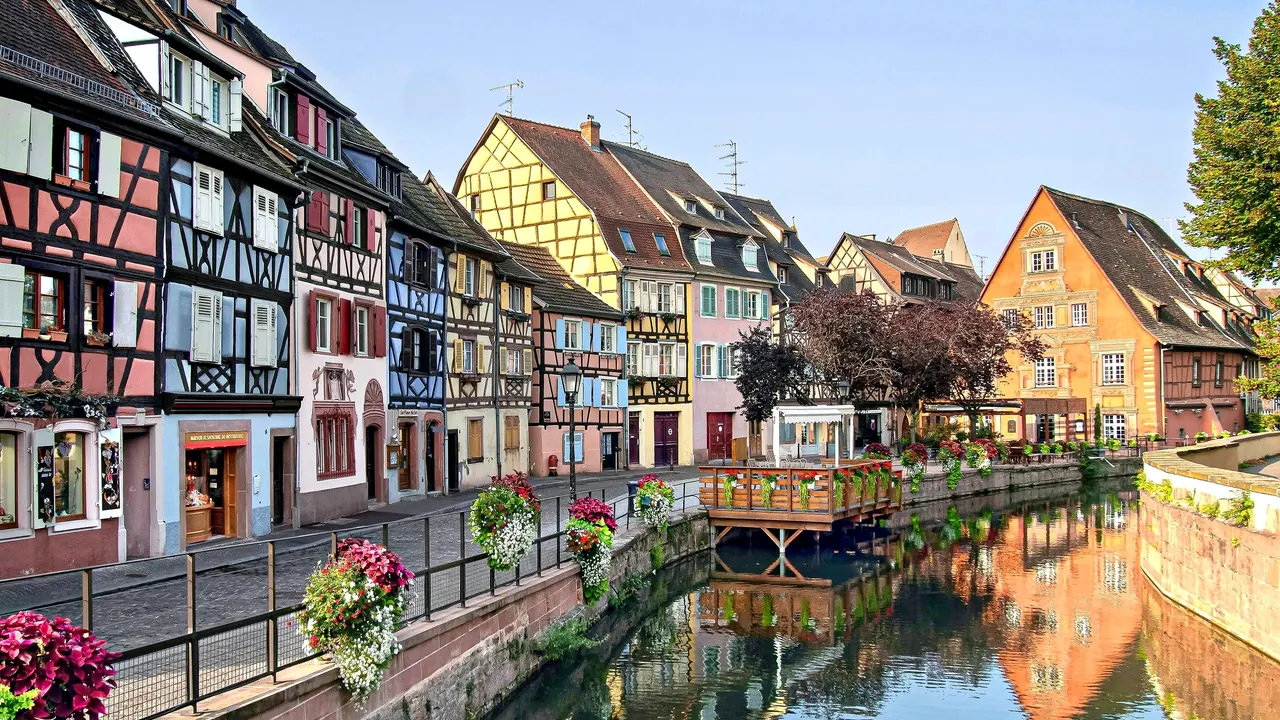
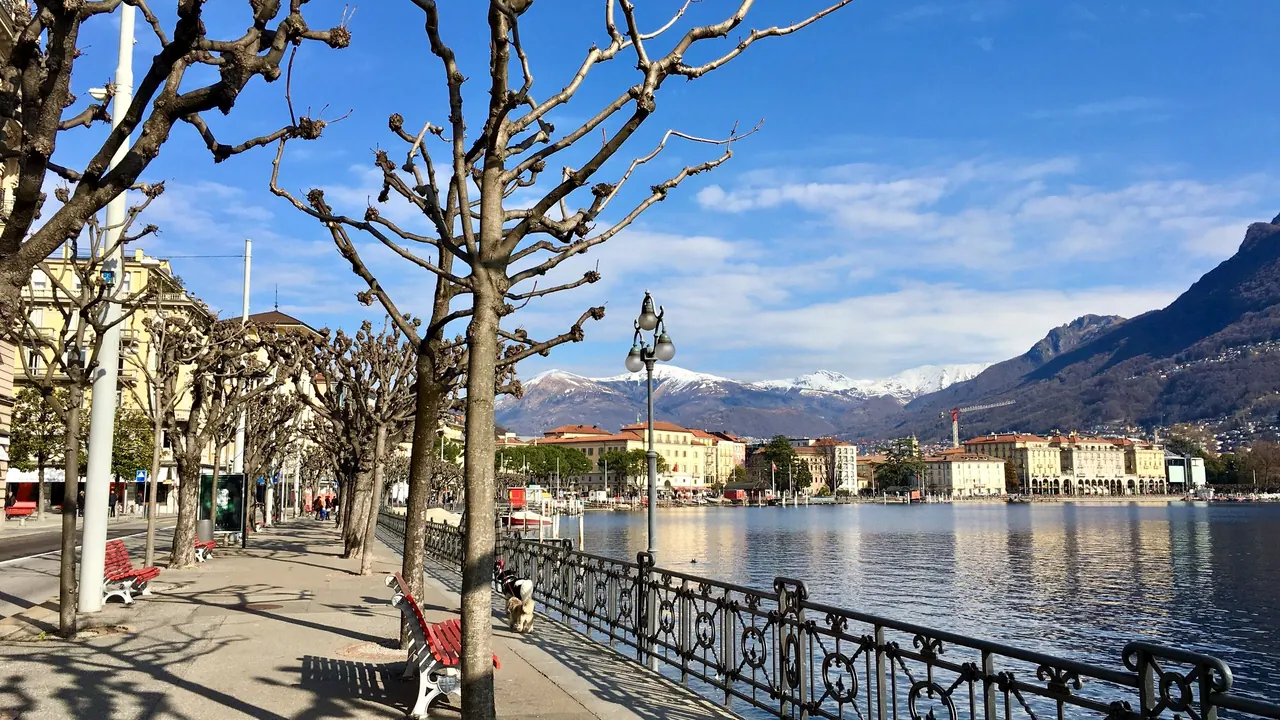
Photos: Colmar by Rolf Kranz, CC BY-SA 4.0, cropped; Lugano by Thomas Woodtli from Zürich, Switzerland, CC BY-SA 2.0, cropped.
Colmar or Lugano?
Our verdict in twelve categories, each scored against the same fixed benchmark cities, and the climate month by month, so you can choose for your trip.
Choose Colmar for
- prices
- culture and sights
- food and drink
Colmar suits a traveller who wants a painted old town, a great altarpiece and a glass of Riesling at the end of the day. The cooking is richer, the old town hangs together better as a whole, and the money goes noticeably further. Add a car or a bicycle and the wine villages and the Vosges are right on the doorstep.
Choose Lugano for
- beaches
- getting around
- live music and the arts
Lugano is the better choice when the landscape matters more than the monuments. The lake, the funiculars and the mountain walks are the point, and you can swim from a lido on a hot afternoon. The transport is excellent and the wellness pace is easy, so it makes a smooth, car-free stay for anyone who can absorb Swiss prices.
Scoreboard
Twelve categories on one fixed scale from 0 to 100. The shaded stretch is the gap between the two.
Your match
Pick a travel style or drag the sliders, and both match scores follow your weighting.
Too close to call, 2 points apart
Wins on prices and culture and sights with your weighting.
Wins on beaches and getting around with your weighting.
What matters to you?
Category by category
What the scores mean for a trip.
Beaches & swimming
Neither has a coast, but only Lugano gives you real swimming. In summer Lake Lugano is warm enough for a proper swim. The main lido at the Cassarate mouth and the smaller spots towards Castagnola and Paradiso give you lawns, decks and pools, and it is lake bathing rather than sand.
Colmar is out on the Alsace plain. All it has is the town pools and a few small lakes up in the Vosges valleys, so water does not belong in the plan.
Food & drink
Colmar is the stronger place to eat. Its winstubs serve a serious regional cuisine of choucroute, baeckeoffe, tarte flambée and munster cheese, and some of France's best white wines come from the slopes right outside town. A small fine-dining tier adds to it, although the most-photographed lanes have plenty of lazy menus.
Lugano's best tables are in its grotti: polenta, braised meats and salumi eaten under chestnut trees, with a glass of Ticino Merlot. Away from those, the choice is thin and expensive, and many visitors save their big meal for Italy.
Culture & sights
Colmar has much more to see. Its half-timbered old town survived largely intact, so Petite Venise, the Maison Pfister and the Koïfhus read as one continuous whole. The Unterlinden's Isenheim Altarpiece alone justifies the journey, and Schongauer's Madonna and the Bartholdi museum fill out two full days.
Lugano offers a pleasant arcaded Lombard centre, San Lorenzo, the Luini Passion fresco and the art collection split between LAC and Palazzo Reali. That is a good morning and afternoon, not a cultural destination in itself.
Nightlife
Both are dinner-and-a-glass towns, and Lugano is slightly livelier. Its lakefront aperitivo, cocktail bars and one or two clubs keep the promenade busy on summer weekends, though you pay for it. Colmar's evenings end in a wine bar or on a terrace by the canals, and anyone after a real night out takes the train to Strasbourg, much as Lugano's young head for Milan.
Nature & outdoors
Lugano has the more dramatic setting. Funiculars climb straight from town to Monte Brè and San Salvatore, the Gandria lake path starts at the edge of the city, and the Monte Lema to Tamaro ridge and the Verzasca valley give it real mountain-and-water scenery, much of it without a car.
Colmar's landscape is gentler and needs wheels. You walk between villages through the vineyards, climb the forested Vosges along the Route des Crêtes and cycle the flat plain. It is lovely in autumn, but it is rolling country rather than lake and peak.
Day trips
Both are first-rate bases, and the difference is in kind. Colmar's best outings are small and close together: Eguisheim, Riquewihr and Kaysersberg a few kilometres apart, Haut-Koenigsbourg on its ridge, and Strasbourg, Basel and Freiburg for a bigger city, which means three countries within an hour.
From Lugano the trips are grander and run by rail and boat. Milan's Last Supper and the Brera, Lake Como, the castles of Bellinzona and the Borromean Islands are all within reach, and you get there more easily than to Colmar's villages, where buses are sparse.
Good for families
Both are calm, safe choices with children, and Colmar edges ahead on things to do. The boat rides through Petite Venise and the rooftop storks keep young children happy in town. Within a drive there is the stork and otter park at Hunawihr, the macaques at Kintzheim, the Mulhouse train and car museums and Europa-Park.
Lugano's appeal is the lake itself: boat hops, lido slides, funiculars and the miniature Switzerland park at Melide. The steep streets are hard work with a pushchair, and there are no big attractions for teenagers.
Getting around
Lugano is easier to manage without a car. Boats, funiculars, rack railways and the Swiss trains reach the lake villages, the summits and Milan, and hotel stays usually include free regional transport. The catch is the slope between the station and the old town.
Colmar's flat centre is quick to walk and the trains to Strasbourg are fast. However, the wine villages and Vosges valleys that make the region worth visiting are badly served by buses, so you will want a car or a bike.
Shopping & style
Lugano offers more for shoppers, and most of it is upmarket. Via Nassa's arcades are lined with Swiss watchmakers and Italian fashion houses, and there is a big designer outlet near Mendrisio. Colmar is the place for things to carry home: wine bought from the grower, Soufflenheim pottery, Alsatian linen and gingerbread, with the Christmas markets as the highlight of the year.
Affordability
Colmar costs far less. It has ordinary Western European prices, cheap tastings in the villages and good-value set lunches, and its only real pressure point is rooms in summer and during the Christmas markets, which you can avoid by staying in a nearby village.
Lugano is expensive in every respect, from the lakeside hotels to the boat trips and mountain railways. Grotti, set lunches and the included transport pass soften the cost a little, but there is no cheap way to stay.
Live music & performing arts
Lugano gives you more to hear and see. LAC's concert hall is home to the Orchestra della Svizzera italiana and has a regular season of drama and dance, and Estival Jazz brings free summer concerts to Piazza della Riforma.
Colmar has a small Italian-style theatre and visits from the Opéra national du Rhin. Otherwise it relies on its July classical festival and autumn jazz, so for anything substantial you go to Strasbourg or Basel.
Wellness & relaxation
Neither has thermal baths, and Lugano is the more restful place. Its palm-lined shore, mild climate, lidos and the large indoor pool and sauna complex near Rivera make slowing down easy. Colmar's version of rest is a quiet canal-side evening and a slow walk through the vines, with nothing beyond hotel spas for real pampering.
When should you go?
Pick your month. The climate figures are measured averages, not a forecast.
Colmar in July
Lugano in July
Daytime high, °C
Rainfall in the month, mm
Temperature and rainfall are climate normals, averaged over the years shown. Colmar: 1991-2020 normals, Ihringen (21.1 km from centre). Lugano: 1991-2020 normals, Lugano (1.2 km from centre).
The two are close in warmth. Both reach about 27°C in July and August and drop to single figures in midwinter, so late spring to early autumn is the time to be out walking in either. The real difference is the rain. Colmar sits in the shelter of the Vosges and stays fairly dry all year, with its wettest month at 87mm in May. Its summers are sunny, but December and January are grey and short of light.
Lugano is much wetter from April to November, often over 150mm a month, which usually means heavy downpours rather than days of drizzle. Its winters are brighter than Colmar's, though, with roughly twice the sunshine in December. June to early September is the season for swimming in the lake. Spring and autumn suit hiking best, while September and October bring Colmar's grape harvest and the turning vines.
Which traveller are you?
For a beach and sun trip, Lugano is the clear pick. Its lake lidos have decks, lawns and ladders into warm summer water, and you can reach village bathing spots by boat. Colmar is far inland, so swimming there means a municipal pool or a small mountain lake.
On a trip on a tight budget, Colmar is far easier on the wallet. Set lunches, local wine and free or cheap cellar tastings keep the cost down, and you can stay in a nearby village. Lugano has Swiss prices on everything, from rooms to mountain railways.
For a culture and arts trip, Colmar offers more. You get an intact late-medieval townscape and Grünewald's Isenheim Altarpiece at the Unterlinden. Lugano has a fine Luini fresco and the LAC arts centre, but its sights are seen in a day.
Before you go
| Measure | Colmar | Lugano |
|---|---|---|
| Official language | French | French, German, Italian, Romansh |
| Currency | Euro (EUR) | Swiss Franc (CHF) |
| Sockets | CE230 V, 50 Hz | CJ230 V, 50 Hz |
| Driving side | Right | Right |
| Time zone | UTC+1, UTC+2 in summer | UTC+1, UTC+2 in summer |
| Emergency number | 112 | 112 |
| Elevation | 185 m | 283 m |
| Main airport | EuroAirport Basel–Mulhouse–Freiburg (BSL)55 km from centre112 non-stop destinations | Milan Malpensa International Airport (MXP)46 km from centre208 non-stop destinations |
| Public holidays this year | 11 days | 15 days |
By the numbers
| Measure | Colmar | Lugano |
|---|---|---|
| City population | 66,970 | 63,495 |
| People per km² | 1,006 | 837 |
| Museums within 10 km | 9 | 17 |
| UNESCO World Heritage sites within 50 km | 3 | 5 |
Where else could you go?
Every comparison below shares a destination with this one, so you can follow Colmar or Lugano somewhere new.