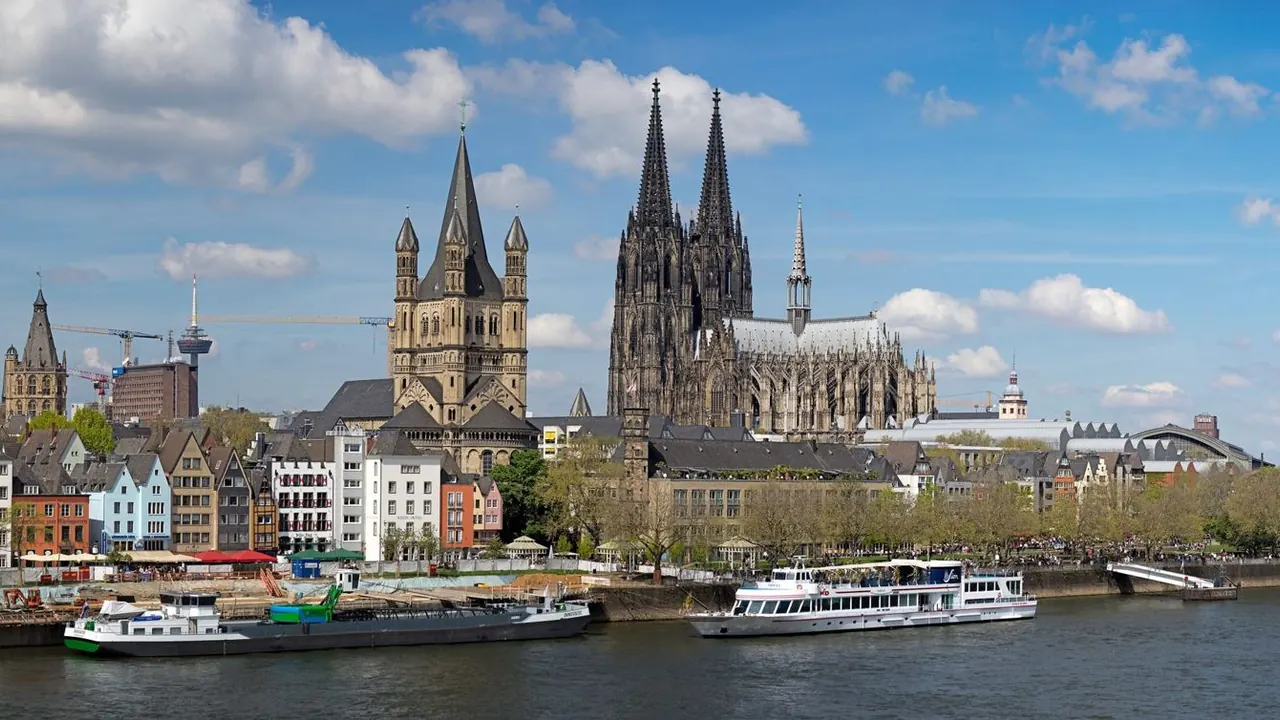
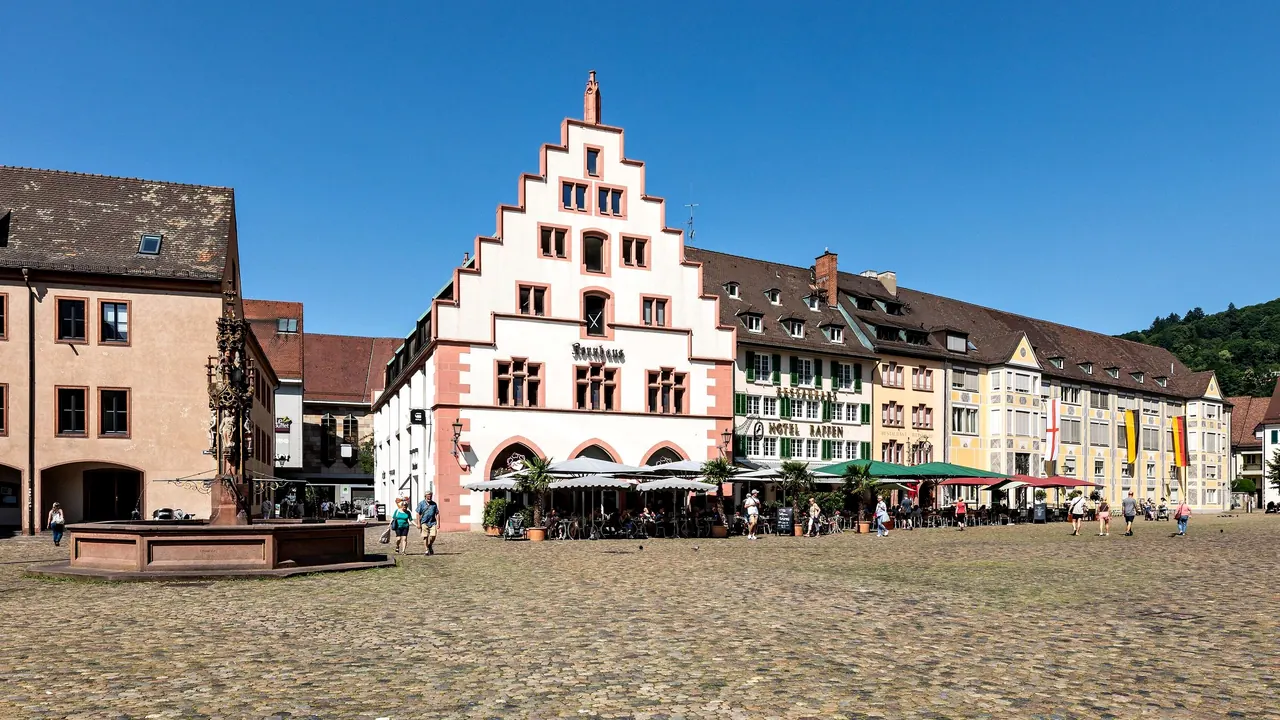
Photos: Cologne by Jörg Braukmann, CC BY-SA 4.0, cropped; Freiburg by Dietmar Rabich, CC BY-SA 4.0, cropped.
Cologne or Freiburg?
Our verdict in twelve categories, each scored against the same fixed benchmark cities, and the climate month by month, so you can choose for your trip.
Choose Cologne for
- nightlife
- live music and the arts
- shopping
Cologne suits travellers who want a proper city with plenty to fill the evenings. Its cathedral, Romanesque churches and major art museums give you more to see. The opera, the Philharmonie and the club scene give you more to do after dark, and the shopping streets are much bigger. It fits a culture-heavy break, a weekend of brewhouses and bars, or a stay that uses the fast trains to reach Bonn, Aachen and the Rhine Gorge.
Choose Freiburg for
- nature and the outdoors
- wellness
- food and drink
Freiburg is the better choice if the countryside matters more than the city. The Black Forest starts at the edge of town, the thermal spas of southern Baden are close by, and the compact old town is easy to walk or cycle. Add the regional wine and cooking and the French and Swiss borders nearby, and it suits hikers, cyclists, families and anyone who wants a slower, greener trip.
Scoreboard
Twelve categories on one fixed scale from 0 to 100. The shaded stretch is the gap between the two.
Your match
Pick a travel style or drag the sliders, and both match scores follow your weighting.
Too close to call, 2 points apart
Wins on nightlife and live music and the arts with your weighting.
Wins on nature and the outdoors and wellness with your weighting.
What matters to you?
Category by category
What the scores mean for a trip.
Beaches & swimming
Neither city is a place for a swimming vacation, and both send you to flooded gravel pits rather than a river or a sea. Cologne's lakes, such as Fühlinger See and Otto-Maigler-See, sit on the edge of the city and have a few small sandy patches.
Freiburg's gravel pits on the Rhine plain have grassy banks, and it adds the option of cooler swims in Black Forest lakes like Titisee, about an hour away, plus busy open-air pools in town.
Food & drink
Freiburg eats a little better, thanks to Baden cooking with a French touch. Flammkuchen, Black Forest trout and spring asparagus come with dry Pinots from the nearby vineyards, and the Münster market runs most mornings. The region around it also has some of Germany's best fine dining.
Cologne's strength is the Brauhaus ritual of Kölsch in small glasses with hearty Rhineland dishes. It also has more variety beyond its local cooking, especially the Turkish and Middle Eastern places along Venloer Strasse in Ehrenfeld, where Freiburg's choice soon starts to repeat itself.
Culture & sights
Cologne gives you far more to see. Freiburg is built around one great church, but Cologne has its cathedral and then a ring of Romanesque churches and Roman remains spread through the centre, two thousand years of history rather than a medieval core. Its museums also go deeper. Museum Ludwig's Pop Art, the Wallraf-Richartz's painting from the Middle Ages to Impressionism and Kolumba's sacred art inside a war-ruined church could fill several days. Freiburg has one main museum, the Augustinermuseum.
Freiburg's heritage is smaller but holds together better. The red sandstone Münster, whose tower you can climb, stands close to the market square, the medieval gates and the Bächle channels, so the old town feels like one place, and a single walk takes in most of it. Both cities were rebuilt after the war, but in Cologne the highlights stand as separate buildings in a plain post-war townscape.
Nightlife
Cologne is far better for going out. A night can start in an Altstadt brewhouse and move on to the Belgian Quarter's bars, the student crowd on Zülpicher Strasse or the clubs in Ehrenfeld's old factories. The city also has one of Germany's biggest gay scenes, and Carnival turns the whole city into a street party.
Freiburg's evenings are friendly and mostly student-driven. They centre on pubs and wine bars around the Martinstor and, in summer, on the squares and the Dreisam banks, with only a few clubs. It is noticeably quieter when the university is on break.
Nature & outdoors
Freiburg is a real outdoor base. The Schlossberg rises right behind the old town, a cable car climbs to about 1,280m on the Schauinsland, and the Feldberg offers summer trails and winter skiing. There are also gorge walks, excellent mountain biking and vineyard cycling on the Kaiserstuhl.
Cologne's landscape is flat. It offers the Grüngürtel parks and long Rhine cycle paths, with the Siebengebirge and the Eifel within reach for day hikes, but nothing close to mountain country.
Day trips
Both cities make excellent bases, but for different kinds of outing. From Cologne, fast trains reach Bonn, Düsseldorf, Aachen and the castle towns of the Rhine Gorge, and even Brussels, so it suits trips to other cities without a car.
Freiburg's appeal is the meeting point of three countries. Basel is under an hour by train, Strasbourg and the half-timbered Alsace wine villages are close, and small towns like Staufen and Breisach are nearby. Some of the Alsace villages are much easier to reach by car.
Good for families
Freiburg is a little easier with children. It is small, green and safe. Children can play in the Bächle and visit the free Mundenhof animal park, and Europa-Park, Germany's largest theme park, is about 40 minutes away.
Cologne has its own major theme park in Phantasialand, along with the zoo, the Chocolate Museum and the cable car over the Rhine. It is also better on rainy days, when Freiburg has few indoor options. Avoid Cologne during Carnival if you have small children.
Getting around
Freiburg is the simpler of the two. Its car-free old town can be crossed on foot in about twenty minutes, it is one of Germany's great cycling cities, and regional trains run straight into the Black Forest.
In Cologne you arrive right beside the cathedral and can walk the flat centre easily. To reach Ehrenfeld or the zoo you need the Stadtbahn, whose map is confusing and whose trams can be crowded.
Shopping & style
Cologne is clearly better for shopping. Schildergasse and Hohe Strasse are among Germany's busiest shopping streets. Ehrenstrasse and the Belgian Quarter add independent fashion and design shops, and Eau de Cologne makes a souvenir with real history.
Freiburg is more modest. It has the chains on Kaiser-Joseph-Strasse, small boutiques in the Gerberau, and wine, ham and cuckoo clocks from the market and shops. For anything more ambitious, locals go to Basel.
Affordability
The two cost about the same, and hotels are the main expense in both. Cologne's rooms are moderately priced in ordinary weeks but become scarce during the big Messe trade fairs and at Carnival.
Freiburg's hotels cost more than you would expect for a city its size, especially on summer weekends, so some visitors stay in nearby Black Forest villages instead. Daily costs are gentle in both: Kölsch with brewhouse food in one, market snacks and wine taverns in the other, and both cathedrals are free to enter.
Live music & performing arts
Cologne offers far more on stage. The opera and the Schauspiel share Offenbachplatz, and the Philharmonie beside the cathedral is home to the Gürzenich and WDR orchestras. The city also has a strong electronic and jazz tradition, small gig venues in Ehrenfeld and the Südstadt, and the dialect songs of the Carnival sessions.
Freiburg has a good repertory theatre and the Freiburger Barockorchester, one of Europe's leading period-instrument ensembles, plus the summer tent festival. It is enough for an evening out, not for a whole trip.
Wellness & relaxation
Freiburg is the better place to slow down. It has a thermal bath on its eastern edge, the large spa at Bad Krozingen twenty minutes south, Badenweiler beyond that and Baden-Baden within an hour. The town itself also moves at an easy pace.
Cologne has the German sauna culture and a thermal bath in the Rheinpark with views of the cathedral, and Aachen's hot springs are a short train ride away. Between visits, though, you are back in a busy city.
When should you go?
Pick your month. The climate figures are measured averages, not a forecast.
Cologne in July
Freiburg in July
Daytime high, °C
Rainfall in the month, mm
Temperature and rainfall are climate normals, averaged over the years shown. Cologne: 1991-2020 (sunshine 1981-2010) normals, Köln-Stammheim (5.4 km from centre). Freiburg: 1991-2020 normals, Freiburg (0.6 km from centre).
Cologne's winters are cool, damp and grey, with short days and little sun, so December to February suits museums, churches and brewhouses more than long walks outside. Spring warms steadily, and from June to August highs of about 25°C make the gravel-pit lakes pleasant. These are also Cologne's wettest months, with around 81mm in July and August, so pack for showers. May, June and September are the most comfortable months for exploring the streets.
Freiburg's year follows a similar pattern but is a little warmer and much sunnier, especially in summer. July reaches about 27°C, which feels warm on the old-town streets at midday but is good for a lake swim. Its rain comes earlier than Cologne's. May is the wettest month at about 103mm, and June and July stay fairly wet, so late spring is a gamble in the hills. September and early October are the better time for hiking, still mild and bright and drier. In winter the town is cool and grey, while the higher Black Forest slopes have snow.
Which traveller are you?
For a culture and arts trip, Cologne gives you several full days of material. Two thousand years of history, from Roman foundations to one of Europe's best Pop Art collections, are followed by evenings of opera or orchestral concerts. Freiburg's sights take a day or two.
On an outdoors trip, Freiburg lets you leave your hotel on foot or by tram and be on a mountain trail within the hour, without hiring a car. Cologne's walking country is lower and gentler, and getting there means planning a day out.
On a relaxing and wellness trip, Freiburg lets the whole stay unwind, with spa afternoons fitted around wine-village lunches and quiet evenings by the river. Cologne can give you a good sauna afternoon, but afterwards you step back out into a busy city.
Before you go
| Measure | Cologne | Freiburg |
|---|---|---|
| Official language | German | German |
| Currency | Euro (EUR) | Euro (EUR) |
| Sockets | CF230 V, 50 Hz | CF230 V, 50 Hz |
| Driving side | Right | Right |
| Time zone | UTC+1, UTC+2 in summer | UTC+1, UTC+2 in summer |
| Emergency number | 112 | 112 |
| Elevation | 59 m | 278 m |
| Main airport | Cologne Bonn Airport (CGN)15 km from centre115 non-stop destinations | EuroAirport Basel–Mulhouse–Freiburg (BSL)50 km from centre112 non-stop destinations |
| Public holidays this year | 11 days | 12 days |
By the numbers
| Measure | Cologne | Freiburg |
|---|---|---|
| City population | 1,025,523 | 238,299 |
| People per km² | 2,532 | 1,558 |
| Museums within 10 km | 40 | 13 |
| UNESCO World Heritage sites within 50 km | 3 | 2 |
Where else could you go?
Every comparison below shares a destination with this one, so you can follow Cologne or Freiburg somewhere new.
- Dusseldorfvs Cologne
- Colmarvs Freiburg
- Baselvs Freiburg
- Strasbourgvs Freiburg
- Zurichvs Freiburg
- Maastrichtvs Cologne