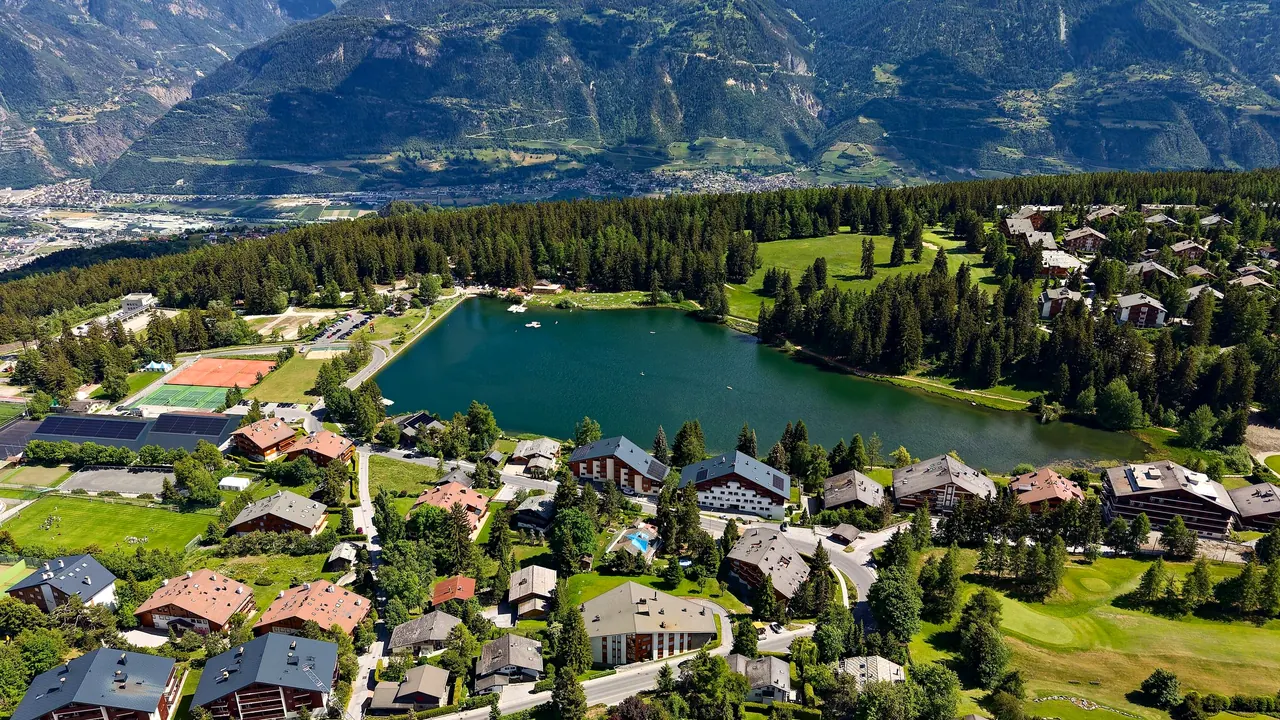
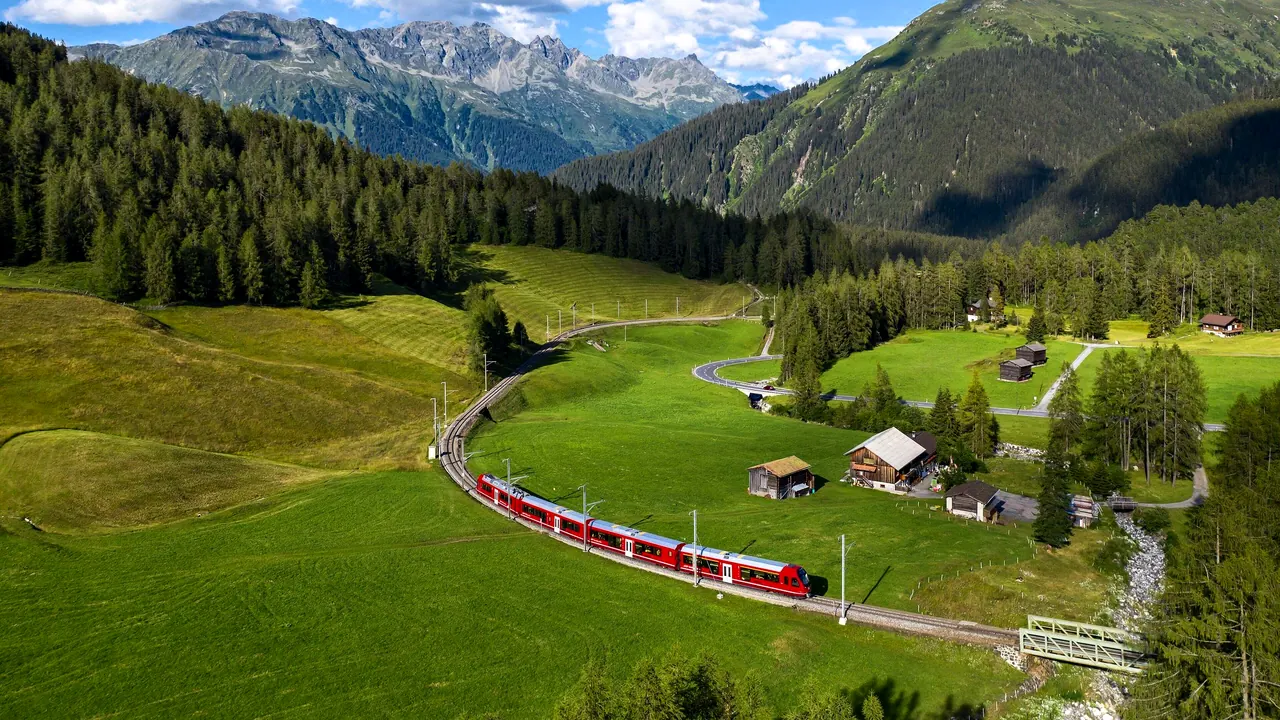
Photos: Crans-Montana by Daniel Reust, CC BY-SA 4.0, cropped; Davos by Kabelleger / David Gubler, CC BY-SA 4.0, cropped.
Crans-Montana or Davos?
Our verdict in twelve categories, each scored against the same fixed benchmark cities, and the climate month by month, so you can choose for your trip.
Choose Crans-Montana for
- shopping
- day trips
- food and drink
Crans-Montana suits travellers who want sun, wide views and a polished resort with a bit of glamour. Its south-facing terrace looks across the Rhône valley to a line of Valais peaks, the main street holds the kind of luxury boutiques few mountain villages have, and the valley railway below opens up castles, wine villages and Lake Geneva for days off the slopes. It is the better pick if your mountain days come with a good bottle of Valais wine and an outing or two down the valley.
Choose Davos for
- culture and sights
- getting around
- families
Davos is the choice for anyone who wants a proper town in the mountains with some history behind it. The sanatorium past of The Magic Mountain, the Kirchner Museum and the Schatzalp give it a cultural thread that Crans-Montana lacks. It is also easier to get around, laid out along a flat valley floor with two railway stations and lifts leaving from town. Cross-country skiers, and travellers who enjoy the famous Rhaetian lines, will feel most at home here.
Scoreboard
Twelve categories on one fixed scale from 0 to 100. The shaded stretch is the gap between the two.
Your match
Pick a travel style or drag the sliders, and both match scores follow your weighting.
Too close to call, 1 point apart
Wins on shopping and day trips with your weighting.
Wins on culture and sights and getting around with your weighting.
What matters to you?
Category by category
What the scores mean for a trip.
Beaches & swimming
Neither resort is a place to plan a swim around, and they are much alike here. The difference is the water. Crans-Montana has several small, shallow lakes on its plateau, such as Lac Moubra and Lac Grenon, which can warm to about 20°C in high summer and have lawns and pontoons. Davos has a single larger lake with a lido and a jetty, but the water stays a few degrees colder, so many people use the indoor leisure pool instead.
Food & drink
Crans-Montana is a little ahead, mostly thanks to the vineyards just below it. Raclette and dried-meat platters come with Fendant, Petite Arvine or Cornalin from the terraces of the Valais. Its wealthy winter guests also keep a few serious gastronomic tables busy.
Davos offers the more unusual regional dishes, such as capuns, pizokel, barley soup and Nusstorte, and they are best eaten on a hut terrace on the slopes. Beyond that the town has less range. In both resorts, cheap eating is scarce and many kitchens close between seasons.
Culture & sights
Davos has a real story to tell, and Crans-Montana mostly does not. The Davos sanatoria inspired Thomas Mann's The Magic Mountain, the Schatzalp still shows that era, and the Kirchner Museum holds the largest collection of the Expressionist painter's work. Add a winter sports museum and St Johann, and a curious visitor can fill a day or two.
Crans-Montana also began as a health resort, but little of that past is left to visit apart from a few period hotels and small chapels. Its castles and old towns are down in the Rhône valley.
Nightlife
Both are small, pricey and tied to the ski season, so this comes down to style. Crans-Montana leans smart, with piano lounges, hotel bars and a couple of late clubs for a dressed-up crowd. Davos is a little looser, with pubs and small clubs along the Promenade after après-ski at the Jakobshorn and Parsenn. In summer, both wind down to a drink on a terrace.
Nature & outdoors
Both resorts are first-rate in the mountains. The difference is in the terrain. Crans-Montana sits on a sunny balcony with views reaching to the Matterhorn and Mont Blanc. Its connected pistes run up to the Plaine Morte glacier and suit intermediates, and in summer there are the level bisse paths, paragliding and alpine golf.
Davos spreads its skiing over five separate areas and is the stronger base for cross-country, with long trails into the Sertig and Dischma valleys. Those quiet side valleys are good for spotting ibex and chamois, and the Swiss National Park can be reached as a day out.
Day trips
Crans-Montana has the better range of outings because the funicular drops you onto the busy Rhône valley line. From there it is easy to reach the two castles of Sion, the wine villages around Salgesch, Roman Martigny and the abbey at Saint-Maurice, and the Lavaux terraces and Chillon are about an hour and a half away.
From Davos the journey itself is the attraction. You can ride the Landwasser Viaduct and the Albula line to St Moritz, or go through the Vereina tunnel to the painted houses of Guarda, and medieval Chur is also within reach. There are fewer places to choose from, though, and Zurich is too far for a comfortable day.
Good for families
For families the two are about equal. Both are safe, both focus on the outdoors, and neither has a zoo or theme park. Crans-Montana's summer lakes have pedalos and playgrounds, and the flat bisse paths suit small legs. Davos has the better plan for bad weather, with a large indoor pool with slides, and it adds long toboggan runs and a big natural ice rink. Its flat layout is also easier with a pushchair than Crans-Montana's sloping hillside.
Getting around
Davos is noticeably easier. The town runs along a flat valley floor with a railway station at each end, buses along the main road and lifts leaving from town. Getting there from Zurich takes a little over two hours.
Crans-Montana can be reached by funicular from Sierre, so you do not need a car either. Once there, though, Crans, Montana and the lift bases are spread across a hillside with climbs between them, and you will rely on the free shuttle buses more than your feet.
Shopping & style
This is one of Crans-Montana's clearest advantages. Crans has a concentration of luxury fashion labels, Swiss watchmakers, jewellers and cashmere that is rare for a mountain village, and it makes for real browsing. The Promenade in Davos covers ski gear, outdoor shops and a few watch stores. You can pass a pleasant evening there, but you would not plan a trip around it. Both resorts have good delicatessens selling local dried meat and cheese to take home.
Affordability
Both are among the most expensive places in Europe for a vacation, and neither gives much relief. Their peak periods differ. Crans-Montana is at its dearest over Christmas and the February school weeks, and Davos fills up and raises its prices around the World Economic Forum in January. In both places, self-catering and the shoulder seasons help a little, and Davos's guest card covers the local buses.
Live music & performing arts
Neither town has a theatre or concert season, and both depend on festivals. Crans-Montana's main event is Caprices, which brings electronic music to the slopes at the end of the ski season, and it also has a summer chamber series. Davos has a summer classical festival where young musicians play in churches and unusual spots. For anything more, Crans-Montana has the valley towns close by, while Davos sends you all the way to Zurich.
Wellness & relaxation
Both towns began as places to recover, so they offer much the same restful mountain air and hotel spas. The difference is in the bathing. Crans-Montana is under an hour from the hot pools of Leukerbad, an easy half day out. Davos has a public leisure pool with a sauna area open to day visitors, and the mineral baths of Scuol are about an hour away through the Vereina tunnel.
When should you go?
Pick your month. The climate figures are measured averages, not a forecast.
Crans-Montana in July
Davos in July
Daytime high, °C
Rainfall in the month, mm
Where the figures come from
Crans-Montana has no weather station within reach, so its figures come from a gridded climate model rather than a measured record, and read a broad area rather than one spot.
Davos's temperatures are measured 53 km from the centre, at S. Valentino Alla Muta.
Davos has no rain gauge within 25 km of the centre, so its rainfall comes from a gridded climate dataset read at the destination rather than from a gauge further away.
Temperature and rainfall are climate normals, averaged over the years shown. Crans-Montana: 2001-2020 normals, NASA POWER reanalysis grid, no weather station within 90 km. Davos: 1991-2020 normals, S. Valentino Alla Muta (53.4 km from centre).
Both resorts have two good seasons: snow from December to March, and hiking weather from June to September. Crans-Montana is the colder of the two in midwinter, with daytime highs below freezing from December to February, while Davos usually gets a little above zero, around 2°C. In summer Davos is slightly warmer too, reaching about 20°C in July and August against 18°C on the plateau. Both are pleasant for walking then, and neither ever gets too hot.
Summer is also when most of the rain falls. On the Crans-Montana plateau the wet spell runs from May to August, and Davos is wettest from June to August, at about 140mm a month, staying fairly damp into September. Swimming in the lakes only makes sense in July and August, and Crans-Montana's shallow lakes are the warmer option. April, May, October and November are cool and in between in both places, with neither good snow nor settled hiking weather.
Which traveller are you?
For a culture and arts trip, Davos is the clear choice. It has the Kirchner Museum, the former sanatoria of The Magic Mountain such as the Schatzalp, and an old church. Crans-Montana has almost nothing to visit on the plateau and sends you down to the Rhône valley for sights.
On a shopping trip, Crans-Montana wins easily. Crans has an unusual cluster of international fashion labels, Swiss watchmakers, jewellers and designer ski wear. In Davos, the shops along the Promenade mostly sell sports gear and food to take home.
For a short city break with no car, Davos is easier. It has two railway stations on the valley floor, buses running the length of town and lifts leaving from the centre. Its museums fit into a day or two. Crans-Montana is spread across a sloping hillside and needs shuttles.
Before you go
| Measure | Crans-Montana | Davos |
|---|---|---|
| Official language | French, German, Italian, Romansh | French, German, Italian, Romansh |
| Currency | Swiss Franc (CHF) | Swiss Franc (CHF) |
| Sockets | CJ230 V, 50 Hz | CJ230 V, 50 Hz |
| Driving side | Right | Right |
| Time zone | UTC+1, UTC+2 in summer | UTC+1, UTC+2 in summer |
| Emergency number | 112 | 112 |
| Elevation | 1,495 m | 1,559 m |
| Main airport | Geneva International Airport (GVA)106 km from centre150 non-stop destinations | Zürich Airport (ZRH)122 km from centre226 non-stop destinations |
| Public holidays this year | 9 days | 9 days |
By the numbers
| Measure | Crans-Montana | Davos |
|---|---|---|
| Population | 10,447 | 10,738 |
| People per km² | 175 | 38 |
| Museums within 10 km | 3 | 3 |
| UNESCO World Heritage sites within 50 km | 1 | 2 |
Where else could you go?
Every comparison below shares a destination with this one, so you can follow Crans-Montana or Davos somewhere new.
- Klostersvs Davos
- Arosavs Davos
- Leukerbadvs Crans-Montana
- Adelbodenvs Crans-Montana
- Lenzerheidevs Davos
- Gstaadvs Crans-Montana