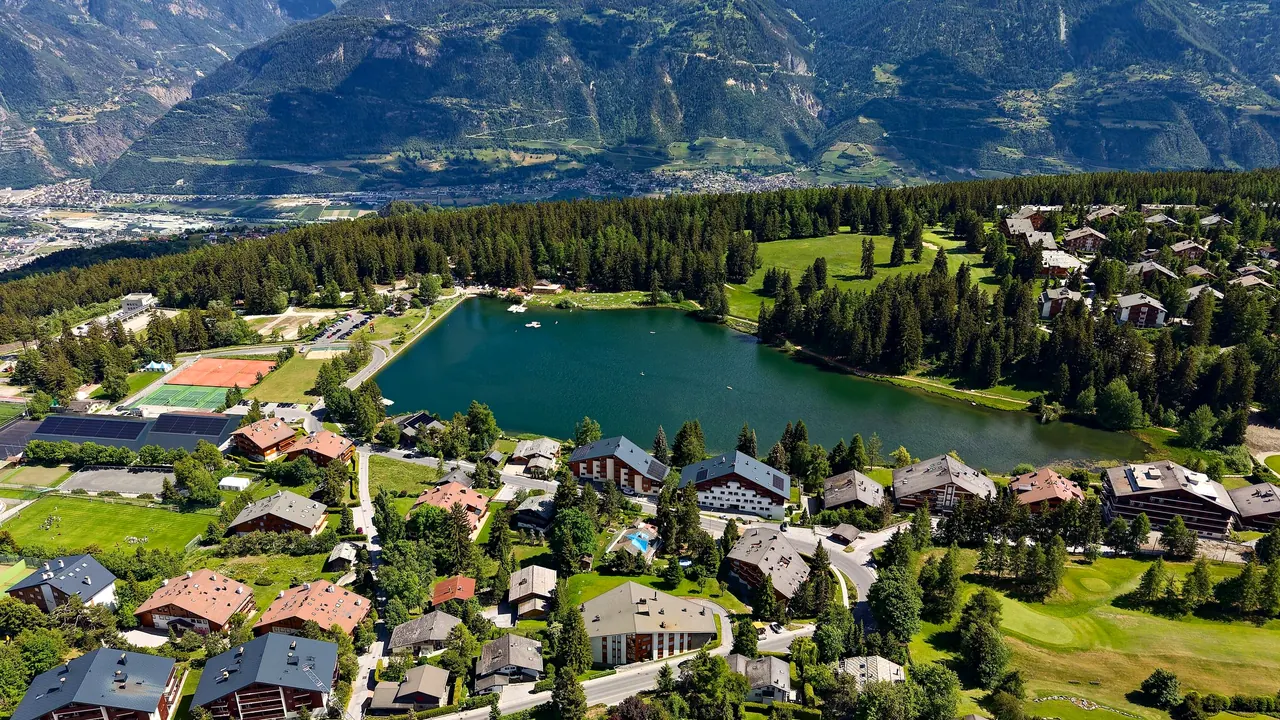
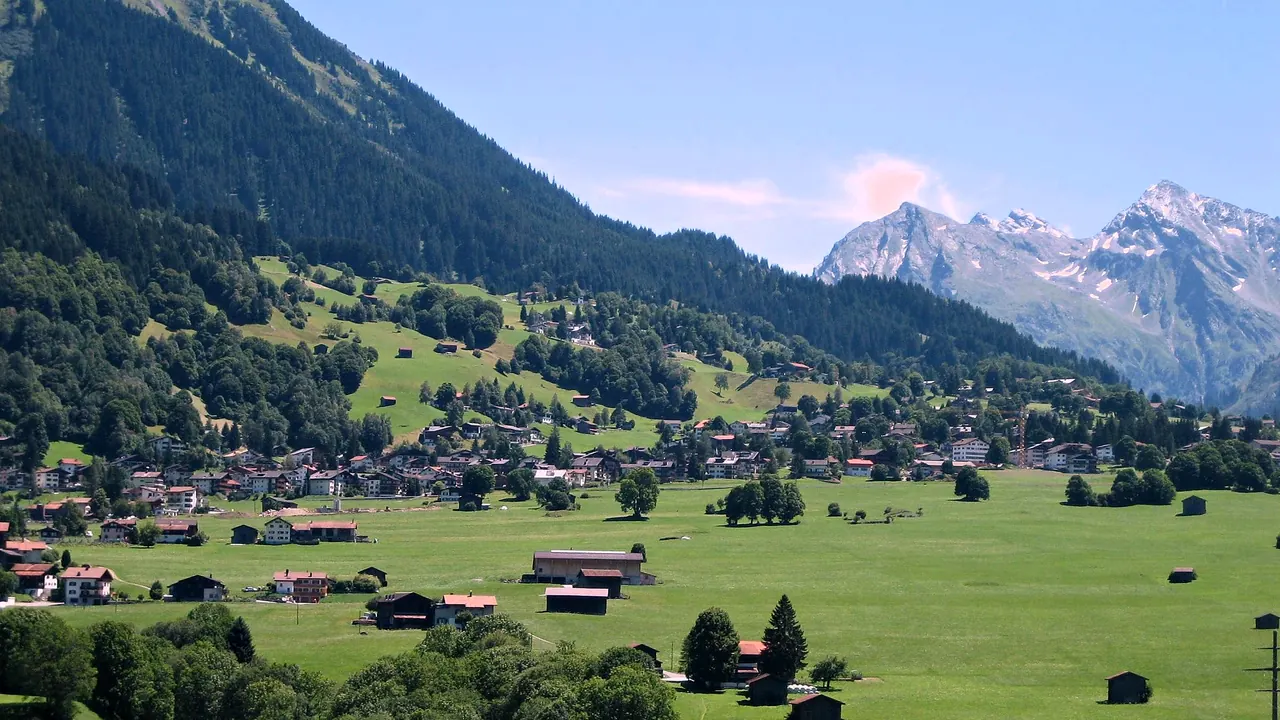
Photos: Crans-Montana by Daniel Reust, CC BY-SA 4.0, cropped; Klosters by Adrian Michael, CC BY-SA 3.0, cropped.
Crans-Montana or Klosters?
Our verdict in twelve categories, each scored against the same fixed benchmark cities, and the climate month by month, so you can choose for your trip.
Choose Crans-Montana for
- shopping
- nightlife
- food and drink
Crans-Montana is the more sociable and polished of the two. Après-ski runs on into hotel bars and a couple of late clubs, Crans has a cluster of designer boutiques, Valais wine comes from the vineyards just below, and the funicular drops straight onto the Rhône valley line for Sion's castles or Lake Geneva. Pick it if evenings out, a special dinner and some shopping matter as much as the skiing or hiking.
Choose Klosters for
- getting around
- families
Klosters suits travellers who want the mountains and very little else. It is a quieter, more discreet village where the Parsenn and Madrisa slopes do most of the work. Children have their own play area and gentle runs on the Madrisa, and the Rhaetian Railway stops right beside the Gotschna cable car. Families, and anyone who likes early nights by the fire, will find it easier to settle into.
Scoreboard
Twelve categories on one fixed scale from 0 to 100. The shaded stretch is the gap between the two.
Your match
Pick a travel style or drag the sliders, and both match scores follow your weighting.
Wins on shopping and nightlife with your weighting.
Wins on getting around and families with your weighting.
What matters to you?
Category by category
What the scores mean for a trip.
Beaches & swimming
Neither place is for swimming, but Crans-Montana at least has its own water. In July and August, Lac Moubra and Lac Grenon on the plateau become bathing spots with lawns, pontoons and shallow water that warms to around 20°C. Klosters has only an outdoor village pool. Its nearest lake is at Davos, half an hour away and colder, so a proper swim there usually means a hotel pool or a thermal bath.
Food & drink
Both kitchens are hearty and alpine, but Crans-Montana has more depth. Raclette, dried meat and fondue come with wine from the Valais vineyards just below the resort, and the wealthy winter crowd supports enough gastronomic restaurants that a special dinner is easy to arrange.
Klosters cooks Graubünden dishes such as capuns and pizokel in wood-panelled stuben, with Pinot Noir from the Bündner Herrschaft, but the choice is smaller and the best meal is often a terrace lunch on the mountain. In both, cheap eating is hard to find and many kitchens close out of season.
Culture & sights
Neither village has much to see, and in both cases the history lies down the valley. The difference is in character. Crans-Montana was built in the twentieth century around sanatoriums and grand hotels and is now mostly chalets and apartment blocks. Klosters keeps its old timber chalets, Augusto Giacometti's stained glass in St. Jakob and a small rural museum in the Nutli-Hüschi farmhouse.
Nightlife
Crans-Montana has the bigger night out, though it is small by any city standard. Après-ski terraces lead on to hotel bars and piano lounges in Crans, and a couple of nightclubs stay open late at weekends for a dressed-up crowd.
Klosters keeps things low-key, with a late spot or two in the peak weeks and regulars who would rather sit by the fire. Anyone who wants more takes the train up to Davos. In both resorts the lively nights fall around Christmas, New Year and February, and the rest of the year is quiet.
Nature & outdoors
Both are first-rate mountain bases, and the difference is in the setting. Crans-Montana sits on a sunny, south-facing terrace with a view from the Matterhorn to Mont Blanc. Its skiing reaches up to the Plaine Morte glacier on broad intermediate runs, and in summer it adds the level bisse paths and alpine golf.
Klosters lies in a valley rather than on a terrace. Its main draw is the long runs down from the Parsenn to the village, with the gentler Madrisa on the other side. Summer brings meadows, tarns and huts towards the Silvretta, and the Swiss National Park can be reached through the Vereina tunnel.
Day trips
Crans-Montana has the slightly better choice, because the funicular to Sierre joins the main Rhône valley line. Sion's hilltop castles of Valère and Tourbillon, the Roman remains at Martigny and the abbey at Saint-Maurice are easy outings, and Chillon and the Lavaux terraces make a longer day by train.
From Klosters the Rhaetian Railway runs to Chur's old town, to Heidi country around Maienfeld and to Vaduz, and through the Vereina tunnel to the sgraffito houses of Guarda and Scuol. It is an attractive list, but it has fewer major sights than the Valais.
Good for families
With small children, the layout is what holds Crans-Montana back. Its villages are spread across a hillside, so where you stay and the free shuttle buses decide how easy the days are. The ski schools still have children's areas on broad, sunny beginner slopes. In summer the plateau lakes add pedalos, playgrounds and flat walks, and the bisse paths are easy on small legs.
Klosters is simpler to manage. The Madrisa side is built around children, with a summer play and adventure area as well as gentle ski slopes, and the traffic-calm village keeps days easy to plan. Wet weather is the weak spot in both, since neither resort has a zoo, an aquarium or much else indoors.
Getting around
You reach Crans-Montana by funicular. It climbs from Sierre in about twelve minutes and connects with mainline trains. Once you are up, Crans, Montana and the lift bases are strung along several kilometres of sloping hillside, so outside each walkable village core you depend on the free shuttle buses.
Klosters sits right on the Rhaetian Railway, with two stations, Platz and Dorf, direct trains to Davos and connections to Chur. The Gotschna cable car leaves from beside the station at Platz, and local and ski buses run the length of the valley village. Without a car, it is the simpler of the two.
Shopping & style
Crans stands out here. For a mountain village it has a dense cluster of international fashion labels, Swiss watchmakers, jewellers and designer ski wear, enough to fill an afternoon. Klosters has ski shops, a handful of fashion and interiors boutiques on the main street around Platz and little else, so serious shopping means Zurich. Both have good delicatessens, with Valais wine and cheese in one and Graubünden cured meats in the other.
Affordability
There is no cheap option between these two. Both are very expensive, with lodging, lift passes, lessons and meals all well above European norms. In Crans-Montana you can save a little by self-catering, buying supplies in the valley and coming in late spring or early autumn. In Klosters the guest card for local transport and an apartment trim the bill only slightly.
Live music & performing arts
Crans-Montana offers more, if only in short bursts. The Caprices festival brings electronic music to the slopes at the end of the ski season, and a summer chamber and classical series fills churches and halls. Klosters has summer classical concerts and the odd church recital but no festival of that kind, and for most of the year live music in either resort means a hotel pianist.
Wellness & relaxation
For a restful stay the two are evenly matched. Neither has a bathing culture of its own, and in both the comfort comes from hotel spas with pools, saunas and treatment rooms. Crans-Montana began as a resort for convalescents, and its sunny, south-facing terrace with long views across the Valais still makes it easy to do very little. Most of the large hotel spas let outside guests in, and the alpine hot pools at Leukerbad are close enough for a half day out.
Klosters offers valley quiet rather than terrace sun, in a low-key village where walking and early nights set the pace. When you want a proper soak, you have two choices: the thermal baths at Scuol, through the Vereina tunnel, or the large public pool and sauna complex in Davos, up the valley.
When should you go?
Pick your month. The climate figures are measured averages, not a forecast.
Crans-Montana in July
Klosters in July
Daytime high, °C
Rainfall in the month, mm
Where the figures come from
Crans-Montana has no weather station within reach, so its figures come from a gridded climate model rather than a measured record, and read a broad area rather than one spot.
Klosters's temperatures are measured 51 km from the centre, at S. Valentino Alla Muta.
Klosters's station stands 280 m above the city centre, so the centre is likely a little warmer than the figures say.
Klosters has no rain gauge within 25 km of the centre, so its rainfall comes from a gridded climate dataset read at the destination rather than from a gauge further away.
Temperature and rainfall are climate normals, averaged over the years shown. Crans-Montana: 2001-2020 normals, NASA POWER reanalysis grid, no weather station within 90 km. Klosters: 1991-2020 normals, S. Valentino Alla Muta (51.4 km from centre).
Both are high mountain resorts with two real seasons, winter for snow and high summer for walking. Crans-Montana is the colder of the two. Its daytime highs stay below freezing from December to February, at about -2°C in January, while Klosters stays a little above, at around 2°C. In July and August Klosters is again slightly warmer, about 20°C against 18°C, which is pleasant hiking weather in both. Summer is also the wettest season in both places. Crans-Montana's lakes are only warm enough to swim in during those two months.
The real difference comes at the edges of summer. In Crans-Montana the rain drops in September, so early autumn is a dry and settled time for the bisse paths. Klosters stays wet into September, with about 110mm, and dries out only in October. In April and November both are cool and between seasons.
Which traveller are you?
On a shopping trip, Crans-Montana is the clear choice. For a mountain village, Crans has an unusual number of international fashion labels, Swiss watchmakers, jewellers and cashmere shops. Klosters has ski shops, a few boutiques and delicatessens, and sends serious shoppers to Zurich.
For a food and nightlife trip, Crans-Montana comes out ahead again. Après-ski moves on to piano lounges and weekend clubs, and raclette with a Petite Arvine or Cornalin beats Klosters' smaller choice of stuben, where most regulars want a fireside drink and an early night.
On a family trip with children, Klosters is the easier base. The Madrisa side is built around children, with a summer adventure area and gentle ski slopes, and the village is calm and on the railway. Crans-Montana is spread across a hillside, so families with toddlers depend on the shuttle buses.
Before you go
| Measure | Crans-Montana | Klosters |
|---|---|---|
| Official language | French, German, Italian, Romansh | French, German, Italian, Romansh |
| Currency | Swiss Franc (CHF) | Swiss Franc (CHF) |
| Sockets | CJ230 V, 50 Hz | CJ230 V, 50 Hz |
| Driving side | Right | Right |
| Time zone | UTC+1, UTC+2 in summer | UTC+1, UTC+2 in summer |
| Emergency number | 112 | 112 |
| Elevation | 1,495 m | 1,179 m |
| Main airport | Geneva International Airport (GVA)106 km from centre150 non-stop destinations | Zürich Airport (ZRH)120 km from centre226 non-stop destinations |
| Public holidays this year | 9 days | 9 days |
By the numbers
| Measure | Crans-Montana | Klosters |
|---|---|---|
| Population | 10,447 | 4,499 |
| People per km² | 175 | 20 |
| Museums within 10 km | 3 | 3 |
| UNESCO World Heritage sites within 50 km | 1 | 1 |
Where else could you go?
Every comparison below shares a destination with this one, so you can follow Crans-Montana or Klosters somewhere new.
- Davosvs Klosters
- Leukerbadvs Crans-Montana
- Arosavs Klosters
- Adelbodenvs Crans-Montana
- Gstaadvs Crans-Montana
- Lenzerheidevs Klosters