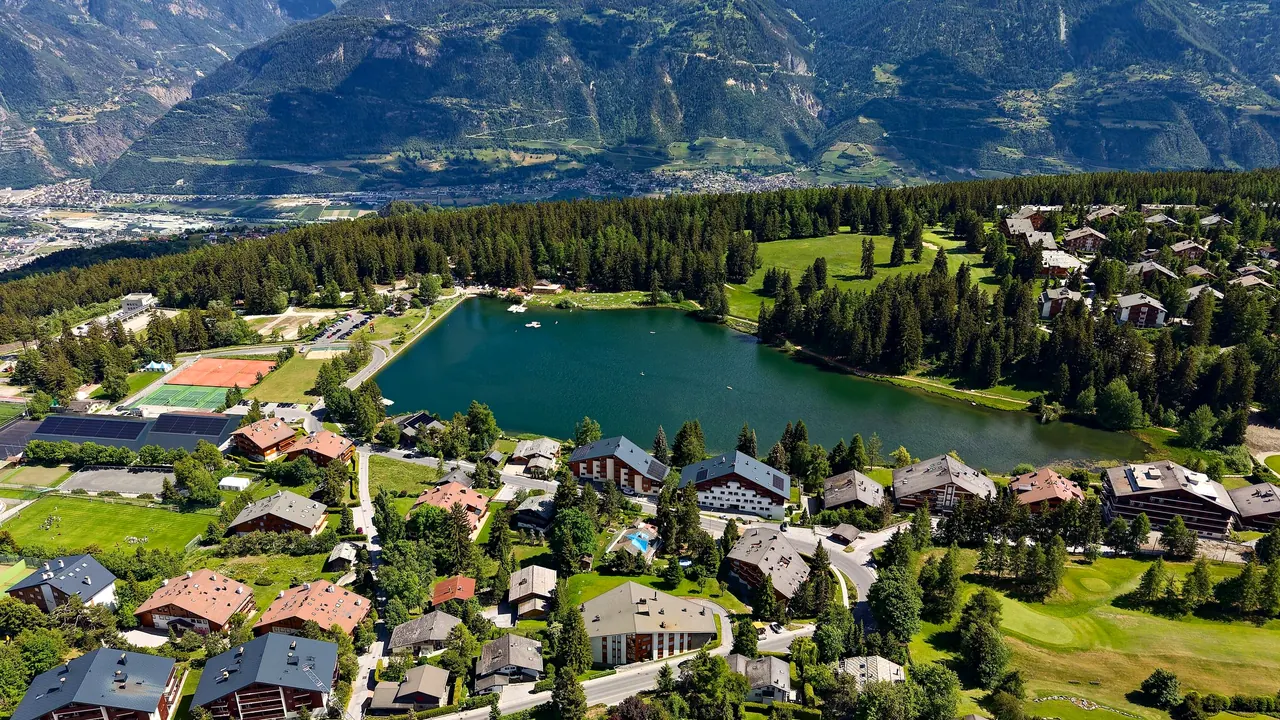
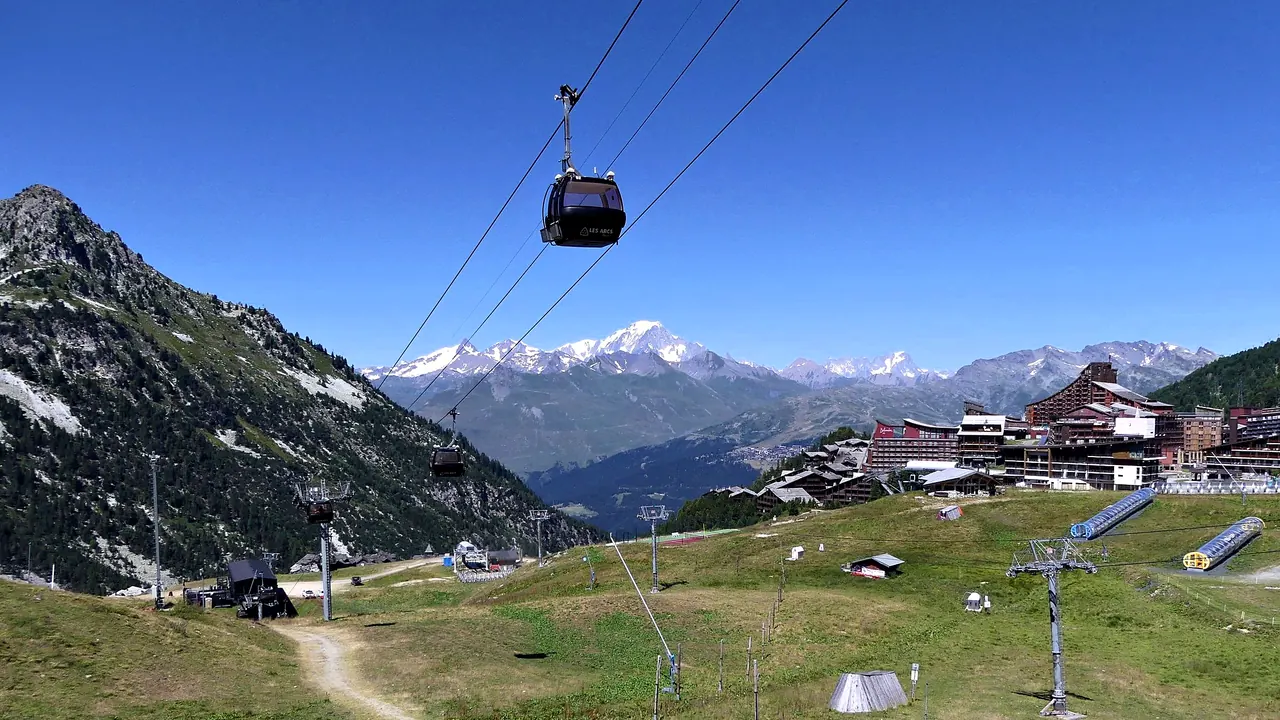
Photos: Crans-Montana by Daniel Reust, CC BY-SA 4.0, cropped; Les Arcs by Florian Pépellin, CC BY-SA 4.0, cropped.
Crans-Montana or Les Arcs?
Our verdict in twelve categories, each scored against the same fixed benchmark cities, and the climate month by month, so you can choose for your trip.
Choose Crans-Montana for
- day trips
- shopping
- wellness
Crans-Montana suits travellers who want the Alps with polish and sunshine. Its terrace above the Rhône valley gives broad, easy pistes, level bisse walks and golf with a view of the Valais peaks. There are hotel spas for slow afternoons and boutiques in Crans for those who like to shop. The railway at the foot of the funicular puts castles, vineyards and Lake Geneva within a day's reach. It costs more than almost anywhere in Europe, so it fits people who are happy to pay for comfort.
Choose Les Arcs for
- prices
- families
- culture and sights
Les Arcs is the stronger pick for a family ski week or a properly active mountain trip. Its car-free villages with apartments on the snow were built around children, and the linked Paradiski area offers longer, steeper skiing and more off-piste. In summer the Vanoise and the Isère add wildlife, rafting and via ferrata. It is still expensive, but self-catering makes it easier to manage, and Perriand's architecture gives it a character of its own.
Scoreboard
Twelve categories on one fixed scale from 0 to 100. The shaded stretch is the gap between the two.
Your match
Pick a travel style or drag the sliders, and both match scores follow your weighting.
Wins on day trips and shopping with your weighting.
Wins on prices and families with your weighting.
What matters to you?
Category by category
What the scores mean for a trip.
Beaches & swimming
Neither is a place for a swimming vacation, but Crans-Montana at least offers natural water. In July and August, Lac Moubra and Lac Grenon on the plateau warm to around 20°C, with lawns and pontoons for a lazy afternoon.
Les Arcs has no natural swimming of its own. Summer swimming means the heated pools in residences, and a real lake swim needs a drive of about two hours to Annecy or the Lac du Bourget.
Food & drink
Both serve melted-cheese mountain cooking, but Crans-Montana has more to offer at table. The terraced Valais vineyards just below the resort supply Fendant, Petite Arvine and Cornalin to go with the raclette, and its wealthy guests support enough gastronomic kitchens to make a special dinner easy to book.
Les Arcs is Savoyard: tartiflette, diots and Beaufort on almost every menu, with long lunches in converted farm huts. Off the slopes, the choice soon comes down to pizzerias, crêperies and supermarket cheese counters, though the Beaufort cooperative in Bourg-Saint-Maurice is a good place to stock up.
Culture & sights
Crans-Montana is a resort with little to visit and Les Arcs is a resort worth looking at. Crans-Montana grew from early sanatoriums and grand hotels, and what you see now is chalets, apartment blocks and a few period hotels, with small chapels and the odd exhibition. For old stones you have to go down to the Rhône valley.
Les Arcs is the more rewarding of the two, because the resort is the sight. Charlotte Perriand helped shape Arc 1600 and Arc 1800, and their stepped blocks and compact interiors are listed as notable twentieth-century French architecture. Design lovers come specifically to see them. The baroque chapels of the Tarentaise lie below, for anyone who goes looking.
Nightlife
Evenings are low-key in both, but the mood differs. Crans-Montana is dressier: après-ski on the terraces leads on to hotel bars, piano lounges and a couple of late clubs for a moneyed crowd, at their liveliest over Christmas and in February.
Les Arcs is louder at five o'clock and quieter at midnight. DJs and table-dancing fill the slope-side bars in Arc 1800 and Arc 2000, then the families in the apartments head home and most nights end early.
Nature & outdoors
Both are first-rate mountain bases, so the choice comes down to what kind of mountains you want. Crans-Montana is about sun and views. Its south-facing terrace looks across to peaks from the Matterhorn to Mont Blanc, and its pistes are mostly broad and suit intermediates. In summer there are level bisse paths, paragliding and spectacular golf.
Les Arcs is bigger and steeper. Paradiski links it to La Plagne, and runs from the Aiguille Rouge at over 3,200m drop to the valley floor, with serious off-piste. In summer, trails lead into the Vanoise among ibex and marmots, alongside rafting on the Isère and via ferrata.
Day trips
Crans-Montana is much better placed for outings, because the funicular meets the main Rhône valley railway at Sierre. From there it is a short ride to Sion's twin hilltop castles, Martigny's Roman remains or the abbey at Saint-Maurice. Montreux, Chillon and the Lavaux terraces are about an hour and a half away by train.
From Les Arcs, most outings are to other mountain places: Bourg-Saint-Maurice, the Beaufortain cheese villages and neighbouring resorts. Annecy and Chambéry are each about two hours by road, and the summer-only pass to Aosta closes in winter.
Good for families
Les Arcs was designed for ski-week families, and it shows. Its villages are largely car-free, children can join ski school from the youngest ages, and gentle beginner areas, sledging, ice skating and pools keep the off-ski hours easy.
Crans-Montana works for families who ski or hike. Its sunny slopes suit beginners, and in summer it adds pedalos on the lakes and flat bisse paths. The villages are strung along a hillside, though, so with toddlers you depend on shuttle buses and need to choose your base carefully.
Getting around
Both can be reached by rail and funicular without a car, and both rely on free shuttles to link their villages. The difference is what lies at the bottom. From Crans-Montana, a twelve-minute ride connects with Swiss mainline trains, so valley outings are easy without a car.
In Les Arcs, the funicular from Bourg-Saint-Maurice reaches only Arc 1600. The other villages are spread along a winding road, shuttles slow down in snow, and in winter the slopes themselves are the best link. A car helps more here for anything beyond the resort.
Shopping & style
Crans-Montana is the clear choice for shopping. Crans has an unusual cluster of fashion labels, Swiss watchmakers, jewellers and cashmere shops for a mountain village, plus delicatessens selling Valais wine and dried meats.
In Les Arcs, shopping is practical: ski rental, outdoor gear and small supermarkets. The things worth taking home are Beaufort, charcuterie and génépi, best bought in Bourg-Saint-Maurice.
Affordability
Crans-Montana costs a good deal more than Les Arcs, and it stays expensive in every season. A winter week brings costly rooms and chalets, then lift passes, ski hire and lessons on top. Even a plain lunch on a mountain terrace is pricey. Shopping for supplies in the valley helps only a little.
Les Arcs is expensive in a different way. The big Paradiski pass, rental gear and ski school add up, and the French school vacation weeks push lodging up hard. Because most beds are in apartments rather than grand hotels, you can cut your daily costs by cooking for yourself.
Live music & performing arts
Live performance in both resorts comes in short festival seasons, and both host classical music in churches and halls in summer. Crans-Montana also has Caprices, which brings electronic music to the slopes as the ski season ends, and the valley towns are close by for theatre.
Les Arcs' summer festival, running since the 1970s, pairs chamber concerts with a music academy in July. In winter, live music means bands in the après-ski bars.
Wellness & relaxation
Crans-Montana does rest better. The plateau was first settled as a place to recover, several large hotels run spas that outside guests can use, and Leukerbad's alpine hot pools are under an hour away.
In Les Arcs, wellness usually means the pool, sauna or hammam in your residence after a day on the slopes. The pace of a ski week only slows in summer and the quieter weeks either side of the seasons, and taking the waters means a trip of about an hour to Brides-les-Bains.
When should you go?
Pick your month. The climate figures are measured averages, not a forecast.
Crans-Montana in July
Les Arcs in July
Daytime high, °C
Rainfall in the month, mm
Where the figures come from
Crans-Montana has no weather station within reach, so its figures come from a gridded climate model rather than a measured record, and read a broad area rather than one spot.
Les Arcs's temperatures are measured 43 km from the centre, at Grand St. Bernard / Grand Saint Bernard.
Les Arcs's station stands 199 m above the city centre, so the centre is likely a little warmer than the figures say.
Les Arcs has no rain gauge within 25 km of the centre, so its rainfall comes from a gridded climate dataset read at the destination rather than from a gauge further away.
Temperature and rainfall are climate normals, averaged over the years shown. Crans-Montana: 2001-2020 normals, NASA POWER reanalysis grid, no weather station within 90 km. Les Arcs: 1991-2020 normals, Grand St. Bernard / Grand Saint Bernard (43.4 km from centre).
Both are winter-and-summer places, with quiet seasons in spring and late autumn. Crans-Montana is the milder of the two. From December to February daytime highs stay just below freezing, cold enough for good snow, and July and August reach about 18°C, comfortable for hiking and warm enough for a dip in the plateau lakes. Its wettest stretch is early summer through August, at around 130mm a month, so expect afternoon showers on walks.
Les Arcs sits higher and stays colder all year. Midsummer highs are only around 12°C, and winter days stay well below freezing. Its heaviest precipitation comes in November and December, up to 193mm, which builds the early snowpack, while December is very short on sunshine. July is the brightest month, with about 211 hours of sun, which makes high summer its best time for hiking and biking. For warmer summer days, Crans-Montana is the better choice.
Which traveller are you?
On a family trip with young children, Les Arcs is the easier choice. Its villages are largely car-free, apartments open onto the snow, and kindergartens, sledging, skating and pools fill the hours off the skis. Crans-Montana's villages are spread across a hillside, and that is harder with toddlers.
For a relaxing and wellness trip, Crans-Montana is better. It began as a place to recover, and its sunny plateau, large hotel spas open to outside guests and easy half day at Leukerbad's hot pools suit a slow stay better than the ski-week energy of Les Arcs.
On a trip on a tight budget, neither is cheap, but Les Arcs costs less. It is built mostly of self-catering apartments, and quieter weeks in January, late March or summer bring real savings. Crans-Montana stays expensive all year, even outside the peak weeks.
Before you go
| Measure | Crans-Montana | Les Arcs |
|---|---|---|
| Official language | French, German, Italian, Romansh | French |
| Currency | Swiss Franc (CHF) | Euro (EUR) |
| Sockets | CJ230 V, 50 Hz | CE230 V, 50 Hz |
| Driving side | Right | Right |
| Time zone | UTC+1, UTC+2 in summer | UTC+1, UTC+2 in summer |
| Emergency number | 112 | 112 |
| Elevation | 1,495 m | 2,273 m |
| Main airport | Geneva International Airport (GVA)106 km from centre150 non-stop destinations | Geneva International Airport (GVA)92 km from centre150 non-stop destinations |
| Public holidays this year | 9 days | 11 days |
By the numbers
| Measure | Crans-Montana | Les Arcs |
|---|---|---|
| Population | 10,447 | - |
| People per km² | 175 | - |
| Museums within 10 km | 3 | 0 |
| UNESCO World Heritage sites within 50 km | 1 | 0 |
Where else could you go?
Every comparison below shares a destination with this one, so you can follow Crans-Montana or Les Arcs somewhere new.
- La Rosièrevs Les Arcs
- La Plagnevs Les Arcs
- Leukerbadvs Crans-Montana
- Tignesvs Les Arcs
- Val d'Isèrevs Les Arcs
- Adelbodenvs Crans-Montana