
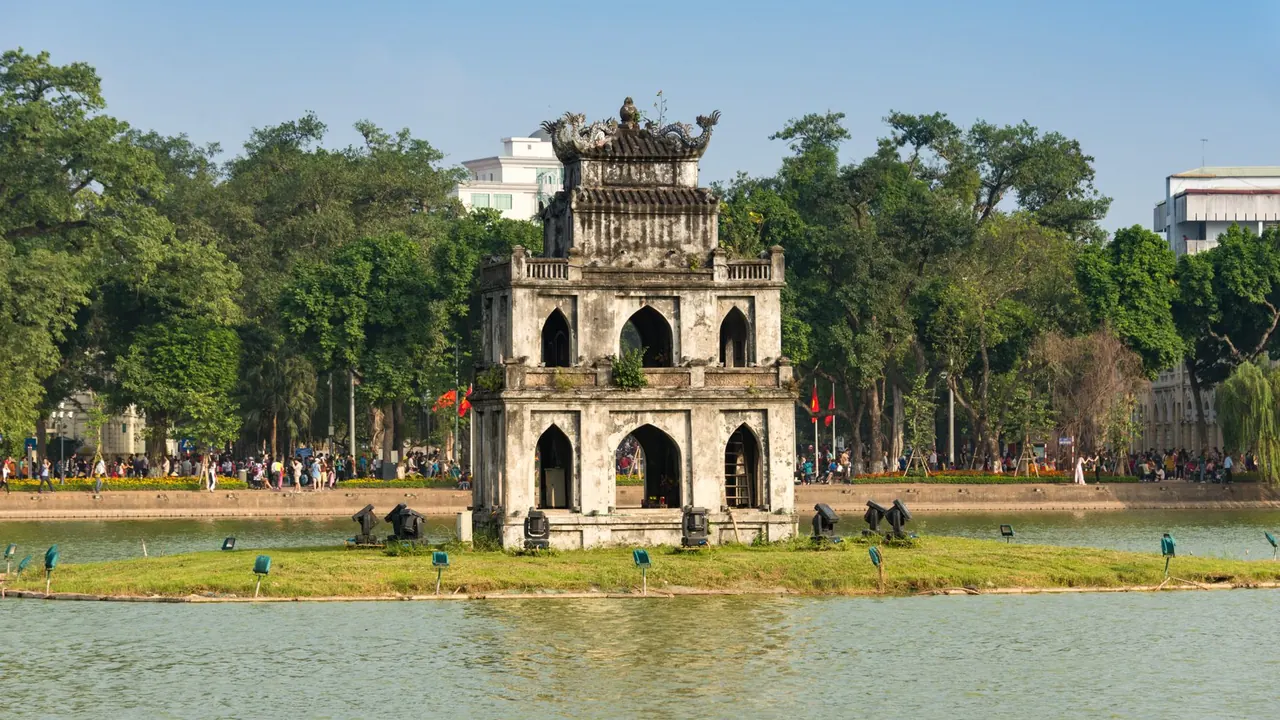
Photos: Da Nang by Nghia Tran, Pexels License; Hanoi by xiquinhosilva, CC BY 2.0, cropped.
Da Nang or Hanoi?
Our verdict in twelve categories, each scored against the same fixed benchmark cities, and the climate month by month, so you can choose for your trip.
Choose Da Nang for
- beaches
- families
- day trips
Da Nang suits travellers who want a beach vacation with plenty to do between swims. The long sandy shore from My Khe to Non Nuoc, the forested Son Tra peninsula and the Hai Van Pass are all close by. With Hoi An, My Son and even Hue within reach, it is the better base for exploring central Vietnam, and families find it far easier going.
Choose Hanoi for
- culture and sights
- live music and the arts
- food and drink
Choose Hanoi if the city itself is the point. The Old Quarter, the French Quarter and the Temple of Literature give it much more history to walk through. Its street food is the most celebrated in the country, and water puppets, ca tru and the Opera House fill the evenings. There is no beach, so add a few nights on the coast if you want sand.
Scoreboard
Twelve categories on one fixed scale from 0 to 100. The shaded stretch is the gap between the two.
Your match
Pick a travel style or drag the sliders, and both match scores follow your weighting.
Wins on beaches and families with your weighting.
Wins on culture and sights and live music and the arts with your weighting.
What matters to you?
Category by category
What the scores mean for a trip.
Beaches & swimming
Here the gap could hardly be wider. Da Nang is built along one continuous stretch of pale sand. My Khe and Non Nuoc have room to spread out and warm, calm water from spring to late summer, and quieter An Bang is a short ride south. Only the autumn monsoon puts swimming off.
Hanoi is an inland river city. Its nearest sea, at Ha Long, Cat Ba or Sam Son, is a separate trip rather than a day out. Swimming there means a hotel pool or a West Lake water park.
Food & drink
Both cities eat on plastic stools and take their coffee strong and iced, but Hanoi is the bigger food destination. It is the home of pho and bun cha, and many of its stalls have cooked the same single dish for decades. Add cha ca fried at the table, egg coffee up narrow stairs and bia hoi corners every evening.
Da Nang's cooking is spicier and more robust, built around mi Quang and fish-cake noodle soup. Its real strength is seafood, picked live from tanks behind the beach. Beyond that the range is narrower, and there is little fine dining.
Culture & sights
Hanoi has far more to see. The Old Quarter's guild streets and tube houses, Ngoc Son temple on Hoan Kiem Lake, the French Quarter, the Temple of Literature and the political heart around Ba Dinh Square fill three or four days. The Museum of Ethnology and Hoa Lo prison tell the country's story well.
Da Nang is a modern city whose own sights fit into two days. The main ones are the Museum of Cham Sculpture, the cave shrines of the Marble Mountains and the Lady Buddha on Son Tra. Most of the region's great heritage lies outside the city.
Nightlife
Neither city is made for late nights, and both wind down around midnight, but Hanoi's evenings are livelier on the street. From late afternoon, bia hoi drinkers on tiny stools fill the Old Quarter pavements, and the lanes around Ta Hien get loud with backpacker bars. At weekends the streets around Hoan Kiem become an evening promenade.
Da Nang's nights are more spread out and more waterside. There are rooftop bars over the Han River, open-air beer halls serving grilled shellfish, and the An Thuong quarter behind the beach for craft beer and cocktails. It also has a few loud clubs near the river at weekends for anyone who wants to dance.
Nature & outdoors
Da Nang has its landscape on the doorstep. The forested Son Tra peninsula, home to douc langurs, is on the city's edge, and the Hai Van Pass climbs north along the coast. The Ba Na Hills rise to nearly 1,500m, and there is snorkelling off the Cham Islands and surf at My Khe in the cooler months.
Hanoi itself is flat and built-up, and its lakes and the West Lake shoreline path are the main green relief. Its great scenery lies further out. The limestone towers and river caves of Trang An take a two-hour drive, and Ha Long Bay and Sapa need a night away.
Day trips
Da Nang is the stronger base. Hoi An's lantern-lit old town is under an hour away and easy to visit more than once. The Cham temple ruins of My Son stand in the jungle about an hour and a half inland. Imperial Hue is a long but rewarding run over or through the Hai Van Pass.
Hanoi's outings are good but more scattered. Around Ninh Binh there are the ancient capital of Hoa Lu and the Bai Dinh pagoda, the Perfume Pagoda is reached by rowing boat, and the craft villages of Bat Trang and Van Phuc are closer in. Its most famous excursion, Ha Long Bay, really calls for an overnight cruise.
Good for families
Children are fussed over in both cities, and both have the same motorbike traffic and blocked pavements, but Da Nang gives families much more to do. The beach has space to play, and the Ba Na Hills cable car and indoor amusement park make a full day out. The city also has a riverside Ferris wheel and water parks. Just avoid the rainy autumn months.
Hanoi works best in small doses. The water puppet show by Hoan Kiem, the lakes, the zoo and the village houses at the Museum of Ethnology all suit children. It is easiest with a hotel near the lake and a driver for anything further.
Getting around
Neither city is easy by public transport, and in both most visitors rely on cheap ride-hailing cars and motorbike taxis. What differs is the layout. Da Nang has no rail at all and is spread along the coast, so you ride between the river centre and the beach, or hire a scooter for the straight road to Hoi An. Walking works mainly on the promenades.
Hanoi's main sights sit close together between the Old Quarter, Hoan Kiem and Ba Dinh, so much of a visit can be done on foot. Stepping round parked scooters and cooking stalls is tiring, though. Cyclos offer a slow way round the Old Quarter.
Shopping & style
Hanoi is the better place to shop, because its Old Quarter still groups trades by street. Hang Gai is the place for silk, embroidery and made-to-measure clothes ready in a day or two. Dong Xuan is the big wholesale market, and the weekend night market runs up from the lake. Lacquerware, Bat Trang ceramics and textiles from the northern hills make good buys.
Shopping in Da Nang is practical. Han and Con markets sell coffee, dried seafood and fabrics, the malls have international chains, and the stone carvers of Non Nuoc make everything from figurines to statues. For tailoring and crafts, visitors head to Hoi An.
Affordability
Both are very cheap by Western standards, but Hanoi stretches money a little further. Street food, bia hoi and boutique hotels in the Old Quarter cost very little. The one big extra is a Ha Long Bay cruise.
Everyday costs in Da Nang are similarly low. A beach vacation, though, tends to pull you towards the pricier options: large beachfront and Son Tra resorts at international rates, the Ba Na Hills and western-style bars near the sand.
Live music & performing arts
Hanoi offers more for an evening out. Water puppetry with live traditional music plays several times a day beside Hoan Kiem. The colonial Opera House stages symphony, ballet and opera on an irregular programme, and ca tru sung poetry and a long-running jazz scene add something rarer.
Da Nang has little stage life. Tuong classical theatre is performed irregularly and mainly for locals, and the bar music is mostly covers. Its big spectacle is the summer fireworks festival over the Han River, along with the staged river shows and bai choi singing games around Hoi An.
Wellness & relaxation
Massage is cheap and everywhere in both cities, but Da Nang is the easier place to actually unwind. Early swims, long coffees and quiet evenings by the river set an unhurried pace. Resort spas on Son Tra have treatment villas over the sea, and a hot springs park with mud baths lies about 30km out.
Hanoi's foot-massage shops are a welcome end to a long day on foot, but the city around them is loud with horns and traffic. For calm, stay near West Lake or walk the lakes at dawn.
When should you go?
Pick your month. The climate figures are measured averages, not a forecast.
Da Nang in July
Hanoi in July
Daytime high, °C
Rainfall in the month, mm
Where the figures come from
Hanoi's sunshine is measured 86 km from the centre, at Phu Lien.
Temperature and rainfall are climate normals, averaged over the years shown. Da Nang: 1991-2020 normals, Da Nang (4.9 km from centre). Hanoi: 1991-2020 normals, Ha Noi (4.4 km from centre).
Da Nang is at its best from February to August, when rain is light and sunshine is reliable. From May the sea is around 28°C, warm enough for long swims, and it stays that way into autumn. Midsummer days reach 35°C, though, so it is best to sightsee early in the day. From September the monsoon takes over and peaks in October at 726mm. Red flags often close the beach until the end of the year.
Hanoi runs on almost the opposite rhythm. Its summer, from May to August, is hot and very wet, with over 300mm of rain in July. Winter is dry but cool and often grey, with January highs of 19°C. The pleasant walking weather comes in October and November, and again in March and April. That makes autumn a good time for Hanoi, just as Da Nang turns stormy.
Which traveller are you?
On a beach and sun trip, Da Nang is the clear choice. It has a long, wide sandy shore, a warm and calm sea from spring through summer, seafood grills behind the sand and massage on every street. Hanoi has no beach within a day's reach.
For a culture and arts trip, Hanoi wins easily. The Old Quarter's guild streets, the Temple of Literature, the Imperial Citadel and the Museum of Ethnology fill several days. Water puppetry and the Opera House add evenings that Da Nang cannot match.
On a family trip with children, Da Nang is easier. Resorts with pools and children's clubs line the beach, and the Ba Na Hills cable car and Golden Bridge delight young visitors. In Hanoi, outings mean squeezing past motorbikes on crowded pavements all day.
Before you go
| Measure | Da Nang | Hanoi |
|---|---|---|
| Official language | Vietnamese | Vietnamese |
| Currency | Dong (VND) | Dong (VND) |
| Sockets | ACFG220 V, 50 Hz | ACFG220 V, 50 Hz |
| Driving side | Right | Right |
| Time zone | UTC+7 | UTC+7 |
| Emergency number | Police 113, ambulance 115, fire 114 | Police 113, ambulance 115, fire 114 |
| Elevation | 19 m | 10 m |
| Main airport | Da Nang International Airport (DAD)3 km from centre47 non-stop destinations | Noi Bai International Airport (HAN)22 km from centre91 non-stop destinations |
By the numbers
| Measure | Da Nang | Hanoi |
|---|---|---|
| City population | 2,819,900 | 8,717,600 |
| People per km² | 238 | 2,595 |
| Museums within 10 km | 2 | 14 |
| UNESCO World Heritage sites within 50 km | 2 | 1 |
| Swim season, months above 21 °C | 12 months | - |
Where else could you go?
Every comparison below shares a destination with this one, so you can follow Da Nang or Hanoi somewhere new.