
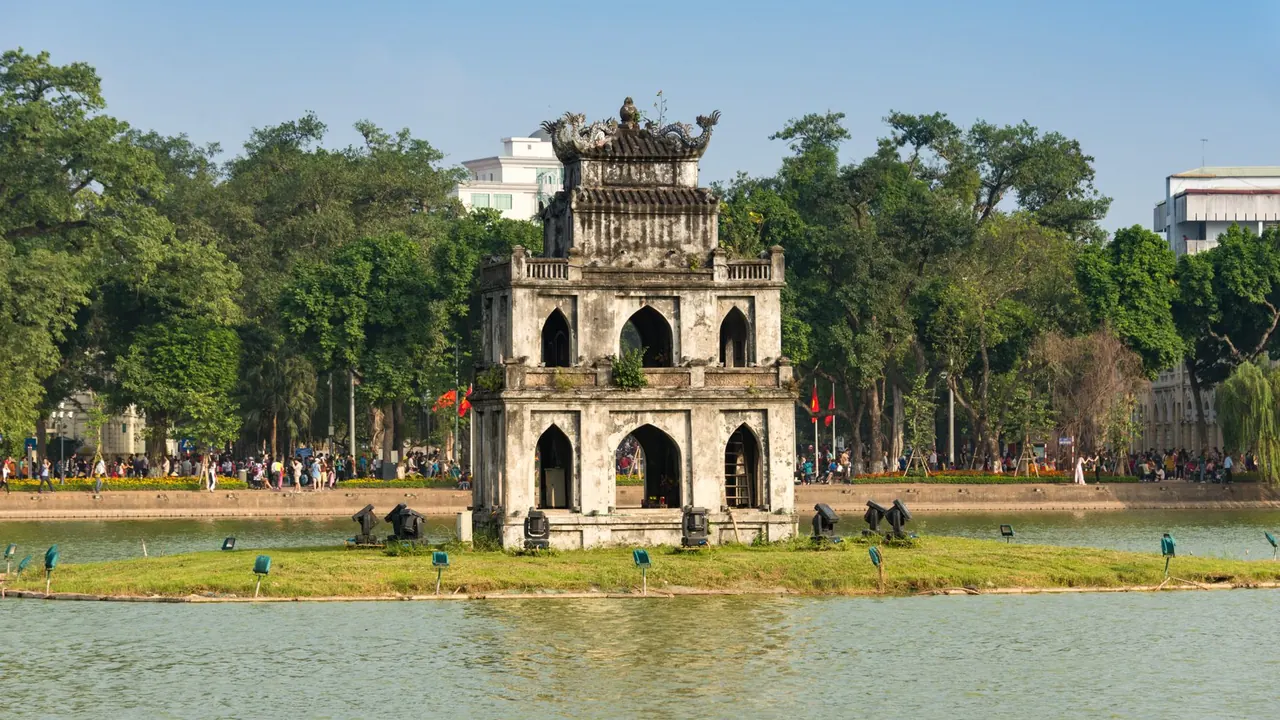
Photos: Ha Long by Takeshi Aida from Hong Kong, Hong Kong, CC BY-SA 2.0, cropped; Hanoi by xiquinhosilva, CC BY 2.0, cropped.
Ha Long or Hanoi?
Our verdict in twelve categories, each scored against the same fixed benchmark cities, and the climate month by month, so you can choose for your trip.
Choose Ha Long for
- beaches
- nature and the outdoors
- families
Ha Long is for travellers who want the scenery. The bay's limestone towers, caves and sheltered lagoons are the whole point, and a night on a boat among them, with kayaking, swimming off the deck and a quiet anchorage, is something Hanoi can only send you to. It also suits families, whose children tend to treat a cruise as an adventure. The town itself is thin on sights, food and evenings out, so plan your days around the water rather than the streets.
Choose Hanoi for
- culture and sights
- food and drink
- shopping
Hanoi suits the curious traveller who wants a city to explore on foot. The Old Quarter's trade streets, the Temple of Literature, the French Quarter and the Museum of Ethnology fill several days, and the street food is among the best in the country, from breakfast pho to evening bia hoi. It is also the cheaper and livelier of the two, with water puppets, craft villages and silk tailors besides. The beach, and the great landscapes, are a journey away.
Scoreboard
Twelve categories on one fixed scale from 0 to 100. The shaded stretch is the gap between the two.
Your match
Pick a travel style or drag the sliders, and both match scores follow your weighting.
Wins on beaches and nature and the outdoors with your weighting.
Wins on culture and sights and food and drink with your weighting.
What matters to you?
Category by category
What the scores mean for a trip.
Beaches & swimming
Ha Long at least has the sea. Bai Chay's town beach is imported sand with shallow, often cloudy water, but swimming off a cruise boat in a quiet cove or on an island beach like Ti Top is a real pleasure in summer, and Quan Lan has cleaner sand for anyone willing to stay overnight.
Hanoi is an inland river city, and swimming there means a hotel pool or a water park by West Lake. Neither place is a beach destination, but only Ha Long lets you get into the sea at all.
Food & drink
Ha Long's table is built around seafood: crabs, clams and mantis shrimp picked from tanks in the halls of Hon Gai and Bai Chay, and springy cha muc squid cakes. Beyond that the choice narrows quickly, with set menus on the boats and large impersonal restaurants on the strip.
Hanoi is one of the great street-food cities. It is the home of pho and bun cha, with cha ca, banh cuon and sticky rice on the side, and a coffee culture of slow drip, iced condensed milk and egg coffee in hidden upstairs cafés. Food lovers will eat far better and more variedly in the capital.
Culture & sights
Ha Long is a young, largely modern city, and its single great sight is natural. The Quang Ninh Museum is worth an hour and the floating villages such as Cua Van show life on the water, but a spare day in town soon runs dry.
Hanoi has a thousand years of layered history to walk through: the guild streets of the Old Quarter, Ngoc Son temple on Hoan Kiem Lake, the Temple of Literature, the Imperial Citadel of Thang Long and the Ho Chi Minh Mausoleum. The Museum of Ethnology and Hoa Lo prison add depth, enough for three or four full days.
Nightlife
Evenings in Ha Long are quiet: beer halls, karaoke and seafood dinners in Bai Chay, winding down well before midnight, or squid fishing from the stern and an early night on a boat.
Hanoi has much more going on after dark. Bia hoi stools crowd the Old Quarter pavements from late afternoon, the lanes around Ta Hien get loud with backpacker bars, and West Lake adds cocktails and craft beer. Neither keeps going until dawn, but Hanoi is the one for a sociable night out.
Nature & outdoors
This is Ha Long's great strength. Nearly two thousand forested limestone islets rise from green water, and you can kayak into lagoons, explore caves like Sung Sot, climb to the Ti Top viewpoint or head for the quieter Lan Ha and Bai Tu Long bays and Cat Ba's national park.
Hanoi's own green space is mostly its lakes, with a shoreline path round West Lake and dawn tai chi at Hoan Kiem. Its best scenery lies two hours away at Ninh Binh, where karst towers rise from rice paddies, a fine landscape but a smaller-scale echo of what Ha Long has on its doorstep.
Day trips
From Ha Long, the standout outing is Yen Tu, the holy mountain of Vietnamese Zen with pagodas climbing through forest, and Hai Phong's colonial streets and the Bach Dang battlefield are also within an hour. Hanoi itself is too far for a comfortable day.
Hanoi has the wider choice. Ninh Binh combines the old capital of Hoa Lu with river caves, the Perfume Pagoda makes a memorable boat-and-cave pilgrimage, and craft villages like Bat Trang for ceramics and Van Phuc for silk, plus old Duong Lam, are close at hand.
Good for families
Ha Long gives children an obvious adventure: boats, caves full of odd rock shapes, kayaking and swimming off the deck, with Sun World's cable car, Ferris wheel and water park back on shore. Check railings and lifejackets on cheaper boats, and save overnight cruises for older children.
Hanoi is warm towards children and the water puppet show suits all ages, but daily life on its streets is harder going. Scooter-filled pavements and constant motorbike traffic make outings with a pushchair tiring, so families do best with short trips from a hotel near the lake.
Getting around
Neither is easy on foot, but Hanoi has the advantage. Its main sights cluster between the Old Quarter, Hoan Kiem Lake, the French Quarter and Ba Dinh, so much can be walked if you learn to cross slowly through the motorbikes.
Ha Long is spread in two halves either side of the Bai Chay bridge, and beyond the Bai Chay waterfront distances are long and pavements patchy. In both, cheap ride-hailing does most of the work, and Ha Long's cruises usually include transfers from Tuan Chau.
Shopping & style
Ha Long offers little beyond the Bai Chay night market, pearl showrooms and the dried squid and fish sauce at Ha Long market in Hon Gai.
Hanoi makes shopping part of exploring. Old Quarter streets are still grouped by trade, Hang Gai turns out silk and made-to-measure clothes in a day or two, and the weekend night market runs up to Dong Xuan. Lacquerware, Bat Trang ceramics and hill-tribe textiles are far better buys than anything in Ha Long.
Affordability
Both are very cheap on land, with inexpensive hotels, street food and taxis. In Ha Long, though, the cruise is unavoidable and usually the largest cost of the visit, and the waterfront seafood places charge tourist prices, so agree the weight before cooking.
Hanoi stretches money even further, since its pleasures are mostly street-level: a stool at a pho stall, a glass of bia hoi, modest temple and museum fees. Only international hotels, imported wine and a side trip to the bay push the budget up.
Live music & performing arts
Ha Long has almost no stage life: staged shows in the Bai Chay entertainment complex and some folk singing on cruise boats.
Hanoi offers several worthwhile evenings. Water puppetry with live traditional music plays daily beside Hoan Kiem Lake, ca tru sung poetry is performed in Old Quarter communal houses, and the colonial Opera House hosts the national symphony, ballet and opera alongside a small jazz scene.
Wellness & relaxation
Both offer cheap massage and foot reflexology, and both towns are noisy with traffic, so the difference lies in where calm can be found. In Ha Long it is out on the bay: dawn tai chi on a sundeck, a night anchored in a sheltered cove, spas on the better boats, and the Quang Hanh hot springs about forty minutes away.
Hanoi has no such escape built in. Its calm comes from herbal baths in Old Quarter spas, the quieter lanes and cafés of West Lake, and the lakesides at dawn before the motorbikes arrive.
When should you go?
Pick your month. The climate figures are measured averages, not a forecast.
Ha Long in July
Hanoi in July
Daytime high, °C
Rainfall in the month, mm
Where the figures come from
Ha Long's temperatures are measured 50 km from the centre, at Phu Lien.
Ha Long has no rain gauge within 25 km of the centre, so its rainfall comes from a gridded climate dataset read at the city rather than from a gauge further away.
Hanoi's sunshine is measured 86 km from the centre, at Phu Lien.
Temperature and rainfall are climate normals, averaged over the years shown. Ha Long: 1991-2020 normals, Phu Lien (49.9 km from centre). Hanoi: 1991-2020 normals, Ha Noi (4.4 km from centre).
Both follow the same northern Vietnamese pattern: a cool, dry and grey winter, a warm but still overcast spring, a hot and very wet summer, and a drier, sunnier autumn. From December to March daytime highs run between 19°C and 24°C in both. That is comfortable for walking Hanoi's streets but too cool for swimming in the bay. Sunshine stays scarce right through April, so the karsts are often softened by mist. October and November are the best months in either place: warm, fairly dry and brighter than spring.
At Ha Long the swimming season runs from May to October, and the sea warms to around 29°C in high summer. The drawback is the rain, which peaks at about 553mm in July, far more than in Hanoi, and storms can disrupt cruises. Ha Long also dries out sooner, so October is already a dry month on the coast, while Hanoi's rain eases more slowly through October and November. Hanoi is the hotter of the two in early summer, reaching about 35°C in June, which makes long days of sightseeing tiring.
Which traveller are you?
On a culture and arts trip, Hanoi is the clear choice. Its temples, the Imperial Citadel, the Temple of Literature and several strong museums fill days, and water puppetry, ca tru and the Opera House give evenings that Ha Long simply cannot match.
For a food and nightlife trip, Hanoi wins again. Generations-old street stalls, egg coffee and bia hoi corners make eating an activity in itself, and the Old Quarter's evenings are sociable and loud, while Ha Long offers seafood halls and an early night.
On an outdoors trip, Ha Long is where to go. Kayaking under arches into enclosed lagoons, cave visits, the Ti Top climb and the trails and rock climbing of Cat Ba put you inside the landscape that Hanoi visitors travel hours to glimpse.
Before you go
| Measure | Ha Long | Hanoi |
|---|---|---|
| Official language | Vietnamese | Vietnamese |
| Currency | Dong (VND) | Dong (VND) |
| Sockets | ACFG220 V, 50 Hz | ACFG220 V, 50 Hz |
| Driving side | Right | Right |
| Time zone | UTC+7 | UTC+7 |
| Emergency number | Police 113, ambulance 115, fire 114 | Police 113, ambulance 115, fire 114 |
| Elevation | 8 m | 10 m |
| Main airport | Noi Bai International Airport (HAN)136 km from centre91 non-stop destinations | Noi Bai International Airport (HAN)22 km from centre91 non-stop destinations |
By the numbers
| Measure | Ha Long | Hanoi |
|---|---|---|
| City population | - | 8,717,600 |
| People per km² | - | 2,595 |
| Museums within 10 km | 1 | 14 |
| UNESCO World Heritage sites within 50 km | 2 | 1 |
| Swim season, months above 21 °C | 9 months | - |
Where else could you go?
Every comparison below shares a destination with this one, so you can follow Ha Long or Hanoi somewhere new.