
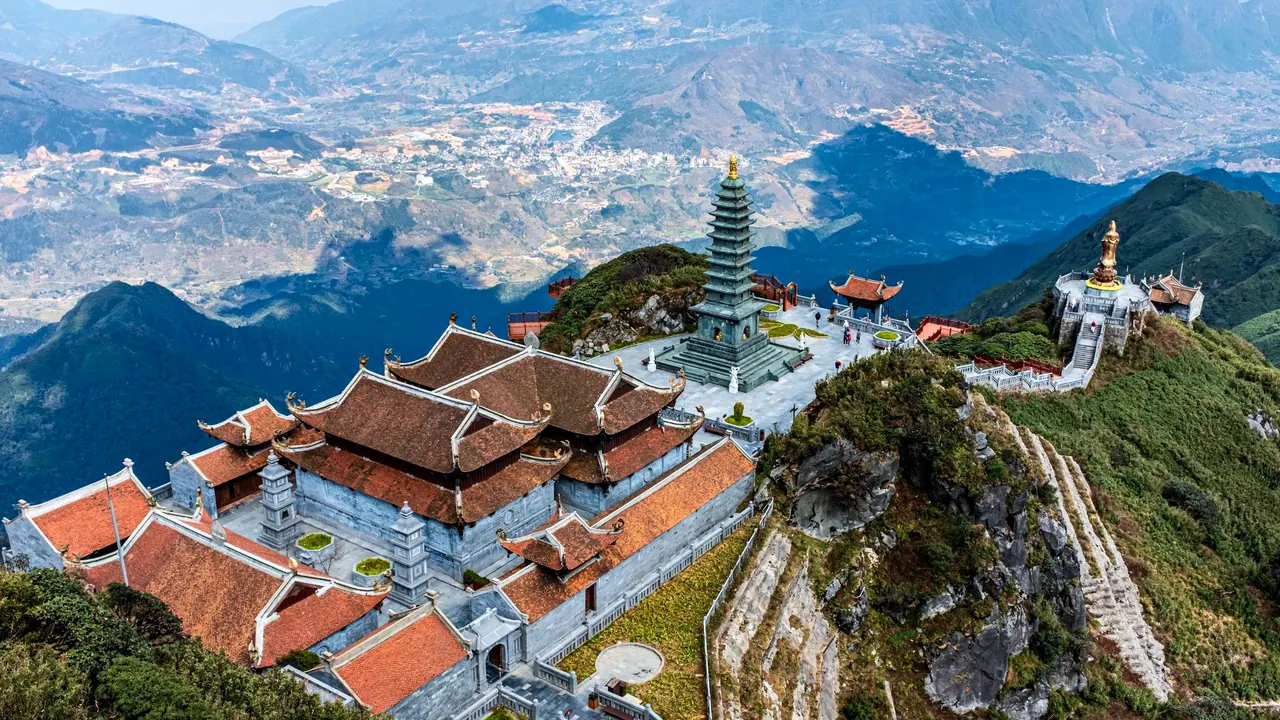
Photos: Ha Long by Takeshi Aida from Hong Kong, Hong Kong, CC BY-SA 2.0, cropped; Sapa by Kirandeep Singh Walia, Pexels License.
Ha Long or Sapa?
Our verdict in twelve categories, each scored against the same fixed benchmark cities, and the climate month by month, so you can choose for your trip.
Choose Ha Long for
- beaches
- families
- food and drink
Ha Long suits a trip built around water: a night or two on a boat among the limestone islands, swimming off the deck, paddling a kayak into enclosed lagoons, then seafood picked from tanks back on shore. It is also the easier choice with younger children, thanks to the cruises, the cable car and water park at Bai Chay and a calm town beach. Its evenings are modest, but they are still livelier than Sapa's.
Choose Sapa for
- shopping
- prices
- nature and the outdoors
Walkers should head for Sapa instead. Here the trip happens on foot: trails leave town through the rice terraces of the Muong Hoa valley, you spend nights in village homestays among Hmong and Dao communities, and Fansipan rises above it all. It is a touch cheaper, better for handmade textiles and cool when the coast is sweltering. It has no swimming, though, and asks more of small children.
Scoreboard
Twelve categories on one fixed scale from 0 to 100. The shaded stretch is the gap between the two.
Your match
Pick a travel style or drag the sliders, and both match scores follow your weighting.
Wins on beaches and families with your weighting.
Wins on shopping and prices with your weighting.
What matters to you?
Category by category
What the scores mean for a trip.
Beaches & swimming
Ha Long at least has the sea. Bai Chay's town beach is imported sand with shallow, often cloudy water, so the better swimming is from the boats, at island stops such as Ti Top or in quiet coves. The cleanest sand is an overnight trip away on Quan Lan.
Sapa has no swimming at all, only cold mountain streams and waterfalls. Anyone combining the two should treat Ha Long as the coastal part of the trip.
Food & drink
Ha Long eats better, mainly because of its seafood. In the halls of Hon Gai and Bai Chay you choose crabs, mantis shrimp and clams from the tanks, and the springy cha muc squid cakes are everywhere. For breakfast there are pho and bun cha in the backstreets.
Sapa's cooking is mountain food for cold evenings: salmon and sturgeon hotpots, skewers from the grills by the lake and Hmong dishes such as thang co. Beyond those, the centre relies on travellers' cafés of uneven quality. Neither town has much wine or fine dining.
Culture & sights
Neither town has many sights of its own, so the difference is in where the interest lies. In Ha Long it is a museum and a seascape: the black glass Quang Ninh Museum, with its sections on mining and the sea, and floating fishing villages such as Cua Van out on the bay.
In Sapa it is the people who live there. Walking to Black Hmong, Red Dao and Tay villages, past indigo dyeing and wooden houses, is the cultural experience. It is best further from town, where the villages feel less staged.
Nightlife
Ha Long has the fuller evening. Bai Chay has beer halls, karaoke and seafood dinners, a night market and a few waterfront bars, though most of it winds down before midnight, and cruise passengers make do with squid fishing off the stern.
Sapa is quieter still: a hotpot, a drink by the fire and bed before the next walk. A handful of travellers' bars and the lakeside grills are the only late life.
Nature & outdoors
Both are among Vietnam's great landscapes, and the choice is between seeing one from a boat and walking through the other. In Ha Long, limestone towers rise straight from the sea, and you explore them by cruise boat, kayak and caves such as Sung Sot, with Cat Ba adding trails and rock climbing.
Sapa's scenery is steep and farmed: terraces stepping down the Muong Hoa valley, bamboo forest, waterfalls near the Tram Ton Pass and Fansipan at 3,143m. In Sapa the outdoors starts at the hotel door, while in Ha Long it starts at the harbour.
Day trips
Ha Long has more within a day's reach. Yen Tu, the forested Zen mountain of pagodas and stupas, is about an hour inland, the colonial port of Hai Phong is a similar drive, and the Bach Dang battlefield is close by.
From Sapa the standout is Bac Ha's Sunday market, about two hours away, with smaller hill markets on other days. Beyond those, most outings are simply more mountains, and Lao Cai below is a border town rather than a sight.
Good for families
Ha Long is the more natural choice for families. Children get boats, caves, kayaks and swimming off the deck, and Bai Chay adds a cable car, a Ferris wheel and a water park. Summer heat and traffic need managing, and overnight cruises suit older children better than toddlers.
Sapa works for children who are old enough to walk: short treks, buffalo in the paddies and a homestay can stay with them. With toddlers it is hard going, because of the steep streets, the mud, cold rooms in winter and persistent vendors, and there is almost nothing built for children.
Getting around
Getting around is equally awkward in both, for different reasons. Ha Long stretches along the bay in two halves joined by a long bridge, so beyond the Bai Chay waterfront visitors rely on cheap taxis and ride-hailing, plus cruise transfers to Tuan Chau.
Sapa's centre is compact but steep, and everything beyond it means trails, a car with driver or a motorbike taxi. Sapa is also further from Hanoi, five to six hours by road or an overnight train to Lao Cai, while Ha Long is a shorter run on the expressway.
Shopping & style
Sapa gives you more reason to browse, thanks to the handwork of the Hmong and Dao: indigo-dyed cloth, batik, brocade and silver. The best places to find it are markets such as Bac Ha's, though machine-made copies are common and sellers can be pushy.
Ha Long's shopping comes down to pearls, night-market souvenirs and the dried squid and fish sauce of Ha Long market. Most of it is food rather than anything made by hand.
Affordability
Both are very cheap once you are there, and the difference is where the big cost falls. In Ha Long it is the overnight cruise, which ranges from basic to luxurious, while hotels, taxis and street food stay inexpensive. Agree the weight and price of any seafood before it is cooked.
In Sapa the one big expense is the Fansipan cable car. Otherwise homestays, hotpot and guided treks cost little, and bargaining is expected at craft stalls.
Live music & performing arts
Neither town has a theatre or concert hall, so this should not decide your trip. Ha Long's performances are staged shows in the Bai Chay entertainment complex and folk singing on some boats. Sapa's are short pan-pipe and dance displays by Hmong and Dao performers on the town square at weekends, simpler but rooted in the communities around it.
Wellness & relaxation
Ha Long has the edge for rest, mainly because of the water: a slow day among the karsts and a quiet night anchored in a cove. There are spas on the better boats and in the resort hotels, and mineral springs feed an onsen resort at Quang Hanh, about forty minutes east.
Sapa's answer is the Red Dao herbal bath, a hot soak in water steeped with forest plants that suits tired legs after trekking, and a homestay in the valleys is genuinely peaceful. Both towns are noisy, so in either place the calm is found outside them.
When should you go?
Pick your month. The climate figures are measured averages, not a forecast.
Ha Long in July
Sapa in July
Daytime high, °C
Rainfall in the month, mm
Where the figures come from
Ha Long's temperatures are measured 50 km from the centre, at Phu Lien.
Ha Long has no rain gauge within 25 km of the centre, so its rainfall comes from a gridded climate dataset read at the city rather than from a gauge further away.
Sapa has no weather station within reach, so its figures come from a gridded climate model rather than a measured record, and read a broad area rather than the city itself.
Temperature and rainfall are climate normals, averaged over the years shown. Ha Long: 1991-2020 normals, Phu Lien (49.9 km from centre). Sapa: 1991-2020 normals, TerraClimate 4 km grid at the town, no weather station within 90 km.
Ha Long is a summer swimming destination with a catch. From May to October the sea is warm, and it is still 28°C in October. June to September bring the heaviest rain, though, with July alone around 553mm, and the days on land are hot and sticky for walking. From December to March the air and water are too cool for most swimmers and the skies are dull, with little sunshine. October, which is warm, much drier and still bright, is the sweet spot, and April and November are milder in-between months.
Sapa never gets hot. Summer highs stay around 25°C, which makes it a cool escape from the lowland heat, but the same wet months make the trails muddy and the views come and go. Autumn is its best season: the terraces turn gold before the September harvest, and October and November are much drier. Its winter is the opposite of Ha Long's summer: dry but cold, around 15°C by day in January, with fog and the odd frost.
Which traveller are you?
On a beach and sun trip, Ha Long is the only real option of the two. Sapa is a mountain town with nowhere to swim, while Ha Long has warm summer water, island beaches such as Ti Top and the chance to swim straight off a cruise boat.
On a family trip with young children, Ha Long is the easier base. A boat trip through caves and lagoons feels like an adventure, Bai Chay adds a water park and rides, and the beach is shallow. Sapa's steep streets and muddy trails suit older walkers better.
For trekkers, Sapa is the place. Trails run straight out of town into the terraced Muong Hoa valley, walks of one to three days link village homestays, and Fansipan, the highest peak in Indochina, can be climbed over one or two hard days.
Before you go
| Measure | Ha Long | Sapa |
|---|---|---|
| Official language | Vietnamese | Vietnamese |
| Currency | Dong (VND) | Dong (VND) |
| Sockets | ACFG220 V, 50 Hz | ACFG220 V, 50 Hz |
| Driving side | Right | Right |
| Time zone | UTC+7 | UTC+7 |
| Emergency number | Police 113, ambulance 115, fire 114 | Police 113, ambulance 115, fire 114 |
| Elevation | 8 m | 1,544 m |
| Main airport | Noi Bai International Airport (HAN)136 km from centre91 non-stop destinations | Noi Bai International Airport (HAN)238 km from centre91 non-stop destinations |
By the numbers
| Measure | Ha Long | Sapa |
|---|---|---|
| City population | - | 70,663 |
| People per km² | - | 103 |
| Museums within 10 km | 1 | 0 |
| UNESCO World Heritage sites within 50 km | 2 | 0 |
| Swim season, months above 21 °C | 9 months | - |
Where else could you go?
Every comparison below shares a destination with this one, so you can follow Ha Long or Sapa somewhere new.