
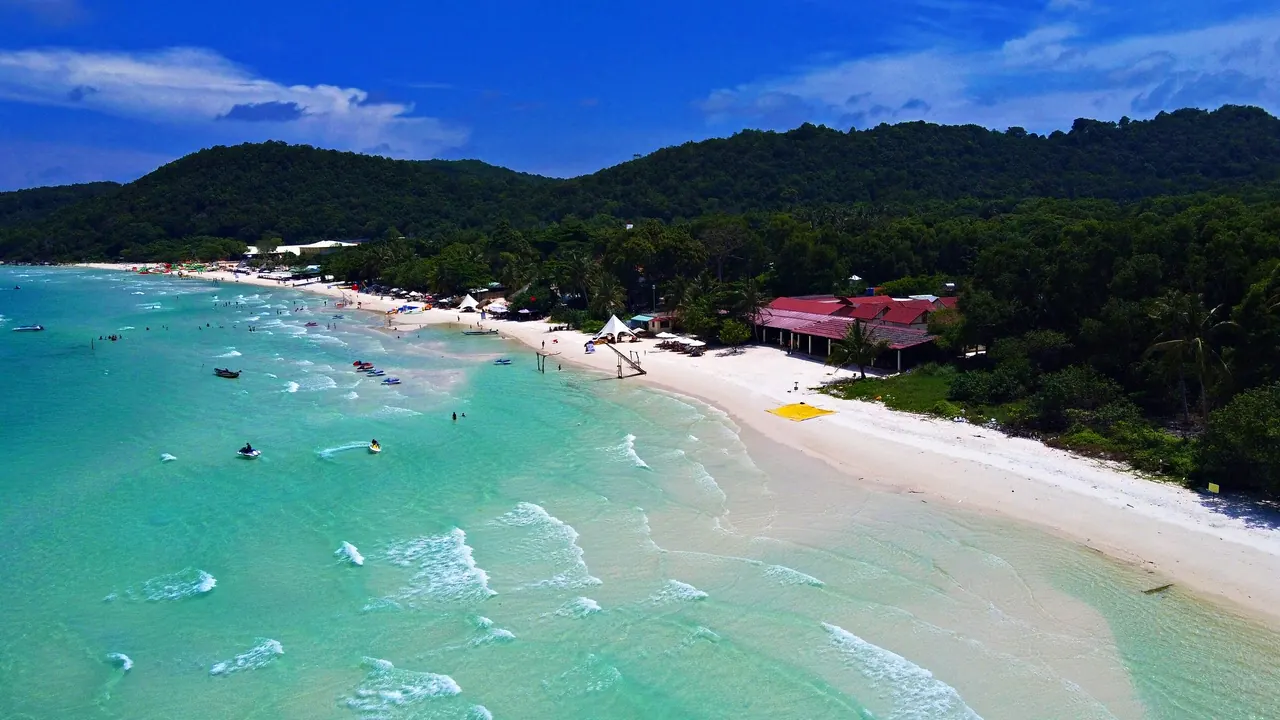
Photos: Da Nang by Nghia Tran, Pexels License; Phu Quoc by Trantuonglam, CC BY-SA 4.0, cropped.
Da Nang or Phu Quoc?
Our verdict in twelve categories, each scored against the same fixed benchmark cities, and the climate month by month, so you can choose for your trip.
Choose Da Nang for
- day trips
- nature and the outdoors
- shopping
Da Nang suits travellers who want a beach with plenty to do away from it. The sand is long and the sea warm in summer, but the bigger draw is what lies around the city: Hoi An's lantern-lit old town, the Cham temples at My Son, imperial Hue and the ride over the Hai Van Pass. It also has the better food and costs less day to day, which makes it a good base for seeing central Vietnam.
Choose Phu Quoc for
- families
- beaches
- getting around
Phu Quoc is the choice for a beach vacation and little else, and for many people that is the point. You can pick between several coasts, the sea stays warm all year, and its dry season falls in the northern winter, when Da Nang is wet and grey. Families get more ready-made fun here, from the safari park to the water park. What you give up is history and variety: once you have tried the beaches and been out on a boat, there are few places to go for the day.
Scoreboard
Twelve categories on one fixed scale from 0 to 100. The shaded stretch is the gap between the two.
Your match
Pick a travel style or drag the sliders, and both match scores follow your weighting.
Wins on day trips and nature and the outdoors with your weighting.
Wins on families and beaches with your weighting.
What matters to you?
Category by category
What the scores mean for a trip.
Beaches & swimming
The beaches are roughly level, but the experience is different. Da Nang has one long city beach. My Khe and Non Nuoc are wide, pale sand with the town right behind them, locals swimming at dawn and seafood restaurants across the road.
Phu Quoc gives you a choice of coasts. You can watch the sunset over the Gulf of Thailand on Long Beach, find whiter sand and turquoise water at Sao and Khem in the southeast, or go to the quiet north. You switch to the east side when the monsoon hits the west, and some stretches away from the resorts are less tidy.
Food & drink
Da Nang eats better and more widely. Its central Vietnamese cooking is spicy and robust: Mi Quang turmeric noodles, banh xeo, pork rolled at the table, plastic-stool stalls from breakfast on and serious iced coffee. Han and Con markets have busy food sections, and the beachfront seafood tanks give you everything Phu Quoc does.
On Phu Quoc you eat seafood almost every time, at the Duong Dong night market or in stilted restaurants over the water at Ham Ninh. Its specialities are raw herring salad, and the fish sauce houses and pepper farms are worth a visit. Beyond that, the choice is narrow.
Culture & sights
Neither is a heritage destination, but Da Nang gives you more. The Museum of Cham Sculpture holds the finest collection of Cham carving anywhere, and the cave shrines of the Marble Mountains, the pink French-era cathedral and the Lady Buddha on Son Tra fill a couple of days.
Phu Quoc has one sight with real weight: the old prison near An Thoi, a sober record of the French and American wars. The rest is the Dinh Cau shrine, a hillside pagoda and resort districts built as copies of European streets.
Nightlife
Da Nang has more of a night out, and a more local one. Evenings start along the Han River, where the bridges light up and rooftop bars look across the city, while locals fill big open-air beer halls over cheap draught beer and grilled shellfish. Behind My Khe, the An Thuong blocks pack in craft beer bars, cocktail spots and late pubs, and a handful of clubs near the river get loud at weekends.
Phu Quoc's evening is quieter and ends sooner. Most of it means sundowners on the sand at Long Beach and a few backpacker bars in Duong Dong. The purpose-built resort districts in the north and south draw crowds for evening walks and shows, and the north has a casino. Outside the dry season even this thins out, and few places keep going late.
Nature & outdoors
Da Nang has mountains as well as sea. You can look for douc langurs on the forested Son Tra peninsula, ride the Hai Van Pass, take the long cable car up the Ba Na Hills or walk the rainforest trails of Bach Ma, with the Cham Islands for snorkelling.
Phu Quoc's outdoor life is mostly on the water: boats from An Thoi to pleasant if unremarkable reefs, kayaking, night squid fishing and the cable car to Hon Thom. The national park's low hills offer only a few trails.
Day trips
This is the widest gap between the two. From Da Nang, Hoi An's old town is under an hour away and many people go more than once. The jungle ruins of My Son and the citadel and royal tombs of Hue make two more full days out.
Phu Quoc mostly keeps you on the island. Apart from island-hopping boats around the An Thoi archipelago, the only real outing is the ferry to Ha Tien, a quiet border town with a temple hill.
Good for families
Phu Quoc is the easier family choice. The safari park, where buses drive through the enclosures, the theme park with its aquarium and the water park at Hon Thom are all aimed at children. The resorts have kids' clubs and the dry-season sea is shallow and calm, though every outing means a taxi.
Da Nang has its own highlights, including the Golden Bridge and indoor amusement park at Ba Na Hills, a riverside Ferris wheel and water parks. Against that, there are streams of motorbikes to cross, broken pavements for pushchairs and an autumn when the beach is closed.
Getting around
Both are places you ride around rather than walk, but the distances differ. Da Nang is compact. The river centre and the beach are a short app-taxi hop apart, and Hoi An is straight down the coast road, though crossing busy streets takes nerve.
Phu Quoc is about 50km long and spread out. Electric buses cover the busy west-coast spine, but the safari park, Sao Beach or the An Thoi cable car are each half an hour or more away by road.
Shopping & style
Da Nang has more to buy, though none of it is stylish. Han and Con markets sell coffee, fabrics and dried seafood, Non Nuoc's workshops carve stone from figurines to statues, and the malls cover the basics. Hoi An's tailors and craft shops are close by.
On Phu Quoc you mostly shop for souvenirs: cultured pearls, black pepper and fish sauce, though airlines may refuse the fish sauce in luggage.
Affordability
Da Nang is the cheaper stay. Street food, app taxis, massages and beach-adjacent mid-range hotels all cost very little, and only the big resorts and Ba Na Hills charge international rates.
Phu Quoc is still good value, but as a resort island it costs more than the mainland. Theme parks, the cable car and boat trips are expensive, and prices peak around the turn of the year.
Live music & performing arts
Da Nang keeps some of its own stage tradition alive, while Phu Quoc's shows are made for visitors. Tuong, central Vietnam's classical theatre of painted faces and drums, has a dedicated theatre in Da Nang, though performances are irregular and mostly for locals. In Hoi An's old town nearby there is folk music and bai choi singing games in the evening, and the fireworks festival over the Han River on several summer weekends is the city's big spectacle.
On Phu Quoc the evening entertainment is polished seaside spectacle, with water, lights, fireworks and drones in the south and multimedia shows in the north. They are well staged, but there is no theatre, concert hall or local music to go with them, only resort bands and the odd beach-bar act.
Wellness & relaxation
In Da Nang you rest in a working city, with a foot or body massage on almost every street near the beach. On Phu Quoc, rest is the whole point of the stay. Da Nang adds herbal steam baths, resort spas on Son Tra with treatment villas over the sea and a hot springs park with mud baths about 30km out. Its early swims and quiet evenings by the river still come with city traffic around them.\n\nPhu Quoc has no thermal bathing, and its treatments are much the same massage and herbal baths. What it offers is pace: yoga at some beach resorts, and quiet bases on the north coast at Ong Lang and Ganh Dau or near Khem Beach in the southeast, away from the busier strip of Long Beach.
When should you go?
Pick your month. The climate figures are measured averages, not a forecast.
Da Nang in July
Phu Quoc in July
Daytime high, °C
Rainfall in the month, mm
Temperature and rainfall are climate normals, averaged over the years shown. Da Nang: 1991-2020 normals, Da Nang (4.9 km from centre). Phu Quoc: 1991-2020 normals, Phu Quoc (0.7 km from centre).
Da Nang's beach season runs from about May to August, when the sea is warm and mostly calm. Midsummer days near 35°C mean sightseeing in Hoi An or Hue is best done early in the morning or in the evening. February to April is milder and fairly dry, the most comfortable time for walking. From September the rain builds to a peak of 726mm in October and the surf closes the beach until the new year. December and January are cool and cloudy, with the sea down to around 24°C.
Phu Quoc runs on the opposite calendar. On the west coast it is hot and humid in every month and the sea stays close to 29°C, so the question is rain, not warmth. December to March is the dry season, with as little as 21mm in January and the west coast at its calmest. From May to October the monsoon brings heavy rain and the sheltered east coast is the better side. In short, winter favours Phu Quoc and late spring and summer favour Da Nang.
Which traveller are you?
On a culture and arts trip, Da Nang is far stronger. The Cham sculpture museum and the Marble Mountains are a start, and Hoi An's old town, the My Son temples and Hue's citadel are all day trips. Phu Quoc offers little beyond its wartime prison museum.
On a family trip with young children, Phu Quoc has more laid on. It has a drive-through safari park, a theme park with an aquarium, a water park at the end of the Hon Thom cable car, and calm, shallow water in the dry season. Da Nang's traffic is harder going.
For a trip on a tight budget, Da Nang makes money go further. Street noodles, app taxis, massages and mid-range hotels near the beach all cost little. On Phu Quoc the resort-island prices, theme parks and boat trips add up, especially in the dry-season peak.
Before you go
| Measure | Da Nang | Phu Quoc |
|---|---|---|
| Official language | Vietnamese | Vietnamese |
| Currency | Dong (VND) | Dong (VND) |
| Sockets | ACFG220 V, 50 Hz | ACFG220 V, 50 Hz |
| Driving side | Right | Right |
| Time zone | UTC+7 | UTC+7 |
| Emergency number | Police 113, ambulance 115, fire 114 | Police 113, ambulance 115, fire 114 |
| Elevation | 19 m | - |
| Main airport | Da Nang International Airport (DAD)3 km from centre47 non-stop destinations | Phú Quốc International Airport (PQC)36 non-stop destinations |
By the numbers
| Measure | Da Nang | Phu Quoc |
|---|---|---|
| Population | 2,819,900 | 179,480 |
| People per km² | 238 | 305 |
| Museums within 10 km | 2 | - |
| UNESCO World Heritage sites within 50 km | 2 | - |
| Swim season, months above 21 °C | 12 months | 12 months |
Where else could you go?
Every comparison below shares a destination with this one, so you can follow Da Nang or Phu Quoc somewhere new.
- Hoi Anvs Da Nang
- Huevs Da Nang
- Koh Rongvs Phu Quoc
- Mekong Deltavs Phu Quoc
- Koh Koodvs Phu Quoc
- Koh Changvs Phu Quoc