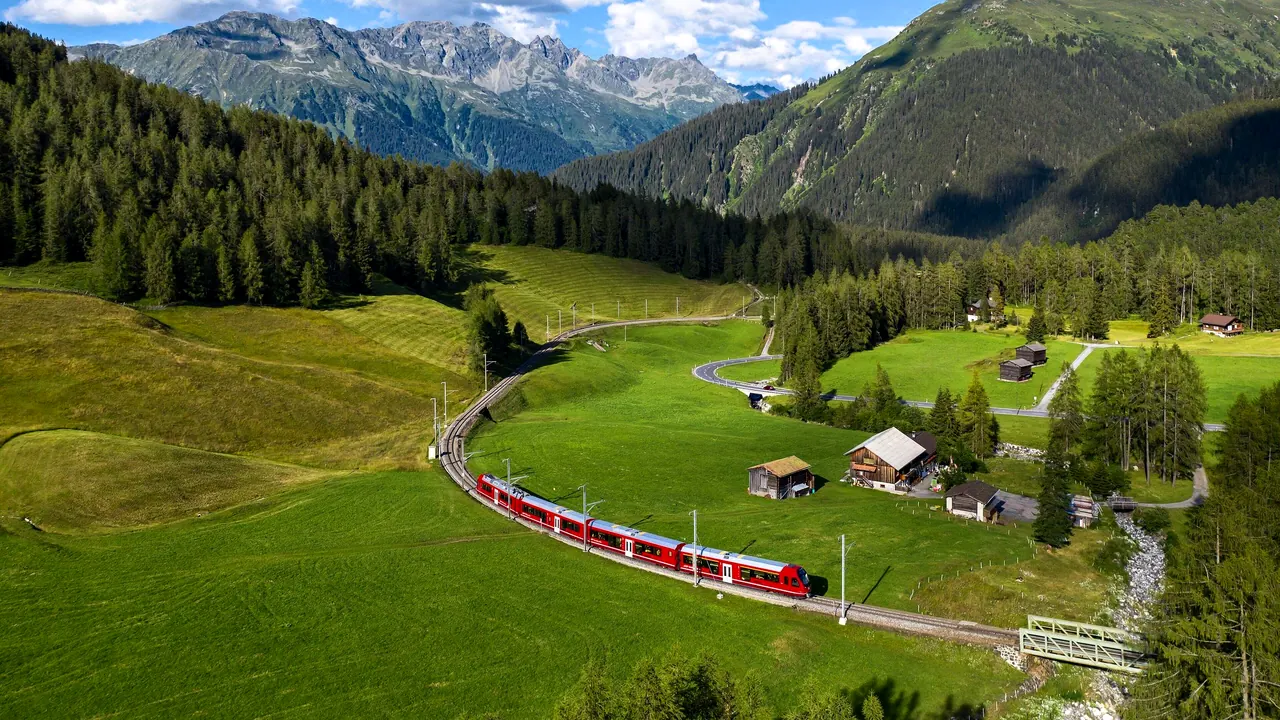
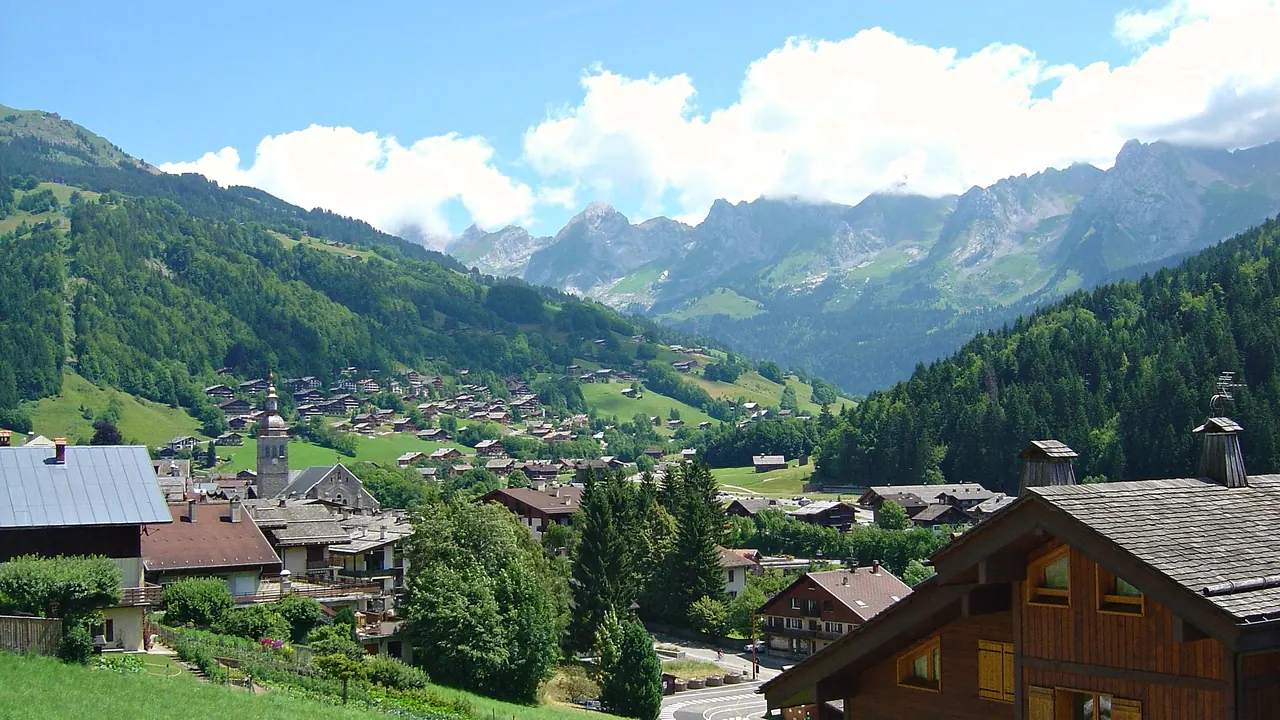
Photos: Davos by Kabelleger / David Gubler, CC BY-SA 4.0, cropped; Le Grand-Bornand by Anthospace, CC BY-SA 3.0, cropped.
Davos or Le Grand-Bornand?
Our verdict in twelve categories, each scored against the same fixed benchmark cities, and the climate month by month, so you can choose for your trip.
Choose Davos for
- getting around
- wellness
- nightlife
Davos suits travellers who want serious mountains and are willing to pay for them. It is higher, with five ski areas, long cross-country trails up quiet side valleys and summer routes climbing past 3,000m. It also has more to fill an evening or a rest day: the Kirchner Museum, the sanatorium history behind The Magic Mountain, hotel spas and a livelier après-ski scene. You can reach it by train and get around without a car.
Choose Le Grand-Bornand for
- prices
- beaches
- families
Le Grand-Bornand is the better pick for families and anyone watching their spending. It is a small Savoyard village built around children, where self-catering is normal and the bills are far lower than in a Swiss resort. Lake Annecy is close enough for summer swims and the town of Annecy for a day out. The trade-off is a quieter, more rural stay, and you will want a car.
Scoreboard
Twelve categories on one fixed scale from 0 to 100. The shaded stretch is the gap between the two.
Your match
Pick a travel style or drag the sliders, and both match scores follow your weighting.
Too close to call, level with your weighting
Wins on getting around and wellness with your weighting.
Wins on prices and beaches with your weighting.
What matters to you?
Category by category
What the scores mean for a trip.
Beaches & swimming
Davos is the weaker choice for a swim. Its own lake, the Davosersee, has a lido with a jetty, but the water seldom gets past 18°C even in midsummer, so most visitors settle for the indoor leisure pool.
Le Grand-Bornand has no swimming water of its own either, but Lake Annecy is under an hour's drive away and reaches the low twenties in July and August. Lawns, pontoons and small beaches line its shores at Talloires, Menthon-Saint-Bernard and Sevrier, so a proper lake afternoon fits easily into a summer stay.
Food & drink
The food is equally limited in both places, and what you get is regional mountain cooking. In Davos the best meals are Graubünden dishes such as capuns, pizokel and barley soup, eaten on a mountain-hut terrace, with air-dried Bündnerfleisch and Nusstorte to take home.
Le Grand-Bornand is all about cheese: Reblochon bought at the farm where it was made, a weekly market and menus heavy on tartiflette and fondue. It has the stronger produce culture, while Davos has a few more ambitious hotel kitchens.
Culture & sights
Davos has more to see, mainly because of its past as a tuberculosis resort. The old sanatoria such as the Schatzalp, the Thomas Mann connection and the Kirchner Museum's Expressionist collection are worth a day or two.
Le Grand-Bornand's heritage is a baroque church, old wooden farm chalets and a farmhouse heritage house, all easy to see in an afternoon. For castles and old streets, people drive down to Annecy.
Nightlife
Winter après-ski in Davos starts at the foot of the Jakobshorn and Parsenn runs, then moves on to hotel bars, pubs and a couple of small clubs along the Promenade. At weekends it goes on past midnight. It is still a small scene and an expensive one, and in summer an evening out usually means a drink on a terrace.
Le Grand-Bornand is quieter all year. A few bars in the village and at Chinaillon fill up after skiing, but there is no club, most families turn in early, and a proper night out means driving to Annecy.
Nature & outdoors
Both are superb bases for time outdoors, and Davos has the bigger, wilder terrain. Its skiing spreads over Parsenn, Jakobshorn, Pischa, Rinerhorn and Madrisa. In summer the Sertig and Dischma valleys lead up towards glaciers, and you have a good chance of seeing marmots, chamois and ibex there. The Swiss National Park is close enough for a day out, but at this height the weather can turn quickly.
Le Grand-Bornand is mid-mountain country below the limestone wall of the Aravis, with peaks that stop at around 2,500m. The skiing runs over open pastures and through woods, with La Clusaz close by. In summer there is a wider range of sports: paragliding, climbing, Tour de France road climbs such as the Col de la Colombière, and sailing or paddling on Lake Annecy.
Day trips
From Davos most outings go by Rhaetian Railway, and the ride is half the point. One trip goes down to Filisur to see the Landwasser Viaduct. Another follows the UNESCO-listed Albula line over the pass to St Moritz and the Upper Engadine. Through the Vereina tunnel you reach the painted houses of Guarda, and Chur's medieval centre is a little over an hour away.
Le Grand-Bornand has the better choice of places to visit. Annecy, with its canals, old town and lakeside castle, is a short drive away, and Geneva's museums are about an hour off. Chambéry and medieval Yvoire are a little further. Almost all of these need a car.
Good for families
Le Grand-Bornand is the more child-friendly of the two. It is compact and calm, with nursery slopes and snow gardens at the village and Chinaillon, and in summer children can visit cheese farms, play in the river and go to the August children's festival.
Davos also works well for active families, with the Schatzalp toboggan run, the big natural ice rink and a leisure pool with slides for wet days. However, the town is spread out and expensive, and teenagers who are not into sport can get bored there.
Getting around
Davos is far easier without a car. It has two railway stations, Davos Dorf and Davos Platz, free buses on the guest card that run along the 4km town and out to the side valleys, and lifts leaving straight from town. Zurich is a little over two hours away by train.
Le Grand-Bornand has a walkable centre and free winter shuttles to the lifts. Beyond that there is no railway and few buses, so trailheads, the lake and day trips all mean driving, sometimes on slow snowy passes.
Shopping & style
Shopping is a minor pastime in both, though the Promenade in Davos gives you a slightly better evening browse. It has Swiss watches, jewellery, a few fashion boutiques and delis for Bündnerfleisch. Le Grand-Bornand's shops are practical, but its weekly market is something Davos lacks, good for Reblochon, honey and some local crafts.
Affordability
Here the gap is wide. Davos charges full Swiss resort prices for rooms, meals, lift passes and hut lunches, and rooms get even scarcer and dearer during the World Economic Forum in January. Shoulder seasons are cheaper, but some places close then.
Le Grand-Bornand is still an Alpine resort, but a much lighter one on the wallet. Self-catering is normal, and outside the school vacation weeks, especially in January, March and summer, costs drop noticeably.
Live music & performing arts
Neither offers a regular season, and each has a single festival aimed at a different audience. In Davos it is a summer classical festival with young musicians playing in churches and hotels. Le Grand-Bornand has Au Bonheur des Mômes, a week of street theatre, circus and puppetry for children every August. For opera or theatre you would go to Zurich from one and to Annecy or Geneva from the other.
Wellness & relaxation
Davos is a larger town full of big hotels, so it has far more spas to choose from. You can pick a hotel for its pool and spa, or buy a day at the leisure pool instead. It is most restful in summer and on winter weekdays outside the peak ski weeks, when the day slows to long lunches on sunny terraces.
In Le Grand-Bornand the spa side is smaller: a sauna or hot tub in your hotel or chalet residence to ease tired legs after skiing, not something to plan a stay around. The rest comes from the village itself, which is at its most peaceful outside peak weeks and in early summer, with green pastures and little to do but sit out on a balcony.
When should you go?
Pick your month. The climate figures are measured averages, not a forecast.
Davos in July
Le Grand-Bornand in July
Daytime high, °C
Rainfall in the month, mm
Where the figures come from
Davos's temperatures are measured 53 km from the centre, at S. Valentino Alla Muta.
Davos has no rain gauge within 25 km of the centre, so its rainfall comes from a gridded climate dataset read at the destination rather than from a gauge further away.
Le Grand-Bornand's temperatures are measured 45 km from the centre, at Bourg-St-Maurice.
Le Grand-Bornand has no rain gauge within 25 km of the centre, so its rainfall comes from a gridded climate dataset read at the destination rather than from a gauge further away.
Temperature and rainfall are climate normals, averaged over the years shown. Davos: 1991-2020 normals, S. Valentino Alla Muta (53.4 km from centre). Le Grand-Bornand: 1999-2020 (rainfall 1991-2020) normals, Bourg-St-Maurice (44.7 km from centre).
Both places run on two seasons, snow and summer, but the climates differ. Davos is high and cold: winter days stay around freezing and even July and August only reach about 20°C. That is good walking and hiking weather but never beach weather. Its wettest months are in summer, when afternoon showers and storms build over the peaks, while winter is comparatively dry and bright for skiing.
Le Grand-Bornand is lower and warmer, at about 27°C in July, which makes high summer the time for swimming trips down to Lake Annecy. Its rain falls the other way round, heaviest in late autumn and early winter at about 144mm in December, much of it as snow on the slopes. For both, late spring and November are the in-between months, with muddy trails and little open.
Which traveller are you?
On a family trip with young children, Le Grand-Bornand is the easier choice. The village is designed around families, with snow gardens, farm visits to watch Reblochon being made and an August children's festival. It is small enough that children can manage it, and Lake Annecy's beaches are within reach in summer.
For a trip on a tight budget, Le Grand-Bornand wins clearly. Self-catering apartments are the norm and French mid-mountain prices are far below Swiss resort rates. Davos is among the costliest places in the Alps, even with free buses on the guest card.
For a relaxing and wellness trip, Davos has the edge. It was built as a place to recover, and dry, clear air comes with well-equipped hotel spas and a public sauna area. The mineral baths of Scuol are an hour away by train, whereas the French village offers calm but no bathing tradition.
Before you go
| Measure | Davos | Le Grand-Bornand |
|---|---|---|
| Official language | French, German, Italian, Romansh | French |
| Currency | Swiss Franc (CHF) | Euro (EUR) |
| Sockets | CJ230 V, 50 Hz | CE230 V, 50 Hz |
| Driving side | Right | Right |
| Time zone | UTC+1, UTC+2 in summer | UTC+1, UTC+2 in summer |
| Emergency number | 112 | 112 |
| Elevation | 1,559 m | 892 m |
| Main airport | Zürich Airport (ZRH)122 km from centre226 non-stop destinations | Geneva International Airport (GVA)41 km from centre150 non-stop destinations |
| Public holidays this year | 9 days | 11 days |
By the numbers
| Measure | Davos | Le Grand-Bornand |
|---|---|---|
| Population | 10,738 | 2,050 |
| People per km² | 38 | 33 |
| Museums within 10 km | 3 | 1 |
| UNESCO World Heritage sites within 50 km | 2 | 2 |
Where else could you go?
Every comparison below shares a destination with this one, so you can follow Davos or Le Grand-Bornand somewhere new.
- La Clusazvs Le Grand-Bornand
- Klostersvs Davos
- Arosavs Davos
- Megèvevs Le Grand-Bornand
- Flainevs Le Grand-Bornand
- Saint-Gervais-les-Bainsvs Le Grand-Bornand