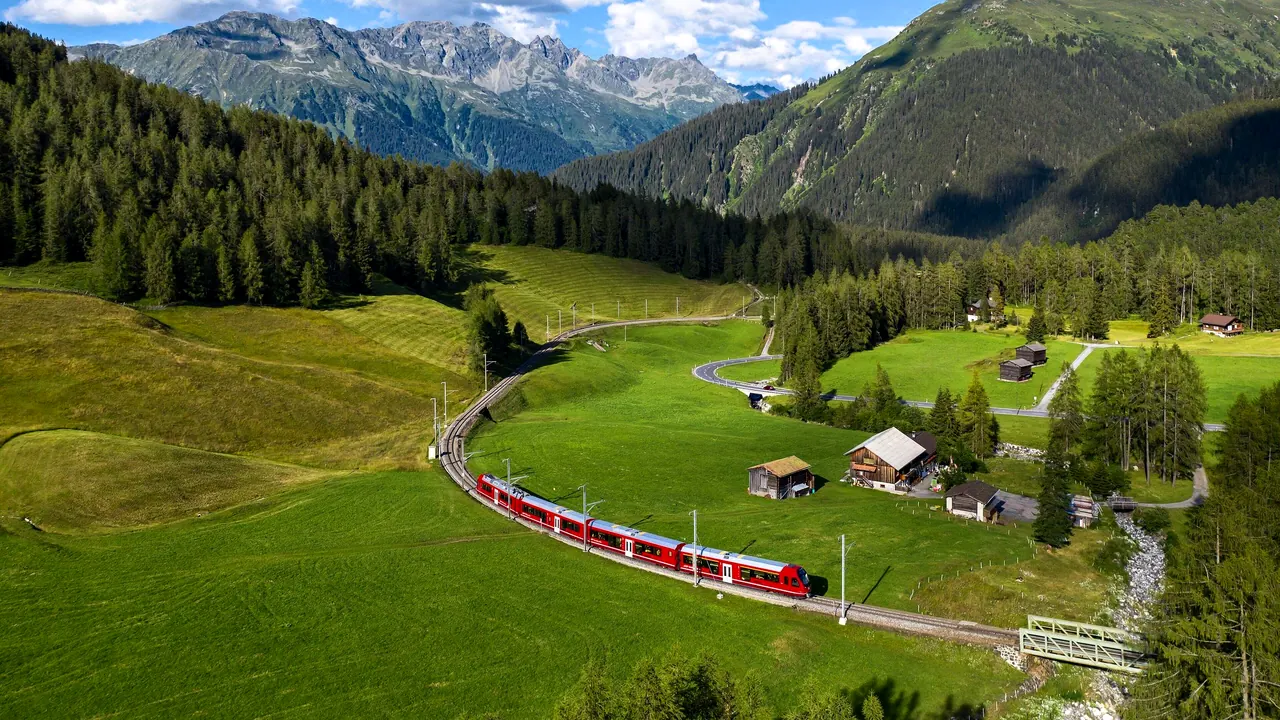
Photos: Davos by Kabelleger / David Gubler, CC BY-SA 4.0, cropped.
Davos or Verbier?
Our verdict in twelve categories, each scored against the same fixed benchmark cities, and the climate month by month, so you can choose for your trip.
Choose Davos for
- getting around
- families
- culture and sights
Davos suits travellers who want a mountain base that is easy to live in. It is a proper small town strung along a valley floor, with trains, free buses and lifts leaving from the streets, so families and anyone without a car manage well. It is also the better choice for a slower stay: spa hotels, cross-country trails, the old sanatorium history and the Kirchner paintings give it more to do on the days you are not skiing.
Choose Verbier for
- nightlife
- day trips
- live music and the arts
Verbier is for skiers who want steep ground and lively evenings. The terrain off Mont Fort and the freeride slopes draw strong skiers, and après-ski around the Place Centrale is far livelier than anything in Davos. Raclette from the Val de Bagnes and Valais wine lift the eating, and the Rhône valley, Lake Geneva and Aosta make for richer outings, best done with a car. Children and anyone who would rather not climb hills are less well served.
Scoreboard
Twelve categories on one fixed scale from 0 to 100. The shaded stretch is the gap between the two.
Your match
Pick a travel style or drag the sliders, and both match scores follow your weighting.
Too close to call, 1 point apart
Wins on getting around and families with your weighting.
Wins on nightlife and day trips with your weighting.
What matters to you?
Category by category
What the scores mean for a trip.
Beaches & swimming
Neither is a place to swim, and both leave you relying on indoor pools in practice. The difference is that Davos at least has the Davosersee lido, with lawns and a jetty for a brisk summer dip. Verbier's alpine lakes are for looking at, and open water means driving down to Lake Geneva.
Food & drink
Verbier eats better, mainly thanks to its surroundings. The Val de Bagnes makes some of Switzerland's most prized raclette cheese, the Rhône vineyards below fill the wine lists with Petite Arvine and Cornalin, and the village has a cluster of ambitious chef-led dining rooms.
Davos offers good Graubünden dishes, capuns, pizokel, barley soup and Nusstorte, mostly at mountain huts in the side valleys, but in town the choice narrows to hotel dining, pizza and fondue. Neither place does cheap or casual food well.
Culture & sights
Davos has a real story to tell and Verbier mostly does not. The old sanatoria with their sun balconies recall the tuberculosis era and the setting of The Magic Mountain, and the Kirchner Museum holds the largest collection of the Expressionist's work. Together they make a worthwhile day or two.
Verbier is a twentieth-century ski village of chalets. Its history is down in Le Châble, which has a stone church, a small museum and old granaries, so for real sightseeing you have to head out to the Rhône valley towns.
Nightlife
Verbier is the clear choice for going out. In winter, après-ski runs from terraces at the lift bases into crowded bars around the Place Centrale and on to clubs open until the small hours, and seasonal workers and wealthy visitors share the same rooms.
Davos has its moments at the foot of the Jakobshorn and in a few pubs and small clubs on the Promenade, but it feels thinner and finishes earlier. Out of the ski season, both settle into quiet evenings.
Nature & outdoors
Both are first-rate mountain destinations, but they suit different skiers. Davos spreads across five ski areas and over 100km of cross-country trails into the Sertig and Dischma valleys. It is the better place for mixed ability, Nordic skiing and quiet side valleys with marmots and ibex, and the Swiss National Park is within a day's reach.
Verbier is steeper and higher. It faces the Grand Combin, its lifts climb to Mont Fort, the 4 Vallées area links on, and its freeride and ski-touring terrain is famous worldwide. In summer it adds a bike park, paragliding and the Haute Route nearby.
Day trips
Verbier has the wider choice of outings. Martigny's Roman remains and art foundation, Sion's hilltop castles, the abbey at Saint-Maurice, Chillon and the Lavaux terraces all lie within about an hour, and Aosta and Chamonix are across the borders. It works best with a car.
From Davos the train itself is the outing: the Albula line over the Landwasser Viaduct to St Moritz, medieval Chur, and the painted houses of Guarda in the Lower Engadine. There are fewer places within reach, but they are easy to do without driving.
Good for families
Davos is the better family base. It has gentle nursery slopes, the long toboggan run from above the town, skating, lakeside walks, playgrounds at the top stations and a leisure pool with slides for wet days, all linked by free buses.
Verbier has ski schools with snow gardens, and La Tzoumaz and Savoleyres have gentler beginner slopes, but the village is steep and spread out and its evenings lean towards après-ski. Neither town has zoos or theme parks.
Getting around
Davos is simpler to get around once you arrive. The town runs along a flat 4km valley floor with two railway stations, buses that are usually free with the guest card, and the Parsenn funicular and Jakobshorn cable car leaving from the streets.
Verbier is easy to reach by train and gondola from Le Châble, but its chalets are scattered over a steep hillside, so you end up relying on shuttles, taxis and icy uphill walks. For outings, a car is close to essential there, whereas in Davos it is not.
Shopping & style
Both resorts are much the same for shopping, which in practice means ski gear, outdoor clothing and a few luxury boutiques. Davos leans towards watch and jewellery stores and delicatessens selling Bündnerfleisch and Nusstorte. Verbier's boutiques cater to chalet owners with interiors, and its best things to take home are Valais wine and Bagnes cheese. For serious shopping from Verbier you go to Lausanne or Geneva.
Affordability
Neither place is cheap, and both rank among the most expensive mountain resorts in Europe for rooms, lift passes and meals. In Davos the free guest-card buses and rental apartments take a little of the sting out, but January conference weeks push prices even higher. In Verbier, the best way to save is to stay down in Le Châble and take the gondola up, and summer is somewhat cheaper in both.
Live music & performing arts
Both towns are quiet for music most of the year and come alive with a summer classical festival, but Verbier's festival carries much more weight. Since 1994 it has brought leading soloists and conductors to a large festival hall and the village church, with a youth orchestra and open masterclasses.
The Davos festival is smaller and showcases young musicians in churches and unusual spaces around the valley. It is a pleasant bonus rather than a reason to plan your dates around.
Wellness & relaxation
Davos was founded on rest and recovery, and it still feels that way. The dry air that drew sanatorium patients remains, the larger hotels have spas, the public leisure pool has a sauna area, and the Scuol mineral baths are an hour away through the Vereina tunnel.
Verbier's wellness is mostly in hotel and chalet spas, with massage after skiing as the usual routine. The thermal baths at Saillon and Lavey-les-Bains are about an hour away, but in peak weeks the village feels busy rather than restful.
When should you go?
Pick your month. The climate figures are measured averages, not a forecast.
Davos in July
Verbier in July
Daytime high, °C
Rainfall in the month, mm
Where the figures come from
Davos's temperatures are measured 53 km from the centre, at S. Valentino Alla Muta.
Davos has no rain gauge within 25 km of the centre, so its rainfall comes from a gridded climate dataset read at the destination rather than from a gauge further away.
Verbier has no weather station within reach, so its figures come from a gridded climate model rather than a measured record, and read a broad area rather than one spot.
Temperature and rainfall are climate normals, averaged over the years shown. Davos: 1991-2020 normals, S. Valentino Alla Muta (53.4 km from centre). Verbier: 1991-2020 normals, TerraClimate 4 km grid at the town, no weather station within 90 km.
Both are high mountain resorts, so winter is for skiing and summer for walking, and neither ever gets warm enough for a beach trip. Davos is a little milder all year. From June to August its days reach about 20°C, which is comfortable for hiking and just warm enough for a quick dip in the Davosersee. Verbier runs a few degrees cooler. Its daytime highs sit at around 0°C in January and February, and its spring warms up more slowly. In both, the coldest months are better spent on the slopes than walking the streets.
Their wet seasons run in opposite directions. Davos is driest in winter and wettest in summer, with about 142mm in August, so hikers there should expect some damp days. Verbier gets most of its rain and snow from November to January, about 145mm in December, and July to September is its driest stretch. For a summer walking trip, Verbier usually has the steadier weather and Davos the warmer days. In winter, less rain and snow falls on Davos.
Which traveller are you?
On a family trip with young children, Davos makes the days simpler. The town centre is level, so there are fewer arguments about walking, and if the weather turns or a child gets tired of snow, there is always something else to do. In Verbier, parents tend to enjoy themselves more than the children.
For a food and nightlife trip, book Verbier, ideally in midwinter. A typical evening there moves from a long dinner to a crowded bar and goes on well past midnight among a young, international crowd. Davos suits people who want a good meal and then bed.
For a relaxing and wellness trip, Davos lets you slow right down. In summer and on quiet weekdays there is room for long walks, a sauna and an unhurried terrace lunch with nothing else planned. Verbier can pamper you too, but it is built for hard skiing and late nights.
Before you go
| Measure | Davos | Verbier |
|---|---|---|
| Official language | French, German, Italian, Romansh | French, German, Italian, Romansh |
| Currency | Swiss Franc (CHF) | Swiss Franc (CHF) |
| Sockets | CJ230 V, 50 Hz | CJ230 V, 50 Hz |
| Driving side | Right | Right |
| Time zone | UTC+1, UTC+2 in summer | UTC+1, UTC+2 in summer |
| Emergency number | 112 | 112 |
| Elevation | 1,559 m | 1,490 m |
| Main airport | Zürich Airport (ZRH)122 km from centre226 non-stop destinations | Geneva International Airport (GVA)88 km from centre150 non-stop destinations |
| Public holidays this year | 9 days | 9 days |
By the numbers
| Measure | Davos | Verbier |
|---|---|---|
| Population | 10,738 | - |
| People per km² | 38 | - |
| Museums within 10 km | 3 | 4 |
| UNESCO World Heritage sites within 50 km | 2 | 0 |
Where else could you go?
Every comparison below shares a destination with this one, so you can follow Davos or Verbier somewhere new.
- Klostersvs Davos
- Arosavs Davos
- Lenzerheidevs Davos
- Crans-Montanavs Verbier
- Chamonixvs Verbier
- St. Moritzvs Davos