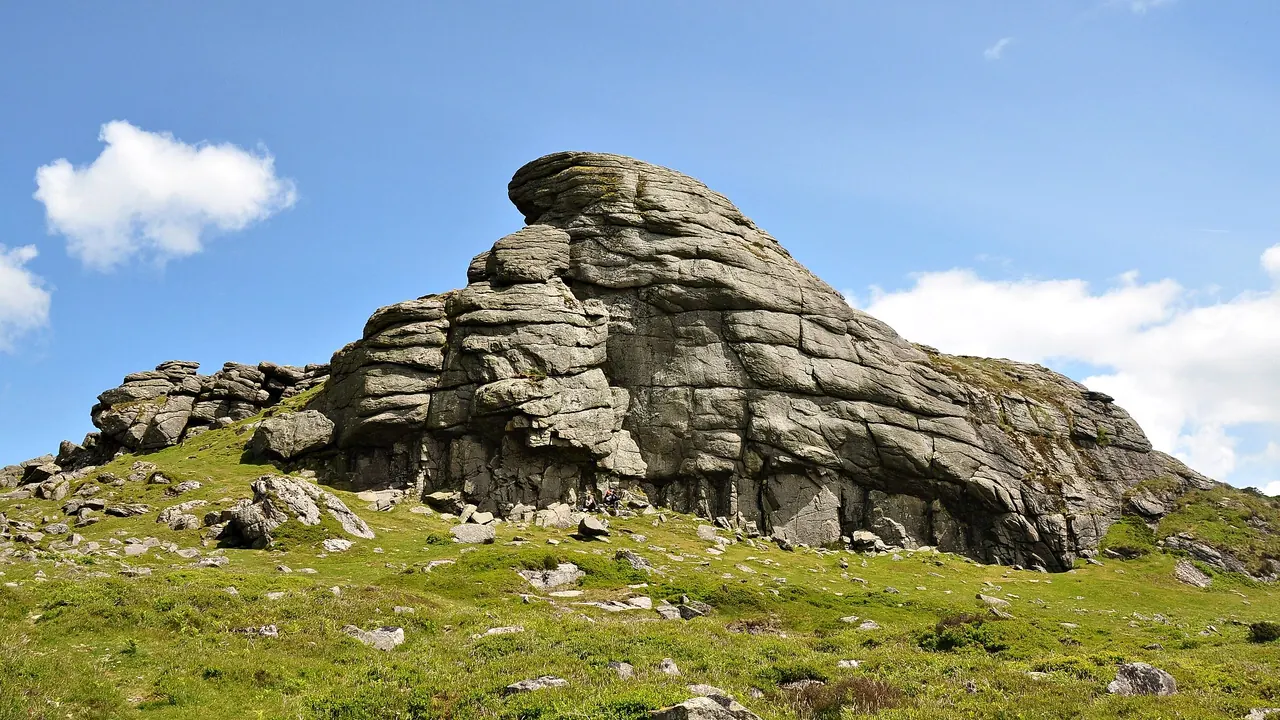

Photos: Devon by Nilfanion, CC BY-SA 3.0, cropped; Northumberland by Clément Proust, Pexels License.
Devon or Northumberland?
Our verdict in twelve categories, each scored against the same fixed benchmark cities, and the climate month by month, so you can choose for your trip.
Choose Devon for
- beaches
- nightlife
- food and drink
Devon is the better pick for a classic seaside summer. It has two coasts, with surf beaches on the Atlantic side and sheltered estuaries in the south, and the sea is a little less cold. Harbour towns such as Dartmouth and Salcombe also give you better eating and a few more evenings out. Families do especially well, with more lifeguarded sand and more to fall back on when it rains.
Choose Northumberland for
- culture and sights
- getting around
- prices
If history matters more to you than swimming, go to Northumberland. The castles along its coast and the finest stretch of Hadrian's Wall give it a much stronger set of sights. Its beaches are emptier, and the coast and the Cheviots stay quiet while Devon's lanes fill up in August. It suits walkers, birdwatchers and anyone happy with a pub fire and an early night.
Scoreboard
Twelve categories on one fixed scale from 0 to 100. The shaded stretch is the gap between the two.
Your match
Pick a travel style or drag the sliders, and both match scores follow your weighting.
Wins on beaches and nightlife with your weighting.
Wins on culture and sights and getting around with your weighting.
What matters to you?
Category by category
What the scores mean for a trip.
Beaches & swimming
Both counties have superb sand, but Devon is the one for swimming. The north coast faces the Atlantic and has surf at Croyde, Saunton and Woolacombe. The south coast adds sheltered estuary beaches around Bantham and Bigbury, shingle coves and the red-cliffed resort beaches of Torbay, many of them with lifeguards in summer.
Northumberland's beaches, under Bamburgh Castle and along Embleton and Druridge Bays, are emptier and wilder. But the North Sea is colder and the wind is often brisk, so most people paddle, fly kites and walk the sands instead of swimming.
Food & drink
Devon eats better and offers more choice. Fish from Brixham, crab from Salcombe and Dartmouth, clotted cream and farmhouse cider are all easy to find. The harbour towns of the South Hams, Dartmouth above all, have proper restaurants to choose from, and Exeter and Plymouth add range.
Northumberland's food is more limited but has real character: Craster kippers, Lindisfarne oysters, crab sandwiches in Seahouses and upland lamb. Most of it is eaten in pubs and coaching inns whose kitchens close early, and for a wider choice you end up driving into Newcastle.
Culture & sights
Northumberland has far more to see. Bamburgh, Alnwick, Dunstanburgh, Warkworth and Lindisfarne line its coast with castles, and Berwick keeps its Elizabethan town walls. Hadrian's Wall, with Housesteads and Vindolanda, is the finest stretch of the Roman frontier.
Devon's best is Exeter Cathedral with its long Gothic vault, Plymouth's Barbican and a scattering of country houses such as Castle Drogo and Greenway. They make pleasant outings, but they lack the drama and historical weight of the border county.
Nightlife
Neither county is the place for a big night, but Devon at least has the option. Exeter and Plymouth have student-driven scenes, with Plymouth's Barbican and Union Street the busiest at weekends, and Torquay has a few bars in summer. Elsewhere, an evening out means a harbourside pint.
In Northumberland, evenings are a fireside inn or a hotel bar in Alnwick or Hexham, and most places are quiet by eleven. Anyone who wants more takes the train to Newcastle.
Nature & outdoors
Both are excellent for the outdoors, and the difference is in character. Devon has Dartmoor's granite tors and ponies, Exmoor's high sea cliffs and the Jurassic Coast around Sidmouth and Beer. It also has plenty to do on the water, from surfing at Croyde to sailing on the Dart and Salcombe estuaries.
Northumberland is emptier and better for wildlife. There are puffins and grey seals on the Farne Islands, wading birds on the Holy Island flats, the rounded Cheviots and Kielder's dark night skies. Choose Devon for surfing and sailing, and Northumberland for solitude and seabirds.
Day trips
The two are evenly matched for days out, and both look beyond their own borders. From Devon, Bath, Wells and the Dorset coast lie to the east, and Cornwall's Eden Project and Fowey to the west. Within the county there is the river boat down the Dart and the sail to Lundy.
Northumberland's outings lean towards cities and history: Edinburgh, under an hour by train from Berwick, Durham's cathedral, Newcastle's quayside and the abbeys of the Scottish Borders. Most of Devon's trips mean driving through summer traffic, while several of Northumberland's best can be done by rail.
Good for families
Devon is the easier of the two with children, and it has long been one of Britain's classic family counties. Families tend to rent a cottage or a caravan pitch and drive to a different beach or farm park each day, which suits younger children. Older ones can meet Dartmoor's ponies, go letterboxing and scramble up the tors. The catch is August, when the narrow lanes and full car parks call for patience.\n\nNorthumberland has fewer big attractions, so it works best for children who would rather explore a castle than ride a rollercoaster.
Devon relies on a zoo, an aquarium and steam trains, but here the big draw is Alnwick. Young fans of the films shot at the castle can try broomstick training there, and the garden next door has a giant treehouse. Racing the tide across the causeway to Holy Island is an adventure of its own. You will need a car, as in Devon, but there is less to fall back on indoors when it rains.
Getting around
Northumberland is the easier county to get around. The east coast main line stops at Morpeth, Alnmouth and Berwick, and the Tyne Valley line reaches Hexham and Haltwhistle for the Wall. The roads are quiet, with the A1 running up the coast, though you need to check the tide tables before driving the causeway to Holy Island.
Devon has trains between Exeter, Plymouth and Torbay, including the sea-wall stretch at Dawlish. The coast and the moor, though, need a car, and that means single-track lanes, summer queues and tight parking in the harbour towns. Rural buses are too sparse to rely on in either county.
Shopping & style
Shopping is modest in both, but Devon has more of it. There is Totnes with its independent and alternative high street, antiques in Honiton, galleries in Dartmouth and Salcombe and craft studios at Dartington, while Exeter and Plymouth cover the chains.
In Northumberland, the best shopping is on the high streets of Hexham and Alnwick. Alnwick's huge second-hand bookshop in the old railway station is worth the trip for readers. Beyond that, it is mostly farm shops and smokehouse counters.
Affordability
Neither county is cheap, but your money goes a little further in Northumberland. It is priced like rural England: the villages near Bamburgh cost the most, Hexham and the Tyne Valley are better value, and castle admissions and a car add to the bill.
Devon during the summer school break costs more, especially in Salcombe and the north coast surf villages. To spend less, stay in Torbay, Plymouth or an inland village, or go in spring or autumn. In both counties the coast paths, moors and beaches cost nothing.
Live music & performing arts
Devon has the bigger stages. Plymouth's Theatre Royal, one of England's largest regional theatres, brings in touring musicals, opera and ballet. Exeter adds the Northcott Theatre and choral evensong at the cathedral, and Dartington has its tradition of summer music.
Northumberland's own sound is folk: the Northumbrian smallpipes, pub sessions and small festivals, with modest arts centres in Hexham and Berwick. For major shows, you have to go to Newcastle and Gateshead.
Wellness & relaxation
Neither county has thermal baths, so relaxing here is about the setting, and Devon has a little more to offer. There are spa hotels on cliff tops and in country houses, a strong habit of cold-water swimming and Plymouth's Art Deco Tinside Lido below the Hoe.
Northumberland has fewer spas but is quieter, with empty roads, villages that go to sleep early and cottage days paced by the tides. It suits anyone who wants calm more than treatments.
When should you go?
Pick your month. The climate figures are measured averages, not a forecast.
Devon in July
Northumberland in July
Daytime high, °C
Rainfall in the month, mm
Where the figures come from
Devon's temperatures are measured 31 km from the centre, at Exeter Airport.
Devon has no rain gauge within 25 km of the centre, so its rainfall comes from a gridded climate dataset read at the destination rather than from a gauge further away.
Devon's sunshine is measured 44 km from the centre, at Plymouth.
Northumberland has no rain gauge within 25 km of the centre, so its rainfall comes from a gridded climate dataset read at the destination rather than from a gauge further away.
Temperature and rainfall are climate normals, averaged over the years shown. Devon: 1973-2025 (sunshine 1981-2010, rainfall 1991-2020) normals, Exeter Airport (31.1 km from centre). Northumberland: 1991-2020 normals, Boulmer (7 km from centre).
Devon is clearly the warmer of the two. Summer highs reach about 22°C in July and the sea peaks at 17°C in August. May to July are the sunniest months, and June to September is the beach season, though a wetsuit is still a good idea. Rain builds from October and stays heavy through the winter, when the moor and the coast path are best left to well-equipped walkers.
Northumberland is a few degrees cooler all year, with summer highs of around 18°C and a North Sea that barely reaches 15°C. Its rain falls at different times: August is one of its wetter months, while spring is drier. That makes May and June a good time for walking and for the seabird colonies. Neither county ever gets too hot for exploring on foot, and in both the winter is chilly and grey, best for short, brisk walks.
Which traveller are you?
For a beach and sun trip, choose Devon. Its north coast has surf at Croyde and Woolacombe and its south coast has sheltered estuary sand, and the water is warmer than the North Sea. Northumberland's beaches are lovely, but they are better for walking than swimming.
On a culture and arts trip, Northumberland has much more to see. Bamburgh, Alnwick, Lindisfarne, and Housesteads and Vindolanda on Hadrian's Wall carry more weight than anything in Devon. For an evening show, though, Devon has the bigger stages in Plymouth and Exeter.
On a family trip with young children, Devon has the edge. It has gently shelving beaches with lifeguards, plus Paignton Zoo, the National Marine Aquarium and steam railways for wet days. Northumberland's castles and puffin boats suit older children, but there is little to do indoors.
Before you go
| Measure | Devon | Northumberland |
|---|---|---|
| Official language | English | English |
| Currency | Pound Sterling (GBP) | Pound Sterling (GBP) |
| Sockets | G230 V, 50 Hz | G230 V, 50 Hz |
| Driving side | Left | Left |
| Time zone | UTC, UTC+1 in summer | UTC, UTC+1 in summer |
| Emergency number | 112 or 999 | 112 or 999 |
| Main airport | Exeter International Airport (EXT)25 non-stop destinations | Newcastle International Airport (NCL)80 non-stop destinations |
| Public holidays this year | 8 days | 8 days |
By the numbers
| Measure | Devon | Northumberland |
|---|---|---|
| Population | 1,209,773 | 323,820 |
| People per km² | 180 | 65 |
| Swim season, months above 21 °C | None | None |
Where else could you go?
Every comparison below shares a destination with this one, so you can follow Devon or Northumberland somewhere new.
- Jurassic Coastvs Devon
- Cornwallvs Devon
- Edinburghvs Northumberland
- Lake Districtvs Northumberland
- Yorkshire Dalesvs Northumberland
- Isle of Wightvs Devon