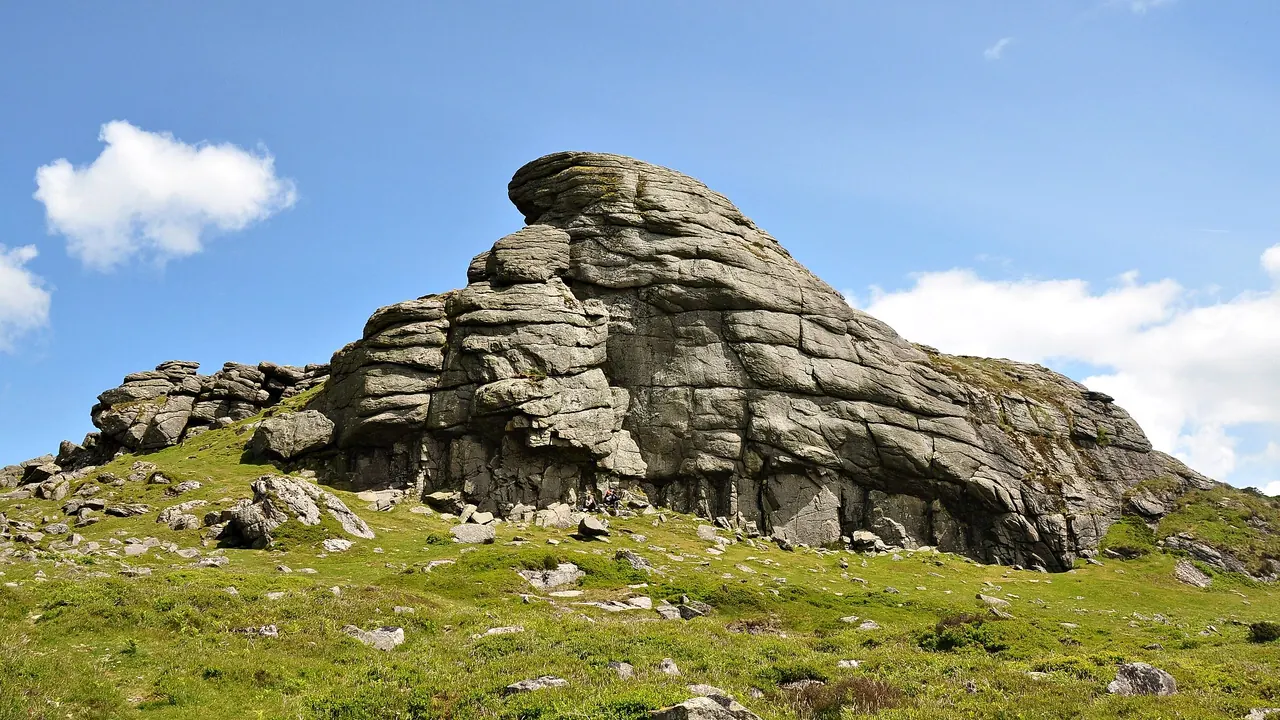
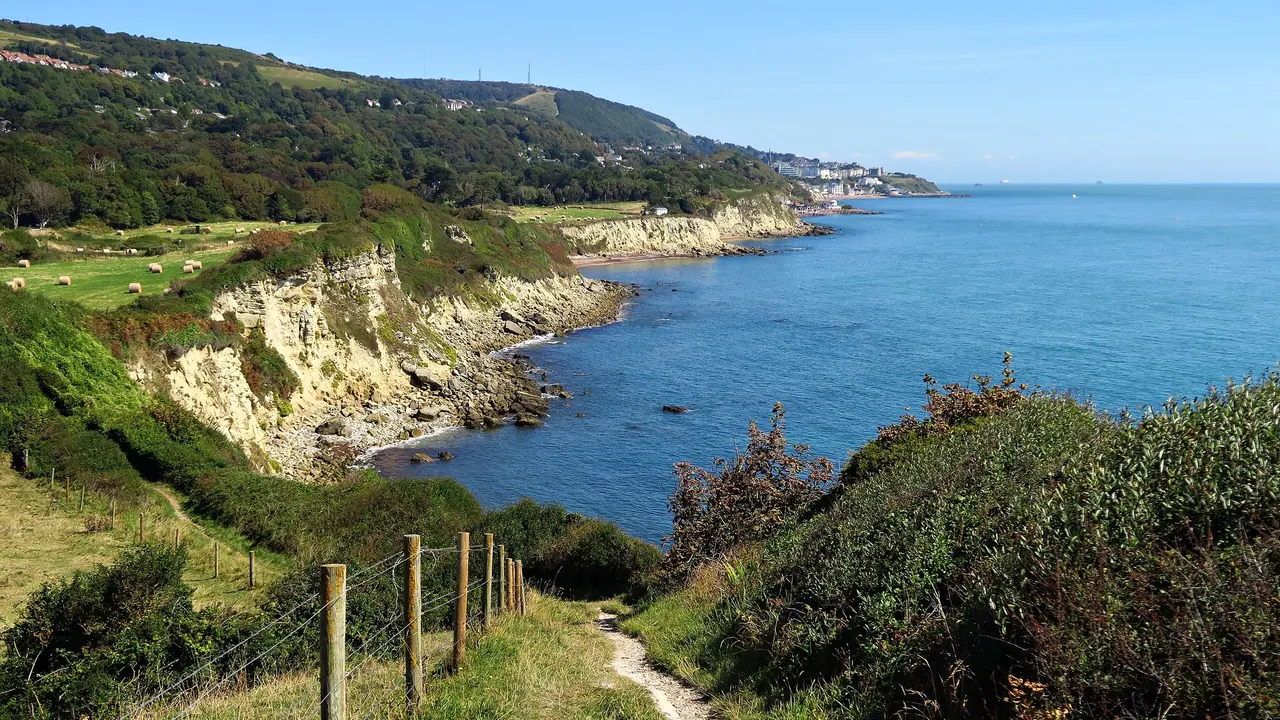
Photos: Devon by Nilfanion, CC BY-SA 3.0, cropped; Isle of Wight by Michael Coppins, CC BY-SA 4.0, cropped.
Devon or Isle of Wight?
Our verdict in twelve categories, each scored against the same fixed benchmark cities, and the climate month by month, so you can choose for your trip.
Choose Devon for
- nature and the outdoors
- day trips
- food and drink
Devon is the bigger and wilder of the two. Choose it if you want to cross open moorland on Dartmoor, walk Exmoor's high sea cliffs, surf the Atlantic beaches of the north coast and eat crab and fish in harbour towns such as Dartmouth. It also holds up better over a long stay, with Exeter and Plymouth for evenings and outings to Cornwall or Bath. In return you will need a car and patience on single-track lanes.
Choose Isle of Wight for
- getting around
- prices
The Isle of Wight suits a gentler, more contained vacation. It is small enough that no drive is long, and its buses and the little railway down the east coast let you leave the car on the mainland. Families get the soft sands of Sandown Bay, Blackgang Chine and fossil hunts close together, and walkers get the chalk ridge out to the Needles. What it gives up is depth: fewer good places to eat, quieter evenings and a ferry crossing before any mainland outing.
Scoreboard
Twelve categories on one fixed scale from 0 to 100. The shaded stretch is the gap between the two.
Your match
Pick a travel style or drag the sliders, and both match scores follow your weighting.
Wins on nature and the outdoors and day trips with your weighting.
Wins on getting around and prices with your weighting.
What matters to you?
Category by category
What the scores mean for a trip.
Beaches & swimming
On sand alone the two are evenly matched, but the beaches are different in character. Devon has two coasts that feel like different places. The north has long, dune-backed Atlantic sand with surf at Woolacombe and Saunton, while the south has sheltered estuary beaches around Salcombe and Bantham, shingle coves and the red-cliffed resort sands of Torbay.
The Isle of Wight is more of a classic bucket-and-spade coast. Sandown Bay curves for miles, gentle and sheltered, and Ryde's flats run far out at low tide. Its wilder side is mainly Compton Bay. The sea off the island warms a touch more in late summer, but both are cold enough that most people paddle or wear a wetsuit.
Food & drink
Devon eats better. Brixham lands fish for the whole county, and Dartmouth, the South Hams harbours and the Exe estuary have the best tables. Exeter and Plymouth add the range of restaurants a small island cannot match.
On the Isle of Wight, the highlights are simpler: crab and lobster sandwiches in harbour pubs at Bembridge or Ventnor, local garlic and tomatoes, and a few ambitious kitchens around Cowes. Both do a proper cream tea, and both have farm shops that suit cottage cooking.
Culture & sights
The two are close here, but the heritage differs in kind. Devon has real historic cities: Exeter Cathedral with its great Gothic vault inside Roman walls, and Plymouth's cobbled Barbican and Mayflower Steps. Beyond them, country houses such as Castle Drogo and Greenway are spread across a large county.
The Isle of Wight centres on one royal set piece, Queen Victoria's Osborne House, together with Carisbrooke Castle, where Charles I was held. Its smaller sites, the Roman villa at Brading and the Needles Old Battery, are all within a short trip of each other.
Nightlife
Both are pub places, but Devon at least has somewhere to go on to. Exeter and Plymouth have student-driven weekend scenes, with the Barbican and Union Street the liveliest areas, and Torquay adds summer bars.
On the Isle of Wight, a few late bars in Newport and Ryde are about the limit. The exception is regatta week in Cowes in August, when the waterfront fills with sailing crews.
Nature & outdoors
Devon has the larger and wilder landscapes. Dartmoor's granite tors and pony-grazed moorland let you walk all day away from roads, Exmoor's cliffs are among the highest in England, and the Jurassic Coast begins around Sidmouth and Beer. There is Atlantic surf at Croyde and cycling on the Tarka Trail.
The Isle of Wight is gentler: chalk downs, Tennyson Down running out to the Needles and the wooded Undercliff. Its coast path is short enough to walk in one vacation. Its own strength is the water, since the Solent and Cowes are great sailing grounds, and the red squirrels are a quiet bonus.
Day trips
Devon gives you more to reach. Bath, Wells and the Dorset coast lie east of Exeter, Cornwall's Eden Project and Fowey lie west of Plymouth, and within the county there is the boat trip down the Dart, Clovelly and the sail out to Lundy. Most of these outings mean driving in summer traffic.
The Isle of Wight's outings start with a ferry. The foot ferry from Ryde reaches Portsmouth's Historic Dockyard, home of HMS Victory and the Mary Rose, quickly. Lymington opens up the New Forest and Beaulieu, and Southampton leads on to Winchester. Otherwise, the trips are hops between the island's small towns.
Good for families
Both are long-standing British family destinations, and either serves children well. The difference is scale. Devon offers bigger set pieces, such as Paignton Zoo and the National Marine Aquarium in Plymouth, plus Dartmoor pony-spotting and letterboxing for older children, but each day usually starts with a drive.
On the Isle of Wight, Blackgang Chine, Robin Hill, the Sandown zoo and fossil hunts on the south-west beaches are all close together. Its attractions are smaller, but the shorter journeys make it easier with toddlers.
Getting around
The Isle of Wight is far easier to get around. It is only about 37km end to end, its buses link every town and climb over the downs to the Needles in summer, and a short railway runs from Ryde Pier to Shanklin. The one fixed step is the ferry at each end.
Devon effectively needs a car. Main-line trains, including the stretch along the Dawlish sea wall, link Exeter, Plymouth and Torbay, but the moor and much of the coast lie beyond them. Getting there means single-track lanes, reversing to passing places and tight harbour parking.
Shopping & style
Neither is a shopping destination, but Devon has more to browse. There are alternative shops and a market in Totnes, antiques in Honiton, galleries in Dartmouth and Salcombe, and chain stores in Exeter and Plymouth. The island offers Newport's ordinary high street, sailing gear in Cowes and the craft studios of Ventnor and Yarmouth, with jars of coloured Alum Bay sand as the signature souvenir.
Affordability
Costs are much the same, and both are expensive in the school summer break. Where you save differs. In Devon, staying in Torbay, Plymouth or an inland village costs far less than staying in Salcombe or the north coast surf villages. On the Isle of Wight, the ferry is the big extra, especially with a car, so crossing on foot and using the buses saves the most. In both, spring and autumn are cheaper, and the coast paths are free.
Live music & performing arts
Devon offers more evenings out. Plymouth's Theatre Royal, one of England's largest regional stages, brings in touring musicals, opera and ballet. Exeter has the Northcott Theatre and choral evensong in the cathedral, and Dartington Hall has its tradition of summer music.
The Isle of Wight's big moment is its June rock and pop festival outside Newport, a name since the late 1960s. For the rest of the year, there is pantomime in Shanklin, a Newport arts centre and pub bands.
Wellness & relaxation
Neither has thermal baths, but Devon has more to offer here. It has spa hotels in country houses and on clifftops, a strong cold-water swimming habit and Plymouth's Art Deco Tinside Lido below the Hoe.
The Isle of Wight's spa options are few, and its calm is more about place. Ventnor was built as a Victorian health resort, and the gardens at Quarr Abbey are peaceful. It is a good choice if you want slow days and sea air rather than treatments.
When should you go?
Pick your month. The climate figures are measured averages, not a forecast.
Devon in July
Isle of Wight in July
Daytime high, °C
Rainfall in the month, mm
Where the figures come from
Devon's temperatures are measured 31 km from the centre, at Exeter Airport.
Devon has no rain gauge within 25 km of the centre, so its rainfall comes from a gridded climate dataset read at the destination rather than from a gauge further away.
Devon's sunshine is measured 44 km from the centre, at Plymouth.
Isle of Wight's temperatures are measured 39 km from the centre, at Bournemouth Airport.
Isle of Wight has no rain gauge within 25 km of the centre, so its rainfall comes from a gridded climate dataset read at the destination rather than from a gauge further away.
Temperature and rainfall are climate normals, averaged over the years shown. Devon: 1973-2025 (sunshine 1981-2010, rainfall 1991-2020) normals, Exeter Airport (31.1 km from centre). Isle of Wight: 1991-2020 normals, Bournemouth Airport (38.9 km from centre).
The two share a mild Channel climate, and their years run almost in step. June to September is the beach season in both, with highs of about 22°C at the peak of summer. Devon's sea is warmest in August at around 17°C, and the island's runs a degree warmer, but either way it is wetsuit or short-dip water. Sunshine peaks from May to July and is much the same in both. Spring and early autumn are mild and good for walking, though too cool for swimming.
The rain is where they part. Devon is the damper of the two in April, May, July and August, and Dartmoor can be wet in any season. The Isle of Wight is drier in those months, so a settled spell of beach weather is a little more likely there. In June and September there is little to choose between them. From October to December both turn wet, with around 100mm a month, and by January highs are down to about 8°C. Winter is for coastal walks and pub fires, not the beach.
Which traveller are you?
On an outdoors trip, Devon is the clear pick. Dartmoor offers whole days of walking with no road in sight, Exmoor drops to the sea in high cliffs, and there is real surf at Croyde. The island's downs are lovely but small.
For a food and nightlife trip, Devon again comes out ahead. It has Brixham fish and Dartmouth's harbour restaurants by day and student-driven weekend nights in Exeter and Plymouth after dark. On the island, most of the eating is pub lunches, and most towns are quiet by eleven.
On a family trip with young children, the Isle of Wight makes life easier. Both are classic family counties, but on the island Sandown Bay, Blackgang Chine and the fossil beaches are all a short ride apart. In Devon, by contrast, every outing means a drive down busy lanes.
Before you go
| Measure | Devon | Isle of Wight |
|---|---|---|
| Official language | English | English |
| Currency | Pound Sterling (GBP) | Pound Sterling (GBP) |
| Sockets | G230 V, 50 Hz | G230 V, 50 Hz |
| Driving side | Left | Left |
| Time zone | UTC, UTC+1 in summer | UTC, UTC+1 in summer |
| Emergency number | 112 or 999 | 112 or 999 |
| Main airport | Exeter International Airport (EXT)24 non-stop destinations | Southampton Airport (SOU)15 non-stop destinations |
| Public holidays this year | 8 days | 8 days |
By the numbers
| Measure | Devon | Isle of Wight |
|---|---|---|
| Population | 1,209,773 | 140,459 |
| People per km² | 180 | 369 |
| Swim season, months above 21 °C | None | None |
Where else could you go?
Every comparison below shares a destination with this one, so you can follow Devon or Isle of Wight somewhere new.
- Cornwallvs Devon
- Cotswoldsvs Isle of Wight
- Normandyvs Isle of Wight
- Cotswoldsvs Devon
- Normandyvs Devon
- Cornwallvs Isle of Wight