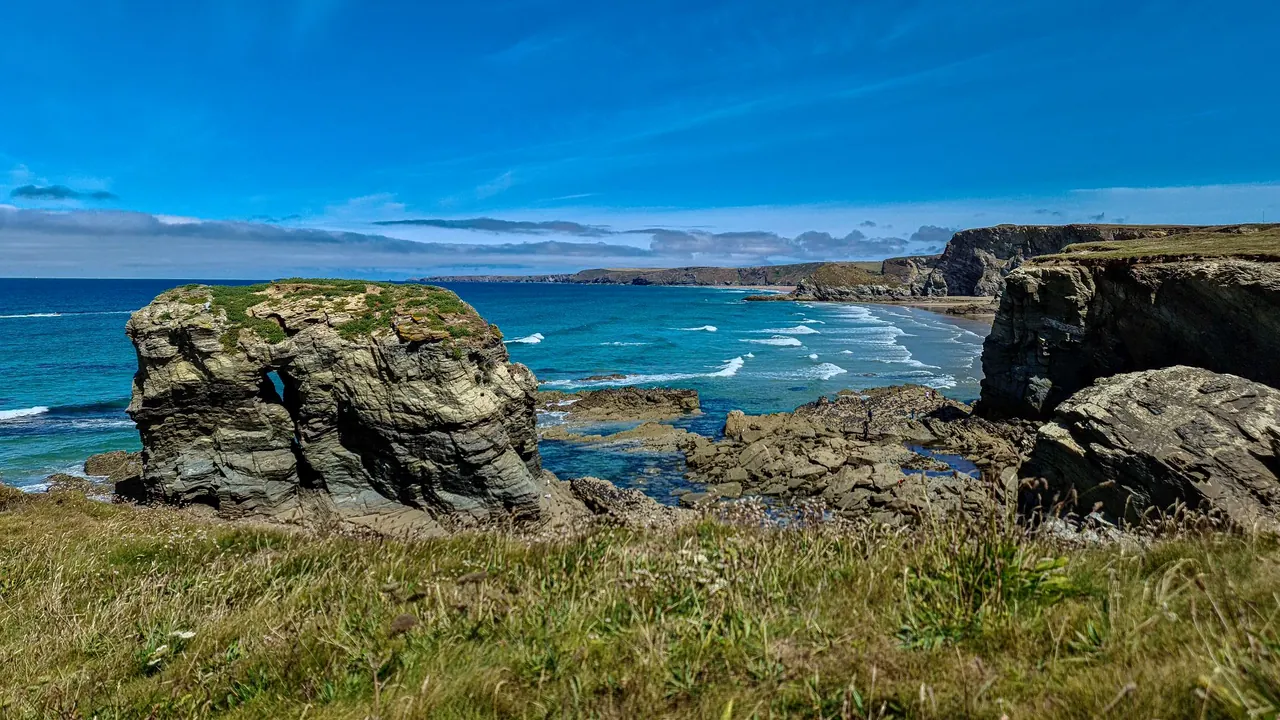
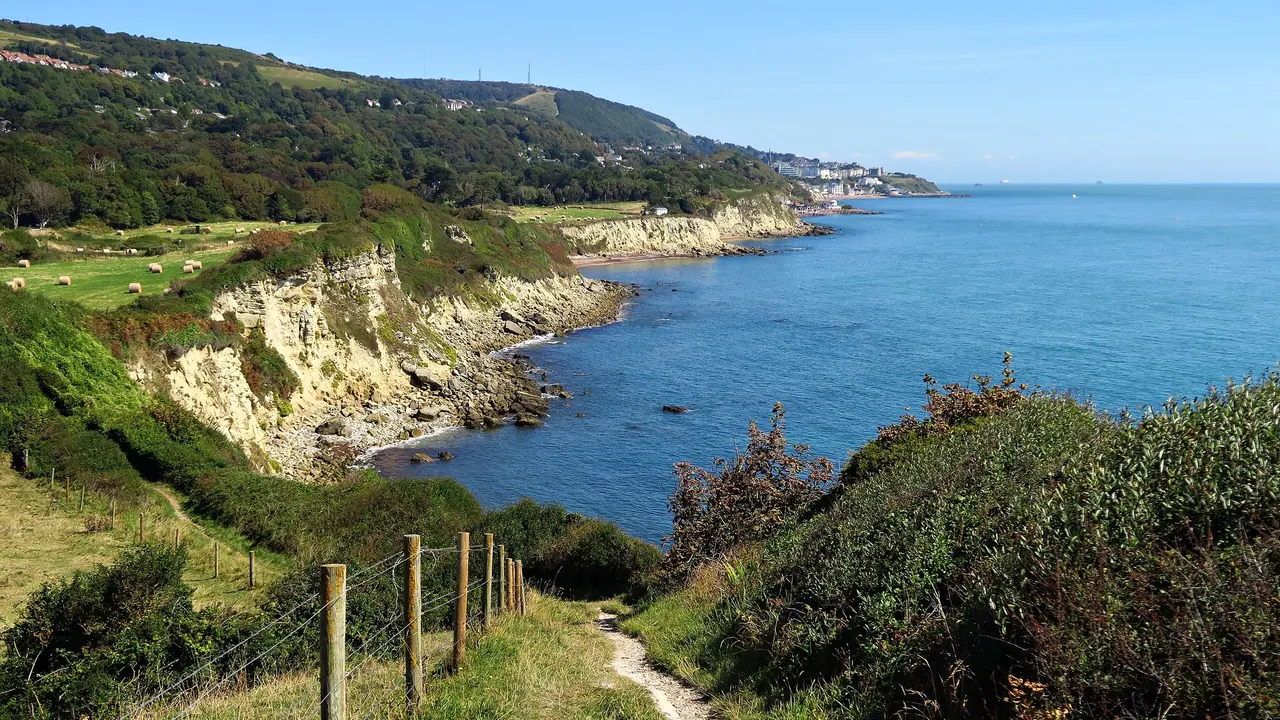
Photos: Cornwall by Howard Senton, Pexels License; Isle of Wight by Michael Coppins, CC BY-SA 4.0, cropped.
Cornwall or Isle of Wight?
Our verdict in twelve categories, each scored against the same fixed benchmark cities, and the climate month by month, so you can choose for your trip.
Choose Cornwall for
- food and drink
- nightlife
- shopping
Cornwall suits a longer trip with more variety, where the coast itself is the main event. It has the bigger surf, the wilder cliffs of Penwith and the Lizard, and seafood towns such as Padstow and Newlyn. St Ives adds art and Newquay adds a night out. It asks more of you in return: long drives on narrow lanes, scattered sights, and a summer that is cooler and wetter.
Choose Isle of Wight for
- getting around
- prices
The Isle of Wight is the easier choice for a gentle seaside week with little travelling. A quick foot-ferry crossing gets you there, the buses and the Ryde railway cover the resort towns, and the gently shelving sand of Sandown Bay and Blackgang Chine keep young children happy. Its summers are a little warmer and sunnier. Its food, culture and evenings are quieter and smaller in scale.
Scoreboard
Twelve categories on one fixed scale from 0 to 100. The shaded stretch is the gap between the two.
Your match
Pick a travel style or drag the sliders, and both match scores follow your weighting.
Wins on food and drink and nightlife with your weighting.
Wins on getting around and prices with your weighting.
What matters to you?
Category by category
What the scores mean for a trip.
Beaches & swimming
Cornwall has the better beaches and many more kinds of them. There are long surf beaches on the north coast at Fistral and Gwithian, white sand and turquoise water at Porthcurno and Pedn Vounder, and the serpentine cliffs above Kynance Cove. Sheltered coves around Falmouth suit calmer swimming.
The island's strength is narrower: the long, gently shelving sands of Sandown Bay and Ryde, made for paddling. Compton Bay gives it one wild, surfy stretch. The water off the island is marginally warmer in late summer, but neither has a sea you linger in.
Food & drink
Cornwall eats noticeably better. Newlyn's fishing fleet supplies the coast, and Padstow, St Ives, Porthleven and Falmouth have serious seafood restaurants. Camel Valley sparkling wine and Cornish cider round out the drinking.
The Isle of Wight is about good produce rather than cooking: crab sandwiches in Bembridge or Ventnor harbour pubs, island garlic and tomatoes, and farm shops that make easy picnics. Only a few ambitious kitchens around Cowes and Ventnor reach beyond pub food.
Culture & sights
Cornwall has more to see, and its sights have more pull. They include St Michael's Mount across its tidal causeway, Tintagel's clifftop ruins, the engine houses of the mining World Heritage Site, the Eden Project's biomes, and in St Ives, Tate St Ives and the Hepworth garden.
The island has one sight of national standing, Queen Victoria's Osborne House, plus Carisbrooke Castle. Around them is a short list of half-day visits such as Brading's Roman mosaics and Tennyson's Farringford. Its sights sit closer together, though, while Cornwall's take driving between.
Nightlife
Neither is a nightlife destination, but Cornwall at least has somewhere to go. In summer Newquay fills with surfers and stag and hen groups and has a few clubs, and Falmouth's students keep a smaller scene going. On the Isle of Wight evenings mean a village inn or a Cowes harbour pub. The only time it gets lively is Cowes regatta week in August.
Nature & outdoors
Cornwall's landscape is bigger and wilder. The coast path runs past the granite cliffs of Penwith and across the Lizard heathland. Bodmin Moor offers open tors, and the Atlantic brings reliable surf, basking sharks and nesting choughs.
The Isle of Wight is gentler: chalk downs leading to the Needles, the overgrown landslips of the Undercliff, and red squirrels around Newtown Creek. A coast path of about 110km circles the island. It has the edge for sailing, since the Solent and Cowes are the heart of British yachting, and its quiet lanes make cycling easy.
Day trips
Both offer a similar range of outings, but of different kinds. In Cornwall you go from one harbour town to the next, from St Ives and Mousehole to Fowey and Padstow, and the most memorable trip is the crossing to the Isles of Scilly.
From the Isle of Wight you can also reach a different mainland. The fast ferry takes you to HMS Victory and the Mary Rose in Portsmouth's Historic Dockyard, Lymington leads to the New Forest and Beaulieu, and Winchester Cathedral is a short train ride from Southampton. These trips are more varied, but every one starts with a crossing.
Good for families
Both are classic British family vacations and suit children about equally well. They differ in style. Cornwall suits older children who want bodyboarding, rock pooling and the Eden Project, but it means long drives and summer traffic between them.
The Isle of Wight is better for younger children. Distances are short, the sands at Sandown are shallow, and there are smaller attractions such as Blackgang Chine, the chairlift down to Alum Bay and fossil hunts on the south-west beaches.
Getting around
The Isle of Wight is far easier to get around. It is only about 37km across, its bus network reaches every town, open-top buses run to the Needles, and the Ryde railway serves the resort towns. A foot-passenger stay works well.
Cornwall is a long county where most visitors drive. That means single-track lanes, summer queues and scarce parking in St Ives and Port Isaac. Staying car-free works only if you base yourself on a branch line, in St Ives, Falmouth, Newquay or Looe.
Shopping & style
Art and craft are where Cornwall pulls ahead. St Ives still has the dense cluster of galleries, potteries and studios left by its artists' colony, Penzance's Chapel Street adds antiques and makers' studios, and Newquay is the place for surf gear.
The island offers less to browse: chandlers and sailing clothes along the narrow Cowes High Street, a few glassblowers and potters, farm-shop chutneys and jars of coloured Alum Bay sand.
Affordability
Neither is cheap in summer, but the Isle of Wight is slightly gentler on the wallet once you are there. Caravan parks, pub meals and buses keep costs down. The ferry is the catch, especially with a car. Cornwall's popular coastal towns charge more for cottages, and seafood dining, parking and attraction tickets add up across a week.
Live music & performing arts
The Minack Theatre gives Cornwall a stage the island cannot match: an open-air amphitheatre cut into the cliffs above Porthcurno, where summer plays are performed against the sea. Male voice choirs, pub folk sessions and Padstow's ancient May Day add a living tradition, so there is a little more to find on an ordinary evening.
On the island, the big draw is a single June weekend, the Isle of Wight Festival outside Newport. Beyond that there is Shanklin's Victorian theatre and Ventnor's small summer fringe.
Wellness & relaxation
Cornwall is better set up for a restorative break. There are spa hotels above the beaches at Watergate Bay, Carbis Bay and St Mawes, and wood-fired saunas by the sea for a cold-swim-and-steam routine.
The island offers rest rather than treatments. Ventnor keeps the calm of the Victorian health resort it was built as, Quarr Abbey's gardens are peaceful, and the quiet villages and clifftop benches set the pace.
When should you go?
Pick your month. The climate figures are measured averages, not a forecast.
Cornwall in July
Isle of Wight in July
Daytime high, °C
Rainfall in the month, mm
Where the figures come from
Cornwall has no rain gauge within 25 km of the centre, so its rainfall comes from a gridded climate dataset read at the destination rather than from a gauge further away.
Cornwall's sunshine is measured 28 km from the centre, at Camborne.
Isle of Wight's temperatures are measured 39 km from the centre, at Bournemouth Airport.
Isle of Wight has no rain gauge within 25 km of the centre, so its rainfall comes from a gridded climate dataset read at the destination rather than from a gauge further away.
Temperature and rainfall are climate normals, averaged over the years shown. Cornwall: 1991-2020 normals, Saint Mawgan (5.7 km from centre). Isle of Wight: 1991-2020 normals, Bournemouth Airport (38.9 km from centre).
Both are summer destinations, at their best from June to September and wet, grey and windy from October to February. Around the island's resort coast, July and August reach about 22°C and are noticeably sunnier and drier. In Cornwall the same months peak at about 19°C, and August brings more rain. The sea is cold in both and warmest in late summer, at roughly 17°C off Cornwall and 18°C off the island, so swims are short or taken in a wetsuit.
Both are pleasant for walking in May, when it is often sunny and fairly dry, and in September, which stays mild. Late autumn and early winter are the wettest months in both, with November rain around 120mm in Cornwall and only slightly less on the island. These months suit storm watching and empty beaches more than days out.
Which traveller are you?
On an outdoors trip, Cornwall is the stronger choice. It has Britain's best surf at Newquay, Bude and Sennen, high granite clifftop walking around Penwith, coasteering and the open moorland of Bodmin. The island's chalk downs and Solent sailing are lovely, but they are gentler in scale.
For a food and nightlife trip, choose Cornwall. Fish landed at Newlyn and the seafood dining rooms of Padstow and Porthleven give it a real food scene. Newquay and Falmouth also stay up late, while the island mostly winds down in the pub by eleven.
On a trip on a tight budget, the Isle of Wight is a little easier. You can cross as a foot passenger, use the island's good buses and the Ryde railway, and picnic from farm shops. In Cornwall a car, parking charges and pricier seafood add up.
Before you go
| Measure | Cornwall | Isle of Wight |
|---|---|---|
| Official language | English | English |
| Currency | Pound Sterling (GBP) | Pound Sterling (GBP) |
| Sockets | G230 V, 50 Hz | G230 V, 50 Hz |
| Driving side | Left | Left |
| Time zone | UTC, UTC+1 in summer | UTC, UTC+1 in summer |
| Emergency number | 112 or 999 | 112 or 999 |
| Main airport | Cornwall Airport Newquay (NQY)14 non-stop destinations | Southampton Airport (SOU)15 non-stop destinations |
| Public holidays this year | 8 days | 8 days |
By the numbers
| Measure | Cornwall | Isle of Wight |
|---|---|---|
| Population | 575,525 | 140,459 |
| People per km² | 162 | 369 |
| Swim season, months above 21 °C | None | None |
Where else could you go?
Every comparison below shares a destination with this one, so you can follow Cornwall or Isle of Wight somewhere new.
- Devonvs Cornwall
- Cotswoldsvs Isle of Wight
- Devonvs Isle of Wight
- Normandyvs Isle of Wight
- Peak Districtvs Isle of Wight
- Cotswoldsvs Cornwall