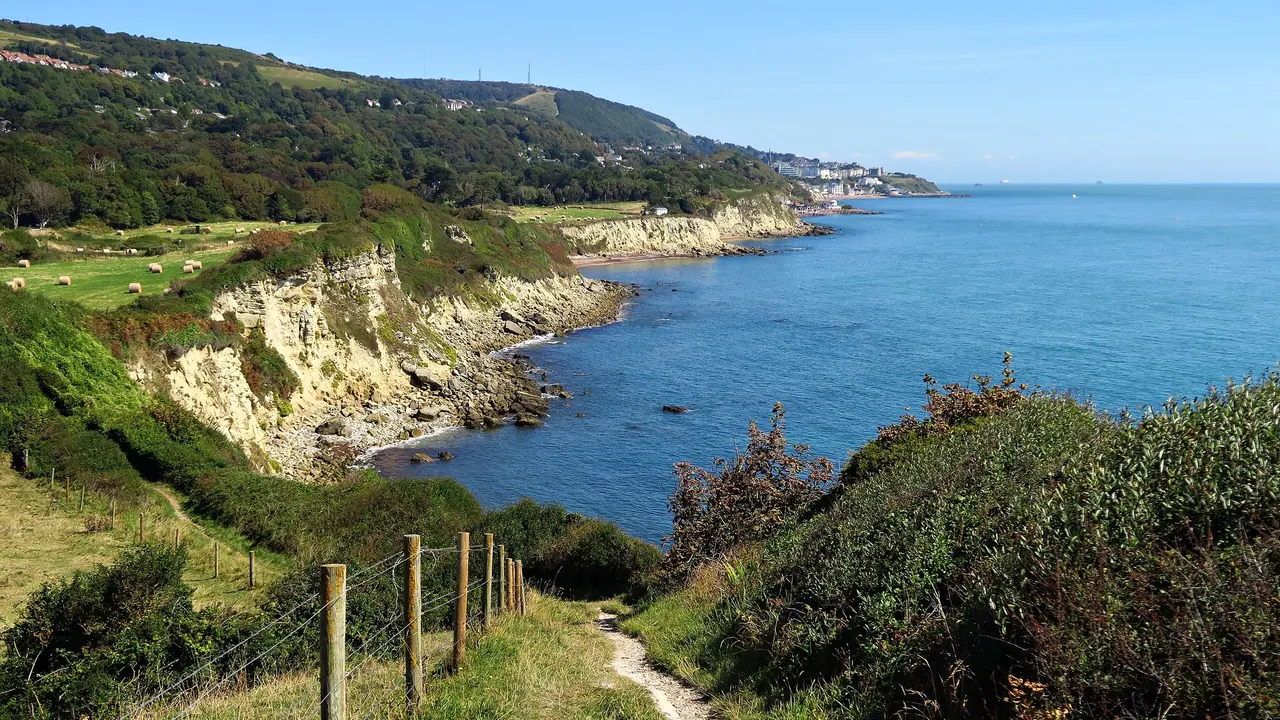
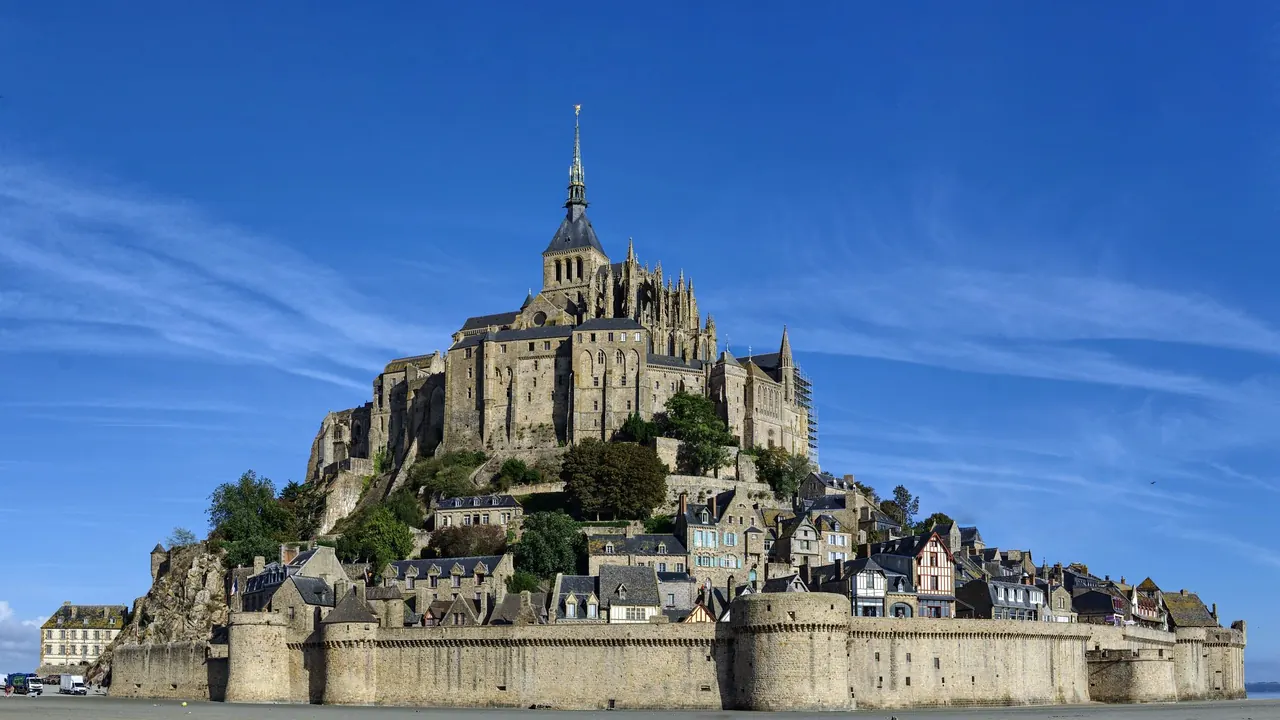
Photos: Isle of Wight by Michael Coppins, CC BY-SA 4.0, cropped; Normandy by Jan, Pexels License.
Isle of Wight or Normandy?
Our verdict in twelve categories, each scored against the same fixed benchmark cities, and the climate month by month, so you can choose for your trip.
Choose Isle of Wight for
- beaches
- families
- getting around
The Isle of Wight is the stronger pick for a classic seaside vacation with children. Sandown Bay's sands shelve gently, attractions such as Blackgang Chine are built for young families, and the island is small enough that no journey is long and buses reach every town. It also suits walkers who want chalk downs and a coastal path without needing a car, and sailors drawn to the Solent.
Choose Normandy for
- culture and sights
- food and drink
- wellness
Travellers who care about history, cooking and seeing a lot should choose Normandy. Mont-Saint-Michel, the D-Day beaches, the Bayeux tapestry and Rouen give it sights the island can't match, and the cheese, cider and oysters make every meal part of the trip. It is a much larger region, best explored by car from two bases, with thalassotherapy on the coast, Paris within reach and a slightly kinder budget away from the famous spots.
Scoreboard
Twelve categories on one fixed scale from 0 to 100. The shaded stretch is the gap between the two.
Your match
Pick a travel style or drag the sliders, and both match scores follow your weighting.
Wins on beaches and families with your weighting.
Wins on culture and sights and food and drink with your weighting.
What matters to you?
Category by category
What the scores mean for a trip.
Beaches & swimming
The island has the better beaches for a seaside trip. Sandown Bay is a long, sheltered curve of sand that shelves gently, Ryde's flats run far out at low tide, and Compton Bay has surf under coloured cliffs. All of them are within a short drive of each other.
Normandy's coast is longer but less suited to bathing. The Côte Fleurie resorts of Deauville and Cabourg have fine sand and striped beach cabins, but big tides pull the sea out hundreds of metres, and Étretat's shingle is better for walking than for swimming. The water is equally cool on both sides of the Channel.
Food & drink
Normandy is where you eat well. Its cheeses, butter, cider and calvados come from farms you can visit along the Pays d'Auge route. The harbours of Honfleur and Granville serve oysters, scallops and mussels in cream, and Rouen adds a proper restaurant scene.
The Isle of Wight has good ingredients too: crab and lobster in harbour pubs at Bembridge and Ventnor, and island garlic and cheese for farm-shop picnics. The cooking stays simple, though, with fish and chips, cream teas in Godshill and pub lunches.
Culture & sights
Here the gap is wide. Normandy has sights people cross continents to see: Mont-Saint-Michel, the landing beaches and their cemeteries, the Bayeux tapestry, Rouen's cathedral and half-timbered streets, and Monet's garden at Giverny.
The island has one sight of national standing in Osborne House. Beyond it there is Carisbrooke Castle, where Charles I was held, and pleasant half days at Brading's Roman mosaics, the Needles Old Battery and Tennyson's Farringford. It is enough for a few rainy afternoons, not a whole itinerary.
Nightlife
Neither is a place to choose for going out, but Normandy offers a little more. Rouen and Caen are university cities with bars around the cathedral and the Vaugueux quarter, and Deauville adds its casino in summer. On the island, evenings mean the pub, and only Cowes regatta week in August keeps the waterfront busy late.
Nature & outdoors
The two are evenly matched outdoors. Both have chalk cliffs and neither has mountains. The island keeps its scenery close together: Tennyson Down out to the Needles, the tangled Undercliff, a coastal path of about 110km to walk in sections, and the Solent for sailing and paddleboarding.
Normandy spreads its landscapes over far more ground. It runs from Étretat's arches to the granite headlands of Cap de la Hague, with guided low-tide walks among the seals in the bay of Mont-Saint-Michel and climbing and kayaking in the Suisse Normande.
Day trips
Normandy makes the better base for outings. Honfleur, Deauville, the Pays d'Auge villages and walled Granville are all close by, Saint-Malo is just over the Breton border, and Paris is under two hours by train.
On the Isle of Wight, day trips go either to its own small towns, which are so close together that they barely count as separate outings, or across the Solent to Portsmouth's Historic Dockyard, the New Forest or Winchester. Every mainland trip starts with a ferry.
Good for families
The island is the more natural choice with young children. It has been set up for the family seaside vacation for generations: Blackgang Chine, Robin Hill, the Sandown zoo, fossil hunts on the south-west beaches and the chairlift down to Alum Bay are all a short hop apart.
Normandy is pleasant with children, with sandy beaches on the Côte Fleurie, a submarine to walk through at Cherbourg's Cité de la Mer and the Cerza safari park. Its attractions are further apart, though, and some D-Day sites are heavy going for young ones.
Getting around
The island is far easier without a car. It is only about 37km from end to end, buses link every town, open-top buses run to the Needles in summer and a short railway runs down the east coast. The narrow lanes do get busy in August.
Normandy has good trains between Paris, Rouen, Caen and Bayeux. The landing beaches, Étretat and Mont-Saint-Michel need a car or an organised tour, and the distances are long enough that two bases work better than one.
Shopping & style
Neither is a shopping destination, but Normandy gives you more to take home. There is calvados and cheese from the farm, lace from Alençon, copper pans from Villedieu-les-Poêles, Rouen's faience and pedestrian streets, and a few boutiques in Deauville. The island has sailing chandlers in Cowes, potters and glassblowers, and jars of coloured Alum Bay sand.
Affordability
Normandy is gentler on the budget, as long as you avoid Deauville, Honfleur and Mont-Saint-Michel in high summer. Chambres d'hôtes, set lunches and the free D-Day sites keep costs reasonable, though hiring a car is part of the bill.
The island charges full English high-season prices in July and August, and the ferry adds a large cost, especially with a car. Foot passengers who use the buses pay much less, and so do visitors in spring or early autumn.
Live music & performing arts
Normandy has the more regular stage programme. Rouen's Théâtre des Arts puts on opera, ballet and an orchestral season, Caen and Le Havre have their own theatres, and Coutances holds Jazz sous les Pommiers in spring.
The island's big moment is the Isle of Wight Festival each June, a name with history going back to the late 1960s. Outside that weekend there is a Victorian theatre in Shanklin and folk bands in the pubs.
Wellness & relaxation
Normandy offers actual treatments. Thalassotherapy centres line the coast from Deauville to Granville, and Bagnoles-de-l'Orne is a belle-époque spa town built around its springs. The island has no bathing tradition and only a few hotel spas, so rest there comes from the pace itself: Ventnor's sheltered Victorian calm, clifftop benches and the gardens at Quarr Abbey.
When should you go?
Pick your month. The climate figures are measured averages, not a forecast.
Isle of Wight in July
Normandy in July
Daytime high, °C
Rainfall in the month, mm
Where the figures come from
Isle of Wight's temperatures are measured 39 km from the centre, at Bournemouth Airport.
Isle of Wight has no rain gauge within 25 km of the centre, so its rainfall comes from a gridded climate dataset read at the destination rather than from a gauge further away.
Temperature and rainfall are climate normals, averaged over the years shown. Isle of Wight: 1991-2020 normals, Bournemouth Airport (38.9 km from centre). Normandy: 1991-2020 normals, Caen (21 km from centre).
The two share almost the same Channel climate. In July and August both reach daytime highs of about 22-23°C, and that is the only time the sea, which peaks near 18°C, is comfortable for a swim. May, June and September are mild, sunny enough and good for walking and sightseeing. Winter highs stay around 8-9°C on both sides of the water, which is fine for a walk but not for the beach.
The real difference comes in autumn. Around the island's resort coast the rain climbs steeply from October, and November is the wettest month at 116mm. Normandy's rain later in the year is lighter and spread more evenly. Its sea also stays warm through September, so early autumn suits it slightly better. The island has a touch more sunshine in early summer.
Which traveller are you?
On a family trip with young children, the Isle of Wight is the easier place. One day can take in woodland play at Robin Hill, a ride on the steam railway and an afternoon on Shanklin's sand, all without a long drive. In Normandy, the Cerza safari park and Cherbourg's submarine are long drives apart.
For a culture and arts trip, the Isle of Wight runs out after Osborne House and a few half days. Normandy can fill a week. It has William the Conqueror's castle and abbeys in Caen, the ruins of Jumièges, Le Havre's Impressionist paintings, and opera in Rouen.
On a food and nightlife trip, the Isle of Wight means fish and chips on the seafront and a pub that is quiet by eleven. In Normandy you can shop at a market in the morning and have mussels in cider for lunch. Dinner can be Rouen's pressed duck, followed by bars around Place du Vieux-Marché.
Before you go
| Measure | Isle of Wight | Normandy |
|---|---|---|
| Official language | English | French |
| Currency | Pound Sterling (GBP) | Euro (EUR) |
| Sockets | G230 V, 50 Hz | CE230 V, 50 Hz |
| Driving side | Left | Right |
| Time zone | UTC, UTC+1 in summer | UTC+1, UTC+2 in summer |
| Emergency number | 112 or 999 | 112 |
| Main airport | Southampton Airport (SOU)15 non-stop destinations | Caen Carpiquet airport (CFR)10 non-stop destinations |
| Public holidays this year | 8 days | 11 days |
By the numbers
| Measure | Isle of Wight | Normandy |
|---|---|---|
| Population | 140,459 | - |
| People per km² | 369 | - |
| Swim season, months above 21 °C | None | None |
Where else could you go?
Every comparison below shares a destination with this one, so you can follow Isle of Wight or Normandy somewhere new.
- Cotswoldsvs Isle of Wight
- Devonvs Isle of Wight
- Brittanyvs Normandy
- Devonvs Normandy
- Loire Valleyvs Normandy
- Cornwallvs Isle of Wight