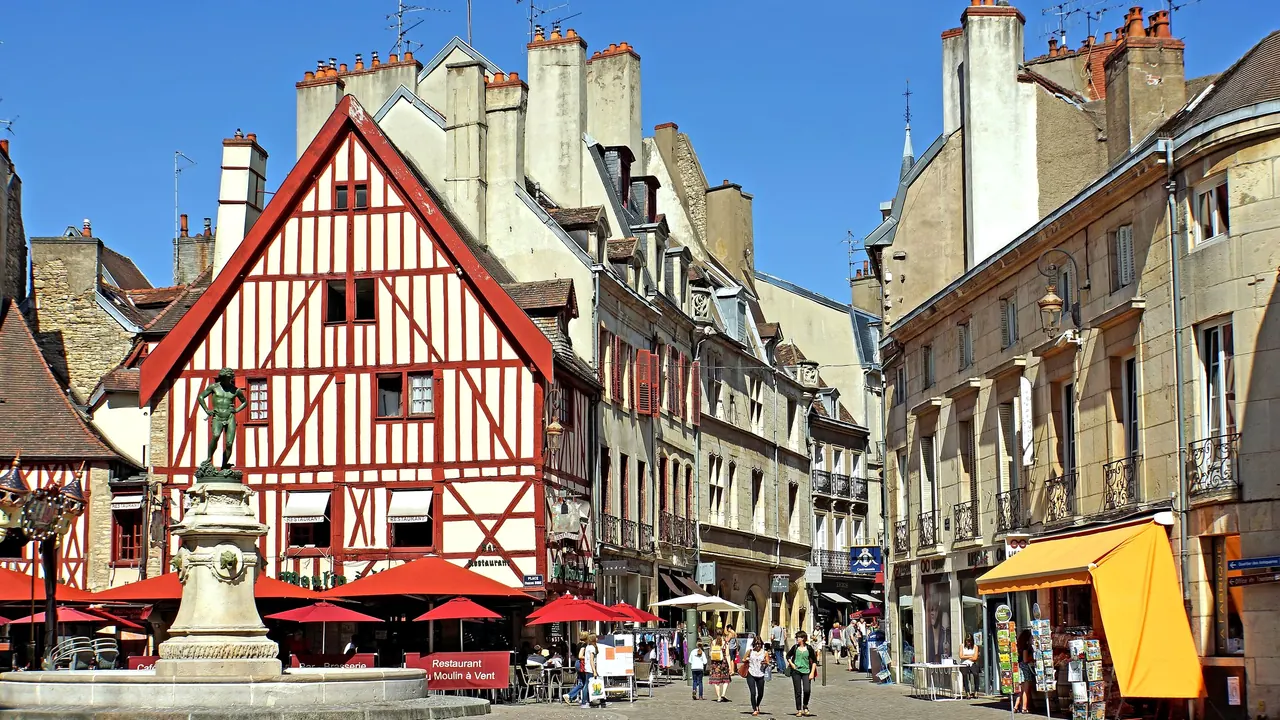
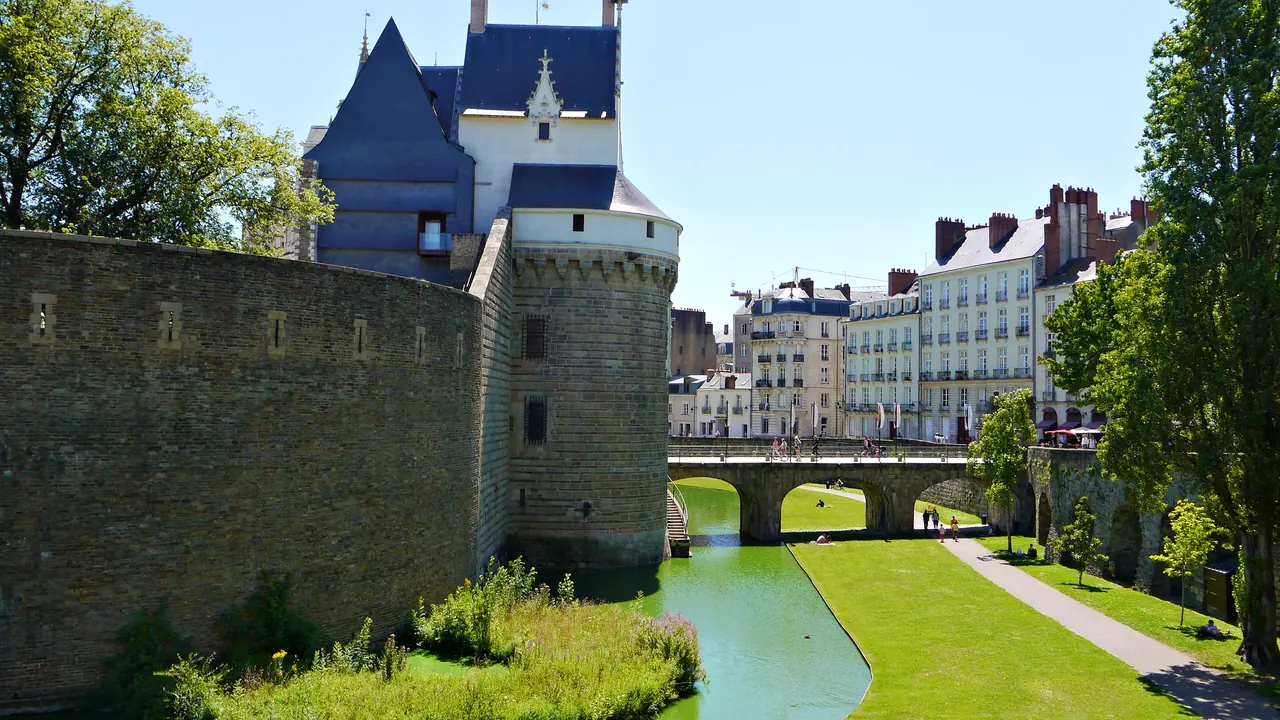
Photos: Dijon by Dennis G. Jarvis, CC BY-SA 2.0, cropped; Nantes by Carole44, CC BY-SA 3.0, cropped.
Dijon or Nantes?
Our verdict in twelve categories, each scored against the same fixed benchmark cities, and the climate month by month, so you can choose for your trip.
Choose Dijon for
- food and drink
- day trips
- prices
Choose Dijon if your trip is built around the table and the vineyard. Burgundian cooking, wine bars pouring village wines by the glass and the Route des Grands Crus starting at the edge of town make it the better base for tasting days and for outings to Beaune, Fontenay Abbey and Semur-en-Auxois. It suits couples and unhurried travellers who are happy with quiet evenings, and it costs a little less.
Choose Nantes for
- beaches
- families
- nightlife
Families, and anyone who wants more going on, will do better in Nantes. The mechanical elephant on the old shipyards, Atlantic sand at La Baule and Pornic within an hour by train, and late nights in Bouffay and on the docks give it a range Dijon can't match. The stage is livelier too, and the seawater spas on the coast are close enough for a day.
Scoreboard
Twelve categories on one fixed scale from 0 to 100. The shaded stretch is the gap between the two.
Your match
Pick a travel style or drag the sliders, and both match scores follow your weighting.
Wins on food and drink and day trips with your weighting.
Wins on beaches and families with your weighting.
What matters to you?
Category by category
What the scores mean for a trip.
Beaches & swimming
Dijon is deep inland, and the nearest it has to a beach is the supervised lawn-and-sand area at Lac Kir, which is fine for a hot afternoon and no more.
Nantes is also inland, but the Atlantic is within reach. La Baule, Pornic and the Jade coast are around an hour away, and their beaches are wide, clean and calm enough for families. The sea is cool and the swimming season short, so beach days work as an extra for a summer trip rather than its purpose.
Food & drink
Dijon has the deeper food culture. It is the classic Burgundian table of boeuf bourguignon, coq au vin, snails and gougères, alongside its own mustard, pain d'épices and cassis. Les Halles is busy with Bresse poultry and Époisses, there is a real fine-dining tier, and the Cité de la Gastronomie gives the subject a home of its own.
Nantes leans towards fish and white wine: beurre blanc, which was born here, oysters from the nearby coast, galettes and Muscadet. Its bistros in Bouffay and around Graslin are good and fairly priced, but this is a city where you eat well rather than one you travel to for its food.
Culture & sights
These two are closely matched, and each is built around a ducal seat. In Dijon it is the Palace of the Dukes of Burgundy, home to the Musée des Beaux-Arts and the carved Valois tombs, set in a medieval and Renaissance core of half-timbered houses, glazed roofs and the gargoyles of Notre-Dame.
Nantes centres on the moated castle of the Dukes of Brittany, but the story it tells is mostly the later one of an Atlantic port. That means the merchant houses of the Ile Feydeau, an honest account of the slave trade at the castle museum and the riverside memorial, and the Jules Verne museum. Either fills two or three days.
Nightlife
An evening out in Dijon and a night out in Nantes are different things. In Dijon it usually means wine, beer and a late dinner, in the small student bars along Rue Berbisey or on the terraces around Place Émile Zola. There are only a few clubs, and outside term time and summer weekends the streets are quiet by around midnight.
Nantes keeps going much later. The pubs and terraces packed into the medieval Bouffay lanes are only the start. From there the crowd moves to the riverside bars and clubs in the old banana warehouses on the Ile de Nantes, which stay open into the early hours, while Graslin and Madeleine suit a quieter cocktail.
Nature & outdoors
There is little between them on quality, but the landscapes are quite different. Dijon has some relief: the limestone combes just west of town offer trails and climbing cliffs, the canal towpath and the vineyard route to Beaune make easy cycling, and the granite Morvan is about an hour and a half away.
Around Nantes the country is flat and watery. You can paddle or take a boat on the Erdre, cycle the Loire à Vélo route, go birdwatching in the Brière marshes, or walk the cliff paths on the Côte Sauvage. Choose Dijon for wooded hills and Nantes for rivers and the coast.
Day trips
Dijon has the edge because its best day out starts at the edge of town. The Route des Grands Crus runs through Gevrey-Chambertin and Vougeot to Beaune, with Fontenay Abbey and the hill towns of Auxois further afield. Most of the wine villages are easiest by car, bike or tour, though.
Nantes covers more varied ground: the salt marshes and walls of Guérande, Angers and its Apocalypse Tapestry, Saumur and the Loire châteaux, and Vannes on the Gulf of Morbihan. It has more variety, but less of the single focus that makes Dijon's excursions so rewarding.
Good for families
Nantes is clearly the better choice with children. The Machines de l'Ile, with its rideable elephant and carousel, is made for them, and the safari park at Port-Saint-Père, Puy du Fou and the sandy beaches can all be done as days out.
Dijon is safe and relaxed, with a small pedestrian centre, a planetarium and Lac Kir for paddling. But most of what fills a stay there, the tastings and fine-art museums, is aimed at adults.
Getting around
Both are easy to manage on foot and by tram, and both are under two hours or so from Paris by TGV. Dijon is the tighter of the two: the station, market, palace and cathedral are minutes apart, and its two tram lines are mainly useful for the outskirts.
Nantes is larger but flat, with three tram lines, a busway, river shuttles across the Loire and easy cycling. The bigger difference is in getting out of town. Regional trains reach the Nantes beaches, while Dijon's wine villages away from the railway need a car, bike or tour.
Shopping & style
Nantes is a little more rewarding to browse. The three-level Passage Pommeraye is a sight in itself, and independent designers and second-hand shops cluster around Bouffay and Decré.
In Dijon, shopping mostly means mustard, cassis, pain d'épices and bottles of Burgundy, plus a few antiques shops off Rue de la Liberté. Neither city is a destination for luxury or fashion.
Affordability
Dijon works out slightly cheaper day to day. Bistro lunch menus are fair, wine by the glass costs less than in most of France, and the tiny centre means you spend almost nothing on transport. The catch is that cellar tastings, wine tours and serious dinners, the reasons most people come, push the bill up quickly.
In Nantes, hotels are easy to find and good value, but dinners and drinks are at normal French prices, and prices rise on the coast in high summer if you add beach days.
Live music & performing arts
For a city its size, Dijon puts on a respectable season, built around its opera company. It stages opera, concerts and dance in the nineteenth-century Grand Théâtre and in the Auditorium, which is known for its acoustics. The programme follows the academic year, though, and in summer it thins out to a few outdoor events.
In Nantes there is more on, and more of it is out of the ordinary. La Folle Journée fills a few winter days with short classical concerts, and the Lieu Unique in the old biscuit factory hosts contemporary theatre and dance. The city's tradition of giant street puppets also brings performance out into its squares and streets, so summer is a good time for the stage there too.
Wellness & relaxation
Neither city has a bathing culture of its own, but Nantes has the stronger option nearby: the long-established thalassotherapy centres at La Baule and Pornic, about an hour away.
Dijon's spas are limited to a few hotels, some offering grape-based treatments in the wine villages. Its restfulness comes from long lunches, quiet squares and slow afternoons among the vines.
When should you go?
Pick your month. The climate figures are measured averages, not a forecast.
Dijon in July
Nantes in July
Daytime high, °C
Rainfall in the month, mm
Temperature and rainfall are climate normals, averaged over the years shown. Dijon: 1991-2020 normals, Dijon (7 km from centre). Nantes: 1991-2020 normals, Nantes (6.6 km from centre).
Both cities are at their best from late May to September, but the two climates have different characters. Dijon is more continental. Its summers are warmer and sunnier, with highs of about 27°C in July, which is good for vineyard cycling but can be tiring on the streets of the old town in the middle of the day. Its winters are cold and grey, with highs around 6°C, and rain is spread fairly evenly through the year, peaking a little in May and again in October and November.
Nantes is milder at both ends. Summers are a few degrees cooler and the driest time of year, at about 44mm in July. Winters are softer but much wetter, building to about 101mm in December. The Atlantic only gets warm enough for comfortable swimming in July and August, when it reaches about 19°C, so beach days fit into a short window. Spring and early autumn suit walking in both cities.
Which traveller are you?
On a family trip with children, choose Nantes. Children can ride the mechanical elephant and the sea-creature carousel, the trams make buggies easy, the beaches are close, and the safari park and Puy du Fou are within a drive. Dijon offers parks and a planetarium, but not much more.
For a beach and sun trip, Nantes is the only realistic choice of the two. Trains reach the sandy bay at La Baule and the coves at Pornic in about an hour. In Dijon, swimming means Lac Kir or a pool.
On a wine-tasting trip, Dijon is unmatched. The Grand Cru villages of the Côte de Nuits start at the city's southern edge, Beaune is a short train ride away, and the bars pour Burgundies by the glass that are hard to find elsewhere. Nantes has crisp Muscadet, but on a smaller scale.
Before you go
| Measure | Dijon | Nantes |
|---|---|---|
| Official language | French | French |
| Currency | Euro (EUR) | Euro (EUR) |
| Sockets | CE230 V, 50 Hz | CE230 V, 50 Hz |
| Driving side | Right | Right |
| Time zone | UTC+1, UTC+2 in summer | UTC+1, UTC+2 in summer |
| Emergency number | 112 | 112 |
| Elevation | 220 m | 2 m |
| Main airport | Lyon Saint-Exupéry Airport (LYS)178 km from centre141 non-stop destinations | Nantes Atlantique Airport (NTE)8 km from centre97 non-stop destinations |
| Public holidays this year | 11 days | 11 days |
By the numbers
| Measure | Dijon | Nantes |
|---|---|---|
| City population | 161,830 | 327,734 |
| People per km² | 3,890 | 5,027 |
| Museums within 10 km | 8 | 11 |
| UNESCO World Heritage sites within 50 km | 1 | 0 |
| Swim season, months above 21 °C | - | None |
Where else could you go?
Every comparison below shares a destination with this one, so you can follow Dijon or Nantes somewhere new.