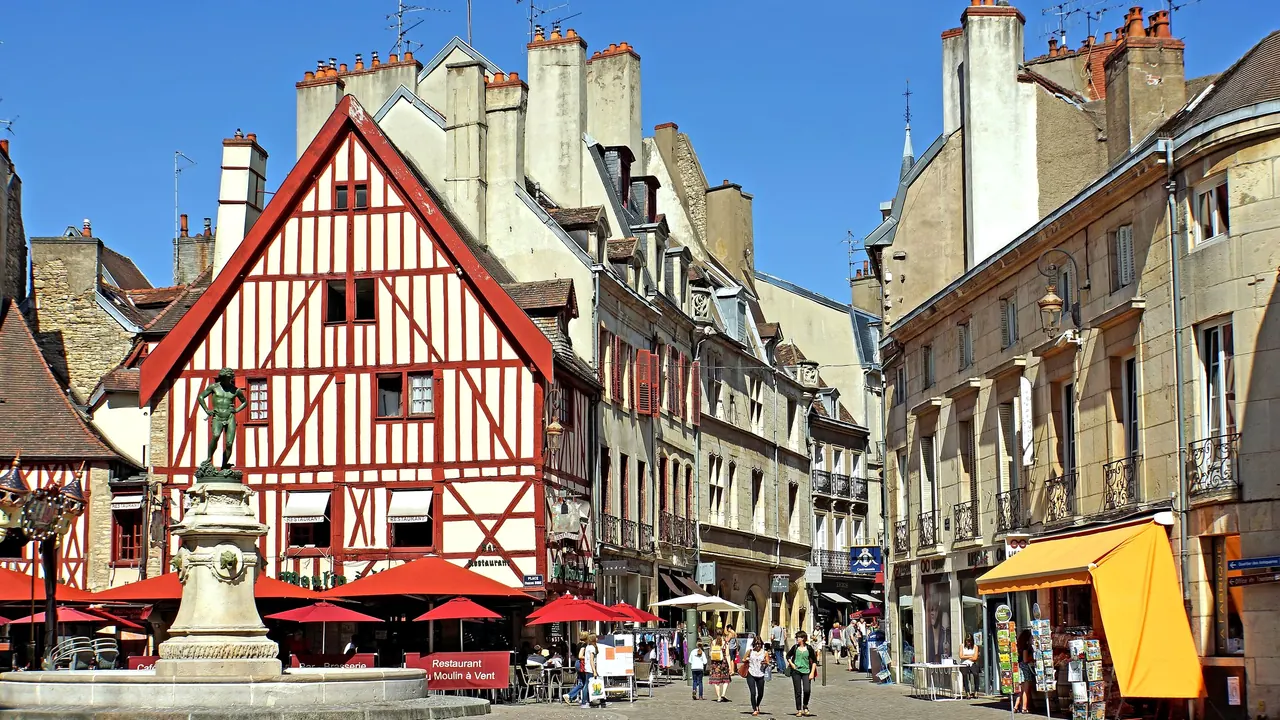
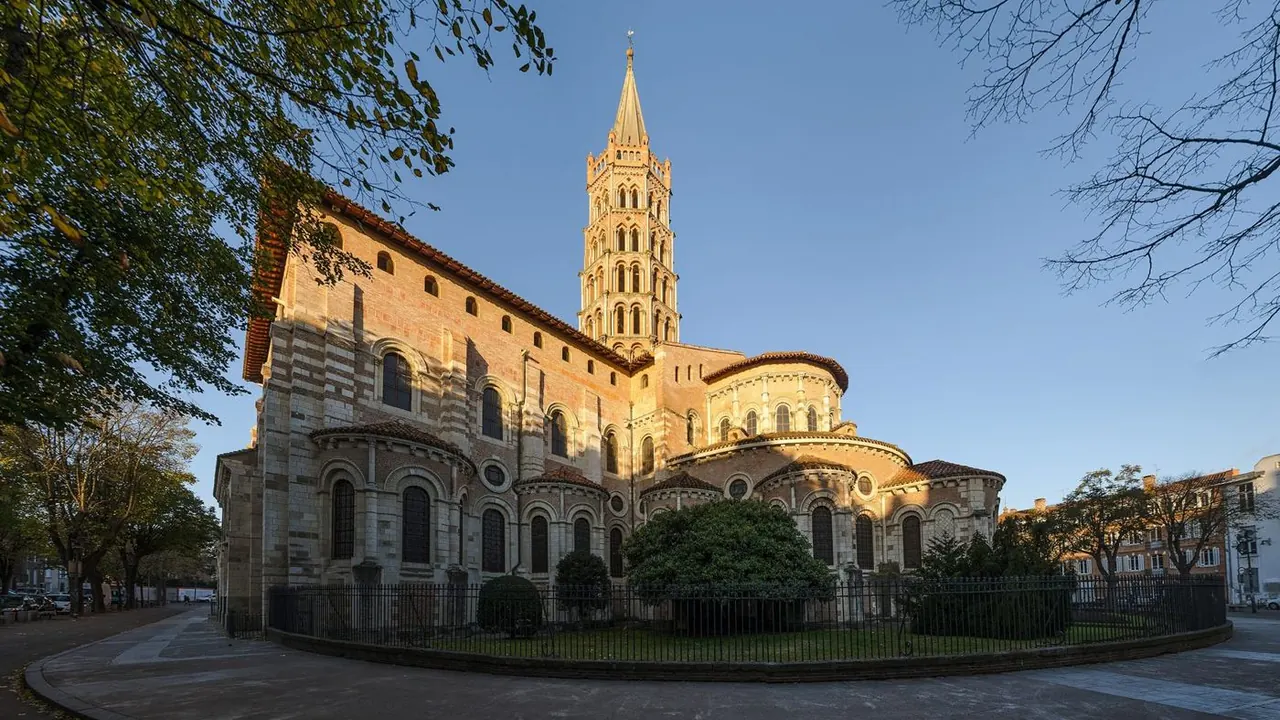
Photos: Dijon by Dennis G. Jarvis, CC BY-SA 2.0, cropped; Toulouse by ZbebVial, CC BY-SA 3.0, cropped.
Dijon or Toulouse?
Our verdict in twelve categories, each scored against the same fixed benchmark cities, and the climate month by month, so you can choose for your trip.
Choose Dijon for
- day trips
- prices
- food and drink
Dijon is the better choice if wine and the countryside around it are the point of the trip. The Côte de Nuits starts at the edge of town, Beaune is a short train ride away, and the small, walkable centre around the ducal palace makes an easy, quiet base for several days of tastings, Burgundian cooking and abbey visits. It suits couples and slower travellers who are happy to be in bed by midnight, and it comes out a little cheaper day to day.
Choose Toulouse for
- nightlife
- families
- live music and the arts
Toulouse gives you more to do once the sightseeing is over. It is a larger and livelier university city, with busy riverside terraces, a strong opera and orchestra season, and the space and aircraft museums that keep children busy for days. The Pyrenees are close enough for hiking or skiing. Pick it for a family trip, for warmer weather or for evenings that go on later.
Scoreboard
Twelve categories on one fixed scale from 0 to 100. The shaded stretch is the gap between the two.
Your match
Pick a travel style or drag the sliders, and both match scores follow your weighting.
Wins on day trips and prices with your weighting.
Wins on nightlife and families with your weighting.
What matters to you?
Category by category
What the scores mean for a trip.
Beaches & swimming
Neither city is a beach destination, and you would need a pool or a lake in both. In Dijon, Lac Kir sits on the western edge of town, close enough for a hot afternoon, with a supervised bathing area, lawns and a strip of sand. The coast is several hours away.
Toulouse has more than one lake, at Sesquières and La Ramée, and it also has the sea within reach. The Mediterranean at Gruissan or Narbonne is about two hours away and warm in summer. That makes a long day out rather than a beach trip, but from Dijon it is not possible at all.
Food & drink
The two cities eat equally well, but in different styles. Dijon offers the more refined Burgundian table: coq au vin, jambon persillé and Époisses cheese from Les Halles, mustard and cassis as local specialities, and a proper fine-dining tier. With the vineyards so close, wine sits at the centre of every meal.
Toulouse's cooking is heartier and more everyday: cassoulet, duck confit and foie gras, with lunch at the market counters above the Victor Hugo hall. Thanks to the student quarters, eating casually and cheaply is easier here than in Dijon. Neither city offers much international food.
Culture & sights
Dijon's sights tell the story of the Dukes of Burgundy. Their palace holds the Musée des Beaux-Arts, with the carved Valois tombs and their ring of mourners, and the tower gives a view over the glazed, patterned roofs. Much of the pleasure is in close-up detail: the gargoyles and the lucky owl on Notre-Dame, the Romanesque crypt of Saint-Bénigne and Sluter's Well of Moses at the Chartreuse de Champmol.
Toulouse is built in rose-red brick, and its monuments are on a larger scale. Saint-Sernin is one of Europe's largest Romanesque churches and a stop on the pilgrim road to Santiago, and the Jacobins has its palm-tree vault. The Capitole's painted rooms and the collections at the Hôtel d'Assézat and the Augustins fill a second day. Here the history is about trade and pilgrimage rather than a ducal court, and the aerospace museums on the outskirts add a modern chapter you won't find in Dijon.
Nightlife
Toulouse is the stronger choice for going out. Place Saint-Pierre fills with students along the river, Carmes and the Daurade suit an older wine-bar crowd, and the clubs and electronic nights keep going late. It gets quieter in high summer.
Dijon's evenings are mostly wine, beer and a late dinner on Rue Berbisey or the market terraces. There are only a few clubs, and outside term time the streets are usually empty by midnight.
Nature & outdoors
Toulouse has slightly more to offer because of the Pyrenees, which take an hour and a half to two hours by car. Luchon and the Ariège offer serious hiking, mountain cycling and winter skiing, and the Aveyron gorges are closer still.
Dijon's countryside is gentler but closer. You can climb or walk in the combes just west of town, or cycle through the vineyards to Beaune. Both have a long, flat canal towpath for cycling, the Burgundy Canal in Dijon and the Canal du Midi in Toulouse.
Day trips
Dijon has the edge, mainly because its best trips are packed so close together. The Grand Cru villages, Vougeot and walled Beaune are all just south of town, with Beaune about twenty minutes by train, and Fontenay Abbey and Semur-en-Auxois make a second full day.
Toulouse's two big trips are excellent and each takes about an hour by train: Carcassonne's ramparts and Albi's brick cathedral. Moissac, Cordes-sur-Ciel and Foix are further apart, so they work better with a car than as easy repeat outings.
Good for families
Toulouse is much the stronger family destination. The Cité de l'espace can fill a whole day with its Ariane rocket and planetarium, and the aircraft museum, the mechanical creatures at Montaudran and a drive-through safari park give you several more.
Dijon is calm, safe and easy with a pushchair. The planetarium at the Jardin de l'Arquebuse and paddling at Lac Kir are pleasant, but there is little else aimed at children.
Getting around
In Dijon almost everything is a few minutes' walk apart. The station, Les Halles, the ducal palace and the cathedral all sit in one small, mostly pedestrian core. Trams and buses cover the outskirts, and a bus will take you out to Lac Kir. Paris is well under two hours away by TGV.
Toulouse needs a little more than your feet. Its flat centre inside the ring of boulevards is pleasant to walk, two automated metro lines share tickets with the trams and buses, and a public bike scheme runs along the river. In both cities the easy part ends where the rail lines do. For Dijon that means the Côte villages that have no station. For Toulouse it means the space centre and aircraft museum out on the edges, and above all the Pyrenees, which are far simpler to reach by car.
Shopping & style
Toulouse is the better place for a shopping trip. Rue d'Alsace-Lorraine has the chains, the lanes of Saint-Étienne add independent boutiques and some designer labels, and the Sunday market around Saint-Sernin is fun to browse.
Dijon's shopping is mostly edible: mustard, pain d'épices, cassis and bottles of Burgundy. Rue de la Liberté has little beyond the chains and one department store. In both cities, the most memorable things to take home come from the covered market.
Affordability
Dijon is a little easier on the wallet. Its wine by the glass is cheap even by French standards, and the tiny centre costs nothing to walk. The catch is that tastings, wine tours and good bottles are the main reason to go, and they add up quickly.
Toulouse makes cheap eating easier thanks to its student bars, and some municipal museums are free on certain days. Hotel prices jump during trade fairs and aerospace events, though.
Live music & performing arts
Toulouse has the stronger programme. The Théâtre du Capitole stages opera and ballet with its own company, the Orchestre National du Capitole plays in the round Halle aux Grains, and the piano festival in the Jacobins cloister and the riverside Rio Loco festival keep things going in summer.
Dijon's opera has two good venues, including an Auditorium known for its acoustics. Its season follows the academic year, though, and thins out to outdoor events in summer.
Wellness & relaxation
Neither city is somewhere to go for a spa vacation. Dijon has a few hotel spas, some with grape-based treatments in the wine villages, and is best for unhurried lunches and quiet squares.
Toulouse adds hammam-style day spas and big open-air pools in summer. The thermal towns of the Pyrenees, such as Luchon and Ax-les-Thermes, are within reach for an overnight stay.
When should you go?
Pick your month. The climate figures are measured averages, not a forecast.
Dijon in July
Toulouse in July
Daytime high, °C
Rainfall in the month, mm
Temperature and rainfall are climate normals, averaged over the years shown. Dijon: 1991-2020 normals, Dijon (7 km from centre). Toulouse: 1991-2020 normals, Toulouse / Blagnac (7 km from centre).
Toulouse is warmer for most of the year, and the difference is clearest in winter. In January, Dijon's afternoons reach about 6°C and the days are grey and short. Toulouse is closer to 10°C and gets noticeably more sun, so it is the better choice for a city walk between November and March. In spring the two are closer. May is the wettest month in both, and both are pleasant for walking from April onwards.
In summer the two cities differ in kind. Dijon peaks around 27°C, which is comfortable for vineyard cycling, though its July rain is about as heavy as in spring. Toulouse reaches 29°C in August and is drier, with about 40mm in July, but its afternoons can be too hot for long walks on the brick streets. September and early October are the sweet spot for both: still warm, sunny and easy to get around. Dijon's autumn turns wet sooner.
Which traveller are you?
On a family trip with children, Toulouse is the clear pick. Children can walk through a Mir module at the Cité de l'espace and climb inside a Concorde at the aircraft museum. Dijon's tastings and fine-art museums are mostly for the parents.
For a food and nightlife trip, Toulouse comes out ahead. The two cities eat equally well, so the evenings decide it: Toulouse has student bars along the quays at Place Saint-Pierre and wine bars in Carmes. Dijon's small scene around Rue Berbisey is usually quiet by midnight.
For wine lovers, Dijon is the place to be. The Route des Grands Crus starts on its southern edge, its bars pour village Burgundies by the glass, and Beaune and Meursault are easy day trips. Toulouse has Fronton and Gaillac nearby, but nothing on that level.
Before you go
| Measure | Dijon | Toulouse |
|---|---|---|
| Official language | French | French |
| Currency | Euro (EUR) | Euro (EUR) |
| Sockets | CE230 V, 50 Hz | CE230 V, 50 Hz |
| Driving side | Right | Right |
| Time zone | UTC+1, UTC+2 in summer | UTC+1, UTC+2 in summer |
| Emergency number | 112 | 112 |
| Elevation | 220 m | 115 m |
| Main airport | Lyon Saint-Exupéry Airport (LYS)178 km from centre141 non-stop destinations | Toulouse-Blagnac Airport (TLS)7 km from centre84 non-stop destinations |
| Public holidays this year | 11 days | 11 days |
By the numbers
| Measure | Dijon | Toulouse |
|---|---|---|
| City population | 161,830 | 514,819 |
| People per km² | 3,890 | 4,352 |
| Museums within 10 km | 8 | 24 |
| UNESCO World Heritage sites within 50 km | 1 | 2 |
Where else could you go?
Every comparison below shares a destination with this one, so you can follow Dijon or Toulouse somewhere new.