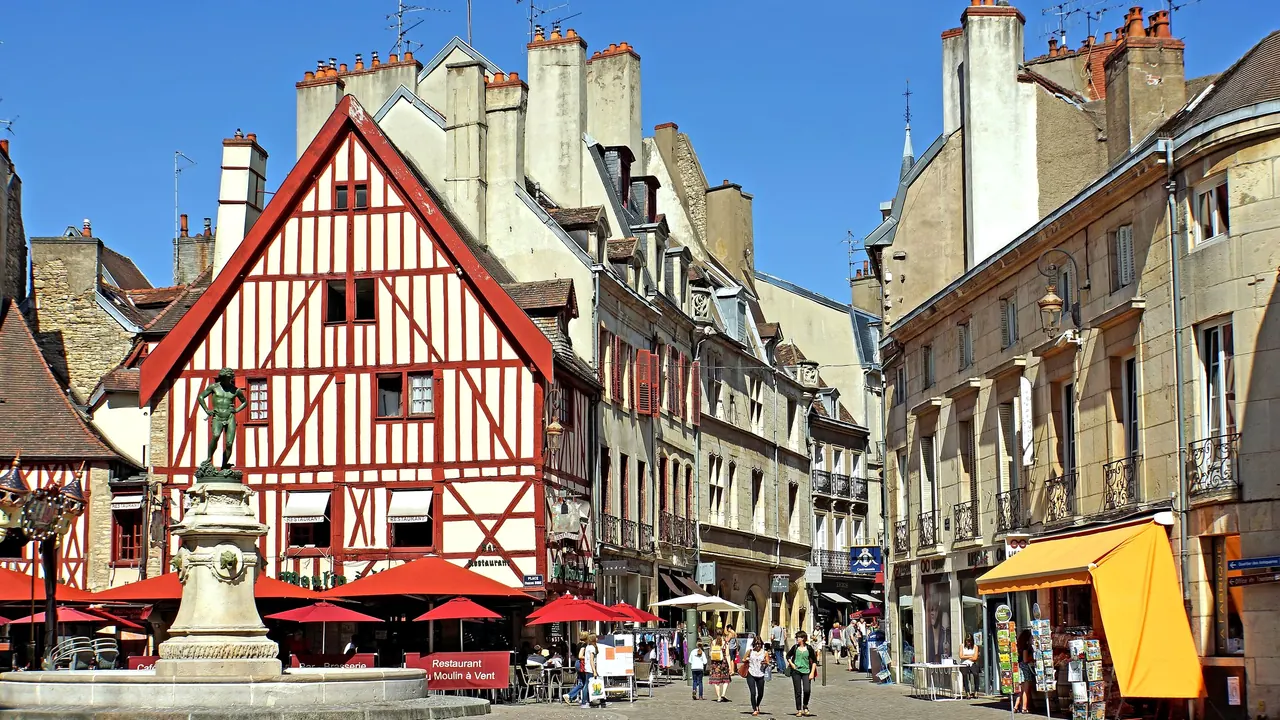
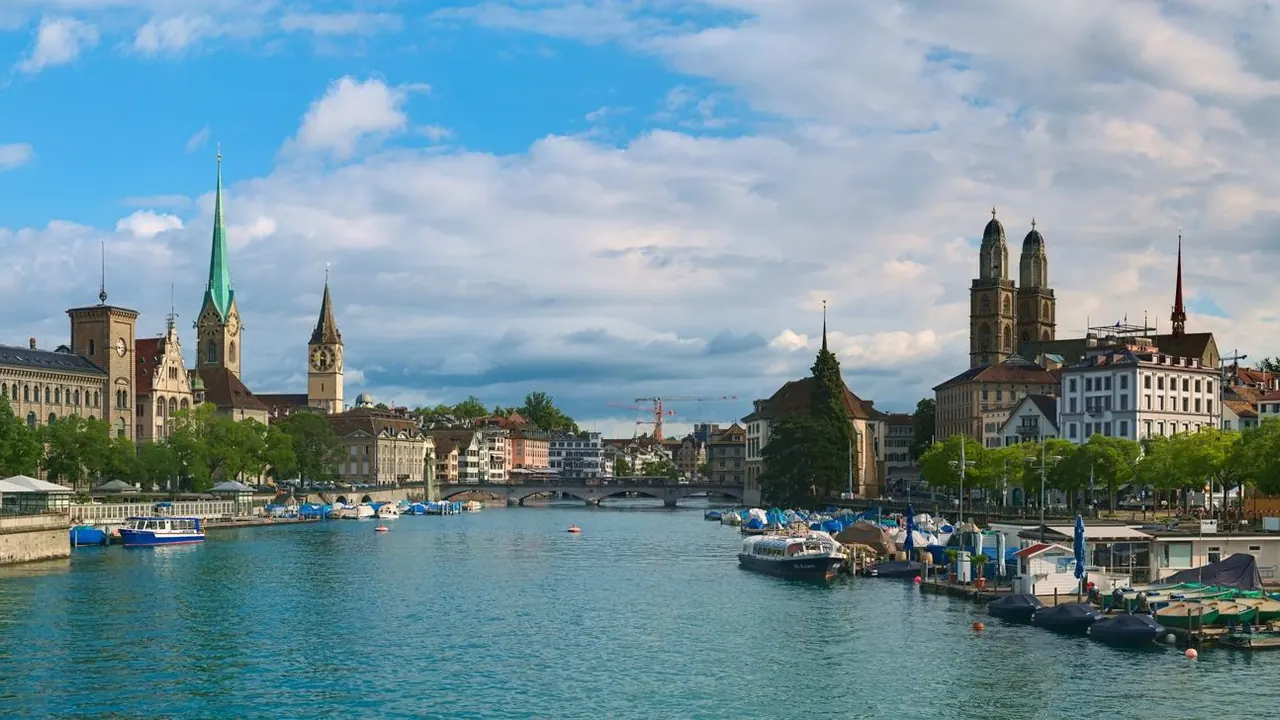
Photos: Dijon by Dennis G. Jarvis, CC BY-SA 2.0, cropped; Zurich by Daniel Kraft, CC BY-SA 3.0, cropped.
Dijon or Zurich?
Our verdict in twelve categories, each scored against the same fixed benchmark cities, and the climate month by month, so you can choose for your trip.
Choose Dijon for
- prices
- food and drink
- culture and sights
Dijon is the pick for travellers who plan a trip around the table and the vineyard. It sits at the head of the Côte de Nuits, the market hall and wine bars serve Burgundy at its source, and the ducal palace and half-timbered old centre fill the hours between meals. It also costs a good deal less, which matters on a slow trip of long lunches and cellar visits.
Choose Zurich for
- families
- beaches
- nightlife
Zurich makes more sense if you want a lake, mountains and a city that runs like clockwork. Families, hikers, skiers and people who like a late night will find much more to do there, and the rail network puts Lucerne, Bern and the Alps within easy reach. The catch is the price, which is among the steepest anywhere in Europe.
Scoreboard
Twelve categories on one fixed scale from 0 to 100. The shaded stretch is the gap between the two.
Your match
Pick a travel style or drag the sliders, and both match scores follow your weighting.
Wins on prices and food and drink with your weighting.
Wins on families and beaches with your weighting.
What matters to you?
Category by category
What the scores mean for a trip.
Beaches & swimming
Neither city is a beach destination, but Zurich makes much more of its water. In summer its clean lake reaches the low twenties, and people swim from the wooden bathing houses, from lawned lidos along both shores, and from the Letten river baths, where they drift with the Limmat current.
Dijon only has Lac Kir, a supervised lawn-and-sand area on a reservoir at the western edge of town, plus the municipal pools. It is fine for cooling off, but Zurich lets you go for a proper swim after sightseeing.
Food & drink
Dijon is the place for a trip built around eating. It has classic Burgundian cooking like boeuf bourguignon, snails and jambon persillé. Its own mustard, cassis and pain d'épices are made here, and Les Halles is piled with Époisses and Bresse poultry. The Côte de Nuits starts at the edge of town, so wine bars pour village Burgundies by the glass.
Zurich eats well but more cautiously: veal in cream with rösti, fondue in the guild houses, and the best chocolate and confectionery of the two. It has more international cooking than Dijon, mostly in Kreis 4 and 5, but every meal there costs a lot more.
Culture & sights
The two are fairly close, and each fills two or three rewarding days. Dijon has the edge as a historic set piece. The Palace of the Dukes of Burgundy and the carved Valois tombs in its fine arts museum, the gargoyles of Notre-Dame and Sluter's Well of Moses all recall a medieval state that once rivalled France.
Zurich's appeal is more varied. The Kunsthaus runs from Monet to Giacometti, and the Rietberg shows art from beyond Europe. In the old town, the Grossmünster is where the Swiss Reformation began, while across the river the Fraumünster glows with Chagall's stained-glass windows of biblical scenes.
Nightlife
Zurich is the place for a big night out. Its electronic music scene fills the clubs of Kreis 4, Kreis 5 and Zurich West until morning at weekends, and Langstrasse stays rowdy late. In summer, people drink in the lake bathing houses and along the Limmat.
In Dijon, an evening means a wine bar, a beer on Rue Berbisey or a late dinner around Place Émile Zola. The students keep it lively during term, but the streets are mostly quiet by midnight. The one thing Dijon has in its favour is price, since a round in Zurich shortens most nights out.
Nature & outdoors
Zurich has much more dramatic scenery. You can see the snow-capped Glarus Alps from the lake promenade, the Uetliberg ridge is a short train ride away, and real Alpine hiking or a ski day at Flumserberg is about an hour off.
Around Dijon the countryside is gentler. There are limestone combes with climbing cliffs, the flat Burgundy Canal towpath and the vineyard cycle route towards Beaune. Its best wilder spot is the Morvan, about an hour and a half away. It is lovely country for an easy ride, but it has no mountains.
Day trips
Both are excellent bases, and they differ more in kind than in quality. Dijon's day trips are about wine and abbeys: the Route des Grands Crus through Gevrey-Chambertin and Vougeot to Beaune, then Fontenay Abbey, Semur-en-Auxois and Vézelay. Many of the villages are easiest to reach by car or bike.
Zurich edges ahead because everything is so easy by train. Lucerne, Bern, Basel, St Gallen and the Rhine Falls are each about an hour or less away, and you never need to hire a car.
Good for families
Both cities are safe and calm, but Zurich offers children far more. The zoo's rainforest hall and elephant park, lake lidos with shallow areas, boat trips, the Technorama in Winterthur and the transport museum in Lucerne can fill a week.
Dijon's small pedestrian centre is relaxed with a buggy, and the planetarium at the Jardin de l'Arquebuse and the play areas of the Parc de la Colombière are useful. After that, the vineyards and fine art museums are really aimed at the parents.
Getting around
Getting around is easy in both, and you need no car in either city. Zurich is in another class, though. Trams, S-Bahn, funiculars, the Uetliberg railway and the lake boats all run on one ticket, and the airport and the rest of Switzerland are a short ride from the main station.
Dijon's centre is small enough to walk across in minutes, with two tram lines for the outskirts and a quick TGV to Paris. Its weak spot is the wine villages away from the railway, which need a car, a bike or a tour.
Shopping & style
Most of what you carry home from Dijon will be edible: mustards in dozens of flavours, cassis, pain d'épices, cheese from Les Halles and bottles from the wine merchants. Rue de la Liberté has a department store and French chains, and the side lanes hold some antiques, but fashion hunters will leave empty-handed.
Zurich gives shoppers far more to work with. Bahnhofstrasse runs from the station to the lake past watchmakers, jewellers and fashion houses, and it is the obvious place to buy a Swiss watch. The viaduct arches of Zurich West add design shops, though almost nothing there comes cheap.
Affordability
Dijon is a mid-range destination, priced well below Paris, and beside Zurich it feels modest. In Burgundy the money goes on the reasons people come: a serious restaurant, a guided tour of the Côte de Nuits, a few good bottles to carry home. Those are choices, and a trip that goes easy on them stays reasonable.
Zurich is expensive before you choose anything. Drinks are steep, and museum entry and transport cost more than most visitors expect. The integrated travel pass and the visitor card that bundles transport with museums take some of the sting out, as do the free lake lidos and drinking fountains. Saving money in Zurich takes deliberate effort, while in Dijon you save without trying.
Live music & performing arts
Zurich has the bigger stage. The Opernhaus is one of Europe's leading opera and ballet houses, and the Tonhalle Orchestra plays in a restored nineteenth-century hall. Below that, the Rote Fabrik and the venues of Kreis 4 and 5 put on jazz, indie and electronic acts, and the Theater Spektakel brings performance to the lake shore in summer.
Dijon's season is solid for its size, with opera and dance at the Grand Théâtre and the Auditorium, which has excellent acoustics. Its programme follows the academic year and thins out in summer.
Wellness & relaxation
Zurich is the one for a proper soak. The stone vaults of the old Hürlimann brewery hold thermal pools and a rooftop pool, and in winter the wooden lake baths open as saunas with cold plunges. Baden's Roman-era hot springs are about twenty minutes away.
Dijon has no bathing culture, only a few hotel spas, some with grape-based treatments. It relaxes you in a different way, through long lunches, quiet squares and slow afternoons among the vines.
When should you go?
Pick your month. The climate figures are measured averages, not a forecast.
Dijon in July
Zurich in July
Daytime high, °C
Rainfall in the month, mm
Temperature and rainfall are climate normals, averaged over the years shown. Dijon: 1991-2020 normals, Dijon (7 km from centre). Zurich: 1991-2020 normals, Zurich Town / Ville. (2.2 km from centre).
Dijon is the warmer and sunnier of the two in summer, with July highs around 27°C and long, bright days from June to August. Its rain is spread fairly evenly through the year, with the wettest spells in May and again in October and November. May, June and September suit walking the old centre and cycling the vineyards best. High summer is warm in the streets but rarely oppressive, and it is the only time Lac Kir is worth a swim. Winters are cold and grey, with highs in single figures from December to February.
Zurich runs a few degrees cooler, peaking around 24°C, and its summers are much wetter, with about 126mm a month from May to August, often as showers and thunderstorms. That makes September the most reliable month for sightseeing and the lake promenades. June to early September is the season for the lake and river baths, if you can live with the odd downpour. Winter is colder than in Dijon, with highs near 4°C from December to February and frequent fog over the lake. That is when the sunny ski areas above the fog come into their own.
Which traveller are you?
On a trip with a tight budget, Dijon is far easier on the wallet. Bistro set lunches, cheap wine by the glass and a walkable centre keep costs moderate, while in Zurich even a simple room or casual lunch costs a great deal.
On a family trip with children, Zurich is the better fit. The zoo with its Madagascar rainforest hall, shallow lake lidos, boat trips and the Technorama nearby keep children busy. In Dijon, most of the day revolves around wine and fine art.
On an outdoors trip, Zurich wins clearly. You get the Uetliberg ridge on the city's edge, high Alpine hiking at Rigi and Pilatus within an hour, and skiing in winter. Around Dijon, the limestone combes and vineyard cycle routes are pleasant but gentle.
Before you go
| Measure | Dijon | Zurich |
|---|---|---|
| Official language | French | French, German, Italian, Romansh |
| Currency | Euro (EUR) | Swiss Franc (CHF) |
| Sockets | CE230 V, 50 Hz | CJ230 V, 50 Hz |
| Driving side | Right | Right |
| Time zone | UTC+1, UTC+2 in summer | UTC+1, UTC+2 in summer |
| Emergency number | 112 | 112 |
| Elevation | 220 m | 408 m |
| Main airport | Lyon Saint-Exupéry Airport (LYS)178 km from centre141 non-stop destinations | Zürich Airport (ZRH)9 km from centre226 non-stop destinations |
| Public holidays this year | 11 days | 10 days |
By the numbers
| Measure | Dijon | Zurich |
|---|---|---|
| City population | 161,830 | 440,935 |
| People per km² | 3,890 | 5,016 |
| Museums within 10 km | 8 | 63 |
| UNESCO World Heritage sites within 50 km | 1 | 1 |
Where else could you go?
Every comparison below shares a destination with this one, so you can follow Dijon or Zurich somewhere new.