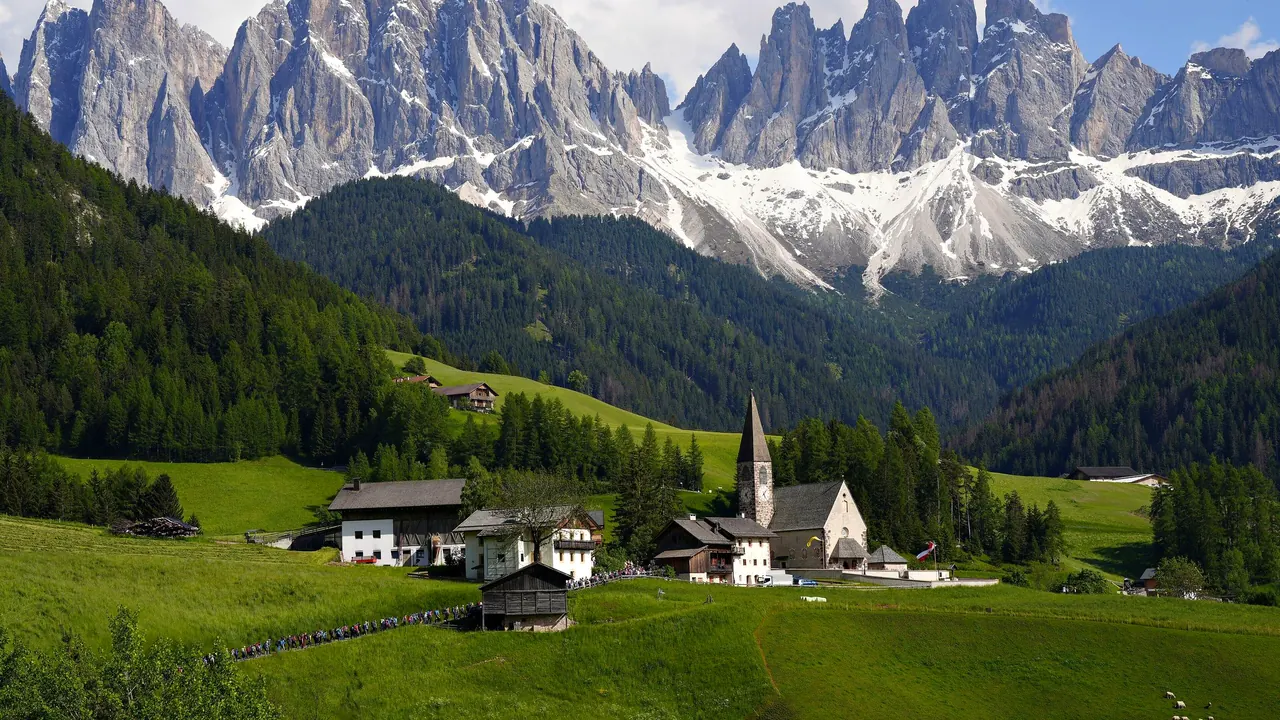
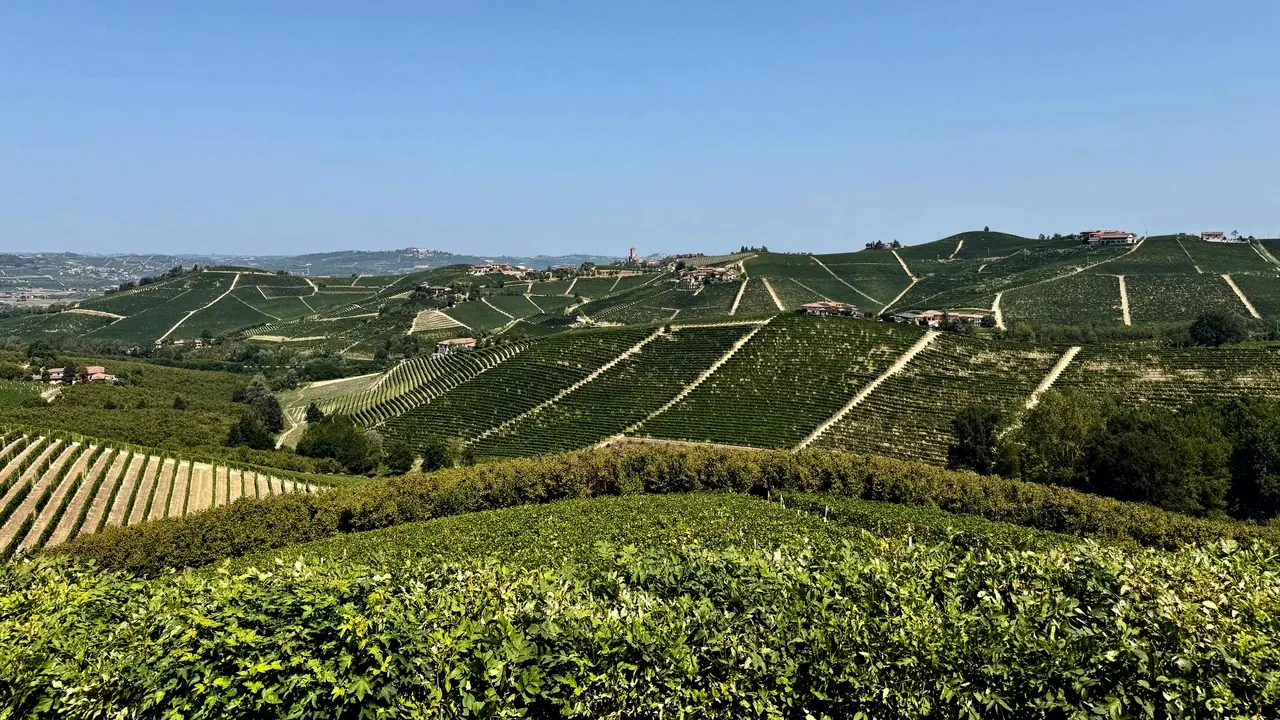
Photos: Dolomites by Chensiyuan, CC BY-SA 4.0, cropped; Piedmont by Martina Amaro, Pexels License.
Dolomites or Piedmont?
Our verdict in twelve categories, each scored against the same fixed benchmark cities, and the climate month by month, so you can choose for your trip.
Choose Dolomites for
- families
- nature and the outdoors
- wellness
Choose the Dolomites if the mountains are the whole point. The pale limestone towers, lift-served high pastures and hut-to-hut routes make it one of the great walking and skiing landscapes anywhere. Families do well on its flat meadow paths and in its child-friendly hotels. In return you accept higher prices, quiet evenings and a short list of sights and performances.
Choose Piedmont for
- culture and sights
- live music and the arts
- prices
Piedmont is the better pick for a trip built around the table and the town. Barolo country, the autumn truffles around Alba, Turin's Egyptian Museum and Savoy palaces, and an opera house with a full season give it far more range, at kinder prices. It has real Alps too, around Monte Rosa and Gran Paradiso, but they need a separate base. It suits travellers who want mountains as one part of a varied stay rather than the core of it.
Scoreboard
Twelve categories on one fixed scale from 0 to 100. The shaded stretch is the gap between the two.
Your match
Pick a travel style or drag the sliders, and both match scores follow your weighting.
Wins on families and nature and the outdoors with your weighting.
Wins on culture and sights and live music and the arts with your weighting.
What matters to you?
Category by category
What the scores mean for a trip.
Beaches & swimming
Neither region has a coast, so this is a choice of lakes, and Piedmont's are easier to use. Lake Maggiore's western shore around Stresa and Baveno has lidos, pebble beaches and bathing platforms, and Lake Orta adds quieter grassy spots below its hill villages.
The famous high lakes of the Dolomites, such as Braies, are for looking at. Swimming means going down to the valleys, to the lawns and lidos of Lake Caldaro on the wine route or to Riva on Lake Garda. In both regions the season runs roughly from June to early September.
Food & drink
Both regions eat well, but people travel to Piedmont for its food in a way they rarely do for the Dolomites. The Langhe around Alba gives Barolo and Barbaresco, white truffles in autumn and dishes such as agnolotti del plin and vitello tonnato. Turin adds historic coffee houses, bicerin and a serious aperitivo.
The Dolomites offer something different: speck, canederli and strudel followed by an Italian espresso, lunch on a hut terrace after a morning's walk, and Lagrein and Gewürztraminer from the slopes below Bolzano. It is good mountain cooking, but the range is narrower and nearly all of it is local.
Culture & sights
Piedmont has far more to see. Turin alone offers the Egyptian Museum, the Royal Palace and the ring of Savoy residences out to Venaria Reale. Beyond the city are the Sacra di San Michele on its crag and the Baroque palaces of the Borromean Islands.
In the Dolomites the landscape itself is the heritage. Ötzi in Bolzano, the frescoed rooms of Trento's Castello del Buonconsiglio and the First World War tunnels on the passes are good for a rainy day, but few visitors plan a trip around them.
Nightlife
Neither is a party destination, but Piedmont at least has a city for a night out. Turin's aperitivo leads on to the bar streets of San Salvario and Vanchiglia and, in summer, the banks of the Po, with some clubs and late bars.
The Dolomites have winter après-ski in Val Gardena, Val di Fassa and Cortina that mostly winds down by early evening. In summer the villages go quiet by eleven, and Bolzano and Trento have wine bars but little that runs late.
Nature & outdoors
For mountain scenery, the Dolomites are the landscape people cross continents for. The Tre Cime, Sassolungo and Seceda rise straight out of green meadows, and lifts reach the high ground from almost every village. The Alta Via routes and the via ferrate open it to walkers and non-climbers alike.
Piedmont's mountains are higher in places, with Monte Rosa and Gran Paradiso, and wilder in the Val Grande, but they lie well away from Turin and the wine hills. What it adds is variety: sailing on Lake Maggiore and road cycling through the Langhe vineyards.
Day trips
Piedmont is the easier base for outings. From Turin, Milan is about an hour away by fast train and Genoa under two. The Barolo villages fill a day of cellars, and boats from Lake Maggiore reach the islands and the Swiss shore.
The Dolomites work well from the Adige valley, with Merano, Trento and Verona within reach of Bolzano and Innsbruck over the Brenner. From the high villages, though, every outing starts on a winding pass road.
Good for families
The Dolomites suit children better, especially in summer. Wide, almost flat paths on the Alpe di Siusi and the Armentara meadows, huts with farm animals, summer toboggan runs and hotels with children's clubs make whole days easy, and the ski schools are well run in winter.
Piedmont works best as a mix of city and lake: the mummies and the Cinema Museum in Turin, then island boats and peacock gardens on Lake Maggiore. The wine hills hold children less well, and neither region has a theme park.
Getting around
Both are easy along their main valleys and harder beyond them, so a car helps in either. In the Dolomites, trains and buses serve the Adige and Puster valleys and lifts link whole ski areas, but crossing between valleys means slow hairpin passes that are busy in July and August.
Piedmont has a proper city at its centre, with Turin's flat grid, trams and metro, and trains to Alba, Asti and Stresa. Out in the Langhe hills and the Alpine valleys, buses thin out and the car takes over.
Shopping & style
Piedmont has more to browse, and most of it is in Turin: Via Roma and Via Garibaldi, the vast Porta Palazzo market and the Saturday Balon flea market. There are also cashmere outlets around Biella. Gianduiotti, vermouth and Barolo bought at the cellar door fill the bags home.
The Dolomites lean on craft and produce: carved wood from the Ortisei workshops, loden in Bolzano's arcades, and speck, cheese and grappa. Their Advent markets in Bolzano and Merano are a real reason to come in December.
Affordability
Piedmont is clearly the cheaper of the two. Turin's hotels, set lunches and aperitivo spreads and the countryside trattorias keep a trip moderate. The main exceptions are the Langhe in truffle season and the Lake Maggiore resort towns in high summer.
The Dolomites are expensive in the ski season and in July and August, with Cortina and Alta Badia among Italy's costliest resorts and lift passes adding up. Staying in Bolzano or the Fassa and Fiemme valleys, or coming in June or September, softens the bill.
Live music & performing arts
Piedmont has the stronger programme because it has Turin. The Teatro Regio's opera and ballet season, the RAI orchestra and the historic Teatro Carignano give a visitor something to book through much of the year, and the Stresa festival adds summer concerts on Lake Maggiore.
In the Dolomites, the appeal lies mostly in the summer settings: musicians on alpine meadows and hut terraces in Trentino, and jazz in castles and wineries. Apart from Bolzano's orchestra and Merano's autumn festival, there is little to attend.
Wellness & relaxation
The two are evenly matched but offer rest of different kinds. The Dolomites offer it through the hotel: saunas facing rock walls, heated outdoor pools in the snow and hay baths around Völs am Schlern. Merano's thermal baths are the one major public option.
Piedmont has true hot springs, above all the Bollente at Acqui Terme, and mountain baths at Valdieri and Vinadio. Its other kind of calm is a farm stay among the Langhe vineyards, where the day is built around a long lunch.
When should you go?
Pick your month. The climate figures are measured averages, not a forecast.
Dolomites in July
Piedmont in July
Daytime high, °C
Rainfall in the month, mm
Where the figures come from
Piedmont has no weather station within reach, so its figures come from a gridded climate model rather than a measured record, and read a broad area rather than one spot.
Temperature and rainfall are climate normals, averaged over the years shown. Dolomites: 1991-2020 normals, Dobbiaco (22.3 km from centre). Piedmont: 1991-2020 normals, TerraClimate 4 km grid at the town, no weather station within 90 km.
The Dolomites figures describe the mountain valleys, where the year has two clear seasons. December and January hover around 0°C, and February and March are milder but still winter, so the ski season runs through them. June to September is walking weather, peaking near 22°C in July and August. That is comfortable on the high trails but only just warm enough for the valley lakes. Summer is also the wettest part of the year, with about 130mm in July, so leave room in the plan for a wet day.
Piedmont's figures come from the lowlands and run much warmer. July and August reach about 29°C, which is good for swimming in Maggiore and Orta but warm for a full day on foot in Turin. The pattern is the reverse of the Dolomites: summer is the drier half here, and the rain builds through autumn to a peak of about 89mm in November, during the truffle months. Spring and September to October are the easiest months for walking towns and vineyards, and winter stays mild enough for a city stay.
Which traveller are you?
On an outdoors trip, the Dolomites are the clear choice. Base yourself in Val Gardena, Alta Badia or Cortina and most of the range is a lift ride away, for hiking from June to October or skiing in winter. Piedmont's Alps need a separate base.
For a food and nightlife trip, Piedmont wins comfortably. Split the stay: a few days in Alba with a car for Barolo cellars and truffle-season trattorias, then Turin for aperitivo and late bars. Evenings in the Dolomites end with dinner and an early night.
On a family trip with children, the Dolomites have the edge in summer. Choose one valley with a lift up to the high pastures and a hotel with a pool for wet afternoons, and skip the pass roads. In Piedmont, pair Turin with Lake Maggiore instead.
Before you go
| Measure | Dolomites | Piedmont |
|---|---|---|
| Official language | Italian | Italian |
| Currency | Euro (EUR) | Euro (EUR) |
| Sockets | CFL230 V, 50 Hz | CFL230 V, 50 Hz |
| Driving side | Right | Right |
| Time zone | UTC+1, UTC+2 in summer | UTC+1, UTC+2 in summer |
| Emergency number | 112 | 112 |
| Main airport | Venice Marco Polo Airport (VCE)103 non-stop destinations | Turin Airport (TRN)65 non-stop destinations |
| Public holidays this year | 13 days | 13 days |
By the numbers
| Measure | Dolomites | Piedmont |
|---|---|---|
| Population | - | 4,341,375 |
| Swim season, months above 21 °C | - | 4 months |
Where else could you go?
Every comparison below shares a destination with this one, so you can follow Dolomites or Piedmont somewhere new.
- Austrian Alpsvs Dolomites
- Lake Maggiorevs Piedmont
- Cinque Terrevs Piedmont
- French Rivieravs Piedmont
- French Alpsvs Piedmont
- Lake Gardavs Dolomites